

TL;DR:
- Most US businesses struggle to act strategically on customer feedback despite investing in data tools.
- Modern Voice of Customer programs require continuous, multi-channel collection, clear ownership, and closing the feedback loop.
- Effective VoC drives measurable improvement in conversion rates by identifying friction points and implementing accountable, data-driven fixes.
Despite investing heavily in feedback tools and data platforms, most US businesses are stuck. The national satisfaction score sits at just 76.9 out of 100, and conversion rates have barely budged for years. The problem is not a lack of data. It is a failure to act on it strategically. Voice of customer (VoC) feedback, when used correctly, can reveal exactly why visitors leave your site, why leads stall, and what changes will actually move the needle. This guide walks you through the full picture: what VoC really means, how to collect it properly, and how to turn raw feedback into measurable conversion growth.
Table of Contents
- What is voice of customer feedback and why it matters
- Core methodologies for collecting and analyzing VoC data
- Addressing biases and pitfalls in customer feedback
- Turning insights into action: Proven strategies for boosting conversions
- Why most businesses miss out and what actually works
- Take your VoC strategy further with proven marketing solutions
- Frequently asked questions
Key Takeaways
| Point | Details |
|---|---|
| VoC drives growth | Strategically using customer feedback can transform website conversion rates and customer loyalty. |
| Multi-channel matters | Relying solely on surveys misses key insights—diversify feedback channels for a complete picture. |
| Turn insights into action | Assign ownership and track results to make sure feedback isn’t wasted or ignored. |
| Benchmarks reveal gaps | Use satisfaction and conversion benchmarks to measure impact and uncover new opportunities. |
| Closing the loop builds trust | Following up on feedback increases customer trust and delivers continuous improvement. |
What is voice of customer feedback and why it matters
VoC is not just a survey you send after a purchase. VoC captures feedback across multiple channels including Net Promoter Score (NPS) surveys, customer satisfaction (CSAT) scores, online reviews, support tickets, live chat logs, and social media conversations. Each channel tells a different part of the story. Relying on just one is like reading every other chapter of a book and calling it done.
The connection between VoC and conversion rate fundamentals is direct and measurable. When you understand why a visitor hesitates at checkout, why a lead never replies to your follow-up email, or why a new user abandons your onboarding flow, you have the raw material to fix it. Feedback is not a customer service tool. It is a growth tool.
Here is where most businesses go wrong. They collect feedback, generate a report, share it in a meeting, and then move on. The loop never closes. Customers feel ignored, and the same friction points persist for months.
| Traditional VoC approach | Modern VoC approach |
|---|---|
| Annual or quarterly surveys only | Continuous, multi-channel collection |
| Data siloed in one department | Shared across marketing, product, and support |
| Reported but rarely acted on | Tied to specific KPIs and owners |
| Focused on satisfaction scores | Focused on root causes and behavior change |
| Feedback loop rarely closed | Customers informed of changes made |
The shift from traditional to modern VoC is not about buying better software. It is about building a culture where feedback drives decisions. Consider this: a business that understands VoC essentials and acts on them consistently will outpace competitors who simply collect data and file it away.
Key benefits of a modern VoC program include:
- Identifying friction points that suppress conversion rates
- Reducing churn by catching dissatisfied customers before they leave
- Improving product-market fit by aligning features with real user needs
- Strengthening brand trust through visible, responsive action on feedback
The bottom line is that VoC done right turns customer voices into your clearest competitive advantage.
Core methodologies for collecting and analyzing VoC data
Core VoC methodologies include inner and outer loop resolution, multi-layer collection, AI-powered theme extraction, prioritization frameworks, closing the loop, and KPI impact measurement. Understanding each layer is what separates programs that produce results from those that produce reports.
The inner loop handles individual incidents fast. A customer complains about a broken checkout button; someone fixes it within 24 hours and follows up. The outer loop addresses systemic patterns. If 200 customers mention the same confusing pricing page over three months, that is a product and UX problem that needs a cross-functional fix.
Feedback also operates at three levels:
- Transactional feedback is collected right after a specific interaction, like a purchase or a support call.
- Relationship feedback measures overall sentiment at regular intervals, usually quarterly.
- Always-on feedback captures passive signals continuously, such as review site monitoring or social listening.
AI-powered sentiment analysis and theme extraction have changed the game. Instead of manually reading thousands of responses, teams can use AI-powered feedback analysis to surface recurring themes in minutes. But AI is only as good as the governance around it. Without human review, you risk acting on misclassified sentiment or missing nuanced context.
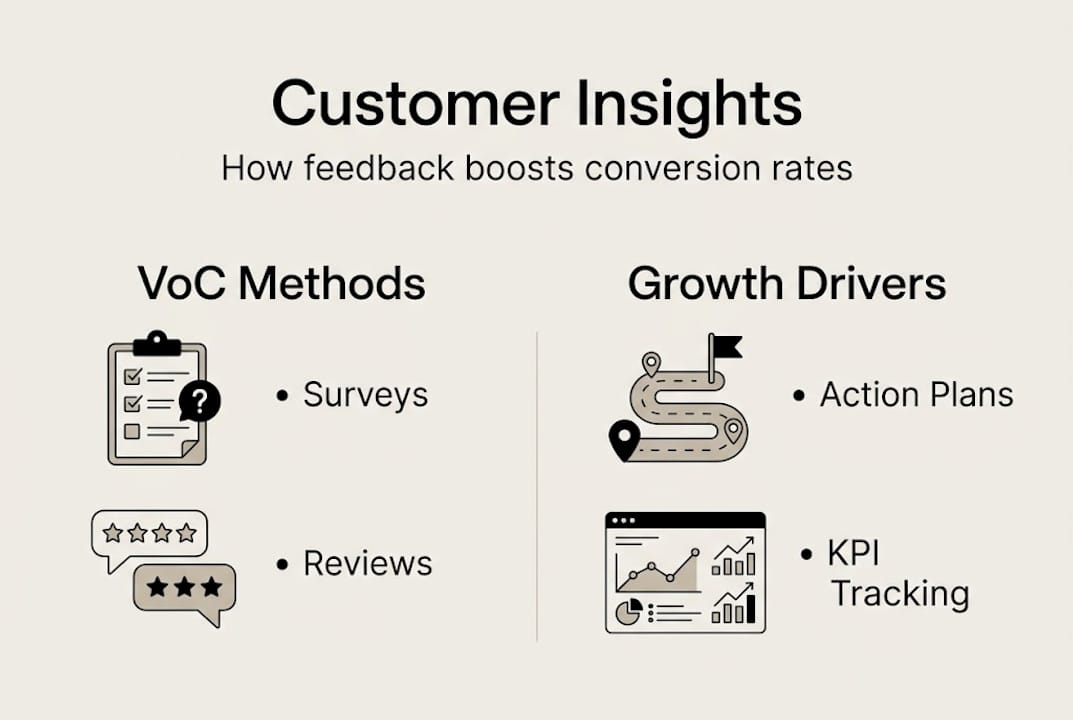
Ownership is the piece most programs skip. Every insight needs a named owner, a deadline, and a measurable outcome. Without accountability, even the best analysis collects digital dust.
| Methodology | Best use case | Key output |
|---|---|---|
| NPS surveys | Relationship feedback | Loyalty score and trend |
| Post-purchase CSAT | Transactional feedback | Satisfaction by touchpoint |
| Social listening | Always-on feedback | Brand sentiment and trends |
| Support ticket analysis | Root cause identification | Top friction themes |
| AI theme extraction | Large-scale qualitative data | Prioritized issue clusters |
Pro Tip: Before scaling any VoC program, tie every planned change to a specific digital marketing KPI. Start with one channel, prove the impact, then expand. Scaling without proof points wastes budget and kills internal buy-in.
For teams building out their first structured program, survey strategies for VoC provide a practical starting point before layering in more advanced methods.
Addressing biases and pitfalls in customer feedback
Here is a truth most feedback guides skip: feedback is noisy. It skews toward the extremes. Customers who are delighted or furious are far more likely to respond than those who are simply satisfied. That means your data is almost always unrepresentative of your average user.
This is not a reason to ignore feedback. It is a reason to interpret it carefully. Distinguishing symptoms from root causes is the real skill. A flood of complaints about slow load times might actually be a symptom of a poorly optimized image pipeline, not a server problem. Treating the symptom without diagnosing the cause wastes time and money.
Common sources of feedback noise and how to counteract them:
- Recency bias: Customers rate based on their last interaction, not the overall experience. Fix it by collecting feedback at multiple journey stages.
- Social desirability bias: Respondents answer how they think they should, not how they feel. Fix it by using anonymous channels and behavioral data alongside surveys.
- Selection bias: Only motivated customers respond. Fix it by diversifying collection methods beyond email surveys.
- Extreme response bias: Ratings cluster at 1 or 5. Fix it by using open-ended questions to capture nuance.
“60% of marketers are diversifying feedback channels beyond surveys.” — Gartner
AI tools can help tag and categorize large volumes of feedback quickly. But they need human governance to prevent misinterpretation. A sarcastic review flagged as positive is worse than no data at all. For more on how VoC pitfalls derail programs, the pattern is almost always the same: over-reliance on one method.
Pro Tip: Combine quantitative scores with qualitative follow-up questions. The number tells you there is a problem. The open-ended answer tells you what it actually is. Apply this to your website conversion improvement efforts and you will find issues that analytics alone would never surface.
Your marketing tone of voice also plays a role here. How you ask questions shapes the answers you get. Leading or overly formal survey language suppresses honest responses.
Turning insights into action: Proven strategies for boosting conversions
Collecting feedback without a structured action process is like hiring a consultant and ignoring their report. The best teams follow a clear cycle: collect, analyze, act, measure. Every step needs an owner, a timeline, and a defined success metric.

Impact measurement links VoC directly to KPIs like conversion rate and churn reduction. Without this link, VoC stays in the “nice to have” category instead of becoming a core growth driver.
Here is what the national e-commerce conversion benchmarks look like in practice: the median e-commerce conversion rate sits between 2.5% and 2.8%, while top-performing sites exceed 11%. That gap is not explained by ad spend alone. It is explained by how well those businesses understand and respond to their customers.
Proven strategies for translating VoC into conversion gains:
- Map feedback to funnel stages. Assign each insight to a specific stage: awareness, consideration, decision, or retention. This focuses your team on the highest-impact fixes first.
- Prioritize by frequency and severity. A minor annoyance mentioned by 500 users beats a major complaint from 10.
- Run A/B tests on proposed fixes. Never assume a change will help. Test it, measure it, then roll it out.
- Close the loop publicly. Tell customers what changed because of their feedback. This builds trust and increases future response rates.
- Review and iterate quarterly. Markets shift. What frustrated customers six months ago may not be the top issue today.
Common mistakes that kill VoC programs:
- Not closing the feedback loop with customers
- Failing to document changes and their measured impact
- Assigning feedback analysis to one person with no authority to act
- Treating VoC as a one-time project instead of an ongoing process
For teams ready to go deeper, conversion optimization strategies and tracking conversions are the natural next steps after building a solid VoC foundation.
Why most businesses miss out and what actually works
After working with businesses across industries, one pattern stands out. Most treat VoC as a checkbox. They buy a survey tool, collect some scores, and call it a program. The technology is the easy part. The hard part is the human follow-up.
Flat US satisfaction scores prove the point. Businesses are collecting more feedback than ever, yet structured VoC loops with cross-functional ownership remain rare. The companies that actually move the needle are relentless about acting on root causes, not just symptoms. They assign real owners. They set deadlines. They report results back to the customers who gave the feedback.
Short-term fixes fade fast. A redesigned landing page based on one round of feedback will not sustain gains unless the process that produced that insight keeps running. Sustainable improvement needs accountability at the leadership level and genuine cross-functional buy-in from marketing, product, and support teams.
The uncomfortable truth is that most VoC programs fail not because of bad data, but because of weak follow-through. Investing in a website conversion guide or a new analytics platform means nothing if the insights sit in a shared folder that nobody opens. Act on the data. That is what actually works.
Take your VoC strategy further with proven marketing solutions
VoC is the foundation, but it is only the beginning. Linking customer feedback to full-scale marketing execution is where the real ROI multiplies. Understanding what your customers want is powerful. Knowing how to reach them, convert them, and keep them is what builds a business that grows year over year.
Our team at seo-analytic.com specializes in turning insights into action. Whether you are working on online conversion growth, getting a handle on digital marketing basics, or ready to build a high-impact marketing team, we have the guides, tools, and expertise to help you move faster. Explore our resources and start turning your customer feedback into real, measurable growth today.
Frequently asked questions
What makes a great voice of customer program?
A great VoC program captures multi-channel feedback, acts quickly on insights, measures impact against defined KPIs, and closes the loop by telling customers what changed as a result of their input.
How can VoC improve website conversion rates?
VoC identifies the specific friction points that cause visitors to leave without converting. By linking VoC to KPIs and using national conversion benchmarks as targets, teams can prioritize fixes that have the highest measurable impact on revenue.
What are common mistakes when using customer feedback?
The most common mistakes are relying only on surveys, ignoring root causes in favor of surface fixes, and failing to assign ownership. Without a named owner and a deadline, even great insights go nowhere, as VoC research consistently shows.
How do businesses filter noise from customer feedback?
Effective teams combine AI analytics with mandatory human review to filter out extreme, biased, or irrelevant responses. AI aids tagging at scale, but human judgment is what keeps the insights reliable and actionable.
Is closing the feedback loop really necessary?
Absolutely. Closing the feedback loop builds customer trust, increases future response rates, and ensures that the changes your team makes are visible and credible to the people who asked for them.
Recommended
- Conversion Optimization Strategies to Boost Sales Fast – seo analytic
- How to Track Conversions to Boost ROI for Your Site – seo analytic
- Conversion Rate: Boosting Online Growth for Businesses – seo analytic
- Top Conversion Rate Optimization Tips for US Businesses 2025 – seo analytic
- 7 Benefits of Interactive Marketing for Mobile Game Growth – playablemaker.com 7 Benefits of Interactive Marketing for Mobile Game Growth