

Struggling to figure out which website actions truly lead to more sales or meaningful user engagement can hold your business back. For American tech entrepreneurs, identifying and tracking the right conversion actions is the foundation for maximizing marketing ROI and growth. You’ll find practical steps for pinpointing your most valuable user interactions and insights on implementing reliable tracking tools so you gain the clarity needed to drive better digital results.
Table of Contents
- Step 1: Identify Key Conversion Actions For Your Business
- Step 2: Select And Set Up Conversion Tracking Tools
- Step 3: Configure Tracking Codes On Your Website
- Step 4: Monitor And Analyze Conversion Data
- Step 5: Verify And Optimize Your Conversion Tracking Setup
Quick Summary
| Key Insight | Explanation |
|---|---|
| 1. Identify Key Conversion Actions | Determine the specific interactions that lead to customer engagement and align with revenue goals. |
| 2. Choose Effective Tracking Tools | Select analytics platforms like Google Analytics or Matomo that provide comprehensive conversion insights. |
| 3. Configure Tracking Codes Properly | Embed JavaScript tracking codes accurately to capture key user interactions across your website. |
| 4. Monitor Conversion Data Regularly | Analyze conversion metrics such as rates and bounce rates to identify areas for optimization. |
| 5. Verify and Optimize Tracking Setup | Regularly test and validate your tracking methods to ensure accurate data collection and analysis. |
Step 1: Identify key conversion actions for your business
Successfully tracking conversions starts with pinpointing the specific actions that drive real value for your business. This means understanding exactly what transformative moments turn website visitors into actual customers or engaged users.
To effectively identify your key conversion actions, you’ll want to carefully analyze your business model and prioritize meaningful interactions. The United Nations Development Programme recommends assessing business impacts by defining clear goals that contribute directly to growth. These conversion actions might include:
- Sales transactions
- Email newsletter sign-ups
- Product demo requests
- Free trial registrations
- Contact form submissions
- Download of marketing materials
Each business will have unique conversion points, so it’s crucial to map out the specific user journey that matters most to your organization. For tech industry small business owners, this often means tracking actions that demonstrate genuine interest in your products or services.
Conversion actions should directly correlate with your primary business objectives and represent tangible steps toward revenue generation.
Carefully track how different conversion actions contribute to your overall business goals. Some interactions might seem minor but can be critical indicators of potential customer engagement.

Pro tip: Create a conversion hierarchy that ranks actions by their potential economic impact, allowing you to prioritize tracking efforts most likely to boost your bottom line.
Step 2: Select and set up conversion tracking tools
Choosing the right conversion tracking tools is critical for understanding how your website transforms visitors into valuable customers. This step involves selecting analytics platforms that provide deep insights into user behavior and conversion performance.
Start by evaluating tools that offer comprehensive conversion goal tracking capabilities. The most effective platforms will allow you to:
- Define specific conversion goals
- Track multiple conversion types
- Analyze marketing channel performance
- Generate detailed conversion reports
- Monitor real-time conversion data
Google Analytics and Matomo are popular choices for small tech businesses, offering robust tracking features that help monitor user interactions. When selecting a tool, consider factors like ease of implementation, depth of reporting, and compatibility with your existing digital infrastructure.
Here’s a comparison of two popular conversion tracking tools to help you select the best fit for your business:
| Feature | Google Analytics | Matomo |
|---|---|---|
| Cost Structure | Free with premium options | Open source, self-hosting possible |
| Data Ownership | Google managed, limited control | Full data ownership, complete privacy |
| Customization | Advanced but requires expertise | Highly flexible, customizable |
| Reporting Depth | Comprehensive, strong integrations | Detailed, GDPR compliant by default |
The right conversion tracking tool transforms raw website data into actionable business intelligence.
Technical setup typically involves installing tracking code on your website, configuring specific conversion goals, and creating custom dashboards that highlight your most important metrics.
Pro tip: Test your conversion tracking setup thoroughly by creating test conversions and verifying that data is being captured accurately across different user scenarios and devices.
Step 3: Configure tracking codes on your website
Configuring tracking codes is a critical step in capturing meaningful conversion data for your digital strategy. This technical process involves strategically embedding snippets of JavaScript that enable comprehensive website interaction monitoring.
To implement effective tracking, you’ll need to focus on precise JavaScript tracking methods that capture user interactions accurately. Your implementation should include:
- Adding tracking scripts to your website header
- Configuring event tracking for key user actions
- Setting up goal and conversion tracking
- Implementing custom dimension tracking
- Ensuring cross-device tracking compatibility
Google Tag Manager and Matomo offer user-friendly interfaces for managing these complex tracking configurations. Most tracking codes require insertion into the HTML of every page, typically within the "
` section of your website template.Properly configured tracking codes transform raw website visits into actionable conversion intelligence.
Different conversion events like button clicks, form submissions, and page views require specific tracking parameters. Some analytics platforms provide tag management systems that simplify this complex process.
Pro tip: Create a comprehensive tracking strategy document that maps out all desired conversion events before implementing tracking codes, ensuring you capture every meaningful user interaction.
Step 4: Monitor and analyze conversion data
The final stage of conversion tracking involves carefully interpreting the data your analytics tools collect to understand your website’s performance. Monitoring conversion metrics provides critical insights into how effectively your digital strategy converts visitors into customers.
To effectively track conversion rates and performance, you’ll want to focus on several key analytical approaches:
- Calculate overall conversion percentage
- Segment conversions by traffic source
- Analyze user behavior across different pages
- Compare conversion rates over specific time periods
- Identify high and low performing conversion points
Google Analytics and Matomo provide robust dashboards that break down complex conversion data into actionable insights. Pay special attention to metrics like bounce rates, time on page, and conversion funnel progression to understand where potential customers might be dropping off.
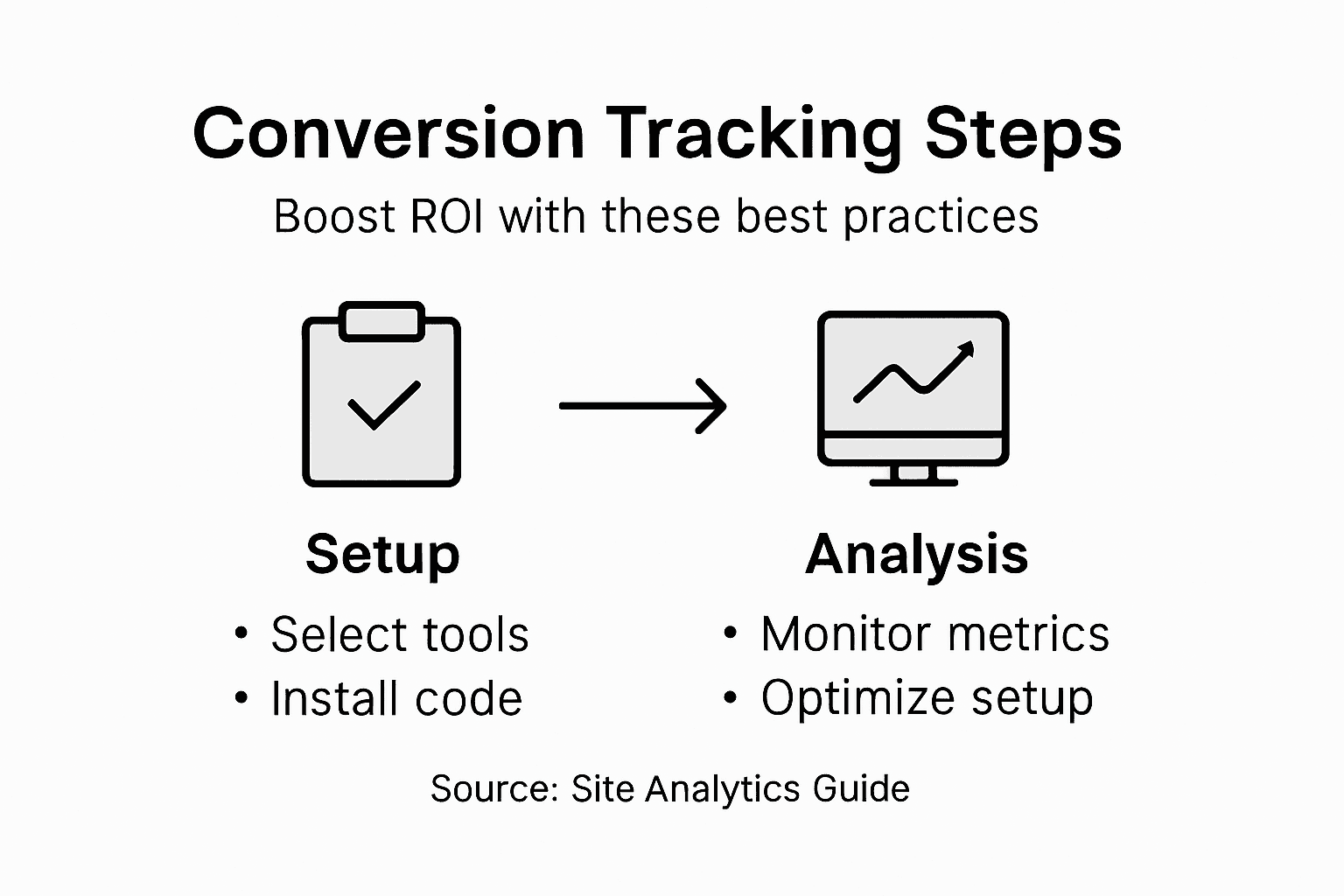
Below is a summary of key analytical metrics to monitor for conversion optimization:
| Metric | What it Measures | Optimization Insight |
|---|---|---|
| Conversion Rate | Percentage achieving set goals | Indicates effectiveness of user journey |
| Bounce Rate | Users leaving immediately | Identifies poor engagement points |
| Funnel Drop-off | Exit points in conversion steps | Reveals stages needing improvement |
| Source Attribution | Originating traffic source | Helps refine marketing efforts |
Data-driven analysis transforms raw numbers into strategic business intelligence.
Regular review of your conversion metrics allows you to make informed decisions about website design, marketing strategies, and user experience improvements. Look for patterns, unexpected trends, and potential optimization opportunities.
Pro tip: Set up automated weekly reports that compare current conversion performance against historical baselines, enabling quick identification of significant changes or emerging trends.
Step 5: Verify and optimize your conversion tracking setup
Ensuring the accuracy and reliability of your conversion tracking system is crucial for making data-driven business decisions. This final step focuses on validating your tracking implementation and fine-tuning your analytics approach to maximize insights.
To guarantee precise tracking, you’ll want to systematically test conversion tracking methods across multiple scenarios. Your verification process should encompass:
- Cross-browser compatibility testing
- Real-time event tracking validation
- Comparing data across different analytics platforms
- Checking tracking code implementation
- Validating goal and conversion configurations
Automated testing tools and manual verification techniques can help identify potential tracking discrepancies. Pay close attention to conversion funnel integrity and ensure that each critical user interaction is being captured accurately.
Rigorous verification transforms basic tracking into a powerful business intelligence tool.
Consider implementing A/B testing to validate your tracking setup and simultaneously optimize user conversion paths. Regular audits will help you maintain the highest data quality and reliability.
Pro tip: Create a comprehensive tracking verification checklist that you review monthly, systematically testing each conversion point to ensure ongoing accuracy and performance.
Unlock True Conversion Growth with Expert Digital Solutions
Tracking conversions is essential for understanding how visitors transform into loyal customers. The challenge lies in configuring precise tracking codes, selecting effective tools, and continuously analyzing data to boost your ROI. If you want to move beyond guesswork and implement a tailored conversion strategy that maximizes your website’s performance, expert help is key. Our team specializes in optimizing your digital presence — from setting up advanced tracking systems to crafting engaging websites designed to convert.
Take the next step toward measurable growth by exploring our Search Engine – seo analytic services that enhance your traffic quality and conversion potential. Complement your efforts with our Website Development – seo analytic solutions built to provide seamless user experiences aligned with your business goals. Ready to transform visitors into customers now? Visit https://seo-analytic.com and partner with digital marketing experts who make every conversion count.
Frequently Asked Questions
How can I identify key conversion actions for my site?
To identify key conversion actions, analyze your business model and prioritize meaningful interactions that drive value. Map out the user journey and focus on actions like sales transactions, demo requests, and newsletter sign-ups to monitor effectively.
What tools should I use to set up conversion tracking for my website?
Select analytics tools that offer comprehensive tracking capabilities, allowing you to define specific conversion goals and analyze user behavior. Tools that facilitate real-time tracking and generate detailed reports will provide the insights needed to optimize your conversion strategy.
How do I configure tracking codes on my website correctly?
To configure tracking codes, embed the required JavaScript snippets in the HTML of your website, focusing on the header section. Ensure to set up event tracking for significant user actions, such as clicks or form submissions, to capture valuable data accurately.
What metrics should I monitor to analyze conversion data effectively?
Monitor metrics like conversion rate, bounce rate, and funnel drop-off to evaluate your website’s performance. Regularly reviewing these metrics will help identify areas for improvement and enhance your overall conversion strategy.
How can I verify that my conversion tracking setup is accurate?
To verify your tracking setup, conduct systematic tests across multiple scenarios and ensure data consistency between analytics platforms. Create a checklist for comprehensive monthly audits to maintain the reliability of your conversion data and optimize performance accordingly.
Recommended
- What Is ROI in Marketing and Why It Matters – seo analytic
- Conversion Optimization Strategies to Boost Sales Fast – seo analytic
- Top Conversion Rate Optimization Tips for US Businesses 2025 – seo analytic
- Measuring ROI in Marketing: Strategies for U.S. Businesses – seo analytic
- Optimizare site – Agentie SEO Bucuresti – Optimizare Garantata