

Every tech founder knows the first customer is the hardest to win and the easiest to lose. For startups in California, messy problems like slow website load times or unclear product messages often block real growth. The right approach means more than quick fixes—it means using a structured toolkit for addressing practical problems effectively, defining the actual issue, digging for root causes, and building solutions your early users can trust.
Table of Contents
- Defining Problem Solving In Business
- Types Of Business Problems Tech Startups Face
- The Product-Market Fit Trap
- Competency Gaps That Kill Growth
- Scaling Before You’re Ready
- Effective Techniques For Digital Challenges
- Integrating Solutions Into Website Performance
- Avoiding Common Pitfalls And Inefficiencies
Key Takeaways
| Point | Details |
|---|---|
| Structured Problem Solving | Effective problem solving involves clearly defining issues, diagnosing root causes, implementing lasting solutions, and ensuring they are maintained. |
| Importance of Data | Rely on factual evidence over opinions; utilize user behavior analytics and feedback to identify real issues for actionable insights. |
| Stakeholder Engagement | Include diverse perspectives from team members and customers to uncover solutions and align on problem definitions for better outcomes. |
| Flexibility in Solutions | Adapt problem-solving strategies based on the context; avoid rigid approaches to tackle different types of challenges effectively. |
Defining Problem Solving in Business
Problem solving in business is far more than just fixing what breaks. It’s a structured approach to identifying what’s actually wrong, understanding why it happened, and building solutions that stick around.
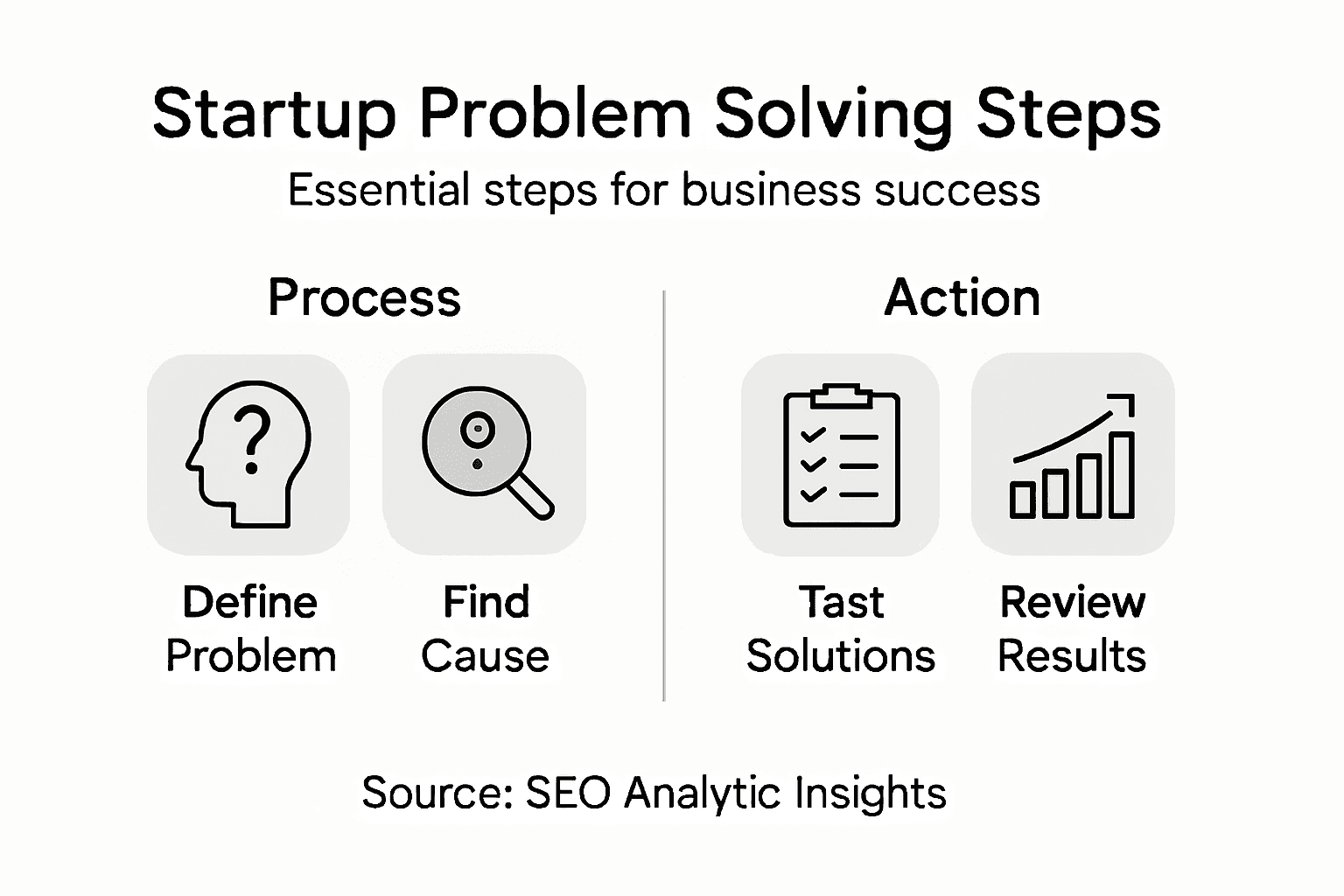
At its core, problem solving involves four critical steps:
- Defining the problem clearly so everyone understands what you’re tackling
- Diagnosing the root cause instead of treating symptoms
- Designing and implementing the best solution for your situation
- Sustaining results to ensure the fix lasts
For startup founders, this matters because your first customers care about whether your solutions work consistently. They’re not forgiving of patches that fall apart in two weeks.
Why Root Cause Analysis Changes Everything
Most startup teams jump straight to solutions. You spot a problem, you fix it, you move on. But that’s exactly backwards.
Root cause analysis forces you to ask “why” multiple times until you find the actual issue, not just its surface symptoms. Your website conversion rate dropped? Maybe it’s not the copy. Maybe users can’t find the checkout button. Maybe your hosting is slow on mobile. Different causes need different fixes.
Without this step, you’re treating the smoke instead of the fire.
Separating Facts From Opinions
Your gut instinct matters. Your team’s experience matters. But they’re not data.
Facts require evidence. You need actual numbers, user behavior, analytics, and stakeholder feedback. Opinions sound convincing in meetings until you check the numbers and realize they’re wrong.
For a tech startup focused on customer acquisition, this distinction is critical:
- Fact: Your landing page bounce rate is 68% (you measured it)
- Opinion: Users are leaving because the design is ugly (someone guessed this)
- Better approach: Run heatmaps, session recordings, and user surveys to find the actual friction point
Your website performance and digital presence rest on accurate data, not hunches.
Engaging Stakeholders in Solutions
The people closest to a problem often see solutions first. But they’re not always heard.
Engage your team, your customers, and your data. A customer support rep handles objections daily. A developer spots technical bottlenecks. A marketer understands why prospects aren’t converting. Each perspective reveals something different.
This structured approach to problem solving works across all levels of your startup because it grounds decisions in methodology rather than politics or personalities.
The strongest solutions come from combining structured analysis with input from people who actually live with the problem.
Pro tip: When your website traffic plateaus, don’t assume the solution is more ad spend. Define the problem precisely (“traffic is flat but bounce rate is 45%”), analyze the actual cause using analytics and user feedback, then design your fix. You might discover a technical issue you were about to throw marketing budget at.
Types of Business Problems Tech Startups Face
Tech startups don’t fail because founders aren’t smart. They fail because they hit specific, predictable problems and don’t solve them fast enough. Knowing what these problems look like helps you spot them before they sink your company.

The most dangerous problems fall into a few categories:
Here’s a summary comparing common categories of business problems tech startups face:
| Problem Type | Typical Cause | Business Impact | Example Scenario |
|---|---|---|---|
| Market | Misunderstood customer needs | Low sales, poor traction | Building features nobody wants |
| Operational | Lack of scalable systems | Chaos, missed deadlines | Unsustainable hiring practices |
| Strategic | Misaligned partnerships | Missed opportunities | Growing faster than infrastructure |
| Execution | Weak validation process | Wasted resources | Launching without market feedback |
- Market problems: You build something nobody wants or misunderstands the customer’s actual needs
- Operational problems: You can’t scale, you lack key skills, or your team can’t execute
- Strategic problems: You partner with the wrong investors or suppliers, or you grow too fast
- Execution problems: You launch without validating demand or ignore market feedback
The Product-Market Fit Trap
You’ve probably heard this term. Most founders dismiss it because they think their product is obviously valuable. It rarely is at first.
Poor customer research and misaligned product-market fit destroys startups before they gain traction. You spend months building features customers don’t need while ignoring the ones they actually want. Your website traffic might grow, but conversions stay flat because the product doesn’t solve the real problem.
This is why validating customer demand before full-scale product development matters so much.
Competency Gaps That Kill Growth
Your team is talented. But is everyone skilled in the areas your startup actually needs right now?
Technical knowledge gaps, weak analytical thinking, and poor customer service orientation create blind spots. A founder strong in engineering might miss why customers are churning. A marketing expert might not understand why the product doesn’t scale technically. Missing skills compound over time.
This connects directly to your digital marketing success. If your team lacks analytical thinking, you’re guessing at what drives conversions instead of measuring it.
Scaling Before You’re Ready
Premature scaling is a startup killer. You hit early traction, get excited, hire aggressively, and suddenly your burn rate explodes while product quality drops.
You add ten salespeople before fixing why the product closes deals. You expand to three new markets before perfecting one. Your website performance degrades as infrastructure gets stretched. Speed feels like progress until cash runs out.
The core issue: you’re solving problems at scale that should be solved at small scale first.
Most startup failures come from rushing to scale before solving fundamental problems at small scale.
Pro tip: Before scaling your marketing spend or hiring more salespeople, validate that your core product-market fit works with your early customers. Measure actual conversion rates, retention, and customer acquisition cost. Let data guide your growth decisions, not momentum.
Effective Techniques for Digital Challenges
Digital challenges don’t require you to reinvent the wheel. They need a methodical approach combined with the right mindset. Your startup’s website performance, customer acquisition, and scaling all depend on solving these challenges systematically.
Three core techniques separate startups that thrive digitally from those that stall:
- Align technology with business goals so investments pay off
- Build a digital-first culture where your team embraces change
- Measure everything so you’re working with facts, not hunches
Adopting a Digital Mindset Across Your Team
Your technology stack doesn’t matter if your team resists using it. A digital mindset means everyone understands that digital channels drive customer acquisition and that data informs decisions.
Building a digital culture requires fostering digital intelligence, which means your team learns to embrace new technologies and understand how digital disruption affects your market. Your designer stops guessing about user behavior. Your developer understands why conversion optimization matters. Your founder sees the website as a revenue channel, not just a storefront.
This isn’t about forcing everyone to become engineers. It’s about creating shared understanding.
Data Analytics as Your Decision Engine
Guessing is expensive. Data analytics turns assumptions into facts.
You can’t improve your website conversion rate if you don’t know why visitors leave. You can’t optimize your marketing spend without understanding which channels actually acquire customers cheaply. You can’t scale if you don’t measure what works.
Start by tracking the basics:
- Landing page bounce rates and time on page
- Conversion rates at each funnel stage
- Customer acquisition cost per channel
- Retention and churn metrics
- Website performance and load times
Tools measure traffic. Analysis explains why patterns exist. Then you experiment to improve.
Strategic Technology Adoption and Project Management
Successful digital transformation requires structured project management with clear roles and scalable technology adoption, not random tool purchases. You don’t need every analytics platform, automation tool, or AI solution available. You need the ones that solve your specific problems first.
Before adopting new technology, ask:
- Does this solve a problem we’re actually experiencing?
- Can our team learn it realistically?
- What’s the expected return on investment?
- How does this align with our growth strategy?
Too many startups buy tools that sound impressive but sit unused. Strategy comes first. Technology follows.
Digital challenges aren’t solved by technology alone. They’re solved by combining the right mindset, data-driven decisions, and selective tool adoption.
Pro tip: Before investing in new marketing automation, analytics platforms, or website tools, map out your current customer journey and identify where decisions are weakest. Then choose one tool that addresses your biggest bottleneck. Master it before adding the next layer of complexity.
Integrating Solutions Into Website Performance
Your website’s performance directly impacts customer acquisition. A slow site loses visitors. A fast, responsive site keeps them. Integrating performance solutions isn’t optional for startups competing for California tech market attention.
Performance improvements fall into three categories:
- Front-end optimization: Reduce load times, improve interactivity, smooth animations
- Back-end infrastructure: Implement caching, content delivery, server scaling
- Monitoring and measurement: Track performance metrics continuously
Measuring Performance Before Optimizing
You can’t improve what you don’t measure. Start by understanding how your website currently performs.
Performance APIs help monitor navigation and resource timings, showing you exactly where delays happen. Is the server slow? Are images too large? Is JavaScript blocking rendering? These aren’t guesses. You measure them.
Key metrics to track:
- Largest Contentful Paint (LCP): When main content appears
- First Input Delay (FID): How fast the site responds to clicks
- Cumulative Layout Shift (CLS): Unwanted visual movements while loading
- Overall page load time
Your analytics dashboard should show these metrics for every version of your site.
Compare key website performance metrics and what they reveal about user experience:
| Metric | What It Measures | Why It Matters | Typical Issue Indicated |
|---|---|---|---|
| Largest Contentful Paint (LCP) | Main content load time | Signals perceived speed | Slow server or large images |
| First Input Delay (FID) | Responsiveness to clicks | Impacts usability | Heavy scripts blocking input |
| Cumulative Layout Shift (CLS) | Unexpected movement | Reduces visual stability | Unoptimized ads or images |
| Overall Load Time | Total page load duration | Affects conversion rate | Many resources or poor caching |
Front-End Solutions That Convert Visitors
Every millisecond matters. A 100-millisecond delay reduces conversion rates. Your landing pages compete with dozens of alternatives for attention.
Prioritize these front-end improvements:
- Optimize image sizes and formats for mobile devices
- Minify CSS and JavaScript to reduce file sizes
- Implement lazy loading for images below the fold
- Remove unused code and third-party scripts
- Use DNS prefetching for external resources
Each change compounds. Combined, they transform user experience from frustrating to smooth.
Back-End Infrastructure and Scaling
Caching strategies, content delivery networks, and server scaling ensure your website performs well even when traffic spikes. You can’t predict when a post goes viral or when a marketing campaign attracts thousands of visitors.
Your infrastructure should handle traffic surges without degradation:
- Implement browser caching so repeat visitors load faster
- Use a CDN to serve content from locations near your users
- Set up database optimization and query caching
- Monitor server resources and scale automatically
- Block malicious traffic that consumes resources
This isn’t about having the fastest server money can buy. It’s about efficiency and resilience.
Website performance isn’t a one-time fix. It’s an ongoing process of measuring, identifying bottlenecks, implementing solutions, and measuring again.
Pro tip: Run a page load time assessment on your top landing pages and product pages using real user data, not just lab tests. Find your slowest pages, implement one optimization at a time, then measure the impact on conversion rates. You’ll quickly see which improvements deliver actual business value.
Avoiding Common Pitfalls and Inefficiencies
Most startup problem-solving efforts fail not because the founders lack intelligence, but because they repeat the same mistakes. You solve one problem the way that worked last time, then get surprised when it doesn’t work this time. Context changes. Solutions must too.
The most dangerous pitfalls destroy momentum quietly:
- Habitual approaches: Using old methods in new situations
- Premature solutions: Fixing before you understand the real problem
- Isolated decision-making: Ignoring perspectives from your team and customers
- Missing alignment: Different departments solving different definitions of the same problem
The Trap of Jumping to Solutions
Your website conversion rate drops. Your first instinct? Change the landing page copy. But what if the real problem is slow load times or confusing navigation?
Jumping to solutions without proper diagnosis is the fastest way to waste resources. You invest in changes that don’t address the actual bottleneck. Weeks pass. The problem persists. Meanwhile, you’ve burned time and money chasing symptoms.
Force yourself to diagnose before designing. Use data. Ask customers. Run experiments. Then decide.
Stakeholder Misalignment Kills Momentum
Your engineering team thinks the problem is technical debt. Your marketing team thinks it’s messaging. Your investors think it’s market timing. Everyone’s right about their piece. But you’re solving three different problems.
Lack of stakeholder alignment on problem definition causes projects to fail. You implement a solution. One team celebrates. Another feels ignored. Progress stalls because you didn’t agree on what you were actually solving.
Start every problem-solving effort with alignment meetings. Write down the problem statement. Get explicit agreement. Then move forward.
Insufficient Follow-Up and Support
You identify a problem. You implement a solution. Then what? Nothing. The solution sits. People forget about it. The problem returns.
Problems solved without follow-up don’t stay solved. Management support matters. Clear ownership matters. Regular check-ins matter.
Build in these practices:
- Assign one person accountability for the solution
- Set specific success metrics and measurement frequency
- Schedule reviews at 2 weeks, 4 weeks, then monthly
- Communicate progress to stakeholders
- Adjust the solution if results don’t match expectations
This keeps momentum alive and catches failures early.
Flexibility Over Rigid Approaches
Different problems need different solutions. A customer acquisition problem requires different thinking than a retention problem. Technical problems require different approaches than people problems.
Recognizing when habitual approaches fail and adapting your problem-solving style separates successful startups from stalled ones. You develop flexibility. You stay data-driven. You listen to feedback and change course when evidence shows you’re wrong.
The costliest mistake in startup problem-solving is solving the wrong problem perfectly instead of solving the right problem imperfectly and iterating.
Pro tip: Before implementing any solution, write a one-page problem statement that answers: What specifically is happening? Why is it happening? Who’s affected? How are we measuring success? Get your team to agree on this page before spending a single dollar on the fix. You’ll avoid 90% of wasted effort.
Master Your Startup’s Problem Solving to Unlock Digital Growth
The article highlights how critical it is to diagnose root causes and avoid premature fixes in startup problem solving. If you face challenges like stagnant website conversions or unclear customer needs it is time to embrace a data-driven approach and strategic solutions that truly scale. You need more than guesswork you need expert guidance to align your website performance and marketing efforts with your business goals.
At SEO Analytic we specialize in building websites designed to convert and optimizing digital marketing campaigns tailored to your unique startup challenges. From enhancing your site’s load speed and user experience to targeted strategies that increase traffic and turn visitors into customers we help you solve problems the right way the first time. Don’t let inefficient fixes drain your resources improve your startup’s success today with proven solutions at SEO Analytic. Discover how we can optimize your digital presence at our website and take the next step toward lasting growth.
Frequently Asked Questions
What are the key steps in effective problem solving for startups?
Effective problem solving involves four critical steps: 1) Defining the problem clearly, 2) Diagnosing the root cause, 3) Designing and implementing a solution, and 4) Sustaining results to ensure the fix lasts.
How does root cause analysis improve problem solving in a startup?
Root cause analysis helps identify the actual issue behind a problem rather than just addressing symptoms. This process ensures that startups find sustainable solutions, preventing recurring issues that can negatively affect business performance.
Why is it important to separate facts from opinions in problem solving?
Separating facts from opinions is crucial because decisions need to be based on data rather than assumptions. Gathering evidence, such as user behavior and analytics, ensures that the startup addresses the real issues effectively, which aids in better decision-making.
How can startups avoid common pitfalls in problem solving?
Startups can avoid pitfalls by ensuring alignment among stakeholders, diagnosing problems accurately before implementing solutions, and maintaining a flexible approach. Regular follow-ups and accountability measures are also essential to ensure problem-solving efforts remain on track.