

Every tech founder knows how quickly priorities shift when building a startup in the United States. As growth hurdles appear and customer expectations rise, you need guidance that goes beyond recycled advice. Business coaching offers actionable strategies and structured accountability to help you move from constant firefighting to clear, measurable progress. This approach provides an external perspective that identifies blind spots, strengthens your digital marketing, and ultimately improves your customer conversion results.
Table of Contents
- Defining Business Coaching for Startups
- Types of Business Coaching for Tech Founders
- How Coaching Enhances Digital Marketing Strategies
- Improving Customer Conversion Rates Through Coaching
- Mistakes Startups Make Without Business Coaching
Key Takeaways
| Point | Details |
|---|---|
| Business Coaching vs. Mentoring | Coaching provides structured, goal-focused partnerships, while mentoring is generally informal and advice-oriented. This distinction helps tech founders understand their best support options. |
| Importance for Tech Founders | Coaching enhances strategic thinking, resilience, and adaptability, leading to improved survival rates and revenue growth in competitive tech markets. |
| Types of Coaching | Founders should recognize the appropriate coaching type—executive, team, career, external, or internal—based on their current business needs and phase. |
| Conversion Improvement | Business coaching drives behavioral changes that enhance customer conversations and identify conversion bottlenecks, ultimately leading to increased sales performance. |
Defining Business Coaching for Startups
Business coaching is professional guidance specifically designed to help tech founders create, grow, and scale their ventures. Unlike informal mentoring, coaching focuses on actionable strategies, clear accountability, and measurable outcomes. A coach works with you and your team to set goals, provide structured feedback, and develop the skills your company needs at each stage.
Think of a business coach as a strategic partner who helps you move from reactive firefighting to proactive planning. You get someone outside your company who can see patterns, challenge assumptions, and hold you accountable to commitments. This external perspective is invaluable when you’re caught in the daily grind of launching or scaling a tech startup.
How Business Coaching Differs from Mentoring
Mentoring is typically informal and relationship-driven, often involving someone sharing wisdom from their experience. Coaching, by contrast, operates as an ongoing management approach creating structured partnerships where the coach asks questions, identifies challenges collaboratively, and works with you on problem-solving.
The key differences include:
- Mentoring: Advice-focused, informal, mentor-led direction
- Coaching: Goal-focused, structured, collaborative problem-solving
- Mentoring timeline: Flexible, often episodic conversations
- Coaching timeline: Ongoing engagement with regular sessions and accountability
For tech startups, coaching often yields better results because it forces clarity and follow-through. Mentors share their playbooks; coaches help you build your own.
Here’s how mentoring and coaching differ across critical dimensions:
| Dimension | Mentoring | Coaching |
|---|---|---|
| Structure | Informal meetings | Structured sessions |
| Approach | Advice-sharing | Collaborative problem-solving |
| Focus | Personal development | Achieving specific goals |
| Accountability | Little accountability | Clear accountability and follow-up |
| Outcome | Wisdom transfer | Measurable business results |
Why Coaching Matters for Tech Founders
Research shows that startup business coaching improves survival rates and accelerates revenue growth by equipping founders with resilience, adaptability, and strategic thinking. This is critical in competitive, technology-driven markets where decisions compound quickly.
A business coach helps you:
- Clarify your company vision and strategy
- Identify bottlenecks slowing growth
- Build effective teams and delegation systems
- Navigate funding conversations with confidence
- Align digital marketing efforts with revenue goals
A coach transforms good intentions into actual results through accountability and structure.
The tech startup environment moves fast. You need someone who understands your challenges and can help you think three moves ahead instead of just surviving this month.
What Business Coaching Looks Like in Practice
Coaching sessions typically involve weekly or bi-weekly meetings where you discuss challenges, progress on goals, and next-week actions. Your coach asks powerful questions rather than telling you what to do. This shifts responsibility onto your shoulders, where it belongs.
The coaching process creates a motivating climate where you feel supported but also challenged to perform. You’re not getting cheerleading; you’re getting honest feedback combined with strategic guidance.
Pro tip: Start your coaching relationship by identifying 3-5 specific goals for the first 90 days, such as improving website conversion rates or establishing a repeatable customer acquisition process. This clarity prevents coaching from becoming vague conversations and ensures measurable progress.
Types of Business Coaching for Tech Founders
Not all coaching is the same. Different types address different challenges at different stages of your startup’s growth. Understanding which type fits your current situation helps you invest coaching dollars wisely and get results faster.
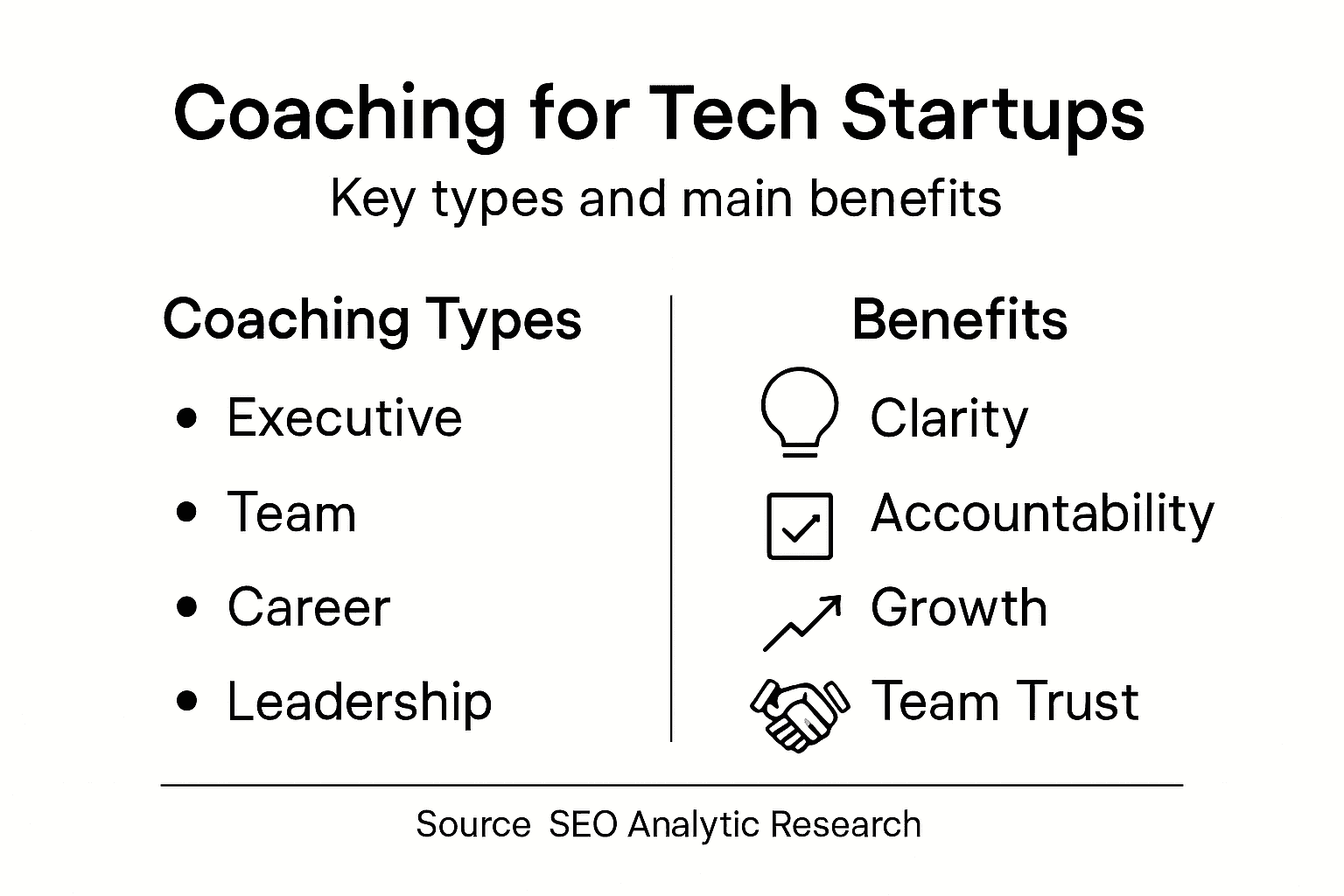
Coaching typically comes in four main varieties, each targeting specific leadership and organizational needs. Some founders benefit from one type; others layer multiple approaches as their company scales and new challenges emerge.
Executive Coaching
Executive coaching focuses on developing senior leaders to improve performance and navigate major transitions. For tech founders, this means working one-on-one with a coach on strategic decision-making, communication skills, and emotional intelligence.
This type works best when you’re facing:
- Major company pivots or scaling decisions
- Team culture challenges requiring leadership shifts
- Fundraising preparation and investor negotiations
- Personal leadership gaps affecting company growth
Executive coaches often have experience with high-growth companies and understand the unique pressures founders face. They help you think through decisions with clearer frameworks instead of gut reactions.
Team Coaching
Team coaching targets groups, fostering collaboration and effectiveness across your organization. Rather than coaching individuals separately, a team coach works with your entire leadership group or department simultaneously.
This approach helps when:
- Your leadership team isn’t aligned on strategy
- Communication breakdowns are slowing decisions
- Remote or hybrid team dynamics need strengthening
- You’re building accountability across functions
Team coaching surfaces conflicts early and builds trust within groups. For tech startups scaling quickly, this prevents silos where engineering and marketing operate separately.

Career Coaching
Career coaching supports individuals navigating career goals and transitions. While less common for founders themselves, it’s valuable for key team members deciding whether to stay or exploring growth paths within your company.
This helps with:
- Retaining top talent by clarifying career progression
- Supporting founders’ co-founders or early team members
- Rebuilding confidence after failed initiatives
- Aligning personal and professional goals
External vs. Internal Coaching Modalities
External coaches provide specialized expertise often for leadership development, bringing fresh perspectives and unbiased accountability from outside your organization. They’ve seen patterns across dozens of companies and aren’t emotionally invested in your internal politics.
Internal coaches are employees trained to coach peers within your company, fostering ongoing skill development at lower cost. Manager-led coaching uses coaching techniques to develop teams while encouraging culture alignment.
For most tech startups, external coaching works best initially. You need someone with no stake in internal dynamics.
Choose coaching types based on your biggest bottleneck right now—not what sounds impressive.
Most founders start with executive coaching to clarify strategy, then add team coaching when leadership alignment becomes critical. Your coaching needs evolve as your company grows.
Pro tip: Ask potential coaches which other tech startups they’ve worked with and what specific outcomes those companies achieved. References from founders in your market segment are worth far more than generic credentials.
To help founders choose the right coaching type, here is a summary of coaching options for tech startups:
| Coaching Type | Primary Audience | Typical Benefits | When to Use |
|---|---|---|---|
| Executive Coaching | CEOs and leaders | Strategic clarity, leadership growth | Major transitions or scaling |
| Team Coaching | Whole teams | Improved collaboration, trust | Alignment challenges, silo issues |
| Career Coaching | Individuals | Talent retention, confidence building | Team member growth, internal moves |
| External Coaching | Outside expert | Objective feedback, broad perspective | Early-stage or leadership shifts |
| Internal Coaching | Company peers | Culture alignment, skill development | Later stage, ongoing employee growth |
How Coaching Enhances Digital Marketing Strategies
Most tech founders treat marketing as an afterthought or delegate it without strategy. Business coaching forces you to think differently about how you acquire customers. A good coach helps you align marketing tactics with actual business goals instead of chasing trends.
Coaching works because it drives you to shift your marketing approach with intention. Research shows coaching significantly impacts entrepreneurial marketing strategies and firm sales by facilitating strategic decision-making and encouraging focused tactics. Founders who lack initial strategic clarity benefit most from this structured guidance.
From Random Tactics to Intentional Strategy
Many tech founders jump between marketing channels without a coherent plan. One month you’re obsessing over social media; next month it’s SEO. A coach helps you stop the noise and ask hard questions about what actually drives revenue.
A business coach guides you to:
- Define your ideal customer profile clearly
- Identify which channels actually convert for your business
- Measure marketing performance against revenue, not vanity metrics
- Allocate budget based on data, not hunches
- Build repeatable customer acquisition processes
Without coaching, you’re optimizing marketing in a vacuum. With it, you’re optimizing toward actual business outcomes that matter to your bottom line.
Mastering Data-Driven Decision Making
Digital marketing strategies leveraging data, automation, and analytics empower businesses to optimize customer engagement. But knowing this exists and actually doing it are different things.
Coaches help you:
- Understand attribution models and customer journey mapping
- Use analytics to identify conversion bottlenecks
- Implement personalization at scale
- Make budget allocation decisions backed by data
- Adopt marketing technology that amplifies your team’s efforts
Your coach isn’t running your campaigns. They’re teaching you how to think about marketing data so you make smarter decisions faster. This compounds over time as your team learns the same frameworks.
Building Marketing Discipline
Coaching creates accountability for marketing initiatives. You set quarterly targets, execute against them, and report results in your coaching sessions. This simple structure prevents marketing from becoming reactive.
Most startups fail at marketing execution not because they lack ideas, but because no one owns the system. A coach ensures someone does.
Coaching transforms marketing from “what should we try next” to “what’s working and how do we scale it.”
Your coach asks why a campaign underperformed and pushes you to adjust rather than accept failure. This mindset shift separates founders who build sustainable customer acquisition from those who stay stuck.
Pro tip: In your first coaching session focused on marketing, bring three months of customer acquisition data: where leads came from, conversion rates by channel, and customer lifetime value by source. Your coach needs this context to ask the right questions and identify your biggest opportunity.
Improving Customer Conversion Rates Through Coaching
Conversion rates reveal the truth about your marketing. You can drive massive traffic, but if visitors aren’t becoming customers, you’re wasting money. Business coaching addresses this directly by improving how your team communicates with prospects and closes deals.
Coaching focuses on behavioral change. A coach doesn’t just tell you to “convert better.” Instead, they help you identify what’s actually blocking conversions and build new habits that remove those obstacles.
Identifying Conversion Bottlenecks
Most founders have no idea where their conversion funnel breaks down. Is it the landing page? The sales call? The pricing page? Without clarity, you’re guessing at fixes.
A business coach helps you:
- Map your customer journey from first click to purchase
- Identify where visitors drop off most frequently
- Understand the specific reasons people don’t convert
- Prioritize which bottleneck to fix first
Coaching improves customer conversion rates by driving behavioral change aligned with business goals, helping teams enhance communication and closing techniques. Your coach asks the hard questions about your funnel that expose the real problems.
Building Better Customer Conversations
Conversion happens in conversations, not in pixels or algorithms. Your sales team’s ability to listen, ask the right questions, and address objections determines whether prospects buy.
Coaching strengthens these skills by:
- Teaching active listening and discovery techniques
- Developing objection-handling frameworks
- Improving messaging clarity and relevance
- Building confidence in high-stakes customer calls
When your team has coaching-driven communication skills, conversion rates follow naturally. People buy from people they trust who understand their problems.
Creating Accountability for Conversion Goals
Executive coaching contributes to improved customer conversion by fostering behavioral changes that impact sales performance through clarified goals and improved collaboration. Coaching creates a system where conversion improvement isn’t a one-time project—it becomes an ongoing practice.
Your coach helps you:
- Set specific, measurable conversion targets
- Track weekly progress against those targets
- Analyze what works and what doesn’t
- Adjust tactics quickly based on real data
Without coaching, conversion optimization feels like constant experimentation. With it, you’re running controlled tests toward predictable improvement.
Conversion rates improve when behavioral change is tracked, reinforced, and celebrated.
This structured accountability prevents teams from abandoning improvements after two weeks. Coaching embeds conversion optimization into your company’s DNA.
Pro tip: Pick one conversion metric to own in coaching: landing page conversion, sales call close rate, or trial-to-customer conversion. Measure it weekly, discuss it in coaching sessions, and test one small change per week. Over 12 weeks, small compounding improvements become dramatic results.
Mistakes Startups Make Without Business Coaching
Startups fail for predictable reasons. Most of these failures aren’t about bad luck or flawed ideas—they’re about competency gaps and poor decision-making that coaching prevents. Understanding these mistakes before they derail your company could save years and millions of dollars.
Without coaching, founders often repeat the same errors that have killed thousands of startups before them. A coach accelerates your learning by helping you avoid these traps entirely.
Skipping Market Research and Customer Validation
Many tech founders build products in isolation, assuming they know what customers want. They launch without talking to enough prospects, validate assumptions through hunches instead of data, or ignore signals that the market doesn’t care.
Common startup mistakes include neglecting market research and ignoring customer feedback, which creates massive problems downstream. Without coaching, you might waste months building features nobody needs or targeting the wrong customer segment entirely.
A coach forces you to:
- Talk to 20+ potential customers before finalizing product features
- Validate assumptions through discovery conversations
- Act on customer feedback instead of defending your original vision
- Adjust quickly when market signals contradict your plan
Market research isn’t optional. It’s the difference between a product people want and expensive failure.
Poor Financial Management and Runway Blindness
Tech founders often obsess over product features while ignoring cash flow. You might have a runway of six months, but because you’re not tracking burn rate carefully, you don’t realize you’re running out until it’s too late.
Common financial mistakes include:
- Not tracking monthly burn rate and runway
- Hiring too quickly without revenue to support payroll
- Spending heavily on growth channels before validating unit economics
- Avoiding difficult conversations about profitability until crisis hits
Coaching creates discipline around finances. Your coach asks monthly: what are your numbers, how many months of runway remain, and what changes if revenue doesn’t hit targets?
Weak Team Building and Leadership Gaps
Research identifies key competency deficits contributing to startup failures, such as gaps in analytical thinking and flexibility, which impair decision-making and market responsiveness. Many founders hire friends instead of experienced operators, neglect leadership development, or create cultures where people avoid speaking up.
Team mistakes include:
- Hiring for loyalty instead of capability
- Avoiding hard conversations about underperformance
- Creating unclear roles and ownership
- Lacking structured feedback and accountability systems
Teams built without coaching operate on chaos and heroics. Teams with coaching operate on clarity and systems.
Coaching helps founders recognize their own leadership gaps and fix them before they poison company culture.
Unfocused Marketing and Scaling Too Quickly
Without coaching, founders scatter their marketing efforts across too many channels, scale customer acquisition before unit economics are proven, or build features nobody asked for.
Pro tip: Before hiring a business coach, document your three biggest current problems: the one burning you down right now, the one you’re avoiding, and the one you suspect but aren’t sure about. A coach helps you address the problem you’re avoiding first, because that’s usually where the leverage is.
Unlock Your Tech Startup’s True Potential with Expert Digital Support
Tech founders often face the challenge of aligning their business coaching insights with real, measurable marketing results. The article highlights how crucial it is to move from random tactics to intentional strategy, improve customer conversion rates, and create accountability for growth. If you are struggling with unclear marketing direction, ineffective customer acquisition, or poor website conversions, these pain points can stall your progress despite your best efforts.
At SEO Analytic, we specialize in bridging the gap between strategic coaching and actionable digital marketing. Our expert team offers tailored website building and digital marketing solutions designed to boost visits and convert visitors into loyal customers. With our support, you can bring clarity to your marketing efforts, align them with your startup’s vision, and accelerate revenue growth. Don’t wait until losing momentum costs you valuable runway. Visit our homepage to take control of your digital strategy today and discover how to turn coaching goals into real business outcomes. For proven ways to optimize every digital interaction, explore our comprehensive digital marketing services. Start transforming your marketing from guesswork into growth now.
Frequently Asked Questions
What is business coaching for tech startups?
Business coaching provides professional guidance to tech founders, focusing on actionable strategies, accountability, and measurable outcomes to help grow and scale their startups.
How does business coaching differ from mentoring?
Business coaching is structured and goal-focused, emphasizing collaborative problem-solving, while mentoring is often informal and advice-based, focusing on personal development and wisdom transfer.
What are the key benefits of business coaching for tech founders?
Business coaching helps tech founders clarify their vision, identify growth bottlenecks, build effective teams, navigate funding conversations, and align marketing strategies with revenue goals.
What types of business coaching are available for startups?
There are various types of business coaching, including executive coaching for leadership development, team coaching for enhancing group dynamics, and career coaching for individual team members navigating career transitions.
Recommended
- What Is a Sales Funnel and Boosting Tech Startup ROI – seo analytic
- Startup Brand Strategy: Complete Guide for Success – seo analytic
- Effective Startup Marketing Strategies to Boost Growth – seo analytic
- Understanding Branding for Startups: Key Concepts Explained – seo analytic
- 7 exemples de contenus valorisant les avis clients utiles