

TL;DR:
- Effective remote marketing teams treat work as a system design problem, focusing on communication and output measurement rather than tools. Prioritizing a 70 percent asynchronous to 30 percent synchronous ratio improves focus and engagement, with outcome-based tracking boosting productivity and retention. Structuring onboarding, scheduling routine virtual social activities, and establishing clear boundaries enhances team cohesion and individual accountability.
The top remote work productivity tips your team needs now
The most effective remote marketing teams share one trait: they treat distributed work as a system design problem, not a technology problem. Before adding another tool or scheduling another standup, the highest-leverage move is redesigning how your team communicates and measures output. Here are the core practices that actually move the needle:
- Set your synchrony ratio first. Aim for roughly 70% async, 30% sync work. Most teams default to the opposite and wonder why focus time disappears.
- Replace activity monitoring with output tracking. Define deliverables, not hours. Outcome-based frameworks consistently outperform presence-based management for both results and retention.
- Build a structured onboarding bridge. A written 30-60-90 day plan with a peer buddy and daily check-ins in week one replaces the informal integration that offices provide passively.
- Use dashboards for visibility, not surveillance. Real-time project dashboards let managers spot issues early without constant check-ins.
- Make team-building intentional. Virtual coffee breaks, peer recognition, and monthly retrospectives are not perks. They are the connective tissue that keeps distributed teams from fragmenting.
- Document everything that matters. Decisions, norms, and workflows belong in one searchable hub, not scattered across Slack threads and inboxes.
Table of Contents
- How to balance async and sync communication for remote marketing teams
- How structured onboarding builds a stronger remote marketing team
- How to track performance without micromanaging your remote team
- What online team-building activities actually work for remote marketing teams
- Time management techniques that actually work when you’re remote
- How to set up a home office that supports real focus
- What tools does a remote marketing team actually need?
- How to protect work-life boundaries when home is also the office
- How to build accountability and motivation in a remote team
- How Seo-analytic helps remote marketing teams perform
- Key Takeaways
- FAQ
How to balance async and sync communication for remote marketing teams
The single biggest lever for remote work productivity is not a new tool. It is your synchrony ratio. High-performing distributed teams reserve live meetings for decisions and blocker resolution only. Everything else defaults to async.
Practically, that means auditing every recurring event your team has each week and labeling each one: does it genuinely require live participation, or could it be a written update? Most teams discover that a significant portion of their meetings could be async without losing anything.
- Async defaults: daily standups (written, 3 lines), status updates, feedback on drafts, decision proposals shared as docs with a comment deadline.
- Sync exceptions: blockers that need real-time problem-solving, sensitive conversations, high-stakes decisions, and onboarding sessions.
- Response-time agreements: publish explicit norms. Slack messages get a 4-hour response window; email gets 24 hours; urgent blockers go to a dedicated escalation channel.
- One canonical hub: every decision, process, and project status lives in a single wiki or project management tool. Not email. Not a shared folder no one can find.
Pro Tip: MIT research shows knowledge workers need at least 90 minutes of uninterrupted work to reach genuine deep-work state. Block a daily no-meeting window of at least two hours and treat it as non-negotiable.
How structured onboarding builds a stronger remote marketing team
Remote work failures stem mostly from process failures, not technology gaps. The informal integration that happens naturally in offices, hallway conversations, ambient observation, spontaneous introductions, simply does not exist when a new hire never walks through the door. You have to replace it deliberately.
A structured 30-60-90 day onboarding plan is the most direct fix. Days 1–30 cover system orientation: async communication norms, tool access, decision log access, and response-time agreements. The new hire gets one peer buddy, not the manager, for informal questions. Daily 15-minute video check-ins in week one taper to twice-weekly by week four.
- Written onboarding doc: team structure, communication norms, key contacts, working hours, and first-week tasks, all in one place.
- Culture deck: a living document covering communication expectations, workflow standards, and decision-making norms. It replaces the unwritten rules that offices transmit through proximity.
- Loom recordings of key processes the new hire can rewatch at their own pace.
- Early deliverables with clear acceptance criteria so the new hire gets specific feedback fast.
Structured onboarding with daily check-ins and written plans measurably reduces early turnover and accelerates the time to first independent contribution. The goal is fewer than 30 days to a new hire’s first shipped output.
How to track performance without micromanaging your remote team
The core shift is from presence-based to output-based management. Monitoring keystrokes, online status, or message response speed tells you nothing about productivity. It does tell you a lot about trust deficiency, and over-monitoring damages both.
McKinsey’s research found that outcome-based frameworks produce higher productivity than activity-based metrics, with meaningfully better morale and retention on top of that.
- Focus time: target 15+ hours per person per week of blocked, uninterrupted work.
- Meeting load: keep average synchronous meeting time below 5 hours per person per week.
- Async standup completion rate: target above 90%.
- Decision speed: from question raised to decision documented in fewer than 48 hours for non-urgent items.
Use real-time dashboard widgets to give managers visibility into campaign capacity and project status. The goal is early issue detection, not surveillance. Firms with structured communication rhythms and outcome-based tracking consistently report higher engagement and lower turnover than those managing ad hoc. For deeper conversion tracking tied to your marketing outputs, Seo-analytic’s guide on tracking conversions for ROI covers the dashboard setup that connects team output to business results.
What online team-building activities actually work for remote marketing teams
Isolation and burnout are the two most common failure modes for remote marketing teams. Regular virtual social events and recognition practices directly counteract both, and they work best when built into the operating rhythm rather than treated as occasional extras.
- Virtual coffee breaks: informal, optional, 20 minutes. No agenda. Just connection.
- Monthly lunch and learns: one team member presents an industry topic or demos a new tool. Rotates ownership and keeps the team sharp.
- Friday wins thread: a dedicated Slack channel where anyone posts completed work or milestones. Managers respond to every post with specific acknowledgment, not generic praise.
- Peer recognition: public shoutouts in team channels carry more weight in remote settings because visibility is scarce. Be specific: name the work and its impact.
- Quarterly retrospectives: what is working, what is not, what experiment should the team run next month. This gives everyone a voice in how the team operates.
The teams that sustain engagement long-term are the ones that make culture-building a scheduled, recurring commitment, not a reaction to a morale dip.
Time management techniques that actually work when you’re remote
Managing time while working remotely requires more deliberate structure than most people expect. Without the natural rhythm of an office, the workday can collapse into a blur of messages and reactive tasks.
The most reliable technique is time blocking: assign specific hours to specific types of work. Creative and strategic tasks go in your peak-focus window (for most people, mid-morning). Administrative tasks, email, and Slack responses go in lower-energy slots. The Pomodoro method, 25 minutes of focused work followed by a 5-minute break, works well for tasks that require sustained attention but tend to stall.
Weekly planning matters as much as daily structure. Every Monday, write down the three outputs that would make the week a success. Not tasks. Outputs. That distinction keeps you from filling the week with activity that does not move anything forward. For a broader look at building a high-impact marketing team, Seo-analytic covers the workflow structures that support this kind of disciplined output focus.
How to set up a home office that supports real focus
An ergonomic, distraction-free workspace is one of the most underrated home office productivity hacks. The physical environment directly affects cognitive performance, and most remote workers underinvest in it.
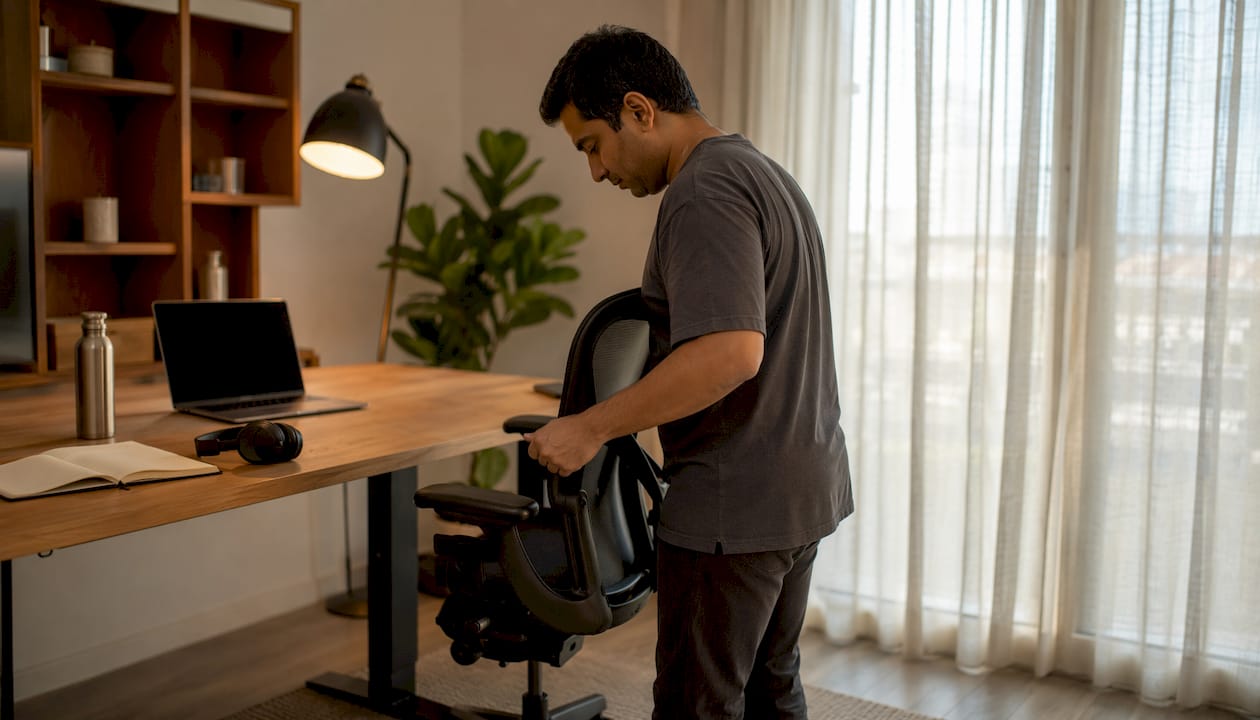
Start with the chair and monitor height. Your eyes should land at the top third of the screen without tilting your head. Your feet should rest flat on the floor. A standing desk or a simple desk riser adds variety and reduces the fatigue that accumulates from sitting for six-plus hours. Lighting matters more than most people realize. Natural light from the side (not behind the screen) reduces eye strain and improves alertness.
Noise is the harder problem. A dedicated room with a door is the gold standard, but not everyone has one. Noise-canceling headphones and a consistent “work has started” signal, whether that is making coffee or a short walk, help the brain shift into focus mode. Keep the workspace visually clean. Clutter competes for attention even when you think you are ignoring it.
What tools does a remote marketing team actually need?
The right tool stack reduces friction without creating new admin overhead. The goal is fewer than 7 core tools, each with a defined purpose.
| Category | Purpose | Examples |
|---|---|---|
| Messaging | Async team communication | Slack, Microsoft Teams |
| Video | Sync meetings and onboarding | Zoom, Google Meet |
| Project management | Task tracking and visibility | Asana, Jira, Linear |
| Documentation | Decisions, SOPs, culture deck | Notion, Confluence |
| Marketing analytics | Campaign performance and reporting | Google Analytics, HubSpot |
| Design and creative | Visual collaboration | Canva, Figma |
Every brief, deadline, creative asset, and approval should live in the project management tool. Scattered context across too many apps is where remote marketing team collaboration breaks down fastest. For a full comparison of analytics platforms, Seo-analytic’s website analytics tools review covers what to look for when choosing a reporting setup.
How to protect work-life boundaries when home is also the office
The clearest boundary strategy is a defined shutdown ritual. Pick a time, close the laptop, and do something that physically marks the end of the workday. It sounds simple because it is, but most remote workers skip it and find themselves checking Slack at 9 PM.
Publish your working hours in your calendar and Slack status. When your team knows your hours, the implicit pressure to respond after hours drops significantly. Encourage your team to do the same. Avoid scheduling messages outside business hours, even if you are writing them at midnight. Most platforms let you schedule sends for the next morning.
Vacation use matters too. Remote workers tend to take less time off because the boundary between work and rest is already blurry. Build a team norm around actually disconnecting during PTO, not just being technically unavailable.
How to build accountability and motivation in a remote team
Accountability without trust is surveillance. The version that actually works is built on clear expectations, visible progress, and consistent feedback.
Start with explicit deliverables. Every team member should know, at the start of each week, what “done” looks like for their work. Weekly 1-on-1s, 30 minutes, owned by the direct report, are the single most important management ritual for remote teams. The agenda covers what was accomplished, what is next, and what obstacles exist. Never cancel two consecutive weeks.
Public recognition in team channels builds motivation in ways that private praise cannot. When a team member’s work is acknowledged specifically and visibly, it signals to the whole team what good looks like. Pair that with a monthly retrospective where the team evaluates its own processes, and you get a feedback loop that keeps both performance and morale from drifting.
How Seo-analytic helps remote marketing teams perform
Remote marketing teams need more than internal process fixes. They need a website and digital presence that converts the traffic their work generates. Seo-analytic specializes in exactly that: building websites, running SEO campaigns, and managing social media for US businesses that want their online presence to match the quality of their team’s output.
Whether your team is managing content, paid media, or brand campaigns remotely, Seo-analytic’s social media marketing services and website building expertise give you the external execution layer that turns internal productivity into real business results.
Key Takeaways
Remote marketing teams that treat distributed work as a system design problem, not a technology problem, consistently outperform those that default to more meetings and more monitoring.
| Point | Details |
|---|---|
| Synchrony ratio first | Target 70% async, 30% sync work before adding any new tools or meetings. |
| Outcome-based tracking | McKinsey 2026 data shows outcome-based frameworks produce 5% higher productivity than activity monitoring. |
| Structured onboarding | A written 30-60-90 day plan with a peer buddy reduces early turnover and targets first contribution within 30 days. |
| Dashboard visibility | Real-time project dashboards let managers catch issues early without surveillance. |
| Intentional culture | Weekly recognition, monthly retrospectives, and virtual social events must be scheduled, not reactive. |
FAQ
What is the most effective remote work productivity tip for marketing teams?
Designing your synchrony ratio before adding tools or meetings is the highest-leverage move. Targeting 70% async and 30% sync work immediately reclaims focus time and reduces calendar fragmentation.
How do you track remote team performance without micromanaging?
Define deliverables and deadlines explicitly, then use project dashboards for visibility. McKinsey’s 2026 research confirms outcome-based frameworks outperform activity monitoring by 5% on productivity, with better morale and retention as well.
What tools do remote marketing teams need?
A lean stack of 5–7 tools covering messaging (Slack or Teams), video (Zoom or Google Meet), project management (Asana or Jira), documentation (Notion or Confluence), and marketing analytics covers the core needs without creating tool-switching fatigue.
How long does it take to see results from a remote productivity system?
Most teams see measurable improvement within 30 days of shifting to an async-first communication structure, primarily because deep-work time returns immediately. The full system, including onboarding and outcome-based measurement, typically stabilizes within 60–90 days.
How do you maintain work-life boundaries when working from home?
Set a defined shutdown time, publish your working hours in your calendar and Slack status, and use scheduled message sends to avoid creating after-hours pressure for your team. Consistent PTO use reinforces the norm across the whole team.