

TL;DR:
- Overcoming imposter syndrome involves challenging self-doubts through evidence-based practices like CBT, evidence documentation, and social disclosure. Recognizing cognitive distortions and maintaining a detailed record of successes help replace feelings of inadequacy with factual proof. Sharing these feelings with trusted individuals reduces shame and normalizes the experience, fostering confidence and resilience.
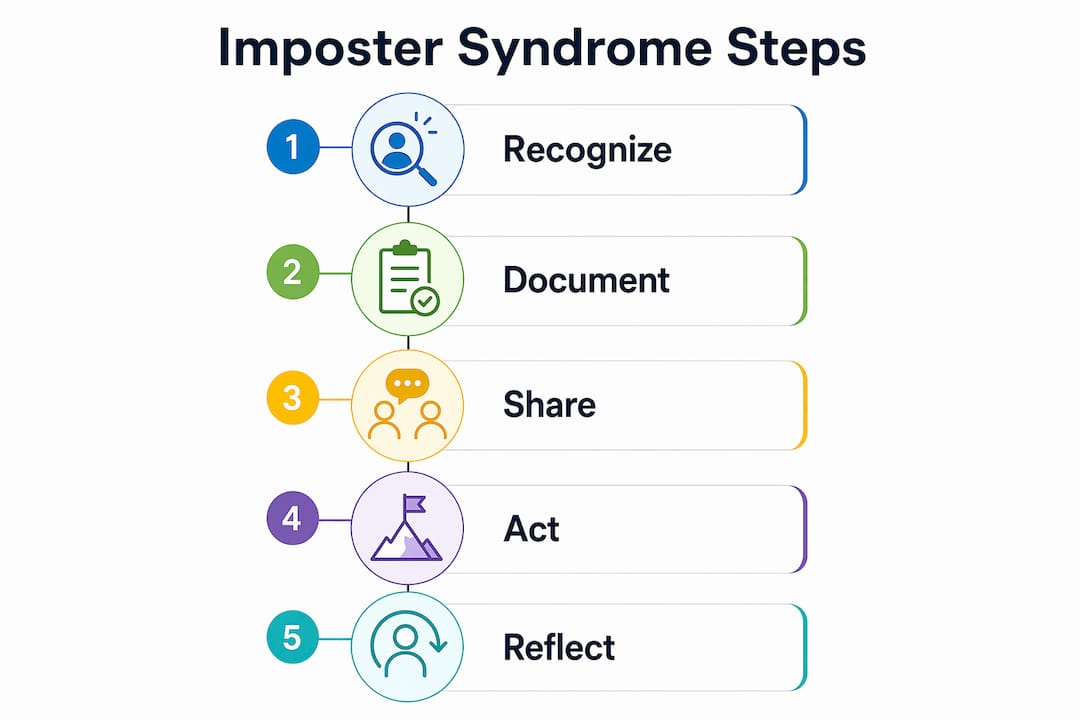
Overcoming imposter syndrome is defined as the deliberate process of dismantling persistent self-doubt and the false belief that your accomplishments are undeserved, using proven psychological and behavioral strategies. Psychologists Pauline Clance and Suzanne Imes first described this experience in 1978, documenting it among high-achieving women who privately feared being exposed as frauds despite clear evidence of their competence. The experience is far more common than most people realize. A 2026 meta-analysis found that imposter phenomenon affects roughly 49% of medical students globally, and comparable patterns appear across law, tech, and creative fields. This article covers the three most effective approaches for tackling imposter phenomenon: Cognitive Behavioral Therapy (CBT) techniques, structured evidence documentation, and social disclosure.
What are the cognitive patterns that sustain imposter syndrome?
Imposter syndrome does not persist on its own. It is maintained by specific, identifiable cognitive distortions that filter out evidence of your competence and amplify every perceived failure. Recognizing these patterns is the first step toward defeating imposter feelings for good.
The two most common distortions are discounting the positive and emotional reasoning. Discounting the positive means dismissing real achievements as luck, timing, or other people’s generosity rather than your own skill. Emotional reasoning means treating a feeling as a fact: “I feel like a fraud, therefore I must be one.” A third pattern, overgeneralization, turns a single mistake into proof of permanent inadequacy.
CBT directly targets these distorted beliefs through a structured process of identification, examination, and challenge. The framework treats imposter syndrome as a hypothesis to be tested, not a fixed truth about who you are. That reframe alone shifts your relationship with self-doubt from passive suffering to active investigation.
Here is what these distortions look like in practice:
- “I only got this promotion because my manager likes me.” (Discounting the positive)
- “I felt nervous during the presentation, so I must have done badly.” (Emotional reasoning)
- “I made one error in the report. I’m clearly not qualified for this role.” (Overgeneralization)
- “Everyone else seems so confident. I’m the only one who doesn’t know what they’re doing.” (Mind reading combined with comparison)
Each of these thoughts feels completely true in the moment. That is precisely what makes them dangerous. Structured cognitive examination through CBT is more effective than reassurance alone in interrupting these patterns, because reassurance does not teach you to question the thought. It just temporarily quiets it.
Pro Tip: Start a dedicated notebook or digital document and write down every automatic negative thought you notice at work for one week. Do not judge the thoughts. Just record them. This single habit builds the self-awareness that makes every other strategy in this article more effective.
How to use evidence documentation to counter imposter thoughts
The most direct way to challenge imposter thinking is to replace interpretation with recorded proof. Documenting successes in a written list and revisiting it periodically is the top recommended strategy from psychologists working with imposter syndrome clients. The reason it works is simple: your brain cannot simultaneously hold a distorted belief and a specific, dated, factual counterexample.

An evidence log is not a generic gratitude list or a vague “wins” journal. It is a structured record of specific behaviors and outcomes with dates attached. The specificity matters because vague entries like “did well at work” are easy to dismiss. Concrete entries like “October 14: Led the client debrief, answered three technical questions without notes, received written praise from the director” are much harder to argue with.
Here is how to build an effective evidence log:
- Open a document or notebook dedicated only to this purpose. Mixing it with other notes reduces the psychological weight of the record.
- Write the date first, every time. Dates create a timeline that proves competence is not a one-off event.
- Describe the specific behavior you demonstrated. What did you actually do? What skill did it require?
- Record the outcome or feedback. What happened as a result? What did someone say or write?
- Review the log when imposter thoughts spike. Do not wait until you feel confident. Read it precisely when you feel least qualified.
Maintaining a dated competence log is the fastest way to reduce imposter rumination because it provides time-stamped counterevidence to challenge thoughts like “I just got lucky.” Lucky people do not produce consistent, documented results across months and years.
Behavioral experiments take this one step further. A behavioral experiment is a planned real-world action designed to test whether an imposter belief is actually true. Examples include accepting a compliment without deflecting, asking a question in a meeting you would normally stay silent in, or volunteering for a task slightly above your current comfort level. Each experiment generates new evidence. Over time, the evidence accumulates into a counter-narrative that shifts focus from feelings to documented facts.
| Behavioral experiment | Imposter belief being tested | What the outcome typically reveals |
|---|---|---|
| Accept a compliment without deflecting | “People will think I’m arrogant if I agree” | Acceptance is received positively and feels manageable |
| Ask a clarifying question in a meeting | “Everyone else already knows this” | Others often have the same question |
| Volunteer for a stretch assignment | “I’ll fail and expose myself as unqualified” | Performance is adequate or better than expected |
| Share a draft before it’s perfect | “My work isn’t good enough to show yet” | Feedback is constructive, not devastating |
Pro Tip: Update your evidence log within 24 hours of a positive event. Memory degrades fast, and imposter syndrome selectively erases positive experiences first. Consistency in updating the log is what separates people who benefit from this technique from those who try it once and abandon it.
Why sharing imposter feelings breaks the cycle
Secrecy is the fuel that keeps imposter syndrome burning. When you keep self-doubt private, it grows in the dark, unchallenged by any external reality check. Sharing imposter feelings with trusted peers normalizes the experience and reduces the social isolation that strengthens the cycle of self-doubt.
Most people fear that disclosure will confirm their worst suspicion: that others will finally see through them. The opposite almost always happens. When you tell a trusted colleague that you feel unqualified, the most common response is recognition. “I feel that way too” is not a polite deflection. It is a statistically likely reaction, given how widespread the imposter phenomenon is across high-performing environments.
The benefits of social disclosure include:
- Normalization. Hearing that respected peers share similar doubts directly challenges the belief that you alone are the fraud in the room.
- Reality testing. A trusted mentor or colleague can offer an external view of your performance that your internal critic cannot provide.
- Reduced shame. Shame thrives in silence. Speaking the fear out loud reduces its emotional charge.
- Accountability. Sharing your behavioral experiments with someone else increases follow-through.
Mentorship plays a specific role here. A mentor who has navigated similar self-doubt can model what building confidence at work actually looks like over time. They are not just a cheerleader. They are a living example that competence and self-doubt can coexist, and that the doubt does not have to win. If formal mentorship is not available, peer groups, professional communities, or even structured online forums can serve the same function.
How ACT and self-compassion complement cognitive strategies
Acceptance and Commitment Therapy (ACT) offers a different angle on how to manage imposter syndrome. Where CBT asks you to examine and challenge distorted thoughts, ACT teaches you to notice thoughts without engaging with them, and to act in line with your values regardless of what those thoughts say. The distinction matters because some imposter thoughts are stubborn. Trying to argue with every one of them is exhausting. ACT gives you a way to act despite them.
The core ACT principle applied to imposter syndrome is this: a thought is a mental event, not a fact, and not a command. “I am not qualified for this” is a sentence your brain produced. It is not a verdict. Mindfulness practice builds the capacity to observe that sentence with some distance rather than fusing with it as if it were reality.
Practical exercises that integrate ACT and self-compassion include:
- Defusion practice. When an imposter thought appears, prefix it with “I notice I’m having the thought that…” This small shift creates psychological distance between you and the belief.
- Values clarification. Write down what you care about in your work. Act from those values even when self-doubt is loud. The action itself builds evidence of competence.
- Self-compassion pause. When you make a mistake, ask: “What would I say to a close friend in this situation?” Then say that to yourself. Research consistently shows self-compassion reduces the emotional intensity of imposter episodes.
- Imperfection tolerance. Set a deliberate standard of “good enough to submit” rather than “perfect before anyone sees it.” Perfectionism and imposter syndrome reinforce each other directly.
Pairing self-compassion with action experiments differentiates constructive coping from avoidance. Avoidance feels like self-protection but actually confirms the imposter belief by preventing you from gathering new evidence. Action, even imperfect action, breaks the pattern.
Key takeaways
Overcoming imposter syndrome requires replacing distorted self-perception with documented evidence, social reality checks, and values-driven action across time.
| Point | Details |
|---|---|
| Name the cognitive distortions | Identify discounting the positive, emotional reasoning, and overgeneralization as the specific patterns sustaining self-doubt. |
| Build a dated evidence log | Record specific behaviors, outcomes, and feedback with dates to create time-stamped proof of competence. |
| Run behavioral experiments | Test imposter beliefs through planned real-world actions and record what actually happens. |
| Disclose to trusted people | Share self-doubt with a mentor or peer to normalize the experience and gain an external reality check. |
| Use ACT alongside CBT | Notice imposter thoughts without fusing with them, then act from your values regardless of what the thoughts say. |
What I’ve learned from watching people fight this battle
I have spent years watching professionals at every level wrestle with imposter syndrome, and the single most common mistake I see is confusing self-compassion with avoidance. People tell themselves they are “being kind to themselves” when they decline a stretch opportunity or delay submitting work indefinitely. That is not self-compassion. That is the imposter belief winning while wearing a friendlier mask.
The strategies that actually produce lasting change are uncomfortable at first. Writing down your achievements feels awkward when you are convinced they do not count. Sharing self-doubt with a colleague feels terrifying when you are certain disclosure will expose you. Running a behavioral experiment feels risky when you expect to fail. But every one of those discomforts is the feeling of the imposter belief being tested rather than obeyed.
The other thing I want to say clearly: imposter moments are transient. They are not your identity. The goal is not to eliminate self-doubt permanently. It is to stop letting self-doubt make your decisions. A documented evidence log, reviewed regularly, is the most reliable tool I have seen for that specific purpose. When the voice says “you don’t belong here,” a page of dated, specific proof says otherwise. If imposter feelings are severely impairing your daily functioning or mental health, working with a licensed therapist trained in CBT or ACT is not a last resort. It is the most direct path to change. You can also explore thought leadership strategies to build professional confidence from the outside in, which often reinforces the internal work.
— Maayan
Build the confidence your professional presence deserves

Self-doubt does not stay in your head. It shows up in how you present yourself online, how you position your brand, and whether potential clients or employers trust what they see. At Seo-analytic, we work with professionals and businesses who are ready to close the gap between their actual competence and how the world perceives them. From goal-setting frameworks to building a digital presence that reflects your real expertise, our team provides the tools and strategy to make your credibility visible. If you are ready to stop hiding your strengths and start showing them, explore our startup growth strategies and take the next concrete step toward the professional presence you have already earned.
FAQ
What is imposter syndrome, exactly?
Imposter syndrome is a persistent pattern of self-doubt in which a person believes their success is undeserved and fears being exposed as a fraud, despite objective evidence of competence. Psychologists Clance and Imes first documented it in 1978 among high-achieving women in academic and professional settings.
How common is imposter syndrome?
Prevalence estimates vary widely depending on how the phenomenon is measured. A 2026 meta-analysis of 34 studies found it affects approximately 49% of medical students globally, and similar rates appear across other high-achievement fields.
Does CBT actually work for imposter syndrome?
Yes. CBT techniques including evidence logs and behavioral experiments are among the most evidence-supported approaches for reducing imposter thoughts, because they replace distorted interpretation with factual, testable counterevidence.
How is ACT different from CBT for this issue?
CBT challenges distorted thoughts directly through examination and restructuring. ACT teaches you to notice imposter thoughts without engaging with them, then act from your values regardless of what those thoughts say. Both approaches are effective and work well together.
Should I tell people at work that I have imposter syndrome?
Selective disclosure to trusted colleagues or mentors is consistently recommended by psychologists. Sharing imposter feelings typically reveals that others share similar doubts, which reduces shame and breaks the isolation that amplifies self-doubt.