
TL;DR:
- Effective onboarding significantly boosts customer retention and lifetime value for small businesses.
- A structured, consistent process includes welcome, education, personalized support, early wins, and ongoing communication.
- Monitoring key KPIs and balancing human touch with automation optimizes onboarding success and reduces churn.
Nearly half of all B2B customers churn within the first 90 days, and 50% abandon apps within the first month alone. That is not a product problem. It is an onboarding problem. For small business owners, losing a customer this early is expensive and largely preventable. This guide walks you through exactly why onboarding drives retention, what a strong process looks like, how to measure it, and when to automate versus keep it personal. Whether you are just starting out or looking to fix a leaky customer journey, you will leave with a clear, actionable framework.
Table of Contents
- Why customer onboarding matters for small businesses
- Core steps of an effective customer onboarding process
- Best practices to maximize onboarding success
- Choosing the right onboarding approach: Human-led vs. automated
- Measuring and optimizing your onboarding performance
- What most onboarding advice misses: Lessons from the field
- Ready to level up your onboarding and customer retention?
- Frequently asked questions
Key Takeaways
| Point | Details |
|---|---|
| Onboarding drives retention | A structured onboarding process significantly reduces churn and increases customer loyalty for small businesses. |
| Follow a clear process | Five key steps—welcome, education, support, early wins, and communication—form the foundation for customer onboarding. |
| Automate but personalize | Automation is valuable for scaling but should be balanced with personal touch, especially early on or for high-value clients. |
| Measure what matters | Tracking KPIs like Time to First Value and Completion Rate is essential to continually optimize onboarding effectiveness. |
| Small tweaks yield big gains | Minor improvements in follow-up speed and clarity can drive major increases in customer satisfaction and retention. |
Why customer onboarding matters for small businesses
Retention is the engine of sustainable growth for any small business. You can pour money into ads, social media, and referrals, but if customers leave before they see real value, you are running in place. Onboarding is the bridge between a customer’s decision to buy and their decision to stay.
The numbers are striking. Great onboarding increases LTV by 300%, and optimized onboarding boosts day-30 retention by 53%. Even more telling: customers who complete onboarding fully show an 82% retention rate, while those who only partially complete it retain at just 19%. That gap is not a coincidence. It reflects how much a structured, intentional process shapes a customer’s long-term relationship with your business.
“The first 90 days are the most critical window in any customer relationship. What happens in that period sets the tone for everything that follows.”
For small businesses, this window is especially important because you often lack the safety net of a large support team or deep discounting to win customers back. The first 90 days are where poor onboarding translates directly into revenue loss. Top-performing firms, those in the top 20% with 85% or better retention, achieve this through fast response times and well-organized client portals.
Here is what strong onboarding actually delivers:
- Higher lifetime value because customers who understand your product use it more
- Fewer support requests since educated customers solve problems independently
- Stronger word-of-mouth from clients who feel genuinely supported early on
- Lower acquisition costs because you are not constantly replacing churned customers
If your startup marketing strategies are working but customers are not sticking around, onboarding is likely where the gap is. Think of onboarding as the bottom of your marketing funnel explained: the moment where interest converts into lasting loyalty. Getting this right is not a nice-to-have. It is a core business growth lever.
Core steps of an effective customer onboarding process
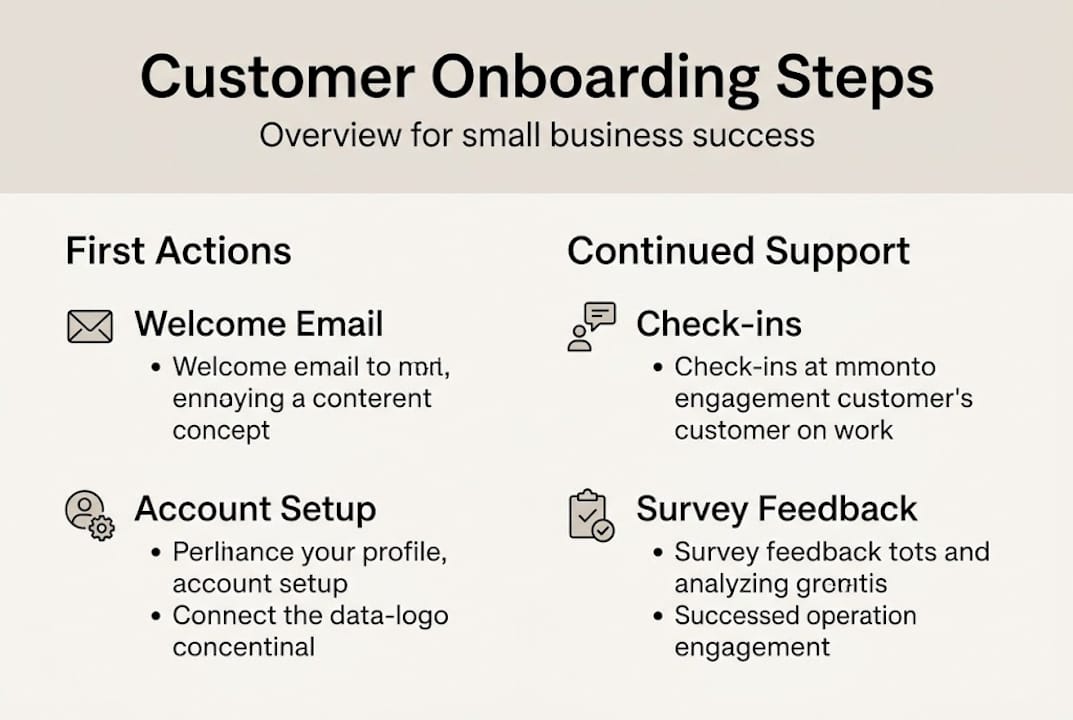
A structured onboarding process does not need to be complicated. It needs to be consistent. According to Gainsight’s onboarding framework, effective onboarding is a defined sequence starting at the point of purchase and moving through welcome, setup, education, personalized support, early wins, and ongoing communication.
Here is how each step works in practice:
- Welcome and setup. Send a warm, clear welcome message within hours of purchase. Include everything the customer needs to get started: login details, next steps, and a timeline. First impressions stick.
- Education. Teach customers how to use your product or service effectively. Short video tutorials, quick-start guides, or a simple checklist all work well. Keep it focused on the actions that matter most.
- Personalized support. Reach out directly based on what the customer bought or their specific goals. Account based marketing tactics apply here: treat each customer as an individual, not a segment.
- Early success moments. Help customers hit a meaningful milestone quickly. This could be completing their profile, making their first use of a key feature, or seeing their first result. Early wins build momentum and confidence.
- Ongoing communication. Keep the conversation going with check-ins, tips, and progress updates. Consistent email marketing best practices ensure customers feel supported beyond the first week.
| Onboarding step | Key action | Goal |
|---|---|---|
| Welcome and setup | Send welcome kit within hours | Reduce confusion, build trust |
| Education | Deliver tutorials or guides | Increase product competence |
| Personalized support | Tailor outreach to customer goals | Boost engagement and confidence |
| Early success | Guide to first meaningful win | Create momentum |
| Ongoing communication | Regular check-ins and tips | Reduce churn, increase LTV |
Using templates and project management efficiency tools to standardize each step means your team delivers a consistent experience every time, even when you are busy.
Pro Tip: Map out your onboarding as a simple checklist and assign a responsible person or automated trigger to each step. Consistency is more powerful than perfection.
Best practices to maximize onboarding success
Knowing the steps is one thing. Executing them reliably with a small team is another. The most effective small businesses treat onboarding like a system, not a series of one-off tasks.
Standardizing your process into reusable templates, using a single link or portal for all client information and forms, collecting documents upfront, and automating follow-up messages are the four moves that separate efficient teams from overwhelmed ones. Each of these reduces friction for both your team and your customer.

Here is what best-in-class onboarding looks like by the numbers:
| KPI | Best-in-class benchmark |
|---|---|
| Time to First Value | Under 14 days |
| Onboarding Completion Rate | Over 80% |
| CSAT score | Above 4.5 out of 5 |
| Churn Rate (first 90 days) | Below 10% |
These onboarding KPI benchmarks give you a target to aim for and a way to diagnose problems before they become expensive.
For automation specifically, tools that send welcome sequences, reminders, and progress nudges let a two-person team deliver the experience of a much larger operation. A marketing automation guide can help you identify which touchpoints to automate first. Start with the most repetitive ones: welcome emails, setup reminders, and milestone confirmations.
Key practices to implement right away:
- Use one central portal where customers find everything they need
- Request documents and information upfront to avoid back-and-forth delays
- Automate follow-ups so no customer falls through the cracks
- Track completion rates weekly to catch drop-off points early
Pro Tip: Review your marketing automation basics before building your onboarding sequences. Knowing what to automate versus personalize makes the difference between efficient and impersonal.
Choosing the right onboarding approach: Human-led vs. automated
Not every customer needs the same level of attention during onboarding. The right approach depends on your business model, your customer’s complexity, and the value of the relationship.
High-touch onboarding works best for early-stage customers, enterprise accounts, and high-value clients where the cost of losing them is significant. Automated or self-serve onboarding scales better for SMBs and lower-ticket customers who just need clear instructions and a smooth setup experience.
Here is a practical comparison:
| Approach | Best for | Trade-off |
|---|---|---|
| Human-led | High-value, complex clients | Time-intensive, hard to scale |
| Automated/self-serve | High volume, lower-ticket clients | Less personal, risk of drop-off |
| Hybrid | Growing businesses | Requires careful design |
The smartest move for most small businesses is to start human-led, learn what customers actually need, and then gradually automate the parts that are repetitive. Rushing to automate before you understand your customer’s journey is one of the most common and costly mistakes.
Here is a simple transition plan:
- Onboard your first 20 to 30 customers manually and document every question they ask.
- Identify the top five recurring friction points or questions.
- Build automated responses or resources for those specific moments.
- Test the hybrid model and measure whether CSAT and completion rates hold steady.
- Expand automation only where the data confirms it works.
Personalized marketing emails and website personalization strategies can support a hybrid model by making automated touchpoints feel tailored rather than generic. The goal is for every customer to feel like they are getting individual attention, even when part of the process is automated. Marketing personalization examples can spark ideas for how to do this at scale.
Pro Tip: Never automate a step you have not done manually first. If you do not understand why a touchpoint matters, automating it will only scale the confusion.
Measuring and optimizing your onboarding performance
Building a great onboarding process is not a one-time project. It requires regular measurement and honest evaluation. If you are not tracking results, you are guessing.
The four core KPIs every small business should monitor are:
- Time to First Value: How quickly does a customer reach their first meaningful outcome? Best-in-class is under 14 days.
- Onboarding Completion Rate: What percentage of customers finish the full process? Aim for over 80%.
- CSAT (Customer Satisfaction Score): Are customers happy with the onboarding experience? Target above 4.5 out of 5.
- Churn Rate: How many customers leave within the first 90 days? This is your most direct signal of onboarding health.
Beyond tracking numbers, you need to define what success actually looks like for your customer. Activation milestones tied to real behavior, like using a core feature, completing a setup step, or achieving a specific result, are far more predictive of retention than simply finishing a checklist.
Feedback loops are equally important. A short survey after onboarding, a quick check-in call at day 30, or even a simple reply-to email asking “how is it going?” can surface problems you would never find in a dashboard. Use that feedback to refine your process quarterly.
Benchmark your results against industry data. If your completion rate is below 80% or your CSAT is under 4.5, those are clear signals that specific steps need attention. Treat your onboarding process like a product: test, learn, and improve continuously.
What most onboarding advice misses: Lessons from the field
Most onboarding guides focus on process. Build a checklist, send a welcome email, set up a portal. That is all useful, but it misses the point. The businesses that actually retain customers long-term are the ones that treat onboarding as a conversation, not a checklist.
Here is what we have seen consistently: the small businesses with the best retention are not the ones with the most sophisticated automation. They are the ones that stay genuinely curious about their customers in the first 30 days. They ask questions. They listen to the answers. They adjust.
The transition from high-touch to automated onboarding should be slow and deliberate. Every time you replace a human interaction with an automated one, you need evidence that the customer experience holds up. Rushing that transition to save time is how businesses accidentally create the churn they were trying to prevent.
Your startup marketing lessons and your onboarding strategy are more connected than most people realize. The same curiosity and responsiveness that drives early marketing success is exactly what makes onboarding work. Do not let process replace judgment.
Ready to level up your onboarding and customer retention?
If this article gave you a clearer picture of where your onboarding process stands, the next step is putting it into action. Building a strong customer journey starts with having the right digital foundation, from a well-structured website to automated communication tools that work while you focus on your business.
At seo-analytic.com, we help small business owners build the digital infrastructure that supports real growth. Whether you are starting with website building basics, getting clear on digital marketing basics, or looking for broader business growth resources, our guides and services are built for businesses exactly like yours. Take the next step today.
Frequently asked questions
What is the customer onboarding process in simple terms?
Customer onboarding is a structured post-purchase journey that helps new clients get set up, learn your product or service, and quickly see value so they stay loyal.
How long should the onboarding process take for small businesses?
Best-in-class small businesses complete onboarding within 5 days or less, responding to new clients within 4 hours to maximize satisfaction and early retention.
What are the most important customer onboarding KPIs?
Track Time to First Value, Completion Rate, CSAT score, and Churn Rate. Best-in-class targets are under 14 days, over 80%, above 4.5 out of 5, and below 10% respectively.
Should small businesses automate customer onboarding?
Automation helps small teams scale efficiently, but welcome sequences and reminders should complement personal touchpoints, especially for complex or high-value clients.
How does onboarding impact customer retention?
Customers who complete onboarding fully show an 82% retention rate compared to just 19% for those who only partially complete it, making onboarding one of the highest-leverage retention tools available.