

TL;DR:
- Structured, honest failure analysis transforms setbacks into competitive insights, fostering resilience and strategic agility.
- Effective post-mortems require clear processes, data-driven follow-through, and a culture that values learning from every type of failure.
Most entrepreneurial post-mortems are exercises in self-deception. You gather the team, walk through what went wrong, nod along to the action items, and move on. But 43% of post-mortems analyzed in a dataset of 200 production incident reviews were either exact repeats or close enough in root cause that a prior action item should have prevented them. Failure does not automatically produce wisdom. It takes structured, honest effort to turn a setback into a genuine competitive advantage, and this guide will show you exactly how to do that.
Table of Contents
- Why learning from failure matters for entrepreneurs
- Types of failure in startups and what each can teach you
- From failure to insight: The process for actionable learning
- Resilience and resourcefulness: Building stronger teams through failure
- Avoiding common traps: Why learning doesn’t always stick
- Why most founders overestimate what they learn from failure
- Next steps: Turn your lessons into growth
- Frequently asked questions
Key Takeaways
| Point | Details |
|---|---|
| Not all failures are equal | Recognizing the type of business failure helps you choose the best strategy for learning and recovery. |
| Structured reflection is essential | Regular, honest reviews and tracked action items prevent repeated mistakes and foster business growth. |
| Culture enables real learning | A psychologically safe environment is critical for teams to turn failures into actionable lessons. |
| Resilience boosts resourcefulness | Learning from failure makes entrepreneurs and teams more adaptive and creatively resourceful. |
| Insight beats optimism | Practical, evidence-based processes matter more than positive thinking when it comes to learning from setbacks. |
Why learning from failure matters for entrepreneurs
With the dangers of repeated mistakes established, we now explore why learning from setbacks is crucial for thriving as an entrepreneur.
Resilience is not a personality trait you either have or do not have. It is an operational skill you build by treating every failure as feedback from the field, cataloging what it reveals, and adjusting your strategy accordingly. Founders who develop this habit stop fearing failure and start designing systems that make failure informative rather than catastrophic.
“Resilience, in practice, is the ability to convert setbacks into actionable learning, not just the emotional capacity to bounce back.”
The business case for this approach is compelling. Companies that build structured reflection into their operations tend to outlast those that treat failure as an embarrassing detour. They develop what behavioral researchers call “strategic agility,” the ability to pivot based on real evidence rather than gut instinct alone. This directly impacts every dimension of a startup, from product development to startup marketing strategies.
Here is why structured failure analysis is non-negotiable for founders:
- Competitive longevity: Startups that reflect on losses adapt faster than those that bury them.
- Team trust: When the team sees leadership take failure seriously, they feel safe reporting problems early, which is when they are cheapest to fix.
- Pattern recognition: Over time, structured reflection trains your instincts. You start to recognize the early signals of a bad decision before it becomes a crisis.
- Capital efficiency: Founders who learn from financial failures spend money more precisely on their next venture, reducing burn rate significantly.
Consider the case of founders who pivoted successfully after an initial product failure. Nearly all of them cite a moment of genuine, uncomfortable reflection, not a motivational speech, as the turning point. The data and the stories align: learning from failure is not optional if you want to build something durable.
Types of failure in startups and what each can teach you
Understanding why learning from failure matters, let’s clarify how not all failures are the same, and why each holds different lessons for founders.
CB Insights research found that “ran out of capital” ranked as the top stated reason for failure among 431 VC-backed companies shut down since 2023, cited by 70% of those businesses. But “ran out of capital” is almost never the real root cause. It is a symptom. The root cause might be poor product-market fit, an inefficient sales cycle, or spending on channels before validating conversion. This is where most founders go wrong in their post-mortems: they treat the symptom as the lesson.
Harvard Business School research outlines a framework that is genuinely useful here. It categorizes failures into three types, each requiring a different learning response.
| Failure type | Definition | Primary lesson | Response strategy |
|---|---|---|---|
| Preventable | Process errors, ignored protocols, human error | Reinforce systems and checklists | Root cause analysis, process redesign |
| Unavoidable (complexity-driven) | Failures in complex, unpredictable systems | Improve monitoring and response | Scenario planning, faster detection |
| Intelligent (frontier) | Small, fast experiments that surface new information | Validate or invalidate hypotheses | Run more experiments, document findings |
Preventable failures are the ones that sting the most because they did not have to happen. A missed follow-up email that cost you a six-figure client. A product bug that shipped because the testing checklist was skipped. These failures are pure process failures, and the lesson is almost always “add a checkpoint.”
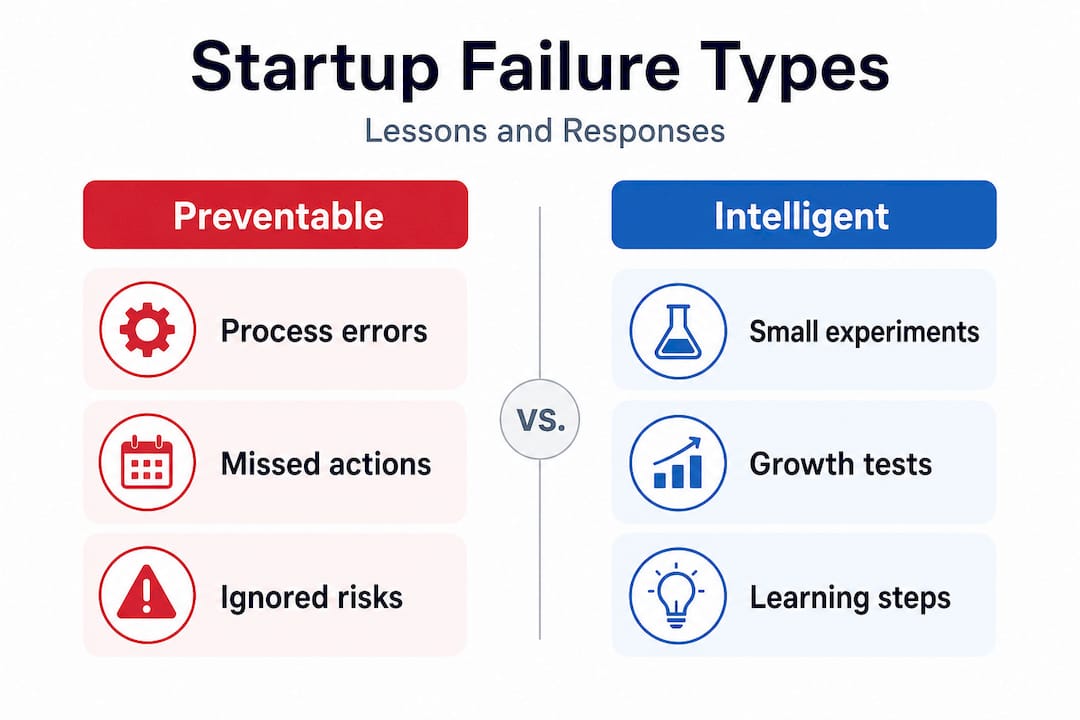
Intelligent failures are the most undervalued category. These are the small bets that did not pan out, the landing page variant that bombed, the pricing model that drove away customers. These failures are supposed to happen. They are how you gather real-world data. Treating them as shameful events rather than information kills the experimentation culture that makes startups competitive.

Pro Tip: After any failure, ask yourself: “Was this preventable with existing knowledge, or did we have to try it to find out?” That single question routes the failure to the right type of analysis and saves hours of misdirected post-mortem time. For managing the process side, strong project management methods help ensure you actually execute on what you learn.
Key things to look for when categorizing a failure:
- Was there a known protocol that was skipped?
- Did the failure involve interdependent systems where no single actor had full visibility?
- Was this a deliberate test with a small scope and a defined success metric?
From failure to insight: The process for actionable learning
Given each failure type requires different learning, let’s walk through concrete steps any founder can use to turn their setbacks into an advantage.
Research on venture failure learning confirms that entrepreneurs can convert failure into higher-level outcomes, but only through distinct learning processes that support recovery and re-emergence. Vague reflection does not cut it. You need a repeatable structure.
Here is a proven six-step post-mortem process built for founders:
- Establish the timeline: Document exactly what happened, in sequence, without blame or interpretation. Just the facts.
- Identify contributing factors: List every factor that played a role, technical, human, strategic, and external.
- Separate symptoms from root causes: Ask “why” five times for each contributing factor until you reach an actionable root cause.
- Classify the failure type: Use the preventable, unavoidable, or intelligent framework from above.
- Write specific action items: Every action item must have an owner, a deadline, and a measurable outcome.
- Schedule a review: Revisit the action items in 30 and 90 days to verify they were completed and effective.
The problem most founders face is step 6. The post-mortem happens, the document lives in a folder, and no one checks back. This is exactly why 43% of incidents repeat. The session was held, but the follow-through was absent.
| Post-mortem element | Done poorly | Done well |
|---|---|---|
| Root cause analysis | “We ran out of money” | “CAC exceeded LTV by 40% because we scaled paid ads before confirming conversion rate” |
| Action items | “Improve our marketing process” | “Reduce CAC by 20% by testing organic channels for 60 days before scaling paid spend” |
| Ownership | Team-level responsibility | Named individual with a deadline |
| Follow-up | Never revisited | Reviewed at 30 and 90 days |
| Data used | Anecdotes and memory | Dashboards, marketing attribution reports, funnel analytics |
One critical upgrade most founders skip is connecting their post-mortem analysis to actual performance data. If a campaign failed, you need measuring marketing ROI data, not impressions or gut feel. If customer acquisition dried up, pull your retargeting strategy data to see where prospects dropped off. The Harvard Business School resource on failing well reinforces this: quality evidence tied to action items is what separates learning organizations from ones that simply hold meetings.
Pro Tip: Build your post-mortem template into a shared document tool your team uses every week, not a separate system that only gets opened after disasters. Normalizing the format reduces the emotional friction of running one after a painful failure.
Resilience and resourcefulness: Building stronger teams through failure
After covering the process, we focus on the strategic advantages that learning from failure brings to resilience and team capability.
Here is something behavioral research confirms that most hustle culture content ignores. Entrepreneurial failure experience is empirically linked to later entrepreneurial behavior through a mechanism called “resource bricolage.” This is the ability to creatively combine available resources to solve problems, essentially entrepreneurial improvisation under constraint. Founders who go through failure and genuinely process it develop this skill at a measurably higher level than those who avoid failure or never reflect on it.
“The founders who adapt best after failure are not those who suffered the least. They are those who built the most honest picture of what went wrong and why.”
This has direct implications for building marketing teams inside your startup. Teams that have a shared vocabulary around failure, who feel safe surfacing bad news early, and who treat every campaign miss as a learning event become dramatically more capable over time. They stop hiding problems. They start running faster experiments. And they build muscle memory for working with limited resources.
Practical ways to build resilience into your team culture:
- Celebrate intelligent failures openly: Recognize experiments that failed quickly and generated useful data. This signals that smart risk-taking is valued.
- Share your own failure stories first: As the founder, modeling vulnerability invites honesty from your team.
- Debrief wins AND losses: Learning only from failure creates negativity bias. Debriefing successes teaches you what to repeat.
- Set “learning goals” alongside revenue goals: These might include “run three pricing experiments this quarter” regardless of whether they succeed.
- Track failure patterns over time: A simple spreadsheet logging failure types, root causes, and action items shows you if you are actually improving or just rotating through the same mistakes.
The Inc. article on resilience lessons from failed ventures makes a point that deserves emphasis: resilience is not about having a high pain threshold. It is about maintaining the operational capacity to keep learning while under pressure. That is a system design problem, not a character trait.
Avoiding common traps: Why learning doesn’t always stick
Finally, let’s tackle why so many organizations fail to truly learn, and what you can do to avoid falling into the same traps.
Research confirms that failure learning is not automatic. It depends on cognitive conditions within the individual and organizational conditions within the company. You can hold all the post-mortems you want and still repeat the same mistakes if these conditions are not met.
The most common traps founders fall into:
- Blame culture: When post-mortems become performance reviews in disguise, people protect themselves instead of being honest. Root causes stay hidden.
- Vague action items: “Do better next time” is not an action item. Without specificity, nothing changes.
- Untested assumptions in the analysis: You reach a root cause based on what feels true, not what the data shows.
- No psychological safety: If junior team members fear speaking up, your post-mortem only captures the perspective of people with positional power.
- One-time events: A single post-mortem after a major failure does nothing if it is not part of a recurring practice.
Pro Tip: Run a short, 15-minute retrospective at the end of every sprint or major campaign, not just after disasters. Making reflection a routine habit removes the emotional charge that comes with doing it only after catastrophic failures. This also helps you identify slow-moving problems before they become crises. For debunking the myths that keep teams from asking honest questions, reviewing common advertising myths is a useful starting point.
Why most founders overestimate what they learn from failure
There is a version of the “fail fast, fail forward” narrative that is genuinely dangerous. It tells founders that the act of failing is itself educational. Just go through it, feel the pain, and you will come out wiser. This is partly true and largely incomplete.
Even when post-mortems exist, learning quality does not automatically translate into prevention. The evidence shows that action-item follow-through and evidence quality are what actually correlate with lower repeat incidents. The post-mortem ritual without those two things is theater.
What we see in practice is founders who are extremely fluent at telling the story of their failure. They have the pitch down. “We went too early, the market was not ready, we learned about distribution.” It sounds like insight. But when you look at their next venture, the same structural mistakes appear, just wearing different clothes. New industry, same premature scaling. New product, same ignored CAC metrics.
The uncomfortable truth is that genuine learning from failure requires things hustle culture actively discourages. It requires sitting with discomfort long enough to do honest root cause analysis. It requires admitting that the mistake was yours, not the market’s. It requires building systems that force you to revisit what you said you would do differently, even when you are busy chasing the next opportunity.
We have seen founders turn real startup growth lessons into durable advantages, not because they failed more than anyone else, but because they built repeatable review processes. They tracked their action items. They brought in outside perspectives to challenge their analysis. They treated their post-mortem document as a living resource, not a formality. That is the difference between failing forward as a cliche and failing forward as a competitive strategy.
Next steps: Turn your lessons into growth
Knowing what separates genuine learning from post-mortem theater is powerful. The next step is putting that knowledge to work in your actual marketing and growth systems.

At our digital marketing agency, we work with founders and startup teams who want to move from reactive to strategic. Whether you are rebuilding after a setback or looking to make your growth more data-driven from the start, we have resources to help. Start with a solid foundation by exploring digital marketing basics for business owners, then explore actionable startup growth strategies you can apply right now. Our team specializes in turning lessons into measurable results, from website performance to full-funnel conversion optimization.
Frequently asked questions
How do I know if a failure is due to a preventable mistake or an unavoidable risk?
Preventable mistakes usually stem from process errors or ignored action items, while unavoidable risks are tied to complex systems you cannot fully control. A useful test: did you have the information needed to avoid it before it happened?
What is one practical step to learn better from business failure?
Schedule structured post-mortems for every major setback and track action items until they are completed. 43% of repeat incidents could have been prevented if prior action items had actually been followed through.
How does learning from failure actually help my team?
Teams who reflect on and act upon failure build resourcefulness, adapt better, and avoid repeating costly mistakes. Resource bricolage research empirically links failure experience to stronger creative problem-solving in later ventures.
Why is ‘psychological safety’ important in learning from failure?
People need psychological safety to honestly report setbacks, which is a prerequisite for true organizational learning. Without it, failure type analysis stays surface-level and blame-driven rather than genuinely diagnostic.
What is ‘resource bricolage’ and why does it matter?
Resource bricolage is creative problem-solving with what’s at hand, a skill founders develop through processing failure honestly. Research confirms it is a key mechanism linking prior failure experience to stronger entrepreneurial behavior in subsequent ventures.