

TL;DR:
- Nearly half of small business owners in the US lack a formal succession plan, risking closure during unexpected events.
- Effective succession planning involves identifying leaders, building internal teams, and documenting company knowledge to ensure business continuity.
- Regular review and preparation for edge cases like family disputes or sudden incapacity are essential to safeguarding long-term business value.
Nearly half of small business owners in the United States have no formal succession plan, leaving their companies dangerously exposed to closure the moment an unexpected event forces a leadership change. For small and medium-sized business owners, this is not a distant, theoretical risk. It is a financial and operational reality that can wipe out decades of hard work in a matter of months. This guide breaks down exactly what succession planning is, which path fits your situation, how to build your plan step by step, and how to handle the messy edge cases that most guides simply ignore.
Table of Contents
- What is succession planning and why does it matter?
- Common succession paths and exit strategies
- Step-by-step succession planning process
- Handling edge cases and succession pitfalls
- The real reason most succession plans fail (and what to do instead)
- Take your business transition to the next level
- Frequently asked questions
Key Takeaways
| Point | Details |
|---|---|
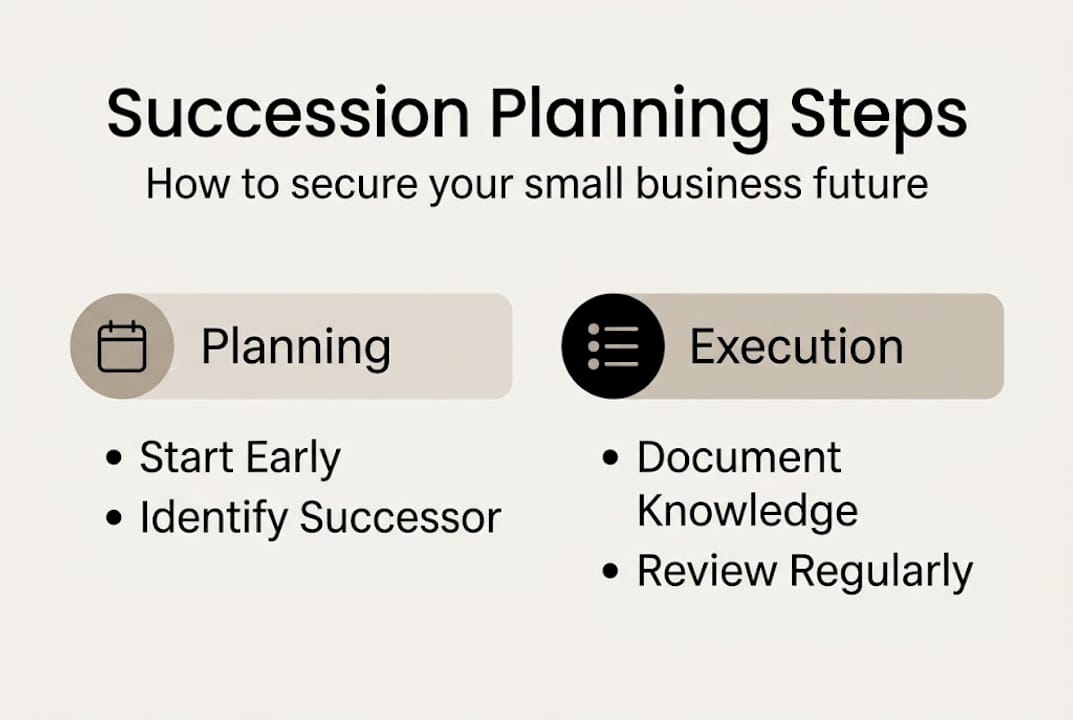
| Start early | Begin succession planning years ahead to avoid rushed or risky transitions. |
| Know your options | Compare paths like family transfer, sale, or ESOP to select your best exit strategy. |
| Document key knowledge | Capture the unique skills and judgments that drive your business’s success. |
| Review regularly | Revisit and update your succession plan each year to stay aligned with your goals. |
| Prepare for surprises | Plan for edge cases, unexpected events, and leadership gaps to build true continuity. |
What is succession planning and why does it matter?
Succession planning is the deliberate process of identifying and preparing the next leader, owner, or ownership structure for your business before you need one. It is not just about retirement. It covers sudden illness, burnout, a buyout offer you did not expect, or a family situation that forces your hand. For small and medium-sized businesses, the stakes are personal as well as financial.
Here is the hard reality: family business survival rates drop sharply with each generation, with roughly 30% making it to the second generation, 12% to the third, and only 3% reaching the fourth. The reasons are rarely about product quality or market fit. They are almost always about leadership continuity and preparation.
The financial case is equally compelling. Businesses with a formal succession plan report significantly higher profitability, with median employer profits reaching $90,000 compared to just $60,000 for those without one. That gap is not a coincidence. A documented plan forces owners to clean up financials, reduce personal dependency, and build systems that run without them.
| Business type | With a plan | Without a plan |
|---|---|---|
| Median employer profit | $90,000 | $60,000 |
| Survival to 2nd generation | 30% | Much lower |
| Owner exit readiness | High | Low |
“Succession planning is not an exit event. It is an ongoing discipline that defines whether your business outlives you or dies with you.”
For small business owners, the clearest benefit is control. When you plan ahead, you decide who takes over, on what terms, and at what price. Without a plan, a court, a creditor, or a family dispute makes those decisions for you. Understanding business exit strategies is the foundation for making those choices wisely.
Common succession paths and exit strategies
Not every succession looks the same, and choosing the wrong path can cost you years and significant money. The main options, as outlined in small business succession resources, include selling to an outside buyer, transferring to a family member, selling to employees through an ESOP (Employee Stock Ownership Plan), executing a management buyout, merging with another business, or winding down entirely.
Each path suits a different situation:
- Sale to an outsider: Best when no internal candidate exists and you want a clean exit at market value.
- Family transfer: Works well when a qualified family member is ready and the family agrees on terms.
- ESOP: Ideal when you want to reward loyal employees and retain company culture.
- Management buyout (MBO): Works when key managers have the financial backing and motivation to lead.
- Merger: A strong option when scale matters and a larger organization can absorb your team and clients.
- Wind-down: Sometimes the most honest answer, especially when no viable buyer or successor exists.
Research on family vs non-family handover shows that family successions carry unique emotional and relational complexity that purely financial deals do not. Sibling rivalry, unequal contribution, and differing visions for the company can derail a transfer even when the business is healthy.
Pro Tip: Do not pick your succession path based on emotion or family pressure. Map it against your financial goals, your timeline, and the actual readiness of the candidate. A capable outside buyer often creates a better outcome than an unprepared family member.
Building the internal team that can support any of these transitions requires serious attention. Owners who invest in building internal teams before they need a successor find the process far smoother because key roles are already filled by people who understand the business deeply.

Step-by-step succession planning process
A strong succession plan is not a document you draft once and file away. It is a living process. Here is the practical roadmap that works for small and medium-sized businesses.
- Set your vision. Decide what a successful exit looks like for you. Is it maximizing sale price, preserving company culture, keeping jobs in the community, or passing something to your kids?
- Assemble an advisory team. Bring in a financial advisor, a business attorney, and a CPA before you make any decisions. Their job is to prevent costly mistakes.
- Get a business valuation. You cannot plan effectively without knowing what your business is actually worth today. Update this number annually.
- Identify critical roles and successors. Map which positions are truly irreplaceable, then assess who internally or externally could fill them. Use a structured success profile rather than gut feeling.
- Build development plans. Assign mentorship, stretch assignments, and training to your top candidates. This is where the start planning early principle matters most: 3 to 5 years of preparation produces far better leaders than 6 months.
- Clean up your financials. Reduce owner-dependent revenue, document processes, and make the business attractive to a buyer or successor.
- Run an annual review. Markets change, people change, and your goals change. Treat the plan like a project management method that requires regular iteration.
One step most owners skip is reducing their own dependency. If every major client relationship, vendor negotiation, or sales decision runs through you, then the business value is tied to your presence. Developing a sales pipeline that operates independently of the owner is one of the highest-value actions you can take before a transition.
A detailed succession planning process also recommends identifying the “5Ds”: death, disability, disagreement, divorce, and distress. Plan for all five, not just the comfortable scenario.
Handling edge cases and succession pitfalls
Process alone is not enough. Many businesses hit walls that no standard guide prepares them for. These are the situations where good intentions collapse without the right strategy.
Multiple heirs with competing interests are one of the most common problems in family businesses. Giving all children equal ownership sounds fair, but it often creates deadlock. Solutions include unequal voting shares, separating ownership from management, or creating buy-sell agreements that let one heir purchase the others out over time.
No clear successor is more common than most owners admit. If nobody inside the business is ready or willing to lead, your options include:
- Hiring an interim or permanent external CEO while you prepare for a sale.
- Setting up an ESOP to transfer ownership to a group of employees.
- Approaching a competitor or strategic partner about a merger.
- Working with a business broker to find the right outside buyer.
Sudden events change everything. If an owner becomes incapacitated without a plan in place, the business can be frozen by legal uncertainty within weeks. A buy-sell agreement funded by life or disability insurance is one of the most cost-effective tools available for this scenario.
“The 5Ds (death, disability, disagreement, divorce, distress) are not rare events. They are the normal circumstances that trigger most unplanned business transitions.”
Common mistakes that sink otherwise solid plans:
- Waiting until retirement is imminent to start planning.
- Assuming a family member wants the role without an honest conversation.
- Ignoring tax implications of the chosen exit structure.
- Failing to update the plan after major business or personal changes.
Strong negotiation skills for owners become especially critical in edge cases, where terms, valuations, and timelines are all under pressure and emotions run high.
The real reason most succession plans fail (and what to do instead)
Here is something most consultants will not tell you: the majority of succession plans fail not because of bad legal documents or wrong exit structures, but because the business owner never transferred what actually made the business work.
We call this the “company genius,” the informal judgment, the client relationship instincts, the way a problem gets solved in a 10-minute hallway conversation. None of that lives in an employee handbook. When the owner leaves and takes it with them, the business struggles even with a competent successor in place.
The solution is to codify your company’s judgment, not just your processes. Document the reasoning behind decisions, not just the decisions themselves. Record how you handle your top clients when things go wrong. Build that knowledge into training, shadowing, and real-time mentorship over years, not weeks.
Small businesses should also resist copying large corporate succession models. A Fortune 500 talent pipeline does not translate to a 40-person company. Instead, build a hybrid bench: a mix of internal candidates you are grooming and external contacts you trust. Make succession a cultural topic, not a once-a-decade crisis. Investing in building resilient teams from day one is what separates businesses that outlast their founders from those that do not.
Take your business transition to the next level
You have spent time building something worth protecting. A strong succession plan keeps that value intact. But business continuity does not stop at leadership transition. Your digital presence, your marketing infrastructure, and your online systems need to be just as resilient as your organizational structure.

Our team at seo-analytic.com works with small and medium-sized business owners to build the digital foundations that make transitions smoother and businesses more transferable. From creating a website building guide tailored to your goals to establishing the digital marketing basics that protect your revenue stream during ownership changes, we help you future-proof what you have built. Reach out and let us help you make your business work without you at the center.
Frequently asked questions
How early should succession planning begin?
Succession planning should start 3 to 10 years before your intended transition and be reviewed at least once a year. Starting early gives candidates enough time to develop and gives you enough time to clean up the business.
What is the most common succession planning mistake?
The biggest mistake is failing to codify company judgment and informal knowledge, not just written procedures. Owners who wait until an exit is imminent rarely transfer what actually makes the business valuable.
What if there’s no family member or employee to take over?
If no successor exists internally, consider selling to an outside buyer, setting up an ESOP, or hiring an external CEO to maintain operations while you prepare for a sale.
How often should a succession plan be updated?
Update your plan at least annually or after any major change in the business, ownership, or your personal circumstances. Markets shift and people’s readiness changes, so the plan must keep pace.
Recommended
- Business Continuity Planning: Securing Online Growth – seo analytic
- Understanding Branding for Small Businesses Effectively – seo analytic
- What is a CMS? A complete guide for small business owners – seo analytic
- Business Exit Strategies to Maximize Sale Value – seo analytic
- Unlocking Business Potential Through Pro… | Orloff Phillips