

TL;DR:
- Most small businesses are unprepared for crises, leading to high failure rates after disasters. Developing a simple, regularly tested crisis plan focusing on risk assessment, communication, and recovery is essential. Ongoing practice and maintenance build resilience, ensuring businesses can survive unexpected events and continue operations.
Most small businesses operate without a crisis plan until it’s too late. 90% of unprepared businesses fail to reopen after a major disaster, and that number should stop you cold. Whether it’s a flood, a ransomware attack, or a supply chain collapse, unforeseen events don’t discriminate by company size. The good news is that effective crisis management planning doesn’t require a corporate legal team or a six-figure budget. With the right framework, even a solo operator or a five-person shop can build a plan that keeps the lights on when everything goes sideways.
Table of Contents
- Why every small business needs a crisis management plan
- Core steps to build a strong crisis management plan
- Key methodologies: Risk analysis, impact modeling, and resilience tactics
- Handling edge cases: Cyber threats, supply chains, remote work, and financial shocks
- Testing, maintenance, and building a crisis-ready culture
- The uncomfortable truth about crisis management for small businesses
- Take the next step: Secure your business for the future
- Frequently asked questions
Key Takeaways
| Point | Details |
|---|---|
| Survival depends on planning | Most unprepared small businesses fail to reopen after a crisis. |
| Follow a simple framework | Assess risks, build a team, outline communications, and update your plan regularly. |
| Address unique risks | Incorporate cyber threats, supply chain issues, and financial preparedness for full resilience. |
| Keep plans actionable | A simple, practiced plan is more effective than a complex one that sits unused. |
Why every small business needs a crisis management plan
Let’s get one thing straight: being small doesn’t protect you. It actually makes you more vulnerable. Large companies have layers of redundancy, legal resources, and cash reserves to absorb shocks. Small businesses usually don’t. When disaster hits, the margin for error is razor thin.
The data is sobering. According to the SBA, 43% of businesses close permanently after a disaster, 51% shut down within two years, and 75% never make it past year three. These aren’t edge cases. They represent real businesses, real owners, and real communities losing their economic foundation.
The risks facing small businesses today come in several forms:
- Natural disasters: Hurricanes, wildfires, floods, and tornadoes can destroy physical locations, disrupt access, and knock out power for weeks.
- Cyberattacks: 43% of cyber breaches target small businesses according to Verizon’s data breach investigations. Small businesses are seen as soft targets with weak defenses.
- Supply chain failures: The pandemic years proved that even a two-supplier dependency can cripple operations overnight.
- Pandemics and public health events: Sudden staff shortages, mandatory closures, and shifting consumer behavior can all devastate revenues.
- Key person dependency: If your business relies heavily on one or two people and they become unavailable, operations can grind to a halt.
| Threat Type | Likelihood | Potential Business Impact |
|---|---|---|
| Natural disaster | Medium to High | Physical loss, closure |
| Cyberattack | High | Data loss, revenue disruption |
| Supply chain failure | Medium | Operational delays |
| Pandemic or health event | Low to Medium | Staffing, revenue collapse |
| Key person loss | Medium | Knowledge and ops gap |
“Small businesses are not too small to be targeted. They are targeted because they are often underprepared.”
Even a basic plan, something as simple as a one-page document with emergency contacts, backup supplier names, and a communication chain, gives you a survival edge. Good business continuity planning isn’t about writing a perfect document. It’s about thinking through what would break and knowing your next move before the crisis hits.
Core steps to build a strong crisis management plan
Recognizing the threats is step one. Step two is doing something about it. The planning process can feel overwhelming, but breaking it into a clear sequence makes it very manageable.
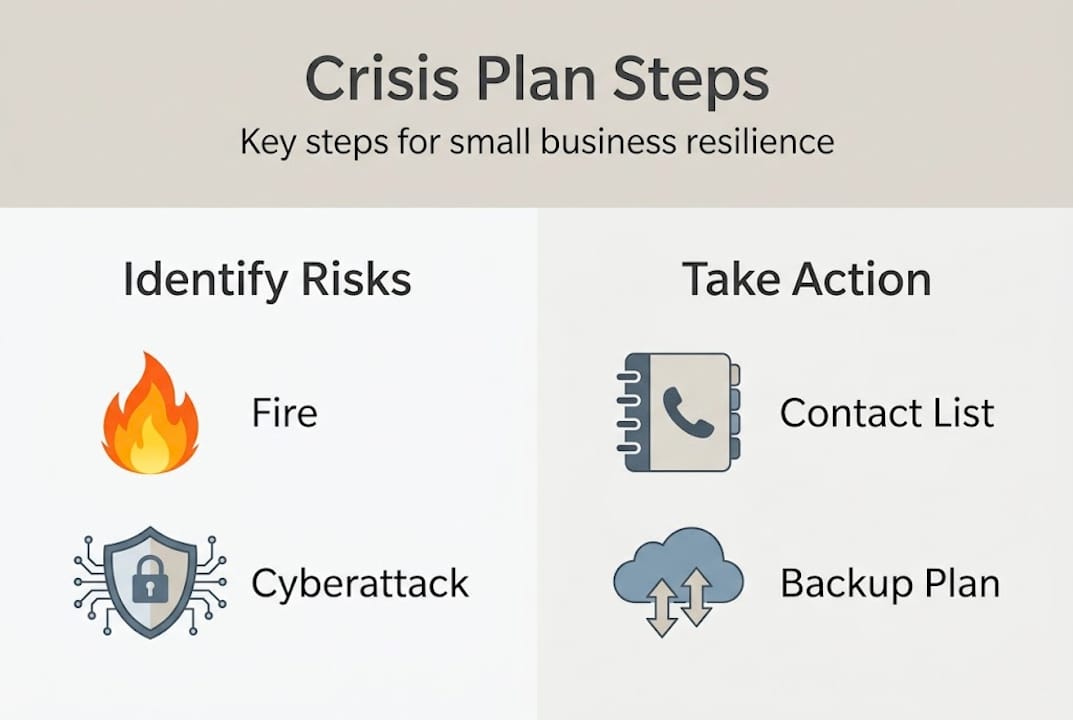
Here is the six-step framework that most resilience experts recommend, based on core planning methodology from business continuity guides:
-
Assess your risks. List every threat that could realistically affect your business. Think about your geography, your industry, your technology dependencies, and your workforce. Be specific. “Flood” is better than “weather event.”
-
Conduct a Business Impact Analysis (BIA). For each risk, ask: what functions stop working, how quickly does revenue drop, and how long can we survive without it? This step forces you to prioritize what truly matters.
-
Assemble a crisis response team. Assign specific roles and responsibilities. Who declares a crisis? Who contacts customers? Who handles insurance claims? Don’t leave these decisions for the moment of impact.
-
Develop communication strategies. You need a plan for internal communication with staff and external communication with customers, vendors, and the media. Pre-written message templates save critical hours when panic sets in.
-
Outline recovery procedures. For your most critical functions, document the exact steps needed to restore them. Think of this as your operational playbook for getting back online fast.
-
Test and update the plan. A plan that’s never been tested is just a theory. Run tabletop exercises, simulate scenarios, and identify gaps before a real event forces you to find them the hard way.
“The best crisis management plans are the ones that get used. Simplicity beats sophistication every time.”
The SBA and FEMA both offer free templates and worksheets designed specifically for small business owners. You don’t need to start from scratch. Organizations like the New Mexico SBDC publish resources such as the Business Resilience Guide, which includes fillable worksheets for each of these steps.
Pro Tip: Start with a one-page “quick reference” card listing your top five risks, your crisis team contacts, and your first three recovery actions. Pin it somewhere visible. This alone outperforms most businesses that have nothing.
Applying structured project management methods to your planning process helps you assign ownership, set deadlines for each section, and avoid the common trap of starting strong and losing momentum halfway through.
Key methodologies: Risk analysis, impact modeling, and resilience tactics
After mapping out the steps, mastering several core methodologies will shape a truly resilient plan. Three concepts deserve special attention: Business Impact Analysis, Recovery Time Objective, and Recovery Point Objective. These sound technical, but the application is straightforward.
Business Impact Analysis (BIA): This is the process of identifying your most critical business functions and understanding what happens if they stop. For a retail shop, that might be point-of-sale systems. For a consulting firm, it’s client communication and data access. The SBA recommends you identify and prioritize critical functions through this analysis before any crisis occurs.
Recovery Time Objective (RTO): How long can your business realistically operate without a given function before it causes serious financial damage? A restaurant might have an RTO of four hours for its kitchen systems. An e-commerce store might have an RTO of two hours for its website. Defining RTO forces you to be specific about urgency.
Recovery Point Objective (RPO): This answers the question: how much data or work can we afford to lose? If your customer database is backed up every 24 hours, your RPO is one day. That might be acceptable for some businesses but catastrophic for others. Knowing your RPO helps you decide how often you need to back up critical information.
| Concept | Definition | Small Business Example |
|---|---|---|
| BIA | Prioritizes which functions matter most | Identify top 3 revenue-generating processes |
| RTO | Max downtime before serious damage | Website must be back online within 4 hours |
| RPO | Max data loss you can tolerate | Back up customer files every 12 hours |
Building resilience also means eliminating single points of failure. Examples include:
- Maintaining accounts with at least two suppliers for critical inventory
- Storing business data in both cloud and offline backups
- Cross-training employees so no single person holds all critical knowledge
- Having a backup payment processing system if your primary vendor goes down
- Keeping printed copies of essential contacts and procedures in case systems go offline
Pro Tip: The SBA’s disaster loan program can fund resilience upgrades. Businesses that qualify may receive up to 20% more than their loan amount specifically for mitigation improvements like backup generators or reinforced infrastructure. This is worth exploring when you assess the financial side of your plan.
Understanding measuring marketing ROI applies here too, because smart resource allocation during a crisis, knowing where every dollar goes during recovery, makes the difference between a controlled response and a scramble.
Handling edge cases: Cyber threats, supply chains, remote work, and financial shocks
Beyond the basics, addressing special scenarios and emerging threats takes your plan from adequate to robust. These are the situations that business owners underestimate until they’re living through them.
Cyber threats: With 43% of cyber breaches targeting small businesses, you cannot treat cybersecurity as a big-company problem. Your crisis plan should include a cyber incident response procedure that covers: isolating affected systems, notifying impacted customers, contacting your cyber insurance provider, and engaging a forensics vendor if needed. Strong cybersecurity for business practices like multi-factor authentication, employee training, and regular software updates also reduce your exposure significantly.
Supply chain disruptions: Map your supply chain and identify where you have only one source. For each critical supplier, document at least one backup option. Build relationships with those alternatives now, before a crisis forces you to make cold calls. Also consider maintaining a small strategic inventory buffer for your highest-priority inputs.
Financial preparedness: Businesses need an emergency fund covering three to six months of operating expenses. This isn’t just a best practice. It’s the minimum buffer that allows you to keep employees paid, negotiate with landlords, and maintain operations during a recovery period. Review your business insurance policies annually to verify they cover your actual risk exposure, including flood, business interruption, and cyber liability.
- Confirm your business interruption insurance includes the events you’re most exposed to
- Know how quickly your insurer pays claims and what documentation they require
- Consider a small business line of credit as a supplemental liquidity buffer
Remote work and key person dependency: Your plan should describe how your most critical functions can continue if your office is inaccessible. This includes remote team management systems, cloud-based document access, and defined communication protocols for distributed work. Additionally, document the essential knowledge held by your top performers so that their unexpected absence doesn’t stop operations cold.

Pro Tip: Create a “succession snapshot” for each key role: a one-page document listing that person’s top responsibilities, key contacts, access credentials (stored securely), and the most important decisions they make. Update these quarterly.
Testing, maintenance, and building a crisis-ready culture
With your plan in place and expanded to cover key vulnerabilities, ongoing readiness is your next priority. A plan sitting in a drawer is not a plan. It’s a false sense of security.
Testing and maintenance should follow a structured cycle:
-
Annual tabletop exercises. Gather your crisis team and walk through a simulated scenario step by step. Ask: what would we actually do in the first hour? What would we tell customers? Who has the authority to make what decisions?
-
Functional drills. Test specific components of your plan, like your backup communication system or your data restoration process. These focused tests reveal practical gaps that tabletop conversations miss.
-
Post-incident reviews. After any significant disruption, hold a structured debrief. What worked? What failed? What would you change? Capture these lessons and update the plan immediately.
-
Scheduled document reviews. As crisis management experts emphasize, plans must be living documents with annual reviews, post-crisis debriefs, and a hybrid approach that blends proactive planning with reactive flexibility.
-
Onboarding integration. Every new employee should receive at least a brief orientation to your crisis plan. They should know their role, who to call, and what not to do during an incident.
“Culture eats crisis plans for breakfast. If your team doesn’t know the plan exists, it doesn’t exist.”
Building a crisis-ready culture means making preparedness part of your normal operations, not a one-time project. Share updates with staff after drills. Celebrate when a team member spots a vulnerability. Reward the behavior you want to see during a real event.
Applying insights from building a high-impact team carries directly into crisis culture. Teams that communicate well under normal circumstances communicate far better under pressure.
The uncomfortable truth about crisis management for small businesses
Let’s say what most guides won’t. The majority of small business crisis plans that exist are binders gathering dust on a shelf. They were created to satisfy a lender requirement, a lease agreement, or a moment of post-disaster panic, and then they were never touched again. That’s not planning. That’s paperwork.
The uncomfortable truth is that the quality of your plan matters far less than the habit of maintaining it. A one-page document that your team reviews every quarter and uses as a genuine reference outperforms a sophisticated 40-page manual that nobody has read since 2022.
We’ve seen businesses survive serious disruptions not because they had perfect plans, but because they had practiced their plans. Their teams knew what to do without waiting for instructions. That level of readiness only comes from treating crisis preparation as an ongoing mindset rather than a compliance checkbox.
Simplicity is your friend. Clarity under pressure is earned through repetition. Start small, make it real, and keep updating. Your practical continuity planning should feel like a living tool, not an archived document.
Take the next step: Secure your business for the future
Ready to put your plan into action and safeguard every part of your business? Here’s where to start.
Your crisis readiness and your digital presence are more connected than you might think. When disaster strikes, your website, your social channels, and your online customer communications become your lifeline. A business without a strong digital foundation loses customer trust fast during a crisis.

Explore our continuity planning tips to strengthen your overall strategy, and visit our guide on website building essentials to make sure your online assets can support you when your physical operations face pressure. Our team helps small businesses build digital infrastructure that works when it matters most.
Frequently asked questions
What are the first steps to create a crisis management plan for my small business?
Start with identifying your main risks, listing key contacts, then use a free SBA or FEMA template to begin mapping your response procedures. The Business Resilience Guide includes fillable worksheets that walk you through each phase at no cost.
How often should I update and test my crisis management plan?
Review and test your plan at least once per year and after any major incident to ensure it stays current and effective. Crisis management experts confirm that living plan documents with regular tabletop exercises produce significantly better outcomes than static plans.
Do I need to worry about cyber threats if I’m a small business?
Yes, nearly half of all cyber breaches target small businesses, so cyber planning must be part of your overall crisis strategy. The 43% breach rate targeting small businesses makes cybersecurity a core planning priority, not an optional extra.
What financial resources can help my business recover from a disaster?
The SBA offers low-interest disaster loans, including the opportunity to receive up to 20% extra for resilience improvements and mitigation measures. Check with your local SBA district office for eligibility and application guidance specific to your situation.