

TL;DR:
- AI in online marketing offers automation, personalization, and optimization that scale beyond human capabilities. Starting with one campaign type, running a small pilot, and measuring a clear KPI can lead to effective adoption. Proper governance, measurement, and documented workflows are essential to scaling AI successfully and avoiding reputation or compliance risks.
AI in online marketing delivers three things at once: automation that removes manual grunt work, personalization at a scale no human team can match, and optimization that compounds with every data point. If you want to act this week, here is where to start:
- Pick one campaign type. Ads, email, or SEO content. One. Google Performance Max and Meta Advantage+ are the lowest-friction entry points for paid media; most accounts can activate them without new tooling.
- Run a small pilot. Set a budget cap, a time box (two to four weeks), and a single hypothesis. Seo-analytic typically scopes pilots to one channel and one audience segment so that results stay readable.
- Measure one clear KPI with a guardrail. Cost per acquisition for ads, organic sessions for SEO, open-to-click rate for email. Set a floor below which you pause, not just a ceiling you hope to hit.
AI-powered ad spending in the U.S. is projected to reach $57 billion in 2026, a 63% jump year-over-year. That number tells you the window for getting ahead of competitors is closing fast.
Table of Contents
- What “AI in online marketing” actually means for practitioners
- Where AI in online marketing delivers the biggest returns
- Which AI marketing tool categories should you evaluate?
- How to design an AI marketing strategy step by step
- From pilot to scale: a practical implementation roadmap
- How to measure whether your AI marketing efforts are actually working
- Governance, copyright, and privacy: what U.S. marketers must get right
- The 2026 U.S. AI marketing landscape: what the data actually shows
- What AI marketing looks like in practice: three micro case studies
- Key Takeaways
- The part most playbooks skip
- Seo-analytic helps you run AI marketing pilots that actually produce results
- Useful sources
- FAQ
What “AI in online marketing” actually means for practitioners
The phrase gets used loosely, so a working definition matters. AI in online marketing is the application of machine-driven systems to marketing tasks that previously required human judgment at every step: writing copy, setting bids, segmenting audiences, predicting churn, and routing leads.
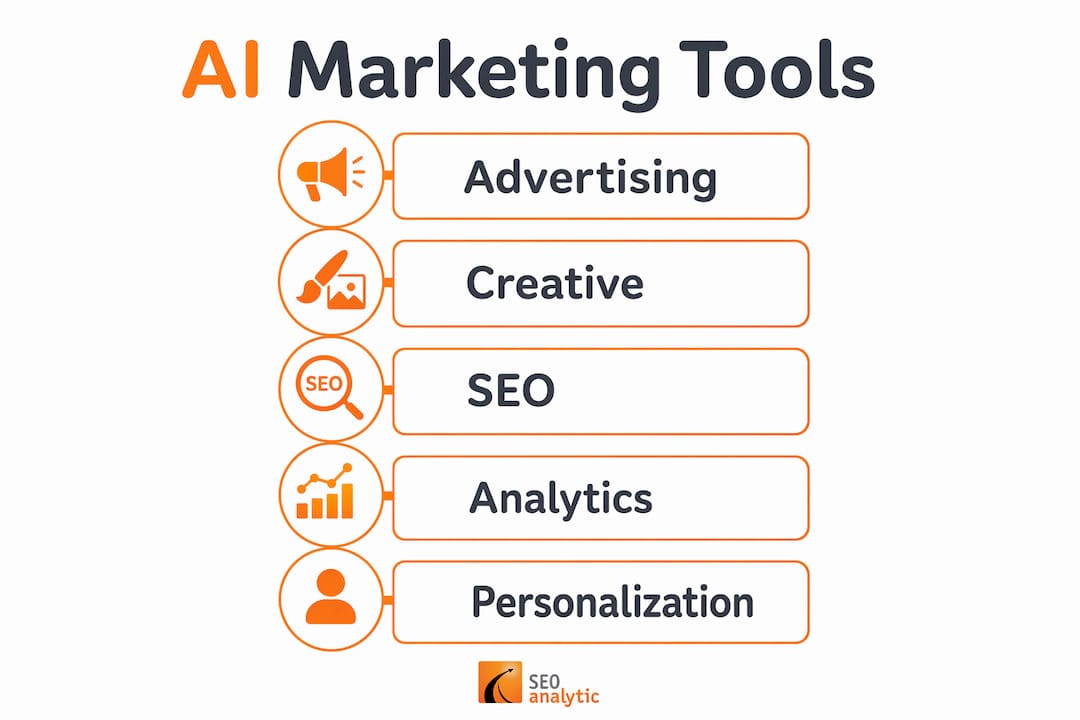
Three technology types do most of the practical work:
Generative AI produces text, images, and video from a prompt or a data input. In marketing, that means ad copy variants, email subject lines, landing page drafts, and social captions. Tools like Jasper and Claude (Anthropic) sit in this category. Jasper is built specifically for marketing workflows, with templates for ads and long-form content; Claude handles nuanced drafting and summarization tasks where tone control matters.
Predictive models use historical data to forecast future behavior. Churn probability, customer lifetime value scoring, next-best-offer logic, and lead scoring all run on predictive machine learning in marketing. Feed your CRM data into a predictive layer and it tells you which leads to call today and which to nurture for six months.
Optimization and agentic systems act on predictions in real time. Automated bidding in Google Ads, dynamic creative optimization in display, and algorithmic send-time selection in email platforms are all examples. These systems close the loop: they observe outcomes, update their models, and adjust behavior without a human touching a dashboard. Surfer SEO and Notion AI represent lighter-weight versions of this in content workflows. Surfer analyzes top-ranking pages and scores your draft against them in real time; Notion AI embeds writing and summarization assistance directly inside project documentation, which cuts the gap between strategy notes and published briefs.
Where AI in online marketing delivers the biggest returns
Not every use case is worth your first pilot dollar. These are the areas where the lift is most consistent and the feedback loop is fastest.
- Programmatic ad optimization. Google Performance Max and Meta Advantage+ are the clearest examples of AI-driven marketing strategies at platform scale. Performance Max feeds your creative assets, audience signals, and conversion goals into Google’s bidding model, which then allocates spend across Search, Display, YouTube, and Gmail automatically. Advantage+ does the same across Meta’s inventory. Most AI advertising activity currently concentrates around AI-generated or AI-adjacent content rather than inside chatbot conversations, which means these platform tools are where the volume is.
- Creative generation and testing. Generative AI cuts the time to produce ad copy variants, email subject lines, and visual concepts from days to hours. The real gain is not speed alone; it is the ability to test ten variants instead of two, which produces better creative data.
- SEO content optimization. AI tools analyze search intent, identify content gaps, and score drafts against ranking signals before you publish. This is one of the highest-ROI uses for teams with limited editorial bandwidth.
- Email personalization. Predictive send-time optimization, dynamic content blocks based on behavioral segments, and AI-generated subject line variants all lift open and click rates without proportional increases in team effort.
- Website personalization. Serving different hero copy, product recommendations, or CTAs based on visitor source, behavior, or CRM status. The input is your existing traffic and CRM data; the output is a higher conversion rate for the same ad spend.
- Chatbots and conversational lead capture. AI-powered chat qualifies leads, books demos, and answers product questions around the clock. The measurable output is a shorter time-to-first-contact and a higher percentage of inbound leads that reach a sales conversation.
- Analytics and insights automation. AI surfaces anomalies, attribution shifts, and audience trends faster than any manual reporting cycle. The practical benefit is catching a broken campaign or a rising segment before the weekly review meeting.
The trade-off across all of these: speed and volume go up, but brand control and quality require active management. Forrester research finds that 37% of marketing leaders cite brand control and quality loss as a top concern, and that number rises when productivity is the only goal driving adoption.
Which AI marketing tool categories should you evaluate?
Think in categories first, then evaluate specific tools. Every category has a different integration footprint and a different risk profile.
Advertising automation platforms
These connect to your ad accounts and manage bidding, budget allocation, and creative rotation. Google Performance Max and Meta Advantage+ are native to their platforms and require no additional subscription. Third-party advertising automation tools typically sit on top of those platforms and add cross-channel reporting, creative management, and rule-based controls. Integration with your CRM is the critical variable: without it, audience signals are weak and personalization is shallow. For a deeper look at how programmatic advertising fits into this stack, Seo-analytic has a full walkthrough.

Creative and generative platforms
Jasper is purpose-built for marketing teams. It connects to brand voice guidelines, supports multi-channel templates (ads, email, blog), and integrates with tools like Surfer SEO for content scoring. Pricing is subscription-based, tiered by seat and output volume. The main integration consideration is your content approval workflow: Jasper produces drafts fast, but without a human review gate, off-brand or inaccurate copy ships.
Claude (Anthropic) is a general-purpose large language model with strong performance on nuanced writing, summarization, and structured reasoning. It does not have native marketing-specific templates, but it handles complex briefs and tone-sensitive copy well. Available via API or the Claude.ai interface; enterprise plans include data privacy controls that matter for U.S. compliance requirements.
Notion AI lives inside Notion workspaces, which makes it useful for teams that already manage briefs, campaign plans, and content calendars there. It drafts, summarizes, and reformats content without switching tools. The limitation is that it is not a publishing or distribution platform; it is a productivity layer.
SEO optimization tools
Surfer SEO scores content against the top-ranking pages for a target keyword, flagging word count, entity coverage, and structural gaps. It integrates with Google Docs and WordPress, which keeps it inside existing editorial workflows. The output is a content brief or a real-time score as you write.
Analytics and attribution platforms
AI-powered analytics tools ingest data from ad platforms, CRM, and web analytics to surface trends, anomalies, and attribution signals automatically. The key evaluation criterion here is data control: where does your customer data go, and who can access it? For attribution methodology, understanding the difference between last-click, data-driven, and incrementality-based models is essential before you trust any AI-generated attribution report.
Personalization engines
These sit between your data layer (CRM, CDP, or data warehouse) and your customer-facing channels (website, email, app). They serve dynamic content based on segment rules or real-time behavioral signals. Scalability is the key differentiator: entry-level tools handle rule-based personalization; enterprise platforms run real-time ML models per visitor.
Conversational AI and chatbots
Evaluate on three dimensions: natural language quality, CRM integration depth, and handoff logic. A chatbot that cannot pass a qualified lead to your CRM with full context is a dead end.
Workflow and agent platforms
These orchestrate multi-step marketing tasks: brief generation, asset creation, review routing, and publishing. They are the newest category and the least standardized. Evaluate carefully for data handling, since agentic systems often access multiple data sources simultaneously.
Selection criteria to apply across every category: primary use case fit, pricing model (subscription vs. per-usage), ease of integration with your existing martech stack and CRM, data control and privacy terms, and scalability as volume grows.
How to design an AI marketing strategy step by step
A pilot that lacks a clear hypothesis produces noise, not signal. Follow this sequence.
- Define the objective and success metric first. Revenue per campaign, CPA reduction, organic session growth, or email-driven LTV uplift. One primary metric, one guardrail metric. Write them down before you touch any tool.
- Audit data readiness. What data sources feed the AI system? Is your CRM tagged consistently? Are conversion events firing correctly in your ad platforms? Do you have privacy consent documentation for the data you plan to use? Gaps here will corrupt outputs.
- Select the pilot scope. One channel, one audience segment, one hypothesis. “If we activate Performance Max with our existing creative assets and conversion data, we expect CPA to drop by 15% versus our current manual campaigns within four weeks.”
- Establish a baseline. Pull four to eight weeks of historical performance data for the same channel and audience. Without a baseline, you cannot measure lift.
- Choose and configure the tool. Match the tool category to the use case. Set data-sharing permissions to the minimum required. Do not connect live customer PII to a public model without reviewing the vendor’s data processing terms.
- Set the test duration and decision criteria. Short tests produce false positives. Four weeks is a minimum for most ad pilots; eight weeks for SEO content. Define in advance what result triggers a scale decision versus a pause.
- Assign a human review gate. Every AI output that reaches a customer should pass through at least one human check before it goes live. This is not optional; the U.S. Small Business Administration explicitly recommends meaningful human review for AI outputs.
- Document the workflow. Write down every step, every approval, every tool login. Only about 20% of organizations have standardized, documented AI workflows, which is the primary reason campaigns stall when the person who set up the pilot leaves or gets pulled to another project.
Pro Tip: Build your pilot checklist before you start: hypothesis, baseline data, tool configuration, test duration, success criteria, human review gate, and a rollback plan. Teams that skip the rollback plan are the ones who end up with a live campaign they cannot turn off cleanly.
From pilot to scale: a practical implementation roadmap
| Phase | Timeline | Key Milestones | Approximate Cost Range | Owner |
|---|---|---|---|---|
| Discovery & data audit | Weeks 1–2 | Data sources mapped, consent documented, baseline pulled | — | Marketing owner + data engineer |
| Tool selection & setup | Weeks 2–3 | Tool configured, integrations tested, review gate established | — | Marketing owner + vendor |
| Pilot launch | Weeks 3–7 | Campaign live, KPIs tracked daily, anomalies flagged | — | Marketing owner |
| Pilot review | Week 8 | Results vs. baseline, scale/pause decision documented | Internal time | Marketing owner + legal/compliance |
| Scale preparation | Weeks 8–12 | Workflow documented, governance policy drafted, team trained | — | All roles |
| Full deployment | Month 4+ | Automated monitoring, regular audits, creative refresh cycle | Varies by channel and volume | All roles |
Cost ranges above are broad estimates for small-to-mid-size U.S. teams. Enterprise rollouts with custom integrations and legal review run significantly higher.
Roles that must be in the room:
- Marketing owner: sets objectives, owns KPIs, approves creative
- Data engineer or analyst: ensures data pipelines, tagging, and privacy compliance
- Legal/compliance: reviews vendor data terms, FTC exposure, and copyright risk
- Creative lead: maintains brand voice standards and runs the human review gate
- Agency or vendor contact: Seo-analytic or your platform rep for configuration and troubleshooting
Before scaling, confirm: governance policy is written, monitoring is automated, a rollback plan exists, and at least one person outside the pilot team has reviewed the workflow documentation.
How to measure whether your AI marketing efforts are actually working
Measurement is where most pilots fall apart. The KPIs are straightforward; the discipline to run tests long enough and cleanly enough is not.
KPIs by use case:
- Paid ads (Performance Max, Advantage+): CPA, ROAS, impression share, and conversion rate by asset group
- Content and SEO: organic sessions, keyword ranking movement, and page-level conversion rate
- Email personalization: open rate, click-to-open rate, and revenue per email sent
- Website personalization: conversion rate lift versus control group, average order value
- Chatbot/lead capture: lead qualification rate, time-to-first-contact, and demo booking rate
Testing methods:
- A/B testing works for email and landing pages where you can split traffic cleanly.
- Holdout groups are the right approach for platform automations like Performance Max, where the platform controls delivery. Run a percentage of your budget on the previous manual setup as a holdout and compare.
- Sequential testing (before/after with a documented baseline) is the fallback when you cannot run a true holdout, but it is more vulnerable to external factors like seasonality.
Attribution inside black-box automations is genuinely hard. Google and Meta’s automated systems optimize toward the conversion signal you give them, but they do not expose the full decision logic. Set a clear baseline before activation, use incrementality tests when budget allows, and treat platform-reported ROAS as directional rather than definitive until you have validated it against your own revenue data.
Pro Tip: Run pilots for at least four weeks before drawing conclusions on paid media, and eight weeks for SEO content. Short windows produce results that look significant but do not hold. A false positive that triggers a premature scale decision is more expensive than a slow, clean test.
Governance, copyright, and privacy: what U.S. marketers must get right
The legal exposure from AI-generated marketing content is real and growing. Advertising attorneys warn explicitly that generative outputs raise copyright infringement, deceptive claims, and potential discrimination risks. Several early AI campaigns were paused or pulled after legal review caught issues that automated systems missed entirely.
Risk checklist every team should run:
- Copyright exposure from generative outputs (training data provenance is not transparent in most commercial models)
- Deceptive or unsubstantiated claims in AI-generated ad copy
- Biased personalization that excludes protected demographic groups from offers or ads
- Data leakage: feeding customer PII or proprietary strategy documents into public model interfaces
Legal and compliance priorities for U.S. teams:
- FTC guidance on endorsements and deceptive advertising applies to AI-generated content. “The AI wrote it” is not a defense.
- State AG activity around AI-generated content and consumer protection is increasing, particularly in California.
- Meaningful human review of every AI output before it reaches a customer is the SBA’s explicit recommendation and the most defensible operational posture.
- 66% of marketing leaders cite compliance, legal, and privacy concerns as a top challenge, which means your legal team is already thinking about this even if your marketing team is not.
Brand control practices:
- Maintain a brand style guide that AI tools are configured against (Jasper supports this natively).
- Build an asset library of approved visuals, copy blocks, and disclaimers that AI systems can draw from.
- Run similarity checks on AI-generated creative before publishing to catch unintentional near-copies of competitor or third-party work.
- Establish a clear escalation path: who approves, who can pause a campaign, and who owns the rollback decision.
Operational mitigations:
- Data minimization: share only the data a tool needs to perform its task.
- Prefer private-model or enterprise-tier options that do not use your inputs to train shared models.
- Implement watermarking or disclosure policies for AI-generated content where platform terms or state law require it.
Pro Tip: Before connecting any AI tool to your CRM or ad account, read the vendor’s data processing agreement. Specifically look for clauses about whether your inputs are used to train shared models. If the answer is yes and you are feeding customer data, that is a compliance problem waiting to happen.
The 2026 U.S. AI marketing landscape: what the data actually shows
$57 billion. That is the projected U.S. AI-powered ad spend for 2026, representing roughly 12% of the entire U.S. ad market and a 63% increase year-over-year.
Adoption is nearly universal at the agency level. 90% of U.S. marketing agencies use generative AI as of Q2 2026, and 81% cite productivity as the primary driver. That last number is the problem. When productivity is the goal, creativity and quality become casualties. Forrester’s research found that many agency leaders warn effectiveness suffers when efficiency is the only lens.
The operational picture is messier than the adoption numbers suggest. Campaigns now routinely involve 10 or more stakeholders, and C-suite approval bottlenecks are a frequent brake on speed. Typeface’s Signal Report found that campaign timelines actually lengthened in 2026 for many organizations, and only a small share have standardized, documented workflows needed to scale AI reliably.
The practical implication: the teams winning with AI in 2026 are not the ones with the most tools. They are the ones who codified their workflows, built governance into the process from the start, and reinvested the time savings from automation back into creative quality rather than just volume. That is the pattern worth copying.
What AI marketing looks like in practice: three micro case studies
Case 1: Paid media automation pilot
A mid-size e-commerce brand running manual Google Shopping campaigns activated Performance Max with their existing product feed and conversion data. Goal: reduce CPA by 15% over four weeks without increasing budget. The team set a holdout group at 20% of spend on the original manual campaigns. After six weeks, the automated campaigns showed a meaningful CPA reduction versus the holdout. The lesson: the holdout group was the critical design choice. Without it, there was no clean way to separate Performance Max’s contribution from seasonal lift.

Case 2: SEO content optimization pilot
A B2B software company used Surfer SEO to score and revise 12 existing blog posts that ranked on page two for target keywords. Each post was revised by a writer using Surfer’s real-time content score, then reviewed by an editor before republishing. Over eight weeks, organic sessions to those pages increased and several posts moved to page one. The lesson: AI-assisted optimization works fastest on content that already has some ranking history. Starting with brand-new pages produces slower signals.
Case 3: Chatbot lead capture pilot
A professional services firm added a conversational AI chatbot to their pricing and services pages. The bot qualified visitors by asking three questions, then routed qualified leads to a calendar booking link and logged the conversation to the CRM. Over 30 days, the share of inbound web visitors who booked a discovery call increased noticeably compared to the prior period. The lesson: the CRM integration was the hardest part technically, but it was also what made the pilot defensible. Without it, the team had no way to track whether chatbot-sourced leads converted differently than form-sourced leads.
Key Takeaways
AI in online marketing works best when you start with one focused pilot, measure against a documented baseline, and build governance into the workflow before you scale.
| Point | Details |
|---|---|
| Start with one channel | Pick ads, email, or SEO for your first pilot; splitting focus across channels makes results unreadable. |
| Governance is not optional | 66% of marketing leaders cite compliance and privacy as a top challenge; build human review gates before launch. |
| Measure with a holdout | Platform automations like Performance Max need a holdout group to produce defensible ROI signals. |
| Codify your workflows | Only about 20% of organizations have standardized AI workflows; document every step before scaling. |
| Seo-analytic as your next step | Seo-analytic designs and runs AI marketing pilots with built-in governance, measurement, and integration support. |
The part most playbooks skip
The $57 billion AI ad spend figure gets cited everywhere. What gets cited less often is what happens to the teams chasing that number without a plan.
The Forrester data is worth sitting with: 90% adoption, 81% productivity focus, and 37% reporting brand control problems. Those three numbers tell a coherent story. When the goal is to do more faster, quality becomes a variable that gets compressed. The teams that end up with off-brand copy, compliance incidents, or campaigns that had to be pulled are not the ones that moved too slowly. They are the ones that moved fast without governance.
The contrarian read on AI in digital advertising is this: the biggest risk in 2026 is not falling behind on adoption. It is adopting fast enough to create a mess that takes longer to clean up than the efficiency gains were worth. The marketers who will look smart in two years are the ones who treated the first pilot as a governance exercise as much as a performance exercise. They wrote down the workflow. They set the human review gate. They measured against a real baseline instead of a platform dashboard. That discipline is less exciting than the technology, and it is exactly what separates durable results from a short-term volume spike.
Seo-analytic helps you run AI marketing pilots that actually produce results
Most teams know they should be using AI in their marketing. The gap is between knowing and having a working pilot with clean measurement, a governance policy, and a path to scale.
Seo-analytic designs and runs AI marketing pilots for U.S. businesses across paid media, SEO, email, and social. The deliverables are concrete: a pilot brief with a documented hypothesis, a baseline measurement report, tool configuration and integration support, a human review workflow, and a post-pilot readout with a scale or pause recommendation. If your team needs a digital marketing foundation before layering in AI, that is where the engagement starts. If you are ready to build the team that runs these programs, Seo-analytic also helps with marketing team structure for AI-era campaigns. Book a free discovery call to scope your first pilot.
Useful sources
Adoption and spend data
- AI-powered ad spend will hit $57 billion in 2026 — eMarketer
- U.S. AI advertising forecast 2026 — eMarketer
- Forrester: Nine in 10 U.S. marketing agencies use AI — Morningstar/Business Wire
- Forrester State of AI Inside U.S. Marketing Agencies — Forrester
Legal and regulatory guidance
- AI use in marketing: legal risks — Law.com / Corporate Counsel
- AI for small business — U.S. Small Business Administration
Practitioner research
- AI promised speed, but complexity is slowing teams down — CustomerThink / Typeface Signal Report
- How to use AI in digital marketing — William & Mary Mason School of Business
Proprietary case studies and additional resources are available on the Seo-analytic website.
FAQ
How is AI used in online marketing?
AI automates bidding, generates creative content, personalizes email and web experiences, scores leads, and surfaces analytics insights. Platform tools like Google Performance Max and Meta Advantage+ are the most widely deployed examples in paid media.
Can I use AI to handle my marketing without an agency?
Yes, for specific tasks. Generative tools like Jasper or Claude handle copy drafts; Surfer SEO guides content optimization. However, governance, data integration, and measurement design typically benefit from experienced oversight, especially for U.S. compliance requirements.
Which AI tools work best for digital marketing?
It depends on the use case. For paid ads, Google Performance Max and Meta Advantage+ are the starting point. For content and SEO, Surfer SEO and Jasper are widely used. For workflow and documentation, Notion AI fits teams already working in Notion. No single tool covers every channel.
How do I start with AI digital marketing if I have no prior experience?
Start with one channel and one hypothesis. Activate a platform automation like Performance Max or Advantage+, set a four-week test window, document a baseline, and measure one KPI. The SBA recommends starting small, protecting sensitive data, and reviewing all AI outputs before they reach customers.
What does AI marketing actually cost to pilot?
A small pilot runs with variable costs depending on channel and team size. Internal time for data audit, configuration, and review adds to that figure. Enterprise rollouts with custom integrations run significantly higher.