On-page SEO is the practice of optimizing the content, HTML elements, and technical components of individual web pages so search engines can understand, rank, and serve them to the right users. Google’s SEO Starter Guide frames the core goal simply: make your content crawlable, readable, and relevant. That has not changed. What has changed is the bar.
In 2026, on-page search engine optimization means satisfying not just Google’s crawlers but also AI systems like ChatGPT and Perplexity, which pull answers directly from web pages. Structured data, entity clarity, and answer-first formatting now determine whether your page gets cited in an AI overview or ignored entirely. The pages winning visibility today are built for both audiences at once.
Here is what effective on-page optimization covers:
- Title tags and meta descriptions that match search intent and drive clicks
- URL slugs that are short, descriptive, and keyword-relevant
- Header tags (H1–H4) that organize content for readers and crawlers
- Keyword placement that is natural, not forced
- Content quality aligned with what users actually want to know
- Internal and external links that build context and authority
- Image optimization covering file size, format, and alt text
- Page speed and mobile responsiveness as direct ranking signals
- Structured data and schema markup for rich results and AI parsing
- HTTPS security as a baseline trust and ranking factor
- Regular content audits to keep pages fresh and accurate
Table of Contents
- How on-page SEO differs from off-page SEO
- Your 2026 on-page SEO techniques checklist
- How AI search is reshaping on-page optimization
- Seo-analytic handles the SEO work you should not be doing alone
- FAQ
- Key Takeaways
How on-page SEO differs from off-page SEO
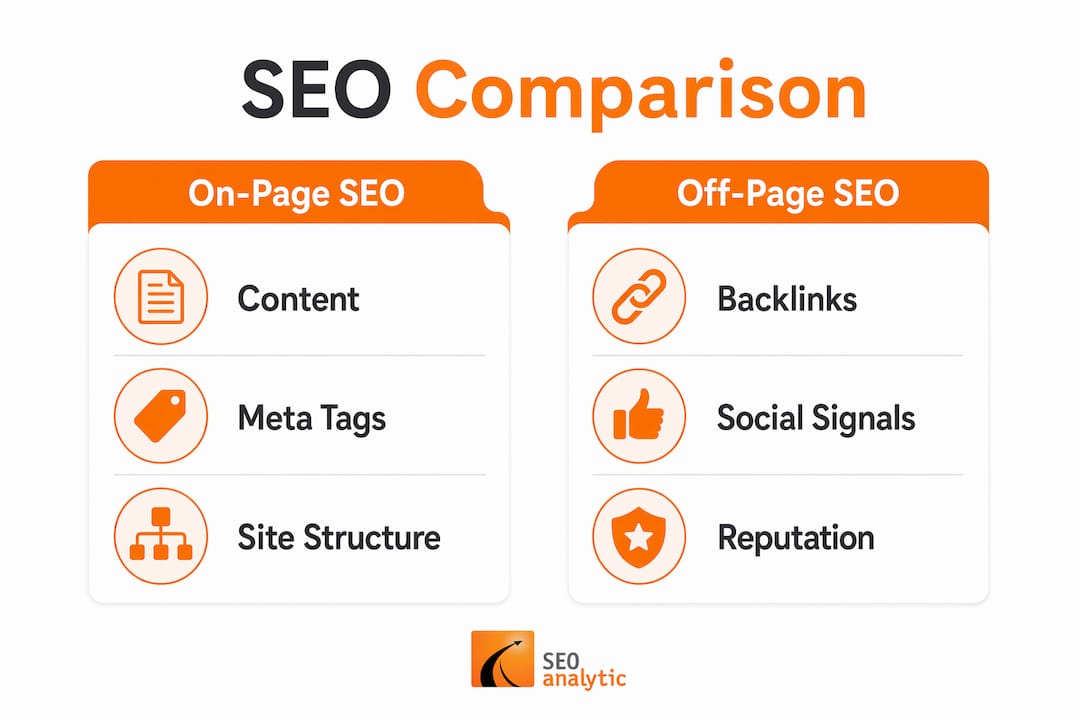
The distinction matters because the two require completely different work. On-page SEO focuses on internal factors you control directly: the words on the page, the HTML structure, the load speed, the links you place. Off-page SEO is everything that happens outside your site, primarily backlinks from other domains, brand mentions, and social authority signals.
Neither works well in isolation. A page with perfect on-site SEO but zero backlinks will struggle to rank for competitive terms. A page with strong backlinks but thin, poorly structured content will lose ground as Google’s quality signals tighten. Think of on-page as the foundation and off-page as the amplifier.
| Factor | On-page SEO | Off-page SEO |
|---|---|---|
| Where it happens | On your own pages | Across external sites and platforms |
| What you control | Fully | Partially or indirectly |
| Core elements | Keywords, meta tags, content, speed, schema | Backlinks, brand mentions, social signals |
| Primary goal | Relevance and crawlability | Authority and trust |
| Time to impact | Faster (days to weeks) | Slower (weeks to months) |
The practical takeaway: start with on-page. You own it completely, and no amount of link building rescues a page that Google cannot read or users do not trust.
Your 2026 on-page SEO techniques checklist
This is where most of the work lives. The checklist below covers every major element, ordered by how they appear in the page-building process.
1. Keyword strategy and placement
Start with strategic keyword research before writing a single word. Target one primary keyword per page and several semantically related terms. Place your primary keyword in the title tag, the H1, the first 100 words of body copy, and at least one subheading. After that, use it where it fits naturally. Google’s spam policies explicitly penalize keyword stuffing, and the meta keywords tag is ignored entirely by Google, so never waste time on it.

2. Title tags
Keep title tags within an optimal length for readability and display in search results. Lead with the primary keyword when it reads naturally. Every page needs a unique title that accurately describes what the page delivers. Vague titles like “Home” or “Services” tell Google nothing and give users no reason to click.
3. Meta descriptions
Meta descriptions do not directly affect rankings, but they drive click-through rates. Write meta descriptions concisely, include the primary keyword, and frame the description as a reason to click rather than a summary. A well-written meta description can boost CTR meaningfully even when your ranking stays the same.
4. URL structure
Short, descriptive slugs outperform long, parameter-heavy URLs. Use hyphens to separate words, include the target keyword, and strip filler words. Compare /blog/on-page-seo-guide versus /blog/post?id=4471&cat=seo&ref=home. The first one tells both users and crawlers exactly what the page covers.
5. Header tags (H1–H4)
Every page gets one H1, and it should match or closely mirror the title tag. Use H2s for major sections and H3s for subsections within those. Headers are not just visual formatting; they give crawlers a map of your content hierarchy. A page with no headers is harder to parse and harder to rank.
6. Content quality and search intent
Google’s core ranking systems reward pages that satisfy the intent behind a query, not just pages that contain the keyword. A searcher typing “on page SEO” wants a practical guide, not a dictionary definition. Write for that person. Cover the topic thoroughly, use examples, and answer the follow-up questions a reader would naturally have. Thin content that technically includes a keyword but leaves users clicking back to search results is a ranking liability.
7. Internal linking
Every page should link to at least two or three related pages on your site using descriptive anchor text. Internal links distribute authority across your site, help crawlers discover new content, and keep users engaged longer. Avoid generic anchors like “click here.” Specific anchors like “keyword research process” tell both users and Google what the linked page covers.
8. External links
Linking out to authoritative sources is not a weakness. It signals to Google that your content is well-researched and connected to the broader web. Link to primary sources, government sites, or recognized industry authorities when you cite a fact. Keep external links to genuinely useful destinations and set them to open in a new tab so users stay on your page.
9. Image optimization
Every image needs three things: a descriptive file name (not IMG_4421.jpg), compressed file size, and an alt tag that describes the image accurately. Alt text serves two purposes: it helps visually impaired users understand the image, and it gives Google additional context about your page’s content. Use modern formats like WebP where possible. Uncompressed images are one of the most common causes of slow page load times.

Pro Tip: Run your images through a compression tool before uploading. A 2 MB hero image that could be 180 KB without visible quality loss is quietly killing your page speed score.
10. Page speed and Core Web Vitals
Google confirms that fast-loading, secure sites improve ranking eligibility and user engagement. Core Web Vitals, specifically Largest Contentful Paint (LCP), Cumulative Layout Shift (CLS), and Interaction to Next Paint (INP), are live ranking signals. Use Google PageSpeed Insights or Lighthouse to identify what is slowing your pages down. Common culprits: render-blocking JavaScript, uncompressed images, and slow server response times.
11. Mobile responsiveness
More than half of all web traffic comes from mobile devices. A page that renders poorly on a phone is not just a bad user experience; it is a ranking disadvantage. Google indexes the mobile version of your site first. If your layout breaks on a 375px screen, your rankings will reflect it. Responsive design is not optional in 2026.
12. Structured data and schema markup
Schema markup from schema.org tells search engines exactly what your content means, not just what it says. Mark up articles, FAQs, products, reviews, and local business information. Rich results like star ratings, FAQ dropdowns, and breadcrumbs come directly from schema. Beyond traditional search, structured data helps AI systems parse and cite your content accurately.
13. HTTPS and site security
HTTPS has been a Google ranking signal since 2014. In 2026, it is simply the baseline. A site without an SSL certificate will display a “Not Secure” warning in Chrome, which kills user trust before they read a single word. Secure website hosting that includes SSL by default removes this risk entirely.
14. Content auditing and updating
A page published two years ago and never touched is losing ground to fresher competitors. Schedule quarterly audits of your top-performing pages. Update statistics, refresh examples, fix broken links, and expand sections where search intent has shifted. Google’s freshness signals reward pages that are actively maintained, especially for topics where information changes frequently.
How AI search is reshaping on-page optimization
Traditional SEO gets your page into the blue-link results. Generative Engine Optimization (GEO) gets your page cited inside AI-generated answers. Those are two different outcomes, and in 2026 both matter.
GEO is the practice of structuring content so that AI systems like ChatGPT, Perplexity, and Google’s AI Overviews can extract, understand, and attribute your content when answering user queries. The shift is significant: instead of a user clicking your link, an AI reads your page and quotes it. If your content is not structured for that kind of extraction, you are invisible in that channel.
The core insight: A significant portion of GEO tactics overlap with traditional SEO, but the emphasis shifts toward structured data, entity clarity, and citation-friendly formats. You are not rebuilding your SEO strategy; you are extending it.
The practical difference shows up in a few specific areas. AI systems favor pages that define their subject clearly and early. Placing a concise entity definition directly under the H1 is one of the highest-impact GEO tactics available. It gives the AI a clean, quotable answer to “what is this page about?” without requiring it to infer from scattered paragraphs.
AI Overviews and featured snippets reward pages with direct answers and structured evidence. Tables, numbered lists, and FAQ sections are not just user-friendly formatting choices; they are the formats AI systems are most likely to extract and cite. A wall of prose, however well-written, is harder for a language model to parse into a clean answer.
One technical note worth knowing: FAQ rich results were deprecated in 2026, meaning FAQPage schema no longer generates the expandable FAQ dropdowns in Google search results. However, FAQPage schema remains valuable for AI parsing. Keep it in place. The benefit has shifted from visual SERP features to AI extraction, but the markup still earns its keep.
Core GEO techniques to layer into your on-page SEO work:
- Entity definition block: 40–50 words under the H1 defining the page’s subject clearly
- FAQPage schema: maintained for AI extraction even without rich-result display
- Answer-first structure: lead every section with the direct answer, then expand
- Structured evidence: tables, numbered lists, and named statistics over narrative prose
- llms.txt file: a plain-text file in your root directory that tells AI crawlers which pages to prioritize
- Citation-friendly statistics: sourced figures with inline links that AI systems can attribute
- Named entities: specific tools, standards, and organizations rather than vague references
The future of SEO is not a choice between ranking for humans and being cited by AI. The pages that do both share the same qualities: clear structure, authoritative content, and precise language. Build for that standard and both channels follow.
Seo-analytic handles the SEO work you should not be doing alone
Getting on-page SEO right across an entire website is genuinely time-consuming. Auditing every page, fixing technical issues, updating content, implementing schema, and keeping up with AI search changes is a full-time job on top of running a business.
Seo-analytic is a US-based digital marketing agency that handles exactly this. The team covers full SEO strategy from technical audits and on-page optimization to content updates and structured data implementation—all without locking clients into long-term contracts. For business owners who want their site to rank and convert without spending months learning the technical details, Seo-analytic provides the expertise and execution. The agency also builds and optimizes websites from the ground up, so if your current site has structural problems that no amount of on-page tweaking will fix, that path is available too. Check out the website building guide to see what a properly optimized site looks like from the start, or contact Seo-analytic directly to get a site audit.
FAQ
What is on-page SEO?
On-page SEO is the process of optimizing individual web pages, including their content, HTML tags, images, and technical elements, to improve search engine rankings and user experience. It covers everything from keyword placement and title tags to page speed and structured data.
How does on-page SEO differ from off-page SEO?
On-page SEO involves factors you control directly on your own pages, such as content, meta tags, and site structure. Off-page SEO refers to external signals like backlinks and brand mentions that build your site’s authority in the eyes of search engines.
What is onsite vs. offsite SEO?
Onsite SEO (another term for on-page SEO) covers optimization work done within your own website. Offsite SEO covers reputation-building activities outside your site, primarily earning links and mentions from other authoritative domains.
What are the three core components of on-page SEO?
The three core components are content quality and keyword relevance, technical HTML elements (title tags, meta descriptions, header tags, schema markup), and page performance factors including speed, mobile responsiveness, and HTTPS security.
Key Takeaways
Effective on-page SEO in 2026 requires optimizing content, technical HTML elements, and page performance while extending those same practices to satisfy AI-driven search systems through structured data and entity-clear formatting.
| Point | Details |
|---|---|
| On-page vs. off-page scope | On-page SEO covers everything you control on your own pages; off-page covers external authority signals. |
| AI search requires GEO | 70% of GEO tactics overlap with traditional SEO, but structured data and entity clarity become the priority. |
| Schema markup still matters | FAQPage schema no longer generates rich results but remains valuable for AI extraction and content parsing. |
| Speed and mobile are non-negotiable | Google indexes the mobile version first; Core Web Vitals (LCP, CLS, INP) are live ranking signals. |
| Seo-analytic for full execution | Seo-analytic provides end-to-end on-page SEO and website optimization for US businesses without long-term contracts. |