
An SEO marketer is a specialist who improves a website’s organic search visibility through keyword research, technical audits, content optimization, link building, and performance tracking. The role has shifted well beyond task execution. According to Ahrefs, the modern SEO specialist is accountable for growing organic visibility and, ideally, organic revenue, not just completing a checklist. That accountability distinction separates the practitioners who advance from those who plateau.
Core functions of an SEO marketer include:
- Keyword research: Identifying search terms that connect a business to its audience
- Technical SEO: Auditing site architecture, crawlability, page speed, and structured data
- On-page optimization: Crafting title tags, meta descriptions, headers, and internal links
- Content strategy: Planning and optimizing content that ranks and converts
- Link building: Acquiring authoritative backlinks to strengthen domain authority
- Performance monitoring: Tracking rankings, traffic, and conversions through tools like Google Search Console and Ahrefs
- Reporting: Translating data into business impact for stakeholders
Why SEO matters more than most businesses realize
Organic search is the only marketing channel that compounds. Paid ads stop the moment the budget runs out. SEO builds equity over time, and a well-ranked page can generate traffic for years without additional spend. That cost efficiency is why businesses of every size treat organic search as a core acquisition channel, not a nice supplement to paid advertising.
Search engines, particularly Google and Bing, update their ranking algorithms constantly, and each update reshapes what works. The rise of AI-generated search results, including Google’s AI Overviews and Perplexity, has added a new layer of complexity. Businesses that invested in authoritative, well-structured content before these changes arrived are capturing the citations that AI systems pull from. Those that did not are watching traffic erode.
Pro Tip: Align your SEO investment with how your customers actually search, not just how they searched two years ago. Voice queries, AI Overviews, and zero-click results have changed the intent signals that matter most. An SEO strategy built around evolving search behaviors will outperform one built around static keyword lists.
What does an SEO marketer actually do day to day?
Analysis of 52 SEO specialist job listings reveals the most common responsibilities and how frequently they appear:
| Responsibility | Frequency in job listings |
|---|---|
| Keyword research | appears in nearly all listings |
| SEO performance monitoring and analysis | appears in most listings |
| On-page and content optimization | found in a majority |
| Reporting | appears in over half |
| Technical SEO | appears in over half |
| Collaborating with other teams | found in over half |
| Staying current with SEO trends and Google updates | appears in over half |
| Developing an SEO strategy | found in more than half |
| Link building | appears in over half |

The breadth here is telling. Some listings even include conversion rate optimization and PPC responsibilities. An SEO marketer’s actual scope can extend into UX, content strategy, and developer coordination, depending on the organization.
Collaboration is built into the role. SEO marketers work with content creators to brief and optimize articles, with developers to implement technical fixes, and with marketing managers to align organic goals with broader campaign objectives. Strong communication skills appear in the majority of job descriptions, reflecting how much of the job involves translating SEO findings into language that non-technical stakeholders can act on.
Key daily and weekly tasks typically include:
- Running crawl audits using tools like Screaming Frog or Google Search Console
- Researching keyword opportunities and mapping them to site architecture
- Reviewing keyword research findings and updating content briefs
- Monitoring rank tracking dashboards for movement after algorithm updates
- Building or reviewing backlink profiles and identifying outreach targets
- Preparing monthly performance reports tied to traffic, leads, or revenue
How does an SEO marketer differ from other digital marketing roles?
The confusion is understandable. Titles overlap, and many organizations use them interchangeably. Here is where the real distinctions sit:
- SEO marketer vs. digital marketer: A digital marketer covers the full channel mix, including paid search, social media, email, and display. An SEO marketer focuses specifically on organic search. The digital marketer owns the broader strategy; the SEO marketer owns the organic slice of it.
- SEO marketer vs. SEO manager: An SEO manager typically leads a team, owns the overall SEO roadmap, and reports to senior leadership. An SEO marketer (or specialist) executes within that roadmap. At smaller companies, one person does both.
- SEO marketer vs. content strategist: A content strategist plans what content to create and for whom. An SEO marketer ensures that content is structured, optimized, and positioned to rank. The roles overlap heavily, which is why many job listings now combine them.
- SEO marketer vs. PPC specialist: PPC specialists manage paid placements on Google Ads and similar platforms. SEO marketers focus on earning unpaid rankings. Both feed the same funnel, which is why collaboration between them produces better results than either working in isolation.
- SEO marketer vs. SEO consultant: A consultant typically works independently across multiple clients, advising on strategy rather than executing daily tasks. An in-house SEO marketer owns execution for a single organization.
Understanding these distinctions matters when you are building a digital marketing team or deciding which role to hire first.
What skills do you need to succeed as an SEO marketer?
The skill set has two layers: the technical foundation that gets you hired, and the analytical and communication skills that get you promoted.
Technical and foundational skills:
- Keyword research and search intent analysis
- On-page SEO, including title tags and meta descriptions, header structure, and internal linking
- Technical auditing: site speed, crawlability, mobile-friendliness, structured data
- Link building and digital PR outreach
- Familiarity with Google Search Console, Google Analytics 4, and Ahrefs
Analytical and reporting skills:
- Data interpretation from GA4, Looker Studio, and rank tracking platforms
- Connecting organic traffic to revenue and pipeline, not just rankings
- Employers increasingly expect SEO professionals to interpret complex data sets and demonstrate measurable business impact
Communication and collaboration skills:
- Writing clear briefs for content teams
- Presenting findings to non-technical stakeholders
- Managing cross-functional projects with developers and product teams
AI and automation skills:
- Building automated reporting workflows in tools like Zapier or Make
- Understanding how AI Overviews and LLM-based search products surface content
- Prompt engineering as a baseline, with system-building as the differentiator
Pro Tip: AI fluency is now the fastest way to separate yourself from the field. Over 54% of SEO job descriptions include AI-related keywords, and candidates who can build automated workflows command a substantial salary premium. Start with one automation project you can document and show.
What can you earn as an SEO marketer, and where is the career headed?

The salary picture in 2026 is sharply bifurcated. Senior roles are paying more than ever. Entry-level roles are shrinking as AI absorbs routine tasks like basic keyword research and meta-tag generation.
The median SEO salary in the US is approximately $83,629, with senior roles earning substantially more. In-house positions pay a premium of about $16,000 more than agency roles on average. Currently, a majority of SEO openings are in-house positions.
AI search expertise commands the biggest premium right now. Job postings combining “AI” and “SEO” have increased significantly year over year, and roles requiring GEO or AEO skills pay notably more than equivalent traditional SEO titles. Standalone AI search roles like “GEO Lead” or “AI Visibility Manager” are appearing at SaaS companies and media organizations with dedicated pay bands.
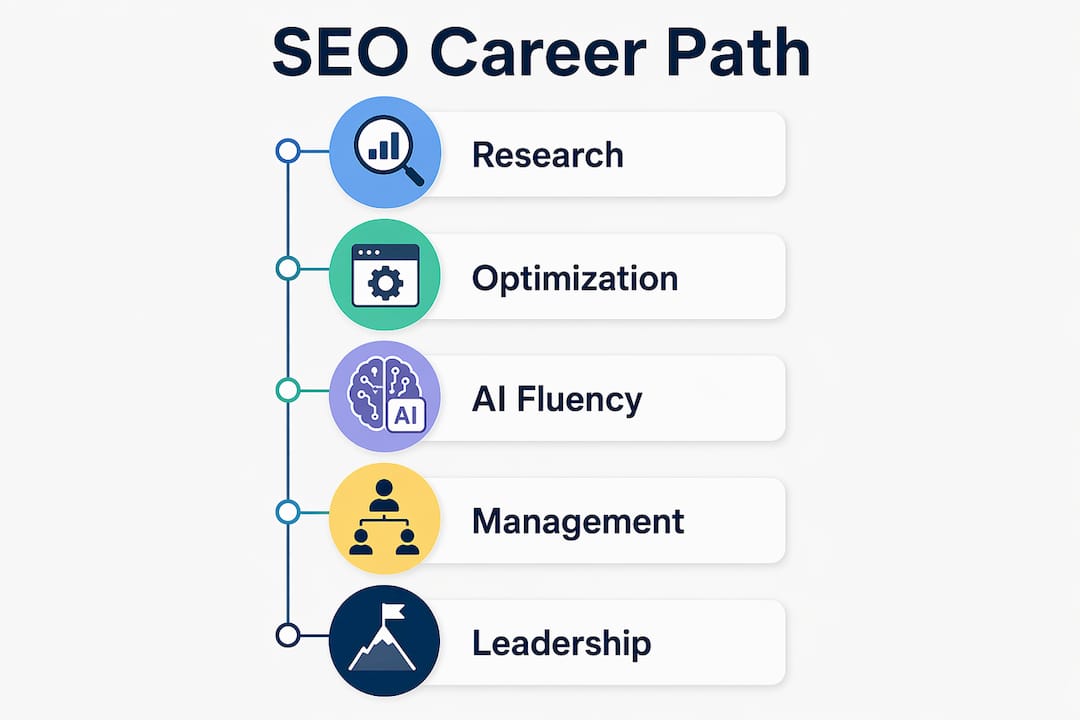
Career paths typically follow this progression: SEO Specialist or Analyst, then SEO Manager (where the biggest compensation jump occurs), then SEO Director, and eventually Head of SEO or VP of Organic Growth. The VP level at well-funded SaaS companies commands a high median base pay, with total compensation packages exceeding that figure when equity is included.
What education and certifications do SEO marketers need?
The good news: formal education requirements are lighter than most people expect. over half of SEO specialist job listings do not ask for a college degree at all. For those that do, the typical ask is a bachelor’s in marketing, communications, business, or information technology. A significant portion of working SEO specialists hold a bachelor’s degree, according to Coursera’s analysis of Zippia data, but the degree field matters less than demonstrated skill.
Certifications carry real weight, particularly for candidates without a traditional marketing background. Useful credentials include:
- Google Analytics 4 Certification (free, from Google)
- Google Search Console training (free, from Google)
- HubSpot Content Marketing Certification (free, widely recognized)
- Coursera and LinkedIn Learning SEO courses (affordable, self-paced)
Building a personal website and optimizing it for real search traffic is worth more than most certifications. It demonstrates hands-on experience with content management systems like WordPress, rank tracking, and the full SEO workflow. Hiring managers consistently cite a live portfolio over a certificate when evaluating candidates.
For career changers, an internship at an SEO agency provides structured training across multiple industries and client types, which is harder to replicate in an in-house role where you may be the only SEO practitioner on staff.
How do you measure whether SEO is actually working?
Rankings are a leading indicator, not the result. The metrics that matter most connect organic search activity to business outcomes.
Traffic metrics: Organic sessions and new users from search, tracked in GA4. Look at trends over 90-day periods, not week to week, to separate signal from noise caused by algorithm fluctuations.
Ranking metrics: Average position and click-through rate from Google Search Console, segmented by page and query. A page ranking in position 4 with a 12% CTR is performing differently than one in position 4 with a 3% CTR, and that gap usually points to a title tag or meta description problem.
Conversion metrics: Organic goal completions, form fills, purchases, or trial signups attributed to organic traffic. This is the number that earns budget and headcount. Connecting organic to revenue is the single most-cited high-value skill by hiring managers in 2026.
Technical health metrics: Core Web Vitals scores, crawl error rates, index coverage, and page speed. These are the inputs that determine whether Google can even surface your content.
Authority metrics: Domain rating, referring domain count, and the quality of inbound links tracked through tools like Ahrefs. Link growth is slow but directionally important over six-month windows.
Reporting cadence matters as much as the metrics themselves. Monthly reports tied to business KPIs, not just ranking tables, are what move SEO from a cost center to a growth function in the eyes of leadership.
What challenges do SEO marketers face, and how do they handle them?
Algorithm volatility is the most persistent challenge. Google updates its core algorithm multiple times per year, and a single update can move a site’s traffic by 30% or more in either direction. The defense is building for quality and user intent rather than for any specific ranking signal. Sites that prioritize genuine helpfulness and strong technical foundations tend to recover faster from updates than those optimized around narrow tactics.
Proving ROI remains difficult because the attribution chain from organic search to revenue is rarely clean. A user might discover a product through an organic blog post, leave, return via a branded search, and convert through a paid ad. The SEO contribution gets lost. The solution is to use assisted conversion reporting in GA4 and to build a consistent narrative around organic’s role in the top-of-funnel, even when last-click attribution undervalues it.
AI-generated content competition has flooded search results with low-quality pages, making it harder to rank with thin content but easier to stand out with genuine depth and original research. SEO marketers who can commission or produce genuinely useful content have an advantage.
Cross-functional friction is common. Developers deprioritize SEO fixes. Content teams resist keyword briefs. The SEO marketer who learns to frame requests in terms of business impact rather than ranking theory gets faster buy-in. “This fix will recover an estimated 15% of crawled pages that are currently returning errors” lands better than “we need to fix our canonical tags.”
Keeping up with AI search is the newest pressure. GEO and AEO are not optional specializations anymore; they are becoming baseline expectations at companies that take organic seriously. SEO marketers who understand how to structure content for AI citation, not just for traditional blue-link rankings, are positioned ahead of the field.
Key Takeaways
An SEO marketer’s value to a business is measured in organic revenue, not just rankings, and the role demands both technical depth and strategic communication.
| Point | Details |
|---|---|
| Core responsibilities | Keyword research leads at a large majority of job listings, followed by performance monitoring and on-page optimization. |
| Salary range | The US median sits at approximately $83,629, with senior roles earning substantially more; in-house positions pay a premium of about $16,000 more than agency roles. |
| AI skills premium | Candidates with advanced AI and automation skills command up to a 30% salary premium over peers at the same level. |
| In-house advantage | — |
| Career trajectory | The biggest compensation jump occurs at the SEO Manager level. |
FAQ
What does an SEO marketer do?
An SEO marketer improves a website’s organic search rankings through keyword research, technical audits, content optimization, link building, and performance reporting. The role is accountable for growing organic traffic and, increasingly, organic revenue.
What is the average SEO salary in the US?
The median SEO salary in the US is approximately $83,629, with senior roles earning substantially more; in-house positions pay a premium of about $16,000 more than agency roles on average.
Is SEO a high-paying career?
Yes, particularly at senior and in-house levels. VP-level roles at well-funded SaaS companies command a high median base pay, with total compensation packages exceeding that figure when equity is included. AI search expertise commands the biggest premium right now, with roles requiring related skills paying notably more than equivalent traditional SEO titles.
Do you need a degree to become an SEO marketer?
Not necessarily. Over half of SEO specialist job listings do not require a college degree. Demonstrated skills, a live portfolio, and hands-on experience with tools like Google Search Console and Ahrefs carry more weight than a specific credential.
How is AI changing the SEO marketer role?
AI is absorbing routine tasks like basic keyword research and meta-tag generation, which is shrinking entry-level roles. At the same time, demand for SEO marketers who can build automated workflows, optimize for AI Overviews, and apply GEO and AEO strategies is growing fast, with over 54% of job descriptions now including AI-related requirements.