

Most startups treat sales and marketing like two separate departments with two separate agendas. Marketing generates leads. Sales closes deals. And somewhere in between, opportunities fall through the cracks. The disconnect is costly, not just in wasted budget, but in missed revenue and slower growth. Smarketing, the practice of aligning your sales and marketing teams around shared goals and processes, changes that equation entirely. In this guide, you’ll learn exactly what smarketing is, why it matters more for startups than any other type of business, and how to put it into practice starting today.
Table of Contents
- What is smarketing? The basics explained
- Why startups need smarketing: Key challenges and opportunities
- Essential components of a successful smarketing strategy
- Implementing smarketing in your startup: Steps and real-world tips
- The real truth about smarketing: What most guides skip
- Ready to accelerate your growth? Explore powerful marketing solutions
- Frequently asked questions
Key Takeaways
| Point | Details |
|---|---|
| Smarketing defined | Smarketing is the integration of sales and marketing with shared goals and collaboration. |
| Startup benefits | Aligning these teams directly boosts lead quality, win rates, and growth for startups. |
| Key practices | Success depends on joint KPIs, clear processes, shared tech, and continuous communication. |
| Implementation tips | Start with small process changes, use real-time data sharing, and adjust as your business evolves. |
| Long-term commitment | True smarketing requires ongoing leadership support and day-to-day discipline. |
What is smarketing? The basics explained
Smarketing is a blend of the words “sales” and “marketing,” but it’s more than a clever portmanteau. It describes a strategy where both departments operate as one unified function, sharing goals, data, and accountability rather than working in parallel silos. According to HubSpot’s smarketing guide, smarketing integrates sales and marketing for shared goals, communication, and metrics.
In a traditional setup, marketing hands off a list of leads and considers its job done. Sales then complains the leads are low quality. Marketing pushes back that sales isn’t following up fast enough. Sound familiar? This friction wastes time, burns budget, and creates a blame culture that slows everyone down.
Smarketing fixes this by establishing a formal structure where both teams collaborate from the start. Here’s what that typically includes:
- Joint goal setting: Both teams agree on revenue targets and pipeline milestones together.
- Shared lead definitions: A “qualified lead” means the same thing to everyone, no more guessing.
- Regular alignment meetings: Weekly or bi-weekly syncs keep both sides informed and accountable.
- Unified data access: Both teams can see the same CRM data, campaign results, and sales outcomes.
- Aligned KPIs: Success is measured by shared metrics, not siloed department scorecards.
For startups specifically, smarketing is a force multiplier. You’re working with limited headcount and tight budgets, so every misalignment costs more than it would at a large enterprise. Pairing smarketing with a solid marketing automation guide can dramatically reduce manual handoffs between teams. And if you’re still building your go-to-market approach, reviewing startup marketing strategies alongside smarketing principles gives you a strong foundation.
Pro Tip: Before your first alignment meeting, get both teams to agree on a single definition of a “qualified lead.” This one conversation eliminates more friction than any tool or process you’ll ever implement.
Why startups need smarketing: Key challenges and opportunities
Now that you know what smarketing is, it’s vital to understand why it’s especially important for fast-moving startups. Startups operate in a constant state of change. Targets shift quarterly, team roles blur, and resources are always stretched thin. In that environment, misalignment between sales and marketing isn’t just annoying, it’s actively dangerous.
When marketing runs campaigns without input from sales, they often attract the wrong audience. When sales closes deals without feeding insights back to marketing, campaigns keep missing the mark. The result is a leaky funnel that burns cash and stalls growth.
The numbers back this up. Startups with aligned sales and marketing saw 36% higher customer retention and 38% higher sales win rates, according to the LinkedIn State of Sales Report.
“Alignment isn’t a nice-to-have for startups. It’s the difference between scaling and spinning your wheels.”
Here’s a side-by-side look at how traditional and smarketing-driven startups compare:
| Factor | Traditional startup | Smarketing-driven startup |
|---|---|---|
| Meeting frequency | Rarely, if ever | Weekly joint syncs |
| Goal setting | Separate department goals | Shared revenue targets |
| Data sharing | Siloed systems | Unified CRM and dashboards |
| Lead accountability | Passed off, then forgotten | Tracked end-to-end |
| Feedback loops | Informal or nonexistent | Structured and regular |
To overcome the most common startup obstacles, follow these steps:
- Audit your current lead handoff process to find where leads are getting lost.
- Set shared revenue goals that both teams are responsible for hitting.
- Create a single source of truth for pipeline data that everyone can access.
- Build a feedback loop where sales shares what’s working and what isn’t with marketing.
Pairing this with clear setting marketing goals practices and a well-mapped marketing funnel gives your smarketing effort a real structural backbone.
Essential components of a successful smarketing strategy
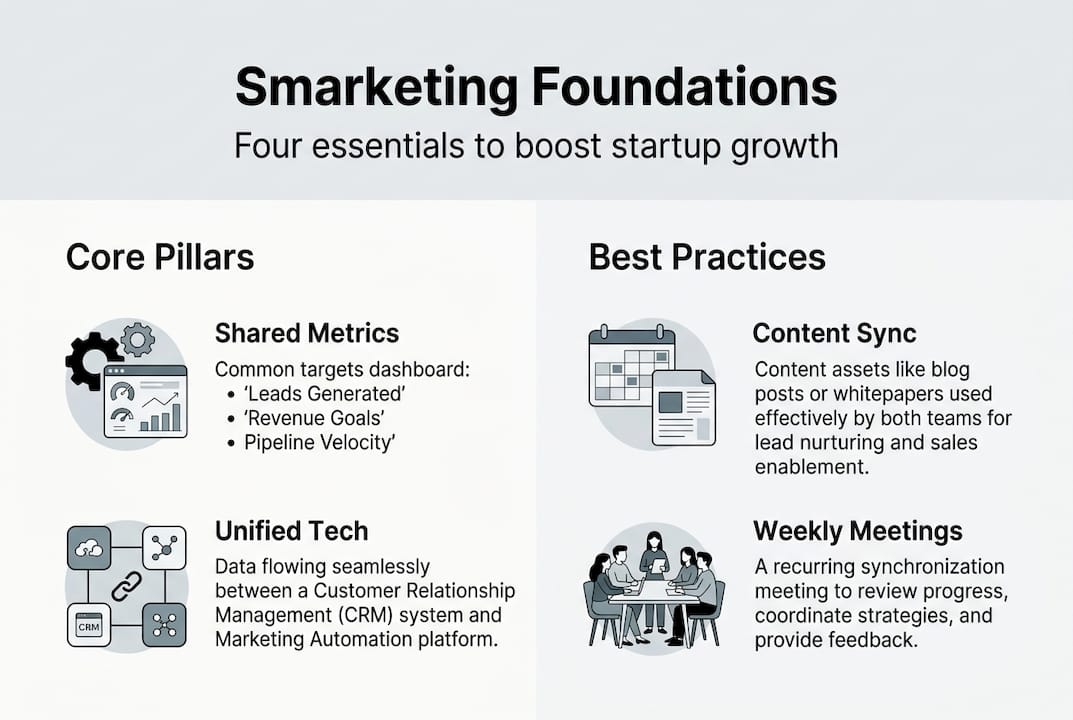
So, what does great smarketing actually look like in practice? It comes down to four core pillars that every startup should build into their operations.
Shared KPIs and metrics. Both teams need to agree on what success looks like. That means defining qualified leads, revenue targets, pipeline stages, and conversion rates together. When both sides are measured by the same outcomes, the incentive to collaborate becomes obvious.
Content collaboration. Marketing shouldn’t create content in a vacuum. Sales knows exactly what questions prospects ask, what objections they raise, and what content actually moves deals forward. Regularly shared metrics increase alignment and accelerate pipeline velocity, and co-developed content is one of the fastest ways to put that into practice.

Unified tech stack. If marketing is using one platform and sales is using another, alignment is nearly impossible. Here’s a quick look at the tools that support smarketing and what each one does:
| Tool type | Role in smarketing | Example use |
|---|---|---|
| CRM | Central lead and deal tracking | Shared pipeline visibility |
| Marketing automation | Lead nurturing and scoring | Trigger emails based on behavior |
| Analytics dashboard | Real-time performance data | Joint KPI monitoring |
| Communication platform | Cross-team collaboration | Shared Slack channels or project boards |
Exploring the right digital marketing tools for your stack is worth the time investment. And once you’re aligned, marketing personalization examples can show you how to make your joint campaigns far more effective.
Consistent communication. Weekly alignment meetings don’t need to be long. Thirty minutes with a clear agenda covering pipeline updates, lead quality feedback, and upcoming campaigns is enough to keep both teams moving in the same direction.
Pro Tip: Build a shared dashboard that both teams can see in real time. Visibility creates accountability without anyone needing to chase down a report.
Implementing smarketing in your startup: Steps and real-world tips
Turning theory into action, here’s how you can put smarketing into place right away.
- Define your shared language. Start with a service level agreement (SLA) between sales and marketing. This document spells out exactly what each team commits to: how many leads marketing will deliver, what qualifies as a sales-ready lead, and how quickly sales will follow up.
- Set joint goals. Bring both teams into the goal-setting process. Revenue targets, lead volume, and win rate benchmarks should be co-owned, not handed down from leadership to each team separately.
- Build your alignment meeting cadence. Weekly syncs work best for most startups. Keep them short, structured, and focused on data, not opinions.
- Create shared workflows. Map out the exact process a lead follows from first contact to closed deal. Identify every handoff point and assign clear ownership.
- Establish feedback loops. Sales should report back to marketing on lead quality weekly. Marketing should share campaign performance with sales just as regularly. Continuous feedback and iteration strengthens sales-marketing alignment over time.
Common pitfalls to avoid include unclear ownership (nobody knows who’s responsible for a stuck lead), lack of leadership buy-in (alignment dies without top-down support), and treating smarketing as a one-time project rather than an ongoing practice.
A practical example: one B2B software startup implemented weekly smarketing syncs and a shared CRM dashboard. Within one quarter, their sales win rate increased by 20%, simply because sales started getting better-qualified leads and marketing started hearing what actually converted.
A yearly marketing plan template can help you structure your smarketing goals across the full year, while a solid content calendar keeps both teams coordinated on campaigns.
Pro Tip: Revisit your shared definitions and goals every quarter. As your startup evolves, what counts as a qualified lead or a priority segment will change, and your smarketing framework needs to keep up.
The real truth about smarketing: What most guides skip
Here’s what we’ve seen working with startups across different industries: most teams read a guide like this, get excited, run one alignment meeting, and then quietly slide back into their old habits within a month. That’s not a failure of strategy. It’s a failure of commitment.
Smarketing surfaces uncomfortable truths. When you put sales and marketing in the same room with the same data, you’ll quickly discover conflicting incentives, territorial behavior, and gaps in accountability that nobody wanted to admit existed. That discomfort is actually the point. It means the process is working.
The teams that get the best results from smarketing are the ones where leadership doesn’t just endorse alignment, they model it. When your CEO or VP of Growth sits in on joint meetings and holds both sides accountable to shared outcomes, the culture shifts fast.
Most guides also miss what we call the “last mile” problem. You can have perfect SLAs, beautiful dashboards, and weekly meetings, but if the day-to-day actions of individual reps and marketers don’t reflect the strategy, none of it matters. Alignment has to live in the habits of your team, not just in your documentation. Revisiting your startup marketing strategies regularly keeps those habits sharp and relevant as your business grows.
Ready to accelerate your growth? Explore powerful marketing solutions
With a solid understanding of smarketing, you’re ready to use the right tools and resources to succeed. Bridging the gap between sales and marketing is one thing. Having the right digital infrastructure to support that alignment is another.

At our agency, we help startups build the digital foundation that makes smarketing actually work. From selecting and integrating the best digital marketing tools to building a social media marketing presence that feeds your pipeline, we offer hands-on support at every stage. If you’re also looking to strengthen your online presence from the ground up, our website building guide is a great place to start. Let’s build something that grows.
Frequently asked questions
How does smarketing differ from traditional sales and marketing?
Smarketing unites both teams with shared goals, constant communication, and aligned metrics, while traditional teams work in separate silos with separate scorecards and minimal overlap.
What’s the biggest barrier to sales and marketing alignment at startups?
The main barrier is the absence of shared goals and structured communication. Misaligned teams waste both budget and growth opportunities that are very hard to recover once lost.
How do you measure the success of smarketing?
Track joint KPIs like qualified lead volume, revenue growth, and sales cycle length. Shared metrics drive both alignment and faster pipeline movement over time.
Is smarketing only for large companies?
Not at all. Smarketing is especially valuable for startups and small businesses where every resource counts. Startups benefit from alignment just as much as large firms, often more because the cost of misalignment hits harder at smaller scale.
What tools help support smarketing?
Shared CRM platforms, marketing automation software, and joint analytics dashboards are the core tools. Unified tech stacks accelerate alignment and make cross-team collaboration far more consistent and measurable.