
TL;DR:
- Remote work productivity depends on building skills to protect focus hours and creating ergonomic work environments.
- Transparency in monitoring and deliberate routines further enhance remote performance and well-being.
Work from home productivity is defined as the measurable output a remote worker generates per hour of focused effort, not per hour logged. 77% of remote employees report higher productivity at home compared to traditional office environments. That number is striking, but it masks a critical truth: the gains belong to workers who design their days with intention. Remote work productivity is a skill you build, not a benefit you automatically receive. The strategies below are grounded in 2026 research and focus on what actually moves the needle: deep focus hours, ergonomic environments, team dynamics, and sustainable routines.
1. How to protect deep focus hours for maximum work from home productivity
Deep focus hours are the core unit of remote work efficiency. Top remote performers track actual deep focus time rather than total desk hours, and research shows 3–4 hours of high-cognitive output per day is both typical and sufficient for strong results. Logging eight hours of fragmented attention produces far less than four hours of uninterrupted work.
The first step is measuring your focus time honestly. Use a simple time-tracking method: log when you start a focused task, note every interruption, and record when you stop. After one week, you will see your real productive window clearly.
Time-blocking is the most reliable method for protecting that window. Assign your highest-priority work to the same two or three hour block every morning before checking email or messages. Treat that block as a meeting you cannot cancel.
- Identify your peak hours. Most people think most clearly in the late morning. Test your own pattern for one week before committing to a schedule.
- Turn off all notifications during focus blocks. Slack, email, and phone alerts are the leading cause of fragmented work sessions.
- Use a visible signal. A closed door, headphones, or a status indicator tells others you are unavailable without requiring a conversation.
- Batch shallow tasks. Schedule email replies, admin work, and routine calls in a single afternoon block rather than scattering them throughout the day.
- Review your focus log weekly. Patterns of distraction repeat. Identifying them once lets you fix them permanently.
Remote work productivity depends on deliberate routines replacing office structure. Without intentional scheduling, the default is reactive work, which feels busy but produces little.
Pro Tip: Set a recurring calendar block labeled “Deep Work” and decline all meeting requests that overlap with it. Most colleagues will respect a visible commitment.
2. Essential home office setups that enhance productivity and comfort
Your physical environment directly shapes your output. Ergonomic home offices with visual separation, acoustic control, and proper lighting solve 90% of comfort and productivity challenges. Skipping these basics costs you hours of discomfort and lost concentration every week.
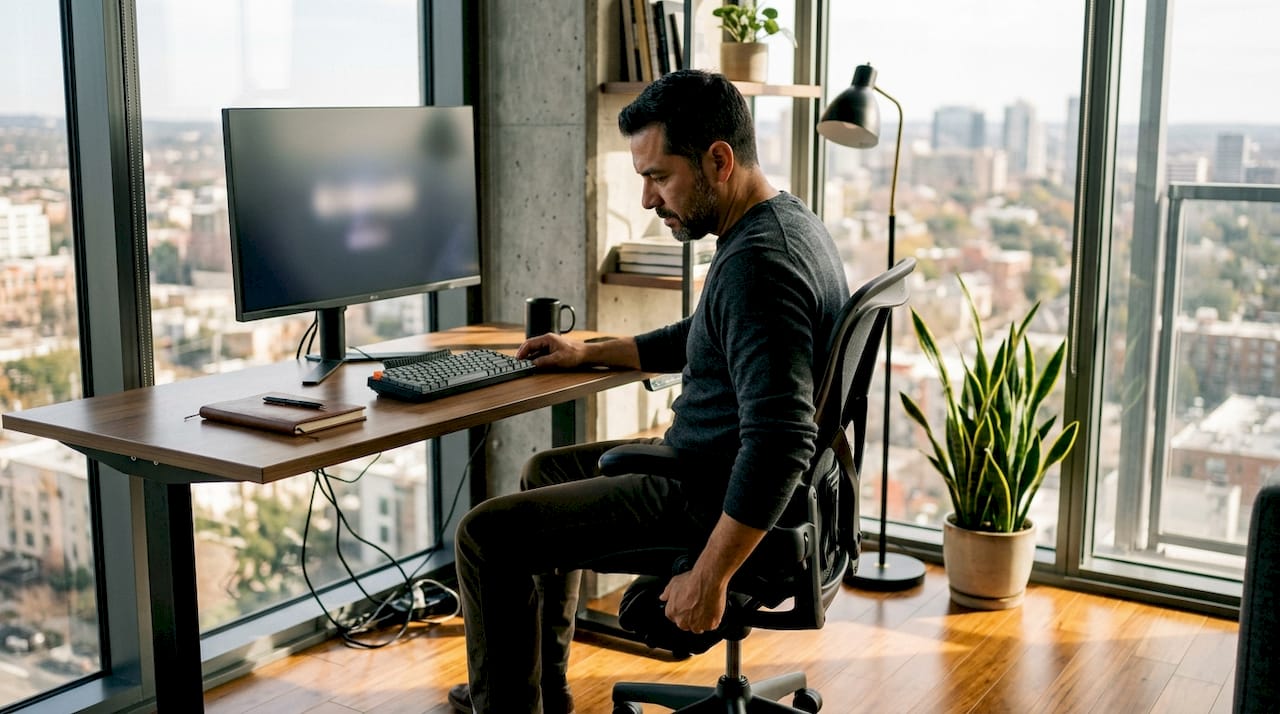
The desk is your foundation. The most effective home office uses a desk at least 48 inches wide and 60–80 cm deep. That size gives you room for a monitor, keyboard, and documents without crowding your arms.
Key setup priorities:
- Chair quality first. A chair with lumbar support and adjustable armrests prevents back pain that compounds over months of remote work.
- Monitor at eye level. The top of your screen should sit at or just below eye level. Looking down for hours strains your neck and shoulders.
- Ergonomic mouse. A vertical or contoured mouse reduces wrist strain significantly compared to a standard flat mouse.
- Lighting from the side. Place your primary light source to the left or right of your monitor, not behind or in front of it. This eliminates glare and eye fatigue.
- Acoustic control. A rug, bookshelf, or acoustic panel reduces echo in hard-floored rooms. Noise-canceling headphones handle the rest.
- Visual separation. A bookshelf, curtain, or even a change in flooring between your work area and living space signals a mental boundary between work and home life.
Pro Tip: Before buying new furniture, test your current setup for one week with a lumbar pillow and a monitor riser made from books. You will know exactly what to invest in before spending a dollar.
3. Leveraging team experience to boost remote work efficiency
Working alongside experienced teammates produces measurable gains. Remote employees on teams with highly experienced members saw a 12.2% productivity increase overall, with the shortest-tenured employees gaining 26.2%. The mechanism is knowledge transfer, not communication volume. Watching how a senior colleague structures their work, handles a difficult client, or prioritizes tasks teaches you more than any training document.
This finding has a direct implication for how you structure your remote team. Pairing newer workers with experienced colleagues on shared projects accelerates skill development faster than solo work or generic onboarding.
Practical ways to build experience-based learning into your remote setup:
- Schedule weekly one-on-ones with senior teammates. Ask specifically about how they approach prioritization and problem-solving, not just project updates.
- Use virtual co-working sessions. Working silently on video with a colleague for 90 minutes replicates the ambient learning of a shared office.
- Document institutional knowledge. Ask experienced team members to record short Loom videos explaining recurring processes. New team members gain access to that knowledge on demand.
- Rotate project leads. Giving newer team members ownership of small projects, with an experienced mentor available, accelerates their development faster than observation alone.
Even one office day per month improves remote team performance by facilitating social learning and alignment. That single day of in-person interaction supplements months of virtual communication in ways that are difficult to replicate digitally. If full in-person days are not possible, a structured virtual team day with shared goals and informal conversation time produces similar alignment benefits.
For remote marketing teams, Seo-analytic’s guide on managing remote teams covers collaboration structures that support this kind of knowledge-sharing at scale.
4. Rituals and psychological practices that protect work-life balance
Clear boundaries between work and personal time are the foundation of long-term remote work motivation. Without them, the workday expands to fill all available hours, which leads to burnout rather than productivity.
Psychological “start” and “stop” rituals help maintain work-life boundaries and prevent work stress from bleeding into personal time. Simple physical actions create powerful mental transitions.
Effective boundary rituals follow a consistent pattern:
- Morning start ritual. Turn on your desk lamp, make coffee, and open your task list in that exact order every day. The sequence signals your brain that work has begun.
- End-of-day shutdown ritual. Write tomorrow’s top three tasks, close all work apps, and turn off your desk lamp. The lamp-off moment is a concrete signal that work is done.
- Physical transition. Change out of work clothes or take a short walk after your shutdown ritual. Physical movement reinforces the mental shift from work mode to personal time.
- No-work zones. Designate at least one room, typically the bedroom, as a space where work devices never go. This protects sleep quality, which directly affects next-day focus.
“Intentional scheduling over spontaneous work prevents the ‘always-on’ stress that erodes both performance and wellbeing over time. The goal is not more hours. The goal is better hours.”
The American Psychological Association links chronic work-life boundary violations to elevated cortisol levels and reduced cognitive performance over time. Protecting your evenings is not a lifestyle preference. It is a performance strategy.
5. Best digital tools and policies for tracking productivity without surveillance stress
Output-based evaluation outperforms presence-based monitoring in every measurable dimension. Remote work environments account for 23.5% of variance in employee performance, and clear digital policies are a primary driver of that variance. Workers who understand how they are evaluated perform better than those who feel watched without context.
The key distinction is between tracking presence and tracking output. Presence-based tools log when someone is at their computer. Output-based tools measure what gets completed, when, and at what quality level.
Effective non-invasive tracking approaches include:
- Time-tracking apps that workers control. Tools that let remote workers log their own focus sessions give them data about their own patterns without creating surveillance anxiety.
- Project management dashboards. Shared boards showing task completion rates give managers visibility into output without monitoring individual keystrokes.
- Weekly output reports. A simple Friday summary of completed tasks, blockers, and next-week priorities replaces the need for constant check-ins.
77% of remote workers would accept productivity monitoring if the purpose and methods were explained clearly. Transparency is the deciding factor. When workers understand what is tracked and why, acceptance rises sharply and performance improves alongside it. Managers who explain monitoring policies upfront build more trust than those who implement tools silently.
For teams managing digital marketing workflows remotely, Seo-analytic’s resource on project management methods covers output-based frameworks that work well for distributed teams.
Key takeaways
Work from home productivity peaks when remote workers protect deep focus hours, design ergonomic environments, and build clear psychological boundaries between work and personal time.
| Point | Details |
|---|---|
| Deep focus over total hours | 3–4 hours of focused output daily outperforms 8 hours of fragmented attention. |
| Ergonomic setup matters | A desk at least 48 inches wide, proper monitor height, and side lighting solve most comfort issues. |
| Team experience drives gains | Working with experienced colleagues raises productivity by 12.2%, with the biggest gains for newer workers. |
| Rituals create boundaries | Start and stop rituals, like turning a desk lamp on and off, prevent burnout by signaling work mode transitions. |
| Transparent monitoring builds trust | 77% of remote workers accept productivity tracking when the purpose is clearly explained. |
What I’ve learned about building a real remote work routine
The most common mistake I see remote workers make is treating productivity as a willpower problem. They believe that if they just tried harder or stayed more disciplined, the results would follow. That framing is wrong, and it leads to exhaustion rather than output.
The workers who consistently perform well remotely have one thing in common: they measure what actually matters. Not hours at the desk. Not the number of Slack messages sent. They track completed outputs against weekly goals and adjust their schedule based on real data. That feedback loop is what separates sustainable high performance from the cycle of grinding and burning out.
Flexibility is remote work’s greatest advantage, but it requires discipline to use well. The best remote routine is not the one copied from a productivity blog. It is the one built around your actual peak hours, your real environment, and your specific work demands. Start with the basics: one protected focus block, one ergonomic upgrade, one clear shutdown ritual. Build from there based on what your own data tells you.
The uncomfortable truth is that most remote work problems are environment problems, not motivation problems. Fix the environment first, and motivation follows.
— Maayan
How Seo-analytic supports remote professionals and digital teams
Remote professionals who manage digital marketing workflows face a specific challenge: staying productive at home while keeping client results strong. Seo-analytic builds resources and tools designed for exactly that situation.
Whether you are refining your team’s digital output or building a stronger online presence for your business, Seo-analytic’s guides on building a high-impact digital team and the website building basics guide give you a clear path forward. Both resources are written for professionals who want results, not theory. The same discipline that drives remote work efficiency applies directly to building a digital presence that converts visitors into customers.
FAQ
What is the most effective way to boost productivity at home?
Protecting 3–4 hours of uninterrupted deep focus time each day produces more output than extending total work hours. Time-blocking and notification management are the two most reliable methods.
How many hours should a remote worker focus per day?
Research shows that 3–4 hours of high-cognitive output per day is typical for top remote performers. Quality of focus matters far more than total time logged.
Does a home office setup really affect productivity?
Ergonomic home offices with proper lighting, acoustic control, and visual separation from living spaces address 90% of comfort and productivity challenges remote workers face.
How do experienced teammates improve remote work efficiency?
Remote employees on teams with highly experienced members see a 12.2% productivity increase, driven by knowledge transfer rather than communication volume.
Is productivity monitoring acceptable to remote workers?
77% of remote workers accept productivity monitoring when the purpose and methods are explained clearly. Transparency is the key factor in building trust and improving performance.