
TL;DR:
- Most small business owners neglect to craft an About Us page that builds trust and drives conversions.
- A focused, visitor-centric About Us page can increase conversions by up to 400% by emphasizing customer value and authenticity.
Most small business owners spend hours on their homepage and product pages, then slap together a generic About Us page that reads like a LinkedIn résumé. That’s a costly mistake. A well-built About Us page builds immediate trust, answers the visitor’s most pressing question (“Can I trust these people?”), and drives real conversions. In fact, redesigning About pages for 12 B2B companies increased conversions by an average of 400%, simply by shifting the focus from company history to customer value. This guide walks you through exactly what to prepare, how to build it, and how to measure results.
Table of Contents
- What you need before you start: essentials checklist
- Step-by-step: How to build an About Us page that converts
- Common About Us mistakes and how to fix them
- Measure and optimize: Improving your About Us page after launch
- What most guides won’t tell you about About Us pages
- Ready to take your brand to the next level?
- Frequently asked questions
Key Takeaways
| Point | Details |
|---|---|
| Focus on visitors | About Us pages should address visitor needs, not just share company history. |
| Show unique value | Highlight your differentiation in plain, specific language for better results. |
| Test and improve | Use metrics like conversions and bounce rate to continually refine your page’s impact. |
| Keep it concise | Shorter, more specific About Us pages are often more effective. |
What you need before you start: essentials checklist
Before you write a single word, you need the right raw materials. Skipping this step is the number one reason About Us pages get rewritten three times and still underperform. Think of this like prepping ingredients before you cook: if you’re missing something essential, the whole dish suffers.
Here’s a checklist of assets to gather:
- Team photos: Authentic, natural shots outperform corporate headshots. Visitors want to see real people, not stock-photo smiles.
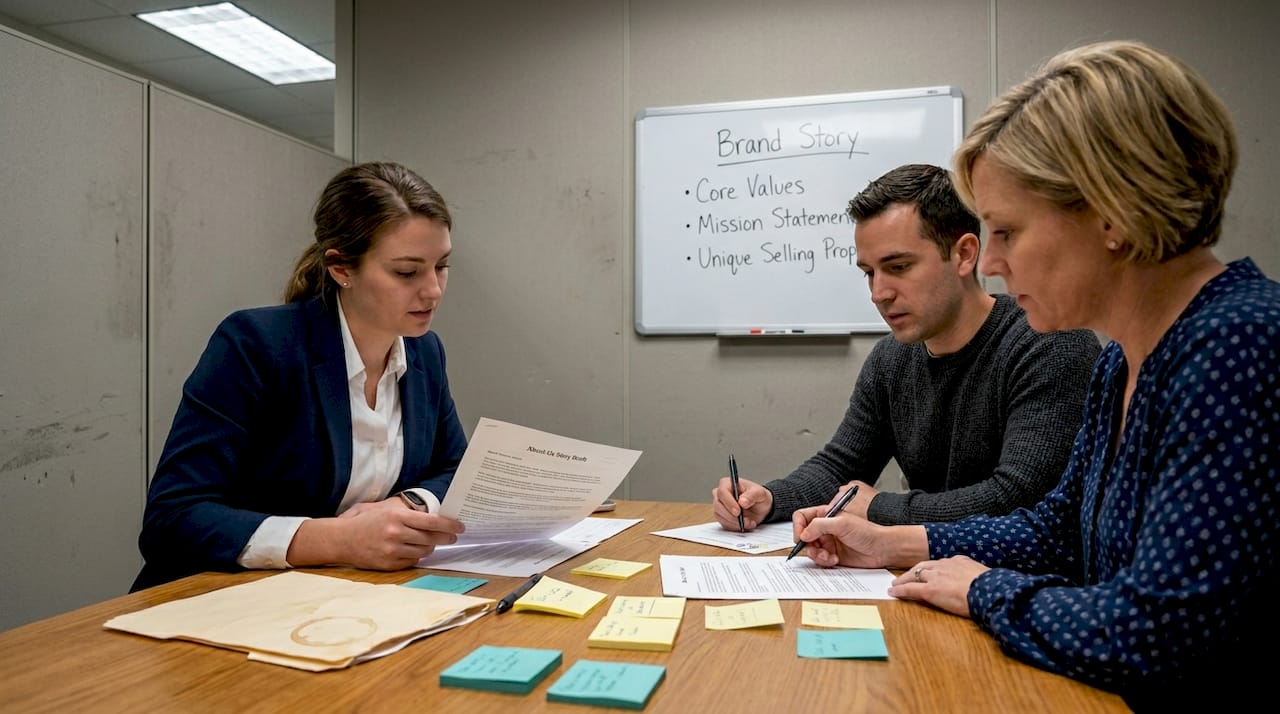
- Brand story notes: Jot down the origin of your business, the problem you set out to solve, and why you cared enough to start.
- Customer testimonials and quotes: Pull real feedback from emails, reviews, or surveys. Nothing builds credibility faster than a specific quote from a satisfied customer.
- Your unique value proposition (UVP): In one or two sentences, what makes you genuinely different from competitors? Not “great service,” but something specific and verifiable.
- Competitor About pages: Review three to five competitors. Note what feels authentic versus what feels copy-pasted from a template. Use this as a benchmark, not a blueprint.
One of the most important preparations is getting your founder story straight. But here’s the thing: About pages often fail when they focus on the founder rather than the visitor. Start with the frustration that led to your product or service, not your credentials. Visitors connect with problems they recognize, not with achievements they can’t relate to.
| Asset | Why it matters | Where to find it |
|---|---|---|
| Team photos | Builds human connection and trust | In-house photographer or smartphone |
| Customer quotes | Immediate social proof | Email replies, Google reviews, surveys |
| Founder story | Establishes authenticity | Personal journal, old pitch decks |
| UVP statement | Clarifies why you over competitors | Sales calls, customer interviews |
| Competitor research | Sets a quality benchmark | Direct website review |
Pro Tip: Read your brand story notes out loud. If it sounds like something any other business could say, it’s too generic. Push for specific details, like the exact moment you realized the problem needed solving.
Good About Us page trust tips consistently point to one truth: specificity wins. A vague story about “passion for quality” loses every time to a concrete story about a real problem you lived through. Keep that in mind as you gather your materials. Pair this with solid storytelling in marketing principles and you’ll have a foundation most competitors can’t match.
Step-by-step: How to build an About Us page that converts
With your materials ready, follow these proven steps to build a page that earns trust and moves visitors to act.
-
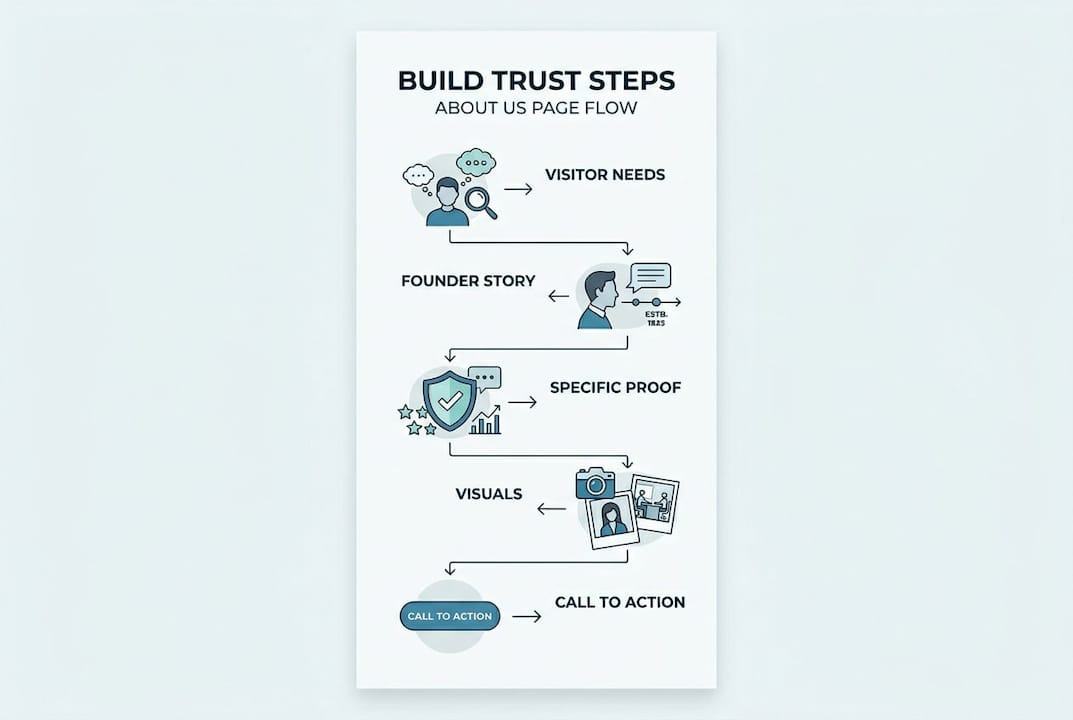
Write a headline that speaks to your customer, not your company. Instead of “Our Story” or “About [Company Name],” try something like “We help small retailers sell more without spending more on ads.” Lead with the benefit. Your headline is the first filter: visitors decide in seconds whether to keep reading.
-
Open with empathy, not ego. Your first paragraph should acknowledge the problem your customer faces. “We started this agency because we watched good businesses fail online, not from bad products, but from bad visibility.” That opening does more work than three paragraphs of founder bio.
-
State your UVP in plain language. After the empathetic opener, give visitors the one or two sentences that make your offer concrete. “We specialize in website building and brand promotion for small businesses that need fast results without a big-agency price tag.” Specific. Clear. No buzzwords.
-
Place testimonials near the top. Don’t bury social proof at the bottom. Move your best customer quote to the top third of the page. Visitors are skeptical; give them a reason to keep reading before they bounce.
-
Tell a brief, relatable founder story. Two to three short paragraphs is plenty. Focus on the turning point that led to the business, the obstacle you faced, and how it shaped what you now offer. This is not the place for your full resume.
-
Close with a clear next step. Your About Us page should not end in a dead zone. Invite the visitor to do something specific: “See how we’ve helped businesses like yours” with a link to case studies, or “Let’s talk about your goals” linking to a contact form.
The 400% conversion improvement seen in those 12 B2B redesigns came from exactly this kind of structural shift: away from company timelines and toward visitor-focused copy with a clear next action.
| Old approach | New approach |
|---|---|
| “Founded in 2010, we have 15 years of experience…” | “We help [target customer] solve [specific problem]…” |
| Founder bio leads the page | Customer problem leads the page |
| Testimonials at the bottom | Testimonials in the top third |
| No clear next step | Strong CTA with a specific action |
| Generic team headshots | Authentic, candid team photos |
Pro Tip: Use brand storytelling techniques to structure your founder story around a three-part arc: the problem you witnessed, the moment you decided to act, and what you built as a result. This structure is immediately readable and emotionally resonant.
One structural issue many small business owners overlook is bounce rate. A poorly structured About Us page with no clear path forward sends visitors away fast. Learn how to reduce website bounce rate by giving visitors meaningful next steps and tightly focused content at every scroll depth.
Common About Us mistakes and how to fix them
Even well-intentioned About Us pages can go off track. Here are the pitfalls to avoid and how to course-correct.
Mistake 1: The founder résumé problem
Many About Us pages read like a LinkedIn profile. A list of awards, degrees, and past employers tells visitors nothing about whether you can solve their problem. The fix is to reframe every credential around the visitor’s benefit. Instead of “15 years in digital marketing,” write “15 years helping small businesses get found online and grow their customer base.”
Mistake 2: Ignoring the visitor’s perspective
Your visitor lands on your About Us page with one core question: “Should I trust this business with my money or time?” If your copy doesn’t answer that question, you’ve lost them.
“If your About page reads like a founder résumé or a list of achievements, consider rewriting it with more visitor empathy and specificity.”
The fix: Read your page as a first-time visitor. Ask yourself, “Does this make me feel understood?” If the answer is no, rewrite the opening to acknowledge the visitor’s challenge before talking about yourself.
Mistake 3: Vague or generic language
Phrases like “committed to excellence,” “passionate team,” and “customer-first approach” are invisible. They say everything and nothing at once. Every competitor uses them. The fix is to replace every vague claim with a specific, verifiable one. Instead of “we deliver results,” write “our clients average a 30% increase in web traffic within 90 days.”
Mistake 4: No visuals or low-quality photos
A wall of text with a single blurry team photo signals low effort. Visitors make visual judgments instantly. High-quality, candid team photos humanize your brand. Behind-the-scenes images of your workspace or process add authenticity that staged shots can’t replicate.
Mistake 5: No clear call to action
An About Us page without a next step is a dead end. Visitors who were warming up to your brand leave without converting. Place at least one action-oriented link near the top and one at the bottom of the page.
- Fix vague language with specific metrics or outcomes.
- Replace résumé-style bullet points with empathy-first storytelling.
- Add a high-quality team photo or behind-the-scenes image.
- Position testimonials early, not at the very bottom.
- Add a clear, low-friction CTA like “See our work” or “Chat with us.”
Smart writing web content practices apply directly here: write for your reader’s needs first, and your ego second.
Pro Tip: Print your About Us page and highlight every sentence that talks about your company. Then underline every sentence that speaks directly to your visitor’s needs. You want more underlines than highlights by a significant margin.
Measure and optimize: Improving your About Us page after launch
Launching your About Us page is just the start. The best pages evolve based on real visitor behavior, not guesswork.
Key metrics to watch:
- Page views: Is your About Us page getting traffic? If not, check internal linking from your homepage and blog posts.
- Bounce rate: A high bounce rate signals that visitors aren’t finding what they expected. Tighten your headline and opening paragraph.
- Time on page: Low time on page means visitors are scanning and leaving fast. Add more scannable subheadings and break up long paragraphs.
- Click-through rate (CTR) on your CTA: This tells you whether your call to action is compelling. If CTR is low, test a different offer or button text.
Simple optimizations that move the needle:
- Move your strongest testimonial up by one section and monitor the change in bounce rate over two weeks.
- Swap a generic stock photo for an authentic team photo and compare time on page before and after.
- Rewrite your headline to be more specific about the visitor’s benefit, then track CTA clicks.
- Test two different CTA phrases (“Let’s talk” vs. “See how we can help”) using a simple A/B test on your platform.
The 400% conversion lift seen in those B2B company redesigns wasn’t achieved overnight. It came from deliberate, ongoing adjustments based on real data. Even small tweaks, like moving a testimonial or clarifying a headline, can compound into significant conversion gains over 60 to 90 days.
Use strategies for lower bounce rate to keep visitors engaged deeper into your About Us page. And revisit more About page tips regularly as your brand evolves. Measuring and iterating is the difference between an About Us page that stagnates and one that quietly drives leads every single week.
What most guides won’t tell you about About Us pages
Here’s a perspective most templates skip entirely: longer is almost never better.
The instinct most founders have is to add more. More background. More credentials. More team bios. More mission statements. But visitor behavior tells a different story. People skim. They make trust decisions in seconds. And a page stuffed with information creates friction, not confidence.
Some of the best-performing About Us pages we’ve seen are also the shortest. They make one strong claim, back it up with one powerful testimonial, and close with one clear action. That’s it. The reason this works is that specificity creates more trust than volume. One truly differentiated claim, stated plainly, does more for your brand than five paragraphs of general company history.
The counterintuitive case for shorter pages is compelling: write your About Us page, then cut 40% of it. Keep only what directly answers your visitor’s core question. What remains is almost always stronger than what you started with.
We’ve seen founders resist this advice. They feel like removing content removes credibility. The opposite is true. Cutting forces you to keep only the most persuasive, most specific, most visitor-relevant content. What survives the cut is what converts.
Think about your single strongest differentiator. Not your three strongest. Your one most specific, most credible, most relevant claim. Lead with that. Build around that. Reference marketing storytelling principles to wrap it in a brief narrative, and you’ll have a page that sticks in a visitor’s memory long after they leave.
Ready to take your brand to the next level?
Your About Us page is one piece of a larger online presence that either builds trust or erodes it. Getting this page right creates momentum for every other part of your website.
At our digital marketing agency, we help small businesses and startups build and optimize every corner of their web presence, from the first click to the final conversion. Explore our website building guide to see how a professionally structured site supports the trust you’re building on your About Us page. Dig into small business branding to align your brand voice across every page. And when you’re ready to turn more visitors into customers, our conversion optimization tips will show you exactly where to focus next. Let’s build something that works.
Frequently asked questions
How long should an About Us page be?
Keep it concise. One to two scrolls is enough for most small businesses. The case for shorter pages is strong: cut 40% from your draft and focus only on what answers your visitor’s biggest question.
What is the most important content for an About Us page?
Lead with what makes you different and how you solve the visitor’s problem. About pages fail most often when they center on founder credentials instead of visitor needs and specific outcomes.
How often should you update your About Us page?
Review and refresh your About Us page at least once a year, or immediately after a significant brand change, pivot in services, or a shift in your target audience.
Can an About Us page really affect sales and conversions?
Absolutely. Focusing on customer value instead of company history drove a 400% conversion increase across 12 B2B companies, proving this page is far more than a formality.