
Most small business owners think customer journey maps are just colorful charts gathering dust in a presentation folder. The truth is, when you focus on actual customer goals and behaviors at each stage, you unlock a powerful framework for aligning your marketing efforts and driving measurable growth. This guide walks you through the essential customer journey stages, shows you how to connect them to your marketing lifecycle, and reveals why documenting specific customer actions transforms abstract concepts into revenue-generating strategies. By the end, you’ll understand how prioritizing customer experience through journey stage insights can help your startup compete with larger competitors and build lasting customer relationships.
Table of Contents
- Understanding Customer Journey Stages
- Aligning Journey Stages With Customer Lifecycle For Better Marketing
- Documenting Customer Actions To Guide Business Decisions
- Why Focusing On Customer Experience Drives Revenue Growth
- Explore Tools And Guides To Build Your Customer Journey Strategy
- Frequently Asked Questions About Customer Journey Stages
Key takeaways
| Point | Details |
|---|---|
| Customer-focused mapping | Effective journey maps prioritize customer goals and emotions over internal business processes. |
| Lifecycle alignment | Matching journey stages to marketing lifecycle stages improves targeting and automation workflows. |
| Actionable documentation | Recording specific customer behaviors at each stage enables better lead routing and intent detection. |
| Revenue impact | Companies prioritizing customer experience see 4-8% higher revenue growth than competitors. |
Understanding customer journey stages
Customer journey stages represent the distinct phases your customers experience as they move from first discovering your business to becoming loyal advocates. Unlike internal business processes that focus on what you need to accomplish, journey stages center on what customers think, feel, and do at each point of interaction. Journey mapping is less about charts and more about building genuine connections with the people you serve. The critical difference between successful and failed journey maps lies in operational clarity. Many customer journey maps fail because they ignore customer goals and lack clear connections to business results.
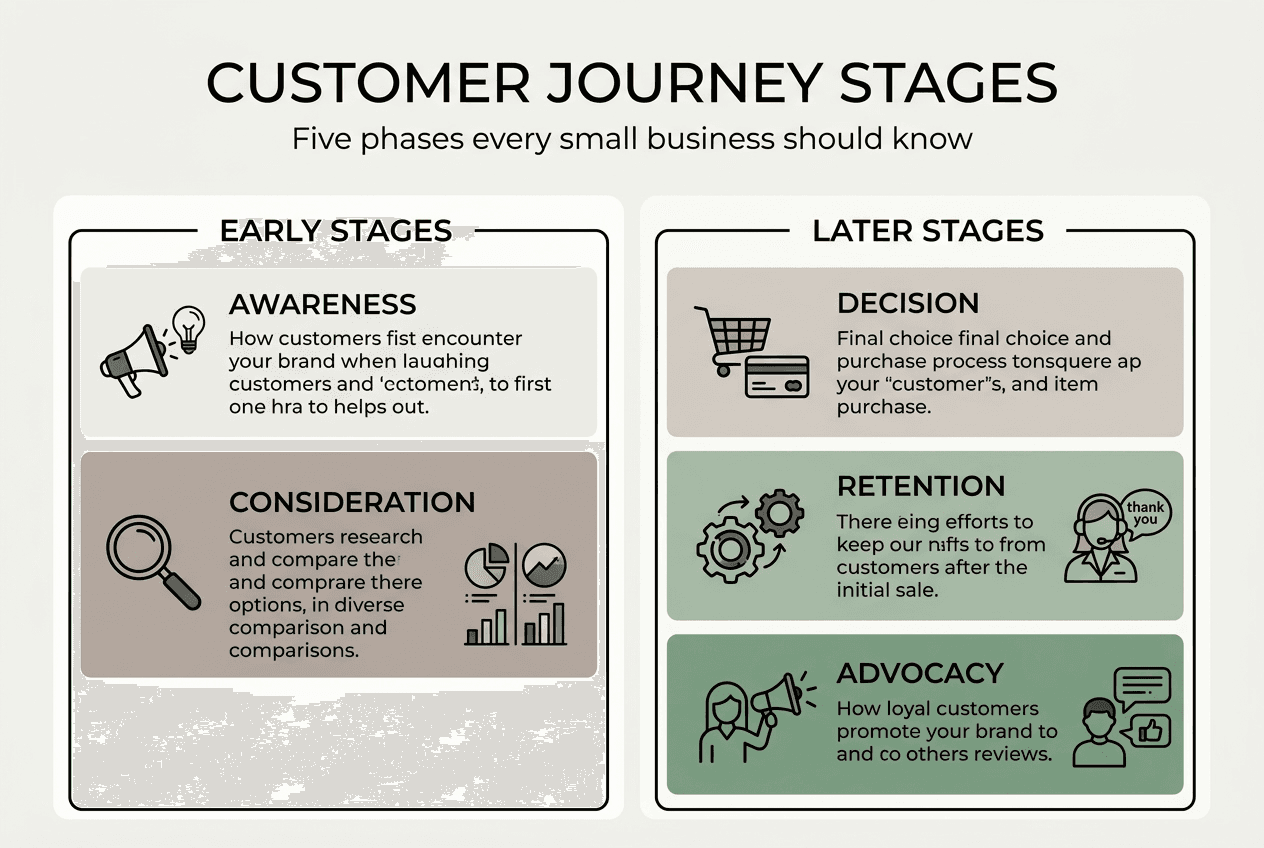
The five main customer journey stages include awareness, consideration, decision, retention, and advocacy. During awareness, potential customers recognize they have a problem or need. In consideration, they research possible solutions and evaluate options. The decision stage involves choosing a specific provider and making a purchase. Retention focuses on the post-purchase experience and continued engagement. Finally, advocacy occurs when satisfied customers recommend your business to others.
Understanding these stages helps you deliver the right message at the right time, rather than bombarding prospects with generic marketing. Each stage requires different content, channels, and approaches based on where customers are in their thinking process. For example, awareness stage content should educate and inform, while decision stage content needs to address specific concerns and differentiate your offering. This strategic approach connects naturally with your broader marketing funnel to create cohesive customer experiences.
Pro Tip: Focus on customer emotions and practical needs during each stage to connect authentically. Ask yourself what worries, questions, or goals your customers have at each point, then create content and experiences that directly address those concerns.
Aligning journey stages with customer lifecycle for better marketing
Customer lifecycle stages represent how your business categorizes contacts based on their relationship with your company, such as lead, marketing qualified lead, sales qualified lead, opportunity, customer, and evangelist. While journey stages focus on customer perspective and emotions, lifecycle stages track progression through your internal sales and marketing processes. Aligning customer journey stages with lifecycle stages improves messaging and lead scoring by ensuring your marketing automation delivers relevant content based on both where customers are mentally and where they sit in your database.
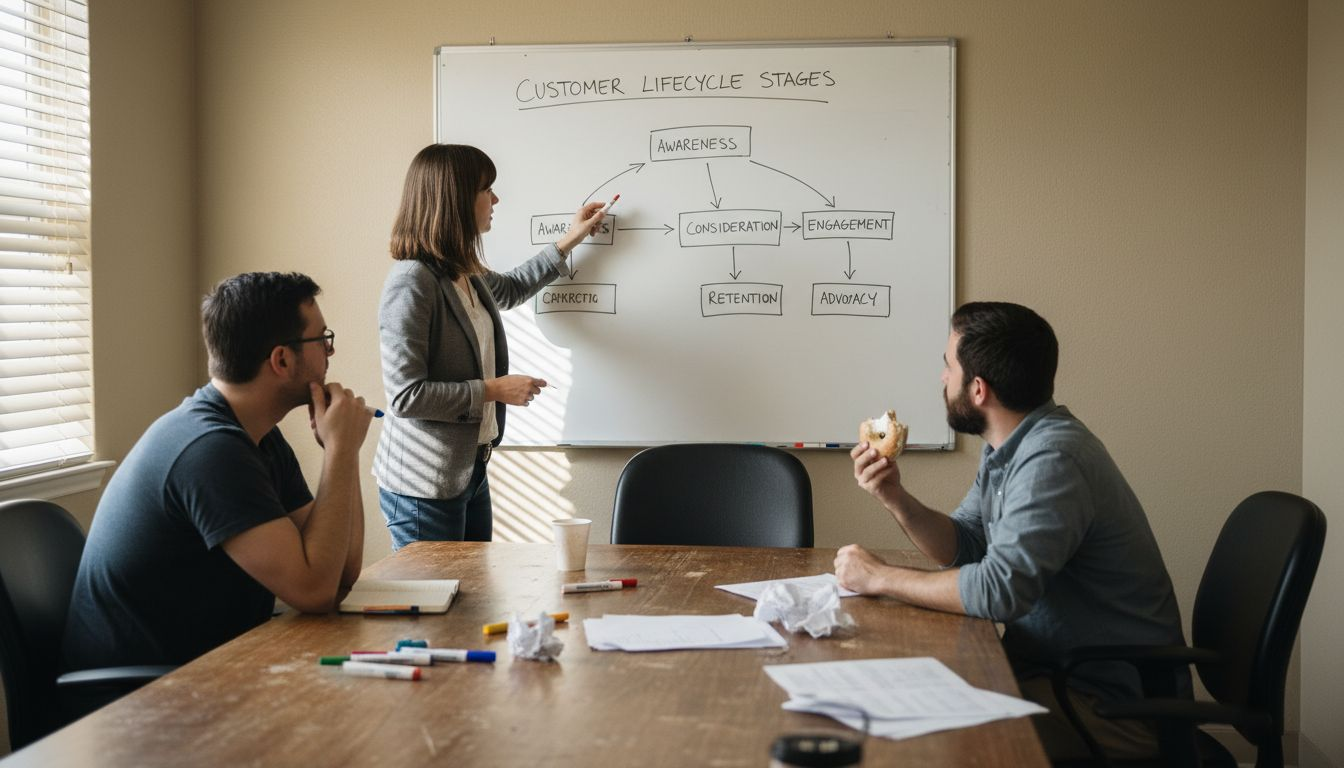
This alignment enables several powerful benefits for small businesses. First, it improves lead scoring accuracy by combining behavioral signals with journey stage indicators. Second, it enhances automation workflows so emails and content match both lifecycle status and journey mindset. Third, it creates clearer handoffs between marketing and sales teams by defining what actions move someone from one stage to another. Fourth, it provides better reporting by showing how journey stage progression correlates with revenue outcomes.
| Aspect | Customer Journey | Customer Lifecycle |
|---|---|---|
| Focus | Customer perspective and emotions | Internal business processes |
| Measurement | Qualitative insights and behaviors | Quantitative metrics and conversions |
| Purpose | Understanding customer needs | Tracking sales progression |
| Ownership | Cross-functional teams | Marketing and sales teams |
Common marketing tactics matched to each combined stage include:
- Awareness/Lead: Blog posts, social media content, SEO optimization, educational webinars
- Consideration/MQL: Comparison guides, case studies, product demos, email nurture sequences
- Decision/SQL: Free trials, consultations, pricing information, testimonials and reviews
- Retention/Customer: Onboarding programs, product training, loyalty rewards, usage tips
- Advocacy/Evangelist: Referral programs, user communities, co-marketing opportunities, exclusive previews
By mapping these connections explicitly, you create a framework that guides both strategic planning and daily execution. Your team knows exactly what content to create, which channels to prioritize, and how to measure success at each stage. This clarity becomes especially valuable when building sales funnels and measuring marketing ROI because you can attribute results to specific journey interventions.
Documenting customer actions to guide business decisions
Specific customer behaviors provide the clearest signals for understanding journey stage progression and triggering appropriate responses. Documenting specific customer actions provides clear signals for lead routing and intent surfacing, transforming abstract journey concepts into operational workflows. Observable actions include completing lead forms, downloading resources, attending webinars, requesting demos, abandoning shopping carts, making repeat purchases, leaving reviews, and referring friends.
To document actions systematically in your journey maps, follow these steps:
- Identify the key touchpoints where customers interact with your business across all channels including website, email, social media, phone, and in-person.
- Record what customers actually do at each touchpoint, focusing on observable behaviors rather than assumed intentions or feelings.
- Categorize actions by journey stage based on the typical sequence customers follow, recognizing some may skip stages or move backward.
- Define what each action signals about customer intent, readiness to buy, satisfaction level, or potential concerns that need addressing.
- Create triggers that connect documented actions to automated marketing responses, sales notifications, or support interventions.
- Assign clear ownership for monitoring and responding to each action type so nothing falls through the cracks.
These documented actions become the foundation for automated marketing and sales workflows that respond intelligently to customer behavior. For example, when someone downloads a pricing guide, your system can automatically send a follow-up email offering a consultation, notify a sales rep to reach out, and adjust their lead score. When a customer’s usage drops below normal levels, you can trigger a check-in email or support outreach before they churn.
The power of this approach lies in replacing guesswork with data-driven decision making. Instead of wondering whether someone is ready to buy, you have clear behavioral indicators. Instead of treating all leads the same, you can personalize based on their demonstrated interests and actions. This systematic documentation also improves your ability to gather meaningful insights through customer satisfaction surveys by targeting the right questions to people at appropriate journey stages.
Pro Tip: Use clear ownership and roles for managing the documented actions to ensure accountability. Assign specific team members to monitor key actions, respond within defined timeframes, and report on patterns that emerge across customer segments.
Why focusing on customer experience drives revenue growth
The business case for prioritizing customer experience through journey stage optimization is backed by compelling research showing measurable financial impact:
Companies focusing on customer experience see revenue rise 4-8% above competitors.
This revenue advantage comes from multiple sources. Excellent customer experience improves loyalty, leading to higher retention rates and lower acquisition costs. Satisfied customers make repeat purchases more frequently and spend more per transaction over time. They also become advocates who refer friends and colleagues, generating high-quality leads at zero marketing cost. Additionally, strong customer experience reduces support costs and negative reviews that can damage your reputation.
Journey stage insights enable specific CX improvements:
- Identifying and eliminating friction points where customers get stuck or frustrated during their journey
- Personalizing communications based on stage-specific needs rather than sending generic messages to everyone
- Proactively addressing concerns before they escalate by recognizing warning signs in customer behavior
- Creating seamless transitions between channels so customers don’t have to repeat information or start over
- Delivering unexpected value at key moments that strengthen emotional connections with your brand
| CX Maturity Level | Revenue Growth Rate | Key Characteristics |
|---|---|---|
| Low | 0-2% | Reactive support, siloed data, generic messaging |
| Medium | 2-5% | Some personalization, basic journey mapping, cross-functional awareness |
| High | 4-8% | Proactive engagement, integrated systems, stage-specific strategies |
Practical steps small businesses can take to focus on CX using journey stage insights include starting with one or two critical stages where improvement would have the biggest impact, gathering direct customer feedback through interviews and surveys, mapping the actual experience customers have versus what you intend, identifying the top three friction points causing problems, and implementing small changes that address those issues. You don’t need expensive technology or large teams to make meaningful improvements.
The connection between journey stage mastery and revenue growth becomes clear when you consider that every interaction either strengthens or weakens the customer relationship. By understanding where customers are in their journey and what they need at each point, you make better decisions about resource allocation, content creation, and process design. This customer-centric approach naturally leads to better customer loyalty programs and more effective marketing ROI strategies because everything aligns around creating value for customers.
Explore tools and guides to build your customer journey strategy
Ready to translate these journey stage insights into action for your business? Our comprehensive resources help you build the foundation for customer-focused marketing that drives real results. Start with our website building guide to create a digital presence optimized for each journey stage, ensuring visitors find exactly what they need whether they’re just discovering your business or ready to make a purchase.
Our digital marketing basics resource walks you through connecting journey stages to practical marketing tactics across channels, while our social media marketing basics guide shows you how to engage customers effectively at each stage of their journey. At seo-analytic.com, we provide professional and reliable solutions tailored to small business needs, helping you increase website visits and convert more browsers into loyal customers through strategic, customer-focused approaches.
Frequently asked questions about customer journey stages
What are the key customer journey stages every small business should know?
The five essential stages are awareness, consideration, decision, retention, and advocacy. During awareness, customers recognize they have a need. Consideration involves researching solutions and evaluating options. Decision is when they choose a provider and purchase. Retention focuses on post-purchase experience and ongoing engagement. Advocacy happens when satisfied customers recommend your business, completing the cycle and potentially starting new journeys for referred contacts.
How can I identify which stage my customer is in right now?
Look for specific actions like website visits to educational content (awareness), downloading comparison guides (consideration), requesting pricing information (decision), or making repeat purchases (retention). Track engagement with emails, social media interactions, and support ticket patterns to gauge stage progression. Regular feedback collection through surveys and conversations helps refine your stage identification accuracy. Combining behavioral data with direct customer input provides the clearest picture of where someone is in their journey.
What is the difference between a customer journey and a marketing funnel?
Customer journeys center on customer goals, emotions, and experiences at each stage from their perspective. Marketing funnels map the steps and processes brands use to convert leads into customers from the business perspective. Journeys focus on understanding what customers think and feel, while funnels focus on moving people through predefined stages toward conversion. Both frameworks complement each other when aligned properly, with journeys informing how you design and optimize your funnel stages.
How often should I update my customer journey map?
Update journey maps at least annually or whenever major business changes occur, such as launching new products, entering new markets, or shifting your business model. Also refresh maps when customer behavior patterns change significantly, which you’ll notice through analytics and feedback trends. Continuous data analysis and regular customer conversations help keep maps accurate between formal updates. Think of journey maps as living documents that evolve with your business and customers rather than static artifacts created once and forgotten.
Can focusing on customer journey stages really increase sales for startups?
Yes, focusing on journey stages improves targeting, messaging, and customer experience, which directly boost sales and retention. Companies prioritizing CX gain 4-8% more revenue than competitors by reducing friction, personalizing interactions, and building stronger relationships. For startups with limited resources, this customer-centric approach helps you compete effectively against larger competitors by delivering superior experiences. Journey stage focus also improves customer loyalty programs and retention efforts, increasing customer lifetime value and reducing expensive acquisition costs.
Recommended
- Customer Loyalty Programs: 18% More Spend & 500% ROI Guide – seo analytic
- Master Website Personalization Strategies for Business Growth – seo analytic
- Website Building Guide for Business Owners: Step-by-Step Success – seo analytic
- Sales Funnel Explained: Boosting Conversions for Startups – seo analytic