

TL;DR:
- Small businesses must implement accurate, transparent privacy policies to comply with evolving legal requirements and build consumer trust.
- Regulatory enforcement risks, fines, and reputational damage increase when policies are outdated or misaligned with actual data practices.
- Maintaining a clear, updated privacy policy fosters customer loyalty and provides a competitive advantage in digital marketing efforts.
Think privacy policies are only for tech giants and Fortune 500 companies? That’s one of the most costly misconceptions a small business owner can hold. Across the US, regulators are stepping up enforcement against businesses of every size, and consumers are paying closer attention to how their data gets handled. This guide breaks down exactly what a privacy policy is, why the law requires it from you specifically, how it affects whether customers trust you with their personal information, and what you need to do right now to stay on the right side of compliance.
Table of Contents
- What is a privacy policy and why is it required?
- Regulatory risks: How enforcement impacts small businesses
- Consumer trust: Why privacy policy transparency counts
- Keeping up with the law: The risks of ‘set-and-forget’
- Why small businesses can’t afford to overlook privacy policy accuracy
- Take the next step: Make privacy a competitive edge for your business
- Frequently asked questions
Key Takeaways
| Point | Details |
|---|---|
| Legal necessity | Privacy policies are a legal requirement for almost any US business that collects personal data online. |
| Regulatory risk | Inaccurate or outdated privacy policies can trigger legal penalties regardless of business size. |
| Builds trust | A clear, up-to-date privacy policy increases consumer trust and supports business growth. |
| Continuous updates | Policies must be reviewed and updated regularly to stay compliant with evolving laws and data practices. |
| Competitive advantage | Transparent privacy practices can set your brand apart in a privacy-focused market. |
What is a privacy policy and why is it required?
A privacy policy is an official legal document that tells your website visitors and customers exactly how your business collects, stores, uses, and shares their personal data. Think of it like a contract written in plain language. It’s not a suggestion, a nice-to-have feature, or something only enterprise-level companies worry about. If your website collects any personal data at all, whether that’s an email address from a contact form, a name from a purchase, or even just tracking cookies for analytics, you are legally required to have one.
Privacy policies function as legally required disclosures and help businesses avoid regulatory trouble by describing their data practices. Federal laws like the Children’s Online Privacy Protection Act (COPPA) and the CAN-SPAM Act already impose specific requirements on certain types of data collection. State laws add another layer. California’s CCPA (California Consumer Privacy Act), Virginia’s VCDPA, Colorado’s CPA, and laws in several other states all require businesses to post a clear and accessible privacy policy if they collect personal information from residents of those states.
Here’s what a compliant privacy policy typically needs to cover:
- What personal data you collect (names, emails, payment information, IP addresses, browsing behavior)
- How and why you collect it (purchases, sign-up forms, cookies, analytics tools)
- Who you share it with (third-party platforms, advertisers, payment processors)
- How long you keep the data
- What rights consumers have over their own data
- How to contact you with privacy-related questions or requests
“Your privacy policy is not a one-and-done document. Regulators expect it to truthfully represent what your business is doing right now, not what you planned to do when you launched your site two years ago.”
Practicing transparent digital marketing ethics is increasingly connected to how well you handle and communicate your data practices. Businesses that fail to keep their policies updated are not just legally exposed. They’re also quietly signaling to their customers that their data isn’t a priority.
Regulatory risks: How enforcement impacts small businesses
Let’s be direct: the Federal Trade Commission (FTC) does not grade on a curve for small businesses. If your privacy policy is inaccurate, outdated, or inconsistent with how you actually handle data, you are vulnerable to enforcement action regardless of how many employees you have or how small your revenue is.
The FTC emphasizes that companies must make sure privacy policies are accurate and honor the promises in them. Misaligned disclosures, meaning your policy says one thing while your actual data practices do something different, can trigger formal enforcement. Fines can reach tens of thousands of dollars per violation, and repeat violations multiply fast.
The FTC has also cracked down on privacy policy accuracy specifically, challenging disclosures that do not match actual data sharing behavior. This means if you say you don’t sell customer data but you’re running third-party advertising pixels that share behavioral data with ad networks, you have a compliance problem. And it’s the kind of problem that regulators can and do act on.
Here’s a practical comparison of the two situations most small businesses fall into:
| Scenario | Policy status | Typical risk level | Likely consequence |
|---|---|---|---|
| Policy matches actual data practices | Accurate and updated | Low | Minimal regulatory scrutiny |
| Policy is outdated or vague | Misaligned or incomplete | High | FTC inquiry, consumer complaints, fines |
| No policy at all | Non-compliant | Very high | Regulatory action, state penalties |
| Policy copied from a competitor | Likely misaligned | High | False disclosures, legal exposure |
State-level requirements are getting more detailed every year. Many now require you to name the specific categories of third parties with whom you share data, describe the consumer’s right to opt out of data sales, and provide clear instructions for submitting a data access or deletion request. If you use retargeting ads or third-party tracking tools, understanding your retargeting disclosure needs is not optional. It’s part of keeping your policy honest.
Pro Tip: Don’t copy your privacy policy from another website. Policies must reflect your specific data practices. A templated policy that describes data handling your business doesn’t actually do is just as problematic as having no policy at all.
Consumer trust: Why privacy policy transparency counts
Regulatory compliance is the floor, not the ceiling. The real opportunity for small businesses is using a clear, transparent privacy policy as a genuine trust-building tool. Customers are paying attention to how businesses treat their data, and what you say in your privacy policy directly affects whether people feel comfortable buying from you.
The FTC connects privacy policies directly to consumer trust by emphasizing that they clarify what businesses do with personal data. When customers can quickly find out what you collect, why you need it, and who else might see it, their anxiety about sharing their email or payment information drops significantly.

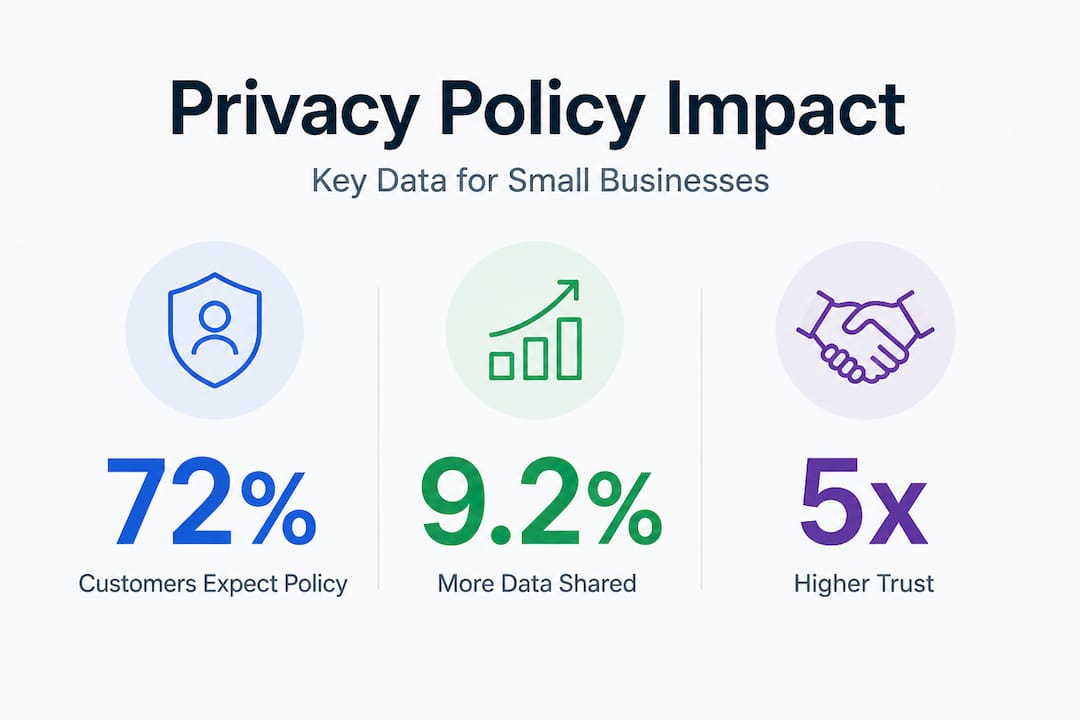
The numbers back this up. Empirical evidence from Harvard Business School suggests that privacy policy and regulatory transparency can causally affect consumer behavior related to data sharing and privacy awareness. Specifically, the research showed a 9.2% increase in data sharing after a privacy policy treatment was introduced. That’s not a rounding error. That’s the measurable impact of simply being clear and honest about how you handle customer data.
Academic research also documents the relationship between privacy policies and how US firms extract and use consumer data, reinforcing why transparency is a structural advantage, not just a legal obligation.
Here’s how privacy policy transparency directly influences buyer behavior in small business contexts:
| Trust factor | Effect on consumer behavior | Business impact |
|---|---|---|
| Clear data collection explanation | Reduces sign-up hesitation | Higher email list conversions |
| Named third-party partners | Increases perceived honesty | Stronger brand credibility |
| Visible opt-out options | Builds sense of control | Lower cart abandonment rates |
| Easy-to-find policy link | Reduces friction | More completed purchases |
Beyond the data, consider what a weak or missing privacy policy communicates to a first-time visitor. They don’t know you. They’re already cautious. When they scroll to the footer and find no privacy policy, or click a link and land on a generic three-paragraph template that clearly wasn’t written for your business, you’ve just told them their data doesn’t matter to you.
Trust signals work together. Adding trust badges for websites and investing in social proof marketing are smart moves, but they work best when they’re supported by a transparent, professionally written privacy policy that reflects real business practices.
Stat to remember: A 9.2% increase in consumer data sharing tied directly to privacy policy transparency is not just a statistic. For a small business with a 500-person email list, that kind of lift could mean 46 additional leads without spending a single extra dollar on advertising.
Keeping up with the law: The risks of ‘set-and-forget’
Here’s where most small business owners fall into a quiet trap. They write a privacy policy, publish it, and assume the job is done. Maybe they even paid someone to draft it. The problem is that a privacy policy isn’t a static document. It has to evolve with your business and with the law.
US state privacy laws now function as compliance mechanisms that require specific consumer rights disclosures and third-party data partner details, and these policies need ongoing updates to match current legal requirements. As of 2026, more than a dozen states have active consumer privacy laws, and several more are in the process of passing new legislation.
Follow these steps to keep your privacy policy accurate, legal, and genuinely useful:
- Audit your data collection every six months. Make a list of every tool on your website that touches user data, including email platforms, chat widgets, advertising pixels, and analytics software. Compare that list to what your current policy discloses.
- Track state law changes. Subscribe to a legal newsletter or work with a privacy attorney who monitors US state law updates. Laws in states like Texas, Montana, and Oregon have all seen significant changes recently.
- Update when you change vendors. Switching from one email marketing platform to another? Adding a new payment processor? Each change may introduce new data sharing relationships that need to be disclosed.
- Review after any marketing campaigns. If you ran a paid ad campaign that used pixel tracking or retargeting, verify that your policy accurately describes that data activity after the campaign ends.
- Test your policy’s readability. Ask someone outside your business to read your privacy policy and summarize it back to you. If they can’t explain it clearly, your customers can’t either.
If you use email marketing, your obligations get more specific. The email marketing best practices your business follows should be directly reflected in how your privacy policy describes data collection and opt-in consent. A policy that doesn’t address email marketing when you actively collect subscriber information is a compliance gap waiting to be flagged.
Pro Tip: Set a recurring calendar reminder every January 1 to review your privacy policy. Use it as a checkpoint to compare your current data practices against what your policy actually says. This one annual habit can prevent the majority of compliance problems most small businesses face.
Why small businesses can’t afford to overlook privacy policy accuracy
Here’s the uncomfortable truth that doesn’t get said enough: most small businesses treat privacy policies as a legal checkbox. They copy a template, publish it in the footer, and move on. That approach is not just risky. It’s a missed opportunity.
Some small business-focused sources frame privacy policy value almost entirely around legal risk avoidance. That framing is incomplete. The FTC’s own guidance ties privacy policy accuracy directly to consumer expectations and transparency. The practical implication is clear. Accuracy and user-centered clarity both matter, and the businesses that get this right gain something most of their competitors don’t have: genuine trust.
Consider the customer who is choosing between two local online retailers. Both sell similar products at similar prices. One has a detailed, clearly written privacy policy that explains exactly what data is collected, why, and how to request its deletion. The other has a generic three-paragraph policy that looks borrowed from a template. Which business do they buy from again? Which one do they recommend to a friend?
The real advantage of treating privacy seriously is loyalty. Repeat customers are worth more than first-time buyers, and repeat business is built on trust. When your privacy policy accurately reflects your practices and is written with the customer’s understanding in mind, you’re communicating something powerful: we respect you and we take your data seriously.
Building genuine business relationships means integrating values like transparency and accountability into every customer touchpoint, not just the ones that feel obviously important. Your privacy policy is a customer touchpoint. It’s often the first detailed look a skeptical visitor takes at how your business operates. Make it count.
The businesses that win in the long run aren’t the ones that just avoided an FTC complaint. They’re the ones that built privacy into their culture, not just their footer.
Take the next step: Make privacy a competitive edge for your business
You’ve seen how privacy policy accuracy protects you legally, increases consumer trust, and creates real business advantages. The next move is building these insights into your online presence in a practical, sustainable way.
At our digital marketing agency, we help small business owners build websites and digital strategies that are credible, compliant, and built to convert. Whether you’re starting fresh or improving an existing site, our resources on website building basics walk you through every element of a trustworthy online presence. Our digital marketing ethics guide goes deeper into how transparency becomes a competitive advantage across your entire strategy. You don’t have to figure this out alone. We’re here to make it straightforward.
Frequently asked questions
Do all small businesses in the US legally need a privacy policy?
If your business collects personal information online from US residents, a privacy policy is required by federal and many state laws, regardless of your business size or annual revenue.
What happens if my privacy policy is inaccurate or outdated?
Inaccurate policies can trigger FTC enforcement action and fines, plus serious damage to consumer trust, and this applies to businesses of any size.
How often should I update my privacy policy?
Review your policy whenever your data practices or relevant laws change, and treat it as a required ongoing update at minimum once a year.
Can a clear privacy policy really increase customer trust?
Yes. Research shows that transparent privacy policies measurably boost consumer willingness to share data, which translates directly into higher conversions and stronger customer relationships.