

Placing high-value resources behind an access barrier often sparks debate among digital marketing teams. For small to mid-sized American startups, gated content can be a game plan for turning interested visitors into qualified leads. Yet, confusion arises when professionals mistake gated content for simply locking away information. This guide clears up common misconceptions and reveals how strategic gating creates a win-win exchange—helping your business grow while offering users unique value.
Table of Contents
- Defining Gated Content And Common Misconceptions
- Popular Types And Examples Of Gated Content
- How Gated Content Works In Lead Generation
- Gated Vs. Ungated Content: Key Differences
- Risks, SEO Implications, And Mistakes To Avoid
Key Takeaways
| Point | Details |
|---|---|
| Understanding Gated Content | Gated content is a digital marketing strategy that requires user interaction for access, facilitating lead generation through high-value resources. |
| Effective Gated Content | Successful gated content should offer exceptional quality, a clear value proposition, and be designed to address audience needs comprehensively. |
| Types of Gated Content | Popular gated content types include white papers, webinars, and interactive tools that provide significant insights in exchange for user information. |
| Balancing Strategies | A hybrid approach utilizing both gated and ungated content can optimize audience engagement and satisfy lead generation goals. |
Defining Gated Content and Common Misconceptions
Gated content represents a strategic digital marketing approach where valuable resources are placed behind an access barrier, typically requiring users to provide contact information or complete a specific action before gaining entry. Unlike freely accessible web content, gated content demands user interaction as a prerequisite for consumption.
Misconceptions about gated content frequently arise from unclear understanding of its purpose and implementation. Many digital marketers mistakenly believe gated content is simply about restricting information. However, the core objective is creating a mutually beneficial exchange where users receive high-value resources while businesses capture qualified lead contact details.
Key characteristics of effective gated content include:
- Exceptional quality that justifies the access requirement
- Clear value proposition for the user
- Relevant and targeted information matching audience needs
- Transparent communication about what users will receive
- Professional design and presentation
Content Types that work well for gating include:
- Comprehensive research reports
- Detailed industry whitepapers
- In-depth video tutorials
- Advanced webinar recordings
- Interactive tools or calculators
- Exclusive research studies
Gated content succeeds when it provides genuine, transformative value that users cannot easily find elsewhere.
Pro tip: Develop gated content that solves a specific problem for your target audience, making the information exchange feel like a win-win scenario.
Popular Types and Examples of Gated Content
Gated content encompasses a diverse range of digital resources strategically designed to capture user information while providing exceptional value. Digital marketing professionals utilize multiple content formats to engage potential leads and create meaningful interactions beyond traditional web browsing.
Companies can leverage various types of gated content to attract and convert potential customers. These resources are carefully crafted to offer substantial insights that justify the user’s investment of personal contact details. Each content type serves a unique purpose in the lead generation ecosystem, targeting different stages of the customer journey.
Primary Gated Content Types include:
- White Papers
- Research Reports
- Comprehensive Webinars
- Detailed Case Studies
- Interactive Toolkits
- Specialized Industry Guides
- Advanced Training Modules
- Exclusive Video Tutorials
Technical Requirements for effective gated content:
- High-quality, original information
- Clear value proposition
- Professional design
- Easy-to-complete registration process
- Mobile-responsive format
The most successful gated content solves specific problems while providing unique insights unavailable through standard web searches.
Emerging Gated Content Trends:
- AI-generated customized learning materials
- Personalized research compilations
- Predictive industry analysis reports
- Interactive diagnostic tools
Pro tip: Design your gated content to address specific pain points in your target audience’s professional or personal challenges, making the information exchange feel genuinely valuable.
How Gated Content Works in Lead Generation
Gated content operates as a sophisticated lead generation mechanism that transforms casual website visitors into potential customers through strategic information exchange. Content access controls capture valuable user data by requiring visitors to provide contact information before accessing premium resources.

The lead generation process through gated content follows a structured approach designed to attract, engage, and qualify potential customers. Businesses create high-value digital assets that address specific audience pain points, strategically positioning these resources behind a registration form. This approach ensures that only genuinely interested prospects complete the access process, effectively filtering and qualifying leads.
Key Stages of Lead Generation with Gated Content:
- Attract target audience with compelling content preview
- Present registration/contact form
- Collect essential contact details
- Deliver promised high-value resource
- Initiate targeted follow-up communication
Critical Components of Effective Gating:
- Irresistible content value proposition
- Minimal form friction
- Clear communication of benefits
- Professional design and presentation
- Immediate content delivery
Successful gated content transforms anonymous website visitors into identifiable, interested potential customers.
Lead Qualification Mechanisms:
- Segmentation based on content type accessed
- Tracking user interaction and engagement levels
- Analyzing information protection strategies
- Scoring leads based on resource selection
Pro tip: Design your gated content forms to collect only essential information, reducing user hesitation and improving conversion rates.
Gated vs. Ungated Content: Key Differences
Content strategy requires a nuanced understanding of when to restrict or open access to digital resources. Content accessibility dramatically impacts marketing outcomes by influencing user engagement, lead generation, and information discovery. Gated and ungated content represent two distinct approaches with unique strategic advantages.
The primary distinction between gated and ungated content lies in their accessibility and primary objectives. Ungated content aims to maximize reach, improve search engine visibility, and provide immediate value to a broad audience. Digital content strategies leverage both approaches to create comprehensive audience engagement frameworks that balance information accessibility with lead generation potential.
Gated Content Characteristics:
- Requires user registration
- Targets high-value, specialized information
- Focuses on lead generation
- Enables detailed audience segmentation
- Provides deeper, more comprehensive resources
Ungated Content Characteristics:
- Freely accessible
- Maximizes organic search visibility
- Builds initial brand trust
- Supports broader audience reach
- Improves overall website traffic
Comparative Analysis:
Here’s a comparison of gated and ungated content strategies and their typical business outcomes:
| Content Type | Primary Goal | Audience Reach | Lead Generation Effectiveness |
|---|---|---|---|
| Gated | Capture qualified leads | Limited, highly targeted | High—detailed user profiles |
| Ungated | Brand awareness, SEO | Broad, general public | Low—minimal data collected |
- Lead Generation Potential
- Search Engine Optimization Impact
- Audience Engagement Levels
- Resource Investment
- Data Collection Opportunities
Strategic content marketing requires a balanced approach, utilizing both gated and ungated content to achieve comprehensive business objectives.
Recommended Content Type Allocation:
- Top-of-funnel content: Primarily ungated
- Middle-of-funnel content: Selectively gated
- Bottom-of-funnel content: Predominantly gated
Pro tip: Develop a hybrid content strategy that progressively gates more valuable content as user interest and engagement increase.
Risks, SEO Implications, and Mistakes to Avoid
Gated content strategies require careful navigation to balance lead generation objectives with potential digital marketing risks. Synthetic content poses significant transparency challenges that can negatively impact user trust and search engine performance. Understanding these potential pitfalls is crucial for developing an effective and ethical content strategy.
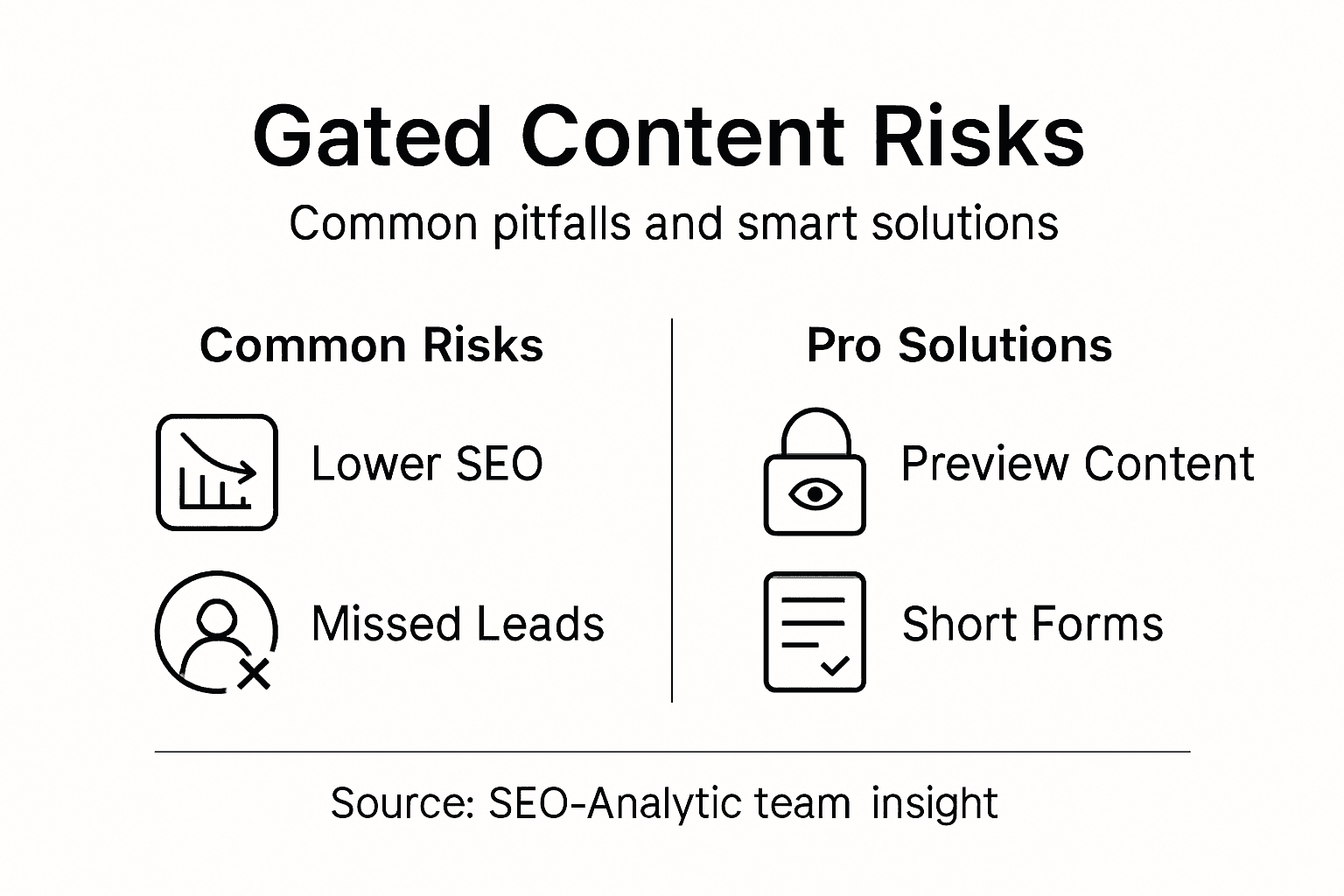
Search engine optimization represents a critical consideration when implementing gated content approaches. Content labeling and disclosure practices directly influence a website’s crawlability and overall digital visibility. Improperly managed gated content can inadvertently create substantial barriers to organic search performance and user engagement.
Primary Risks Associated with Gated Content:
- Reduced search engine indexing
- Decreased organic traffic potential
- Limited content discoverability
- Potential user trust erosion
- Increased bounce rates
Common SEO Mistakes to Avoid:
- Completely blocking content from search engine crawlers
- Failing to provide alternative accessible content
- Overusing gating across entire content strategy
- Neglecting mobile user experience
- Creating excessive friction in access process
Successful gated content strategies balance lead generation goals with transparent, user-friendly access mechanisms.
Technical Mitigation Strategies:
Below is an overview of common risks and recommended mitigation techniques for gated content:
| Risk Factor | Potential Impact | Mitigation Technique |
|---|---|---|
| Poor SEO crawlability | Lower search ranking | Offer partial previews |
| Excessive form requirements | Higher bounce rates | Simplify registration process |
| Lack of mobile optimization | Loss of mobile users | Use responsive design |
| Over-gating content | Reduced traffic | Gate only high-value resources |
- Implement partial content previews
- Use structured data markup
- Develop SEO-friendly registration processes
- Create alternative ungated content variations
- Optimize page load speeds
Pro tip: Design gated content with strategic peek mechanisms that provide enough value to entice users while maintaining overall content accessibility.
Unlock the Power of Gated Content to Capture Qualified Leads
Are you struggling with turning website visitors into loyal customers because your gated content strategy lacks impact? This article highlights common challenges like balancing lead generation with SEO and creating truly valuable resources that users are willing to exchange their contact details for. If you want to overcome these pain points such as poor content discoverability, excessive form friction, and unclear value propositions, our professional digital marketing agency can help you craft an optimized gated content plan that attracts and converts the right audience.
Discover how our expert team at SEO-Analytic specializes in building websites designed for superior user engagement and lead capture. Leveraging tailored strategies that include compelling landing pages, seamless registration forms, and mobile-responsive design, we ensure your gated content delivers exceptional value without sacrificing search engine visibility. Don’t let your content go unnoticed. Take the next step to boost your lead generation effectiveness today by learning more about our website building services and start converting casual visitors into qualified customers now.
Frequently Asked Questions
What is gated content?
Gated content is a digital marketing strategy that requires users to provide contact information or complete a specific action before accessing valuable resources, creating a reciprocal exchange of information.
What are common types of gated content?
Common types of gated content include white papers, research reports, webinars, case studies, interactive toolkits, and exclusive video tutorials, all designed to provide high-value insights to users.
How does gated content enhance lead generation?
Gated content enhances lead generation by capturing valuable user data through registration forms, transforming anonymous visitors into qualified leads by requiring contact information in exchange for access.
What are the risks associated with gated content?
The risks associated with gated content include reduced search engine indexing, decreased organic traffic, and potential user trust erosion if access is too restrictive or if the content is not perceived as valuable.
Recommended
- 7 Practical Lead Generation Ideas for US Business Owners – seo analytic
- 7 Lead Magnets Ideas to Boost Startup Conversions Fast – seo analytic
- Creating Sales Funnels for Higher Conversion Rates – seo analytic
- Creating Effective Landing Pages to Boost Conversions – seo analytic
- Bénéfices De L’Automatisation Marketing B2B