
TL;DR:
- Fair use allows limited, unlicensed use of copyrighted material for criticism, commentary, or education under specific conditions. Courts evaluate four factors collectively to determine if a use is legal, considering purpose, nature, amount, and market effect. Recent rulings, like Warhol v. Goldsmith, emphasize the importance of genuine purpose and market impact in fair use assessments.
Fair use is a legal doctrine that permits limited, unlicensed use of copyrighted material for purposes such as criticism, comment, news reporting, teaching, scholarship, or research. Codified under Section 107 of the U.S. Copyright Act, it exists to balance the rights of copyright holders against the public interest in free expression and the open exchange of ideas. The U.S. Copyright Office describes fair use as a flexible doctrine, not a fixed rule. For educators, content creators, and individuals, understanding what is fair use means knowing both its power and its limits before you publish, post, or teach.
What is fair use and how does the law define it?
Fair use is the legal right to use copyrighted material without permission under specific conditions, evaluated through a four-factor test established by Congress. The doctrine does not grant blanket permission. Instead, it creates a framework courts use to decide whether a particular use is lawful after the fact. That distinction matters enormously for anyone who creates or shares content professionally.
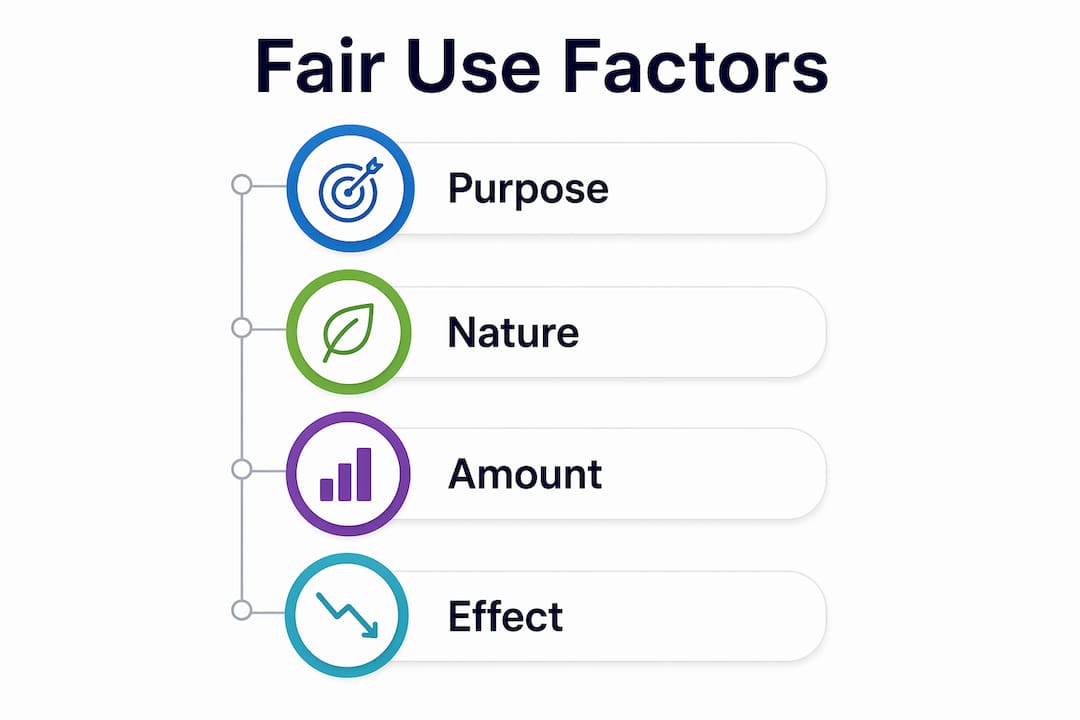
The four factors courts weigh are not a checklist where passing three out of four guarantees protection. All four factors are considered together, and no single factor is decisive on its own. A use that scores well on three factors can still fail if the fourth, particularly market harm, weighs heavily against it. Courts treat the analysis as a balancing act, not a scorecard.
The doctrine traces its roots to 19th-century case law and was formally written into the Copyright Act of 1976. Congress deliberately left the four factors open-ended so courts could adapt the doctrine to new technologies and creative practices. That flexibility is why fair use still applies to YouTube commentary, AI-generated content analysis, and TikTok parody in 2026, even though none of those formats existed when the law was written.
What are the four factors courts use to evaluate fair use?
Understanding the four factors is the foundation of any fair use analysis. Courts apply them to every case, and so should you before relying on the doctrine.
-
Purpose and character of the use. Courts ask whether the use is transformative, meaning whether it adds new expression, meaning, or message to the original work. Transformative use providing new expression carries significant weight in favor of fair use. Commercial uses are not automatically excluded, but they face higher scrutiny than nonprofit or educational uses. A YouTube video that critiques a film by analyzing specific scenes is more likely transformative than one that simply replays those scenes for entertainment.
-
Nature of the copyrighted work. Using factual works, such as news articles or scientific reports, is more likely to qualify than using highly creative works like novels, songs, or films. Courts recognize that creative works deserve stronger protection because the author’s original expression is the core of what copyright law protects.
-
Amount and substantiality of the portion used. Using a smaller portion generally favors fair use, but quality matters more than quantity. Copying the “heart” of a work, the most memorable or commercially valuable section, weighs against fair use even if the excerpt is brief. A 30-second clip that contains the chorus of a hit song carries more weight than two minutes of instrumental bridge.
-
Effect on the potential market. This factor is often the most decisive. Courts ask whether the use harms the market for the original work or for licensed derivatives. If your use substitutes for a purchase the copyright holder could have made, fair use is unlikely to apply.
Pro Tip: Run through all four factors before publishing any content that uses copyrighted material. Write down your reasoning for each one. That written analysis can serve as evidence of good faith if a dispute arises later.
What are common examples of fair use in practice?
Common examples of fair use include quoting short passages in a book review, using brief video clips in news commentary, creating parody that comments on the original work, and incorporating copyrighted text into classroom instruction. Each of these uses serves a purpose distinct from simply reproducing the original for consumption.

Parody is one of the clearest applications. A comedian who rewrites a pop song’s lyrics to mock the original artist is creating something new with a distinct communicative purpose. Courts have consistently protected parody because it requires borrowing from the original to make its point. Satire, by contrast, gets less protection because it uses copyrighted material to comment on something other than the original work itself.
News reporting is another strong category. A television network that airs 10 seconds of a viral video to report on a public event is using copyrighted material, but the purpose is informational and the amount is limited. That combination typically supports fair use. The same network airing the full video as entertainment content would not.
Several uses are unlikely to qualify, and creators often misjudge these:
- Reproducing an entire article, song, or image, even for educational purposes
- Using a competitor’s copyrighted marketing materials in your own campaigns
- Posting full episodes of a TV show with commentary added at the beginning
- Downloading and redistributing stock photos without a license, regardless of how they are used
- Assuming that adding a credit line transforms infringement into fair use
Fair use is determined case by case. There is no bright-line rule for how much of a work you can use, which means every situation requires its own analysis. Relying on a rule of thumb like “10% is always safe” is legally unsupported and potentially costly.
What recent legal shifts are reshaping fair use in 2026?
The 2023 Supreme Court decision in Warhol v. Goldsmith significantly tightened the definition of transformative use. The Court ruled that Andy Warhol’s licensed use of Lynn Goldsmith’s photograph of Prince did not qualify as fair use because Warhol’s foundation licensed the image for the same commercial purpose as the original photograph. The ruling clarified that aesthetic transformation alone is not enough. The new work must serve a genuinely distinct purpose from the original.
“The first factor asks whether the use has a further purpose or different character, and the degree to which it is transformative. But the degree of transformation required is not simply a matter of how different the new work looks from the original.” — Andy Warhol Foundation v. Goldsmith, 598 U.S. (2023)
This ruling has direct consequences for graphic designers, digital artists, and marketers who build on existing visual works. If your derivative work competes in the same market as the original, the transformative use argument is much weaker than it was before 2023.
On the enforcement side, the post-2015 Lenz v. Universal Music Corp ruling requires copyright holders to consider fair use before issuing DMCA takedown notices. This means platforms like YouTube and Instagram have a legal obligation to factor fair use into their content moderation processes. Creators who receive wrongful takedowns have legal recourse, but pursuing it requires documentation and, often, legal counsel.
AI-generated content adds another layer of complexity. When an AI model trains on copyrighted works and produces derivative outputs, the fair use question is unresolved in most jurisdictions. Courts in 2025 and 2026 are actively working through these cases, and the outcomes will reshape how content creators, publishers, and platforms think about copyright compliance.
Pro Tip: If you receive a DMCA takedown notice, do not assume the copyright holder is automatically correct. Document your fair use reasoning before filing a counter-notice, and consult an intellectual property attorney if the content is commercially significant.
How can creators and educators apply fair use responsibly?
Fair use is an affirmative defense, not a preemptive shield. You cannot claim fair use before a dispute arises to guarantee protection. It only becomes relevant if you are sued for infringement, at which point you must prove your use qualifies. That legal reality should shape how you approach every decision to use copyrighted material.
For educators, the stakes are particularly nuanced. Nonprofit educational uses weigh in favor of fair use, but they do not create blanket exemptions. A teacher who photocopies an entire textbook chapter for every student in a class is not automatically protected simply because the setting is educational. Each use must be evaluated against all four factors. The NYU Fair Use Guide and the Copyright Clearance Center both offer checklists specifically designed for academic settings.
For content creators and marketers, the practical approach is to treat fair use as a last resort rather than a first option. When you can license content affordably, do it. When you cannot, apply the four-factor test honestly and document your reasoning. Tools like content reuse strategies can help you build original content that avoids the question entirely.
Here is a practical comparison of uses that typically qualify versus those that typically do not:
| Likely qualifies | Likely does not qualify |
|---|---|
| Short quote in a published book review | Reproducing a full article on your blog |
| Parody song commenting on the original | Cover song posted for commercial gain |
| Brief clip in a news report | Full episode posted with minor commentary |
| Classroom discussion using a short excerpt | Distributing full copies to every student |
| Critical analysis citing specific passages | Copying a work to avoid purchasing it |
When the use is extensive, commercial, or involves highly creative works, seeking permission or a license is the lower-risk path. An intellectual property attorney can assess your specific situation in under an hour, and that cost is almost always less than defending an infringement claim.
Key takeaways
Fair use protects specific, limited uses of copyrighted material evaluated through four factors, and it functions as a legal defense rather than a guaranteed right.
| Point | Details |
|---|---|
| Fair use definition | Section 107 of the U.S. Copyright Act permits limited unlicensed use for criticism, education, and commentary. |
| Four-factor test | Courts weigh purpose, nature, amount used, and market effect together with no single factor being decisive. |
| Transformative use post-2023 | After Warhol v. Goldsmith, aesthetic changes alone do not establish transformative use. |
| Affirmative defense | Fair use only protects you if sued; it cannot be claimed preemptively to prevent infringement allegations. |
| Educator responsibility | Nonprofit educational settings favor fair use but do not exempt educators from the four-factor analysis. |
Why fair use is harder than most creators think
I have worked with content teams across dozens of industries, and the most common mistake I see is treating fair use as a permission slip rather than a legal defense. Creators quote a paragraph, add a citation, and assume they are covered. They are not. Fair use is only determined by a court, after the fact, if someone sues you. That is a fundamentally different situation than having permission.
The Warhol v. Goldsmith decision was a wake-up call for the creative industry, and I think many people still have not absorbed its implications. The Supreme Court did not say Warhol’s work lacked artistic merit. It said the commercial purpose of the licensed use was too similar to the original to qualify as transformative. That logic applies directly to graphic designers, video editors, and social media marketers who build on existing works for commercial campaigns.
What I find most useful in practice is the market harm test. Ask yourself honestly: if everyone did what I am doing, would it damage the market for the original work? If the answer is yes, or even maybe, the use is risky. The transformative purpose question matters, but market harm is where courts often land their final judgment.
Fair use exists to protect creativity and free expression, not to provide a free pass for using other people’s work. The creators who navigate it best are the ones who understand both its power and its boundaries, and who build original content as their default strategy.
— Maayan
Build content that stands on its own
Understanding fair use is one part of running a legally sound and effective content operation. The other part is building original, high-quality content that does not require borrowing from others in the first place.
At Seo-analytic, we help content creators, educators, and business owners build digital presences that are both compelling and compliant. Whether you are starting from scratch or scaling an existing site, our website building guide for US business owners walks you through every step of creating a legally sound, high-performing web presence. For a broader view of how content strategy and digital marketing basics connect to copyright compliance, our 2025 marketing guide covers the frameworks that protect your brand while growing your audience.
FAQ
What is the fair use definition in simple terms?
Fair use is a legal doctrine under Section 107 of the U.S. Copyright Act that allows limited use of copyrighted material without permission for purposes like criticism, education, commentary, or parody. It is not a blanket right but a case-by-case defense evaluated through four statutory factors.
Is fair use legal in the United States?
Yes, fair use is a legally recognized doctrine in the United States, codified in the Copyright Act of 1976. It functions as an affirmative defense, meaning it protects you only if you are sued for infringement and can demonstrate your use qualifies under the four-factor test.
What qualifies as fair use for educators?
Nonprofit educational use weighs in favor of fair use, but it does not create an automatic exemption. Educators must still evaluate all four factors, and distributing full copies of copyrighted works to students is unlikely to qualify even in a classroom setting.
How did the Warhol v. Goldsmith case change fair use?
The 2023 Supreme Court ruling in Warhol v. Goldsmith tightened the transformative use standard by requiring that a new work serve a genuinely distinct purpose from the original, not just look different. Commercial uses that serve the same market function as the original now face significantly higher scrutiny.
Can I use copyrighted material if I give credit to the author?
No. Attribution does not create fair use protection. Courts evaluate the four statutory factors regardless of whether you credit the original author. Giving credit is good practice, but it does not substitute for a legitimate fair use analysis or a license.