

TL;DR:
- Venture capital is a complex, structured financial system that shapes startup growth through specific incentives and timelines. Founders must understand fund mechanics, investor priorities, and operational changes to navigate funding successfully. Preparing thoroughly and aligning expectations before securing VC support is essential for long-term success.
Most founders assume venture capital is straightforward: pitch a great idea, take the money, build the company. The reality of venture capital basics is far more layered. VC is a structured financial system with specific incentives, timelines, and expectations that directly shape your company’s trajectory. Before you walk into your first investor meeting, you need to understand how the money works, what investors actually want, and what you’re agreeing to when you say yes. This guide covers all of it, from fund structure to founder implications, in plain language.
Table of Contents
- Key takeaways
- Venture capital basics: how VC funds actually work
- What VCs actually look for in founders and startups
- How VC funding changes your company, not just your bank account
- Navigating VC in 2026: trends and tips for founders
- My honest take on what nobody warns founders about
- Build the digital presence your VC funding deserves
- FAQ
Key takeaways
| Point | Details |
|---|---|
| VC is a structured partnership | Understanding fund economics helps founders align expectations before signing term sheets. |
| VCs prioritize market size and team | Scalability and founding team quality matter more than a polished idea alone. |
| Dilution is real and cumulative | Each funding round reduces your ownership percentage and can shift board control. |
| AI dominates current VC funding | AI startups captured 73% of capital deployed in April 2026, shaping where investors focus. |
| Post-funding operations are harder | Hiring, growth execution, and cap table transparency become critical challenges after closing a round. |
Venture capital basics: how VC funds actually work
Venture capital is a form of private equity where professional investors fund early-stage companies with high growth potential in exchange for equity. That much most people know. What fewer founders understand is the machinery behind the money.
Every VC firm raises a fund from outside investors called Limited Partners, or LPs. These are typically university endowments, pension funds, family offices, and wealthy individuals. The firm’s partners, called General Partners or GPs, manage that fund, source deals, and sit on boards. The standard fee structure is a 2% annual management fee on committed capital and 20% carried interest on profits, commonly called “2 and 20.”
How the fund lifecycle shapes decisions
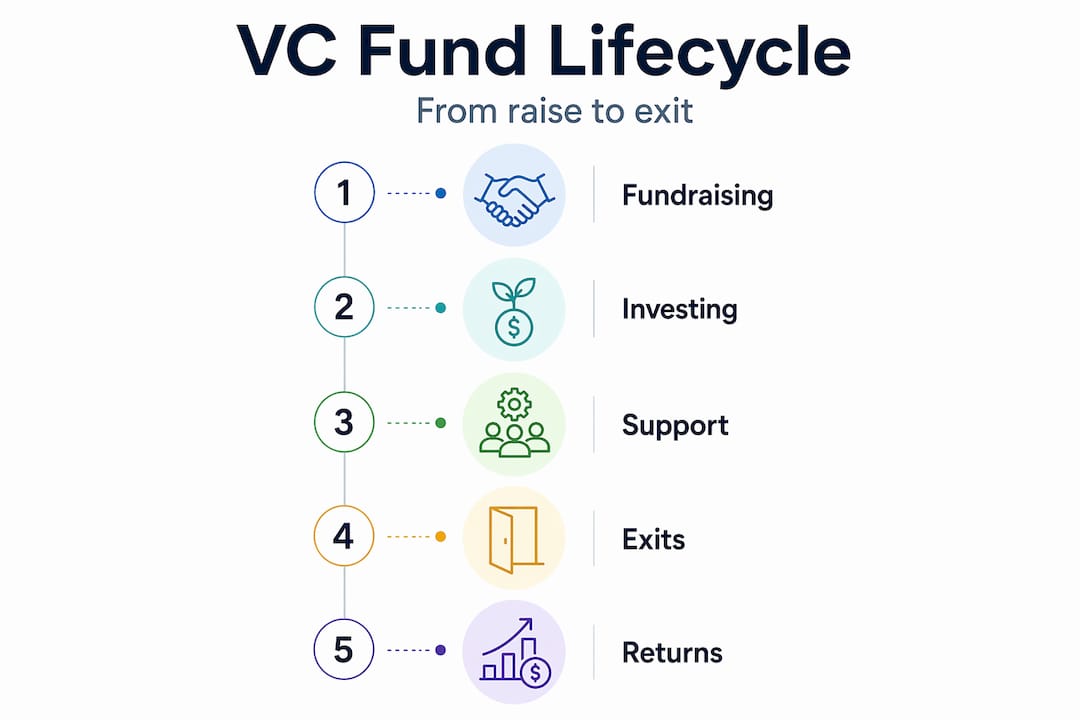
VC funds have a 10 to 12 year lifecycle. During the first three to five years, GPs deploy capital into portfolio companies. The next phase is supporting those companies as they grow. The final phase is harvesting returns through acquisitions or IPOs. Early in the fund’s life, the J-curve effect kicks in: fees and investments create negative net returns before any exits occur. Patience is structurally built into the model, but that doesn’t mean GPs are patient with your growth rate.
Here’s the detail most founders miss. VC returns follow a power law: roughly 80% of total returns come from 20% of investments. GPs know that most of their bets will fail or return less than invested capital. Over 40% of startups in vintage funds returned less than the capital put in. This means VCs aren’t looking for decent outcomes. They need at least one company in their portfolio to return the entire fund, which pushes them to seek massive, category-defining exits.
| Fund mechanic | What it means for founders |
|---|---|
| 2% management fee | GPs are compensated regardless of performance, so they are incentivized to deploy capital |
| 20% carried interest | GPs profit only from winners, driving pressure for outsized exits |
| 10-year fund lifecycle | Your exit timeline must fit within the fund’s window |
| Power law returns | VCs need one company to return 10x or more the entire fund |
| J-curve effect | Early fund returns look negative; patience is built in but limited |
Pro Tip: Ask any prospective VC what year their current fund was raised. A fund in year seven has a much shorter runway for supporting you than one in year two, and that changes the pressure they’ll place on your exit timeline.
What VCs actually look for in founders and startups
Understanding venture capital terminology is one thing. Knowing what makes a VC say yes is another. VCs evaluate startups on market potential, team trustworthiness, traction, competitive edge, and exit potential. Let’s break each one down honestly.

Market size is non-negotiable. VCs need to believe your company could capture a large enough share of a large enough market to return their fund. A $10 million business, even a profitable one, won’t move the needle for a $200 million fund. If your total addressable market is under $1 billion, most institutional VCs won’t be interested, regardless of how good your product is.
Team quality often matters more than the idea itself, especially at the early stage. Investors bet on people who can adapt, recruit, and execute under pressure. A brilliant concept with a first-time team often loses to a proven team working on a good concept.
Here’s what founders often overlook when preparing to pitch:
- Traction beats projections. Revenue, active users, signed letters of intent, or measurable retention all outperform slides filled with hockey-stick forecasts.
- Competitive edge must be defensible. Proprietary technology, exclusive partnerships, regulatory moats, or strong network effects qualify. “We’ll be better” does not.
- Exit clarity signals maturity. VCs want to know you’ve thought about IPO or acquisition outcomes, not because they’re cynical, but because it shows you understand the game.
- The 100/10/1 rule is real. From 100 startup pitches, roughly 10 advance to serious due diligence, and only one gets funded. Know that going in.
Pro Tip: Before pitching, map your competitive landscape and identify at least two acquirers who would pay a premium for your company at scale. Mentioning this in your pitch signals you understand how VCs get paid, and that kind of fluency earns respect fast.
Specialized alignment also matters more than founders expect. Physician-led VC investments in healthcare, for example, provide clinical insights that generalist funds simply can’t replicate. If you’re in a complex vertical like biotech, fintech, or deep tech, targeting sector-specific investors dramatically improves your chances.
How VC funding changes your company, not just your bank account
Raising VC is not just a financial event. It restructures your company’s ownership, accountability, and operational DNA. Founders who understand this before signing are far better positioned than those who figure it out afterward.
Here’s a practical breakdown of how your world changes after closing a round:
-
Equity dilution begins immediately. If you own 80% of your company before a seed round and raise $2 million at a $8 million pre-money valuation, you’ll own roughly 64% after. Add a Series A, and that can drop to 40% or lower. Each round dilutes further.
-
Board seats shift control. Most seed deals don’t transfer board control, but Series A and B rounds often include preferred board seats for investors. This means major decisions, including hiring and firing the CEO, require investor approval.
-
The pressure to scale becomes structural. VC fund economics drive GPs to seek massive exits rather than steady growth. That pressure becomes your pressure. Quarterly board meetings will reflect that urgency.
-
Hiring gets harder, not easier. Candidates scrutinize strike price, upside potential, and the risk of down rounds when evaluating equity packages. After a highly publicized raise, top talent may actually be more skeptical, not less.
-
Cap table transparency becomes a competitive advantage. Founders who master equity math and can explain valuation clearly build credibility with both hires and future investors. Candidates who ask hard questions deserve direct answers, and being prepared for those conversations separates great founders from overwhelmed ones.
-
Deep diligence in later rounds focuses heavily on your cap table. Founders who can’t explain their capitalization structure clearly risk losing credibility at the worst possible moment.
Understanding these realities before you raise puts you in control of the conversation. Consider working with a startup attorney and a financial advisor to model dilution scenarios across multiple funding rounds before you commit to a term sheet.
Navigating VC in 2026: trends and tips for founders
The current environment for venture funding is both exciting and highly concentrated. US VC funding surged 178% year-over-year in early 2026, with the US accounting for 80% of global VC funding value between January and April 2026. That sounds like great news. But look closer and you’ll see the money is flowing to a narrow slice of the market.
AI startups captured the lion’s share of that capital, making non-AI founders work harder to compete for attention. If your company is not AI-native, you need a sharper pitch that connects your market to where technology is heading or clearly distinguishes why your vertical commands premium returns without it.
For most seed-stage founders, the practical reality is this: seed rounds typically range from $500,000 to $5 million depending on sector competitiveness, with check sizes between $500,000 and $2 million and a six to twelve week timeline to a term sheet. That’s faster than many founders expect. Being prepared before you start the process isn’t a nice-to-have. It’s table stakes.
A few tips that actually move the needle when approaching VCs in this environment:
- Research each firm’s recent portfolio to confirm your sector fits their current thesis. A fund that just deployed heavily into logistics won’t have appetite for another logistics bet, regardless of how strong your pitch is.
- Work with specialized advisors who understand your sector’s regulatory and commercial landscape. Generalist advisors miss nuances that specialized investors will probe hard.
- Build your startup marketing strategy before you close the round. VCs want to see go-to-market clarity, not just product vision.
- Use cap table modeling tools to understand how each round affects your exit outcomes. Tools like Carta and Pulley make this accessible even for non-finance founders.
Pro Tip: Treat your investor pipeline like a sales funnel. Track every outreach, follow-up, and conversation in a spreadsheet or CRM. VCs talk to each other. A warm intro that converts reflects well on you; cold outreach that goes nowhere often disappears into the noise.
The AI wave in digital marketing is also directly relevant to how you present your company online. Startups that leverage AI-driven marketing strategies build credibility with investors who want to see sophisticated growth thinking before the money lands.
My honest take on what nobody warns founders about
I’ve spent years watching founders celebrate their funding announcements, and then quietly struggle six months later. The pattern is remarkably consistent. The raise felt like the finish line. It was actually the starting gun for a much harder race.
What I’ve found is that the operational challenges post-funding are underestimated almost universally. Hiring is the one that blindsides people most. You’d think a big round makes recruiting easier. In my experience, it actually raises the stakes for every conversation. Candidates do their homework now. They ask about your valuation, your runway, your cap table structure. If you can’t answer confidently and transparently, you lose the candidate you needed most.
The other thing I’ve seen consistently is founders who didn’t truly internalize what they agreed to when they took VC money. VC fund economics mean your investors need a massive exit to justify their fund’s returns, and they will push you toward decisions that serve that outcome, sometimes at the expense of what feels right for your company’s culture or pace. That’s not malicious. It’s math. But founders who understand that dynamic going in can have honest conversations about it. Founders who discover it too late feel blindsided.
My advice is to read your term sheet with an attorney who works with founders, not just any corporate lawyer. Understand every protective provision and board consent requirement. And build your operational infrastructure, your hiring process, your financial reporting, and your culture before the money arrives. Because once it does, you’ll be too busy deploying it to build the foundation.
— Maayan
Build the digital presence your VC funding deserves
Securing venture capital is one milestone. Turning that capital into measurable growth online is what sustains it. At Seo-analytic, we work with funded startups that need to move fast without compromising on digital quality.

Whether you’re building your first company website or refreshing your digital presence to match your new scale, our guides walk you through every step. Start with website building basics tailored for US business owners, then explore our step-by-step website guide to align your online infrastructure with your investor narrative. A credible, well-built digital presence signals execution ability to investors, partners, and the customers you’re racing to acquire. Let Seo-analytic help you build it right from day one.
FAQ
What is venture capital in simple terms?
Venture capital is a type of private investment where professional investors fund early-stage startups with high growth potential in exchange for equity ownership. The goal is a large financial return through an eventual IPO or acquisition.
How does a VC fund make money?
VC firms charge a 2% annual management fee on committed capital and earn 20% of the fund’s profits as carried interest. GPs only receive that profit share after LPs have received their invested capital back plus a preferred return, typically around 8%.
What do VCs look for when evaluating a startup?
VCs prioritize large addressable markets, strong founding teams, evidence of traction, and a clear path to exit through IPO or acquisition. Scalability and a defensible competitive edge are equally critical factors.
How much equity do founders give up in a VC round?
Seed rounds typically result in 15% to 25% dilution for founders, with each subsequent round adding further dilution. After a Series A and B, founders commonly own 40% to 60% of their original stake, depending on valuation growth.
Is venture capital the right choice for every startup?
No. VC is designed for companies targeting billion-dollar markets with the potential for massive, fast exits. Founders building profitable, sustainable businesses at a smaller scale are often better served by bootstrapping, revenue-based financing, or angel investment.