

User experience in web design is everywhere and it shapes the way we connect with digital products every day. Some companies are now seeing a return of one hundred dollars for every single dollar spent on user experience improvements, which sounds almost unbelievable. Many think that UX is just about making things look pretty but it is really what separates forgettable websites from ones that people love to use and remember.
Table of Contents
- What Is User Experience In Web Design?
- Why User Experience Matters For Businesses
- How User Experience Influences Design Choices
- Key Principles Of Good User Experience In Web Design
- The Impact Of User Experience On Business Success
Quick Summary
| Takeaway | Explanation |
|---|---|
| User experience is essential for effective web design. | Good UX design creates intuitive and engaging websites that meet user needs and ensure satisfaction during interactions. |
| Investing in UX leads to financial returns. | Businesses gain significant advantages, including higher conversion rates and reduced costs, translating investment in UX into substantial revenue growth. |
| Understanding user behavior is critical. | Conduct user research to gather insights on needs and preferences; this informs design choices that enhance navigation and interaction. |
| Accessibility enhances user engagement. | A website must be usable by all, including people with disabilities; this expands the audience and improves brand image. |
| Continuous feedback improves user experience. | Gather and implement user feedback frequently to iteratively enhance website design and functionality, leading to greater user satisfaction. |
What is User Experience in Web Design?
User experience in web design represents a comprehensive approach to creating digital interfaces that are not just functional, but genuinely engaging and intuitive for users. At its core, this discipline focuses on understanding how people interact with websites and designing those interactions to be as smooth and satisfying as possible.
Defining the Core Concept
User experience (UX) goes beyond mere aesthetics. It encompasses the entire journey a user takes when navigating a website, including how easily they can find information, understand content, and complete desired actions. Boston.gov’s User Experience Toolkit emphasizes that effective UX design requires a deep understanding of user needs, behaviors, and potential challenges.
Key elements of user experience include:
- Usability: How easily users can navigate and interact with the website
- Accessibility: Ensuring the website can be used by people with diverse abilities
- Information Architecture: Organizing website content in a logical, intuitive manner
The Human-Centered Design Approach
Successful web design places human interaction at its center. This means continuously gathering and incorporating user feedback, observing how people actually use a website, and making iterative improvements. The goal is not just to create a visually appealing site, but to craft an experience that feels natural and meets users’ specific needs and expectations.
Designers achieve this by:
- Conducting user research and creating detailed user personas
- Performing usability testing to identify potential friction points
- Designing clear, predictable navigation paths
- Implementing responsive design that works across different devices
By prioritizing user experience, websites transform from static information repositories into dynamic, interactive platforms that genuinely connect with their audience.
The table below summarizes the fundamental components of user experience (UX) as outlined in the article, providing clear definitions for each element to support deeper understanding.
| Component | Definition |
|---|---|
| Usability | How easily users can navigate and interact with the website |
| Accessibility | Ensuring the website can be used by people with diverse abilities |
| Information Architecture | Organizing website content in a logical, intuitive manner |
| Clarity | Presenting information in a straightforward, uncluttered manner |
| Simplicity | Designing interfaces that require minimal cognitive effort |
| Consistency | Maintaining uniform design language throughout the website |
| Predictability | Creating navigation that meets user expectations |
| Performance | The speed, responsiveness, and smoothness of website interactions |
Why User Experience Matters for Businesses
User experience is not just a design concept but a critical business strategy that directly impacts revenue, customer satisfaction, and long-term organizational success. In today’s digital marketplace, businesses cannot afford to ignore the profound connection between user experience and their bottom line.
The Economic Impact of UX Design
According to Usability.gov, investing in user experience design delivers significant economic advantages. Companies that prioritize UX can see substantial returns, with every dollar invested in user experience potentially generating 100 dollars in return. This remarkable ROI stems from reduced development costs, increased customer retention, and higher conversion rates.
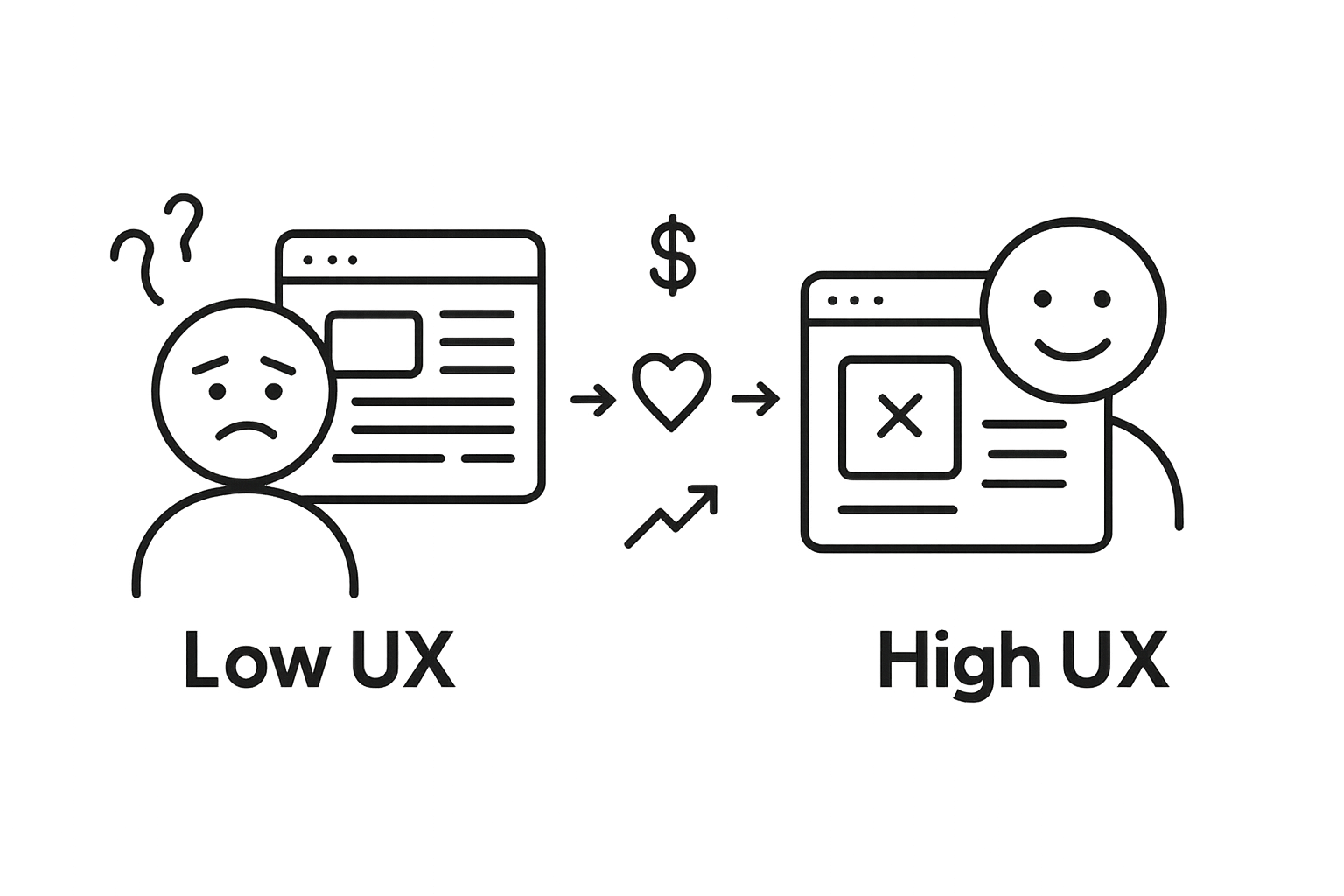
Key economic benefits include:
- Reduced customer support expenses
- Lower website abandonment rates
- Increased customer loyalty and repeat business
- Higher conversion rates and sales performance
Customer Behavior and Digital Expectations
Modern consumers have increasingly sophisticated digital expectations. A seamless, intuitive online experience is no longer a luxury but a fundamental requirement. Users quickly abandon websites that are difficult to navigate, slow to load, or visually unappealing. Businesses that fail to meet these expectations risk losing potential customers to more user-friendly competitors.
The psychological impact of good UX cannot be overstated. When users find a website easy to use, they develop positive associations with the brand, which translates into trust, credibility, and ultimately, customer loyalty.
Competitive Differentiation Through UX
In saturated markets, user experience becomes a powerful differentiator. While products and services might be similar across competitors, the quality of user interaction can set a business apart. Companies that invest in understanding and anticipating user needs create memorable digital experiences that resonate with their target audience.
Strategic UX design involves:
- Understanding user personas and behavioral patterns
- Creating intuitive navigation and interaction flows
- Designing consistent and responsive interfaces
- Continuously gathering and implementing user feedback
By treating user experience as a strategic priority, businesses transform their digital platforms from mere transactional spaces into engaging, customer-centric environments that drive growth and success.
How User Experience Influences Design Choices
User experience serves as the fundamental compass guiding design decisions, transforming websites from mere information displays into intelligent, user-centric digital environments. Design choices are no longer driven by aesthetic preferences alone, but by a deep understanding of human interaction and psychological engagement.
Principles of User-Centered Design
Jakob Nielsen’s Usability Heuristics provide a foundational framework for understanding how user experience directly shapes design strategies. These principles emphasize creating interfaces that are predictable, consistent, and intuitive.
Key design considerations include:
- Maintaining clear visibility of system status
- Providing users with freedom and control
- Designing for error prevention and recovery
- Ensuring consistency and standardization
- Minimizing user memory load
Psychological Foundations of Design Choices
Design choices are deeply rooted in understanding human cognitive processes and behavioral patterns. Designers must anticipate how users will perceive, interpret, and interact with digital interfaces. This involves studying visual hierarchy, information processing speed, attention spans, and emotional responses to different design elements.
Critical psychological factors influencing design include:
- Color psychology and emotional triggers
- Cognitive load management
- Visual perception and information processing
- Emotional engagement and user motivation
Adaptive and Inclusive Design Strategies
Modern user experience design transcends one-size-fits-all approaches. Designers now prioritize creating flexible interfaces that accommodate diverse user needs, abilities, and technological contexts. This means developing responsive designs that work seamlessly across different devices, screen sizes, and user capabilities.
Inclusive design strategies focus on:
- Creating accessible interfaces for users with disabilities
- Developing responsive and adaptive layouts
- Supporting multiple interaction methods
- Providing clear, comprehensible navigation paths
By placing user experience at the core of design decisions, businesses create digital platforms that are not just functional, but genuinely engaging and meaningful to their audience.
Key Principles of Good User Experience in Web Design
User experience in web design transcends visual aesthetics, requiring a holistic approach that prioritizes human interaction, functionality, and intuitive navigation. The goal is to create digital environments that feel natural, accessible, and effortlessly engaging for users across different devices and contexts.
Fundamental Design Usability Principles
ECPI University highlights critical principles that form the backbone of exceptional web design. These principles are not just technical guidelines but a philosophy of putting user needs at the forefront of digital experiences.
Key usability principles include:
- Clarity: Presenting information in a straightforward, uncluttered manner
- Simplicity: Designing interfaces that require minimal cognitive effort
- Consistency: Maintaining uniform design language throughout the website
- Predictability: Creating navigation that meets user expectations
- Accessibility: Ensuring the website is usable by people with diverse abilities
User-Centered Information Architecture
Effective web design requires thoughtful organization of information that anticipates and supports user goals. This means creating intuitive pathways that guide users seamlessly toward their desired outcomes. Information should be structured logically, with clear hierarchies and meaningful categorizations that reflect how users naturally think and search.
Critical considerations for information architecture include:
- Logical content grouping
- Clear and descriptive navigation labels
- Intuitive menu structures
- Efficient search functionality
- Contextual links and related content recommendations
Performance and Interaction Design
Beyond visual appeal, user experience heavily depends on website performance and interaction quality. Users expect rapid load times, smooth transitions, and responsive interfaces that work consistently across different devices. Interaction design focuses on creating digital experiences that feel fluid, responsive, and emotionally satisfying.
Strategic performance considerations involve:
- Minimizing page load times
- Creating responsive mobile designs
- Implementing smooth micro-interactions
- Providing clear feedback for user actions
- Designing adaptive interfaces
By embracing these principles, web designers transform websites from static information repositories into dynamic, user-centered experiences that genuinely connect with and support their audience.
The Impact of User Experience on Business Success
User experience has transformed from a design concept to a critical business strategy that directly influences organizational performance, customer loyalty, and long-term competitive advantage. In the digital age, businesses that prioritize seamless, intuitive user interactions create powerful pathways to sustainable growth and market differentiation.
Economic Value of Exceptional User Experience
The Maryland Institute College of Art highlights that investing in user experience is not merely an aesthetic choice but a strategic business decision with measurable financial implications. Businesses that develop sophisticated, user-centric digital platforms can significantly enhance their economic performance and market positioning.
Key economic benefits include:
- Increased conversion rates
- Reduced customer acquisition costs
- Higher customer retention percentages
- Enhanced brand reputation and perceived value
- Lower customer support and technical intervention expenses
Psychological Dimensions of User Interaction
User experience extends beyond functional design, encompassing the emotional and psychological responses users have when interacting with digital platforms. Successful businesses understand that each interaction represents an opportunity to build trust, demonstrate value, and create lasting positive associations with their brand.
Psychological factors influencing business success include:
- Creating positive emotional connections
- Building user confidence through predictable interactions
- Reducing user frustration and cognitive load
- Establishing a sense of brand reliability
- Encouraging repeat engagement
Competitive Differentiation Through User Experience
In saturated markets where products and services often appear similar, user experience becomes a decisive competitive advantage. Companies that invest in understanding and anticipating user needs can distinguish themselves by creating more engaging, efficient, and memorable digital interactions.
Strategic approaches to competitive differentiation include:
- Conducting continuous user research
- Implementing personalization strategies
- Developing adaptive and responsive interfaces
- Prioritizing accessibility and inclusive design
- Leveraging user feedback for iterative improvements
By treating user experience as a core business strategy, organizations can transform digital platforms from transactional spaces into powerful tools for building meaningful, long-lasting customer relationships.
This table highlights the economic and psychological benefits businesses gain from investing in user experience, helping readers quickly compare ways UX impacts organizational success.
| Type of Benefit | Description |
|---|---|
| Economic | Increased conversion rates, reduced support and development costs |
| Economic | Higher customer retention, repeat business, and sales performance |
| Economic | Enhanced brand reputation and perceived value |
| Psychological | Positive emotional connections and increased user trust |
| Psychological | Lower user frustration and improved confidence in brand reliability |
| Psychological | Encouragement of repeat engagement and long-term loyalty |

Transform Your User Experience into Real Business Growth
Are visitors struggling to find what they need on your website? Many brands face missed opportunities because their digital presence lacks the seamless, intuitive user experience discussed in this article. If you want your website to be more than an online brochure and truly convert visitors into loyal customers, you need a partner who understands how usability, accessibility, and conversion-focused design work together.
Let our experts at seo-analytic.com help you put proven user experience principles into action. We specialize in building websites that make navigation effortless and keep customers engaged on any device. Take the first step toward higher conversions and lasting business success by contacting us now. Your next loyal customer could be just one great digital experience away.
Frequently Asked Questions
What is user experience (UX) in web design?
User experience in web design focuses on creating engaging and intuitive digital interfaces that enhance how users interact with websites. It involves understanding user needs, behaviors, and creating smooth interactions.
Why is user experience important for a business?
User experience is critical for businesses as it directly affects customer satisfaction, loyalty, conversion rates, and overall revenue. A positive UX can generate significant returns on investment, making it a vital aspect of digital marketing strategy.
How do design choices impact user experience?
Design choices affect user experience by influencing how intuitive, predictable, and accessible a website is. Good design considers user behaviors and psychological factors, making interactions seamless and engaging, which enhances overall satisfaction.
What are some principles of good user experience in web design?
Key principles of good user experience include clarity, simplicity, consistency, predictability, and accessibility. These principles help create effective navigation paths and information architectures that facilitate user interactions.