

TL;DR:
- The ‘think global, act local’ principle emphasizes balancing global industry trends with specific community and cultural conditions. Failure to authentically engage locally or align with global values risks reputational damage and superficial impact. Successful strategies involve deep community understanding, genuine partnerships, local adaptation within brand values, and continuous measurement of social and business outcomes.
Most business owners hear “think global act local” and picture a multinational slapping a local flag on its website. That’s not the concept. The real principle asks you to hold two things in your head at once: the broader forces reshaping your industry worldwide and the specific community, culture, and conditions where you actually operate. Get that balance right, and you build a business that’s both scalable and deeply trusted. Get it wrong, and you end up with a strategy that fits nowhere perfectly.
Table of Contents
- Key takeaways
- Think global act local: where the idea came from
- Real risks when acting locally goes wrong
- Strategies and models that actually work
- How to act locally with a global mindset
- Measuring the impact of your global-local strategies
- My take on why local depth beats local breadth
- How Seo-analytic helps you execute global-local marketing
- FAQ
Key takeaways
| Point | Details |
|---|---|
| Global thinking, local doing | Use global trends as a lens, but make every decision through the filter of your specific local market. |
| Community over sponsorship | Authentic engagement builds network density of real relationships, not transactional brand presence. |
| Ethical alignment matters | Local adaptations must stay within your global brand values or they create long-term reputational risk. |
| Measure what you localize | Track community satisfaction and sustainability metrics alongside revenue to assess true local impact. |
| Informal networks are assets | Connecting to existing local networks beats designing solutions the community never asked for. |
Think global act local: where the idea came from
The phrase has a longer history than most people realize. It originated not in corporate boardrooms but in urban planning and environmental advocacy during the 1970s, when thinkers like Patrick Geddes and later environmentalists wrestled with a specific problem: how do you apply universal ecological principles without flattening the local conditions that make solutions actually work?
“Thinking globally while acting locally requires constant intellectual calibration to avoid parochialism and generic solutions.” (Sustainability Directory)
That calibration is the whole point. The principle was never about creating a global template and translating it into local languages. It was about recognizing that global problems, whether environmental degradation, inequality, or economic fragility, can only be solved through actions that are grounded in local specificity. A policy that works in Berlin may fail entirely in Nairobi not because the goal is wrong but because the conditions are different.
For business owners, the intellectual evolution of this idea matters because it reframes what “going global” actually means. Globalization didn’t make local context irrelevant. It made understanding local context more valuable, because the businesses that win globally are the ones that calibrate global standards with local realities rather than ignoring them. The companies that treat markets as interchangeable are the ones that eventually get disrupted by someone who actually listened to the community.
Real risks when acting locally goes wrong
Acting locally is not automatically a good thing. This is where most entrepreneurs stumble. They interpret “act local” as permission to do whatever sells in a given market, and that’s where the ethical floor can drop out.
Unethical local adaptations can directly conflict with a company’s global brand values, and the reputational damage travels fast. A pricing practice that seems acceptable in one region might read as exploitative when reported on globally. A marketing message tailored to local humor might offend the brand’s broader audience. These aren’t hypothetical risks.
Here are the most common failure modes entrepreneurs run into:
- Overgeneralizing a local market. Assuming that because a strategy worked in one city, it applies across an entire country or region. Local cultures are granular, not monolithic.
- Mistaking proximity for understanding. Hiring a local manager doesn’t replace genuine cultural anthropological research into local sentiment and behavior.
- Treating local communities as cost centers. Running token sponsorships or surface-level CSR programs while extracting value from a market creates resentment, not loyalty.
- Standardizing everything for efficiency. Global brand consistency matters, but the tension with local customization is real. Resolving it by defaulting to standardization usually leaves money and trust on the table.
Pro Tip: Before adapting any product, message, or practice for a local market, run it through your global brand values as a checklist. If a local adaptation requires compromising on any of them, it’s not worth the short-term gain.
Strategies and models that actually work
The companies doing this well share a pattern: they treat local engagement as infrastructure, not marketing. They build before they need to sell.

The IKEA and WWF partnership is one of the strongest documented examples of global-local alignment at scale. Over a 23-year collaboration, the two organizations trained 400,000 farming families and protected 75% of virgin forests in the Carpathian region. That result didn’t come from a single global program applied uniformly. It came from adapting conservation and sourcing practices to the specific ecological and social conditions of each region.
L’Oréal took a different route but achieved similar logic with its supplier network. Through its “Spread the Best Practices” program, L’Oréal engaged 1,900 suppliers globally via a centralized platform to share sustainability methods and accelerate Scope 3 emission reductions. The key was using a global knowledge-sharing framework while letting local suppliers apply the practices in ways relevant to their own operations.
The comparison below shows what separates high-impact global-local strategies from superficial ones:
| Approach | What it looks like | Typical outcome |
|---|---|---|
| Superficial localization | Translating ads, adding local images | Short-term awareness, low loyalty |
| Authentic community engagement | Co-creating with local stakeholders | Long-term trust and brand advocacy |
| Sustainability integration | Embedding local environmental priorities into supply chain | Reduced risk, stronger supplier relationships |
| Knowledge network model | Sharing global best practices through local adapters | Scalable impact without imposing uniformity |
The World Bank’s Framework for Financial Incentives offers another model worth understanding. It provided up to $28 million to countries like Tunisia by tying local investment in pandemic preparedness to global public benefit. The practical lesson for business owners: when you structure incentives so that local priorities and global outcomes reinforce each other, participation becomes self-sustaining rather than dependent on external pressure.
Pro Tip: When evaluating a global-local strategy, ask whether local communities would choose to participate even if your company left tomorrow. If the answer is no, you’ve built dependency, not alignment.
How to act locally with a global mindset
Getting this right operationally requires a specific sequence. Here’s a framework you can actually use:
-
Map your local market with real ethnographic attention. Demographics tell you who lives there. Observation tells you how they make decisions. Visit in person. Talk to community members, not just customers. Read local media. This is building genuine cultural insight rather than importing assumptions.
-
Identify existing informal networks before designing new ones. Entrepreneurs consistently make the mistake of building new systems when local communities already have functioning informal networks. Connecting those networks to your value chain is nearly always more effective than replacing them with a technical solution nobody asked for.
-
Build partnerships that share value, not just visibility. A true local partnership means the community partner gains something durable. Revenue sharing, capacity building, or co-ownership models work. Logo placements do not.
-
Weave sustainability standards through your local supply chain. Don’t treat sustainability as a global marketing claim. Apply it at the sourcing level, locally. This is where sustainable marketing practices create real differentiation, because it’s visible and verifiable to the communities that matter.
-
Use digital tools to share knowledge, not just broadcast content. Platforms that enable your local teams or partners to share what they’re learning with other regions multiply impact without requiring central coordination. This is what separates a global mindset from global control.
-
Revisit your local strategy on a defined cycle. Markets shift. Communities evolve. What worked in 2023 may not fit 2026. Build a regular review cadence tied to local feedback, not just global reporting cycles.
Pro Tip: For businesses with multiple locations, consider international digital marketing frameworks that allow each location to customize campaigns within defined brand guardrails. You get consistency and local relevance at the same time.
Measuring the impact of your global-local strategies
You cannot refine what you don’t measure. The challenge with global awareness local action strategies is that they produce both quantitative and qualitative outcomes, and you need both to understand what’s actually happening.
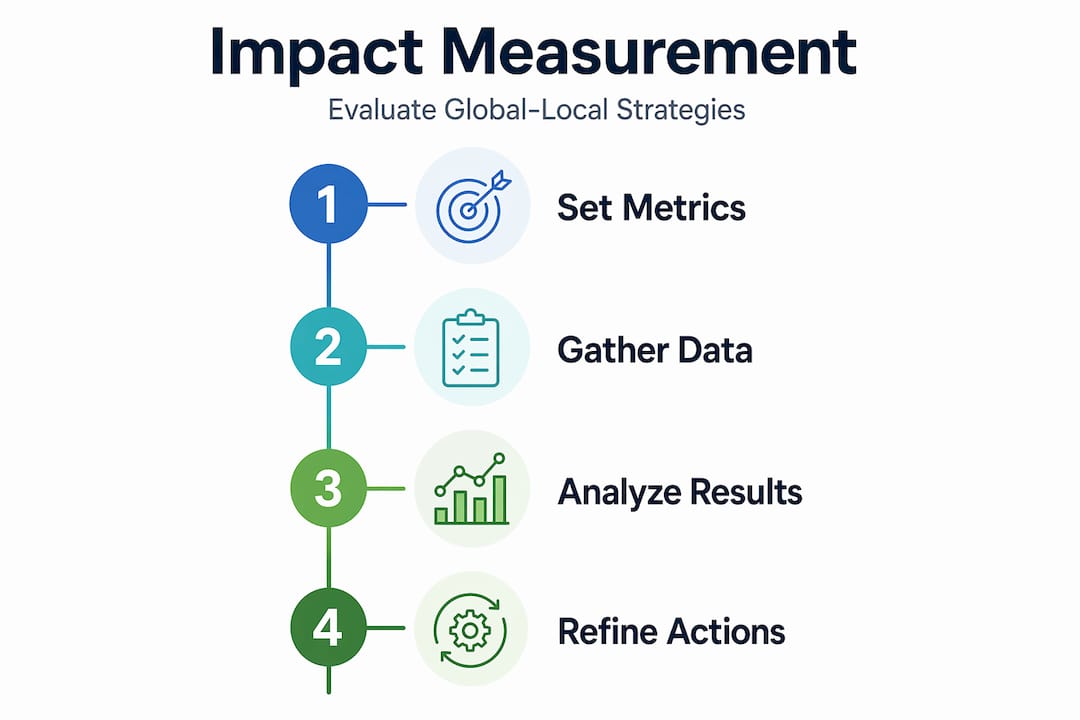
Here’s a practical breakdown of what to track:
| Metric category | What to measure | Why it matters |
|---|---|---|
| Community engagement | Local event participation, partnership retention rates | Reveals depth of trust, not just reach |
| Sustainability impact | Scope 3 emissions, supplier sustainability scores | Tracks supply chain accountability |
| Local brand sentiment | Reviews, local press mentions, community feedback | Shows cultural alignment over time |
| Business outcomes | Local revenue growth, customer retention by region | Connects community investment to financial performance |
Beyond the numbers, qualitative feedback loops matter enormously. Conduct regular conversations with local partners and community members, not just customer satisfaction surveys. The most revealing signals about whether your community impact on global change strategy is working often come from informal conversations, not dashboards.
A few specific practices sharpen your measurement:
- Set baseline metrics before launching a local initiative, so you can demonstrate change rather than just report a snapshot.
- Separate metrics by region. Aggregated global data hides local failures and local successes equally.
- Use qualitative data to explain anomalies in quantitative data. A sudden drop in local engagement rarely has a purely numerical explanation.
My take on why local depth beats local breadth
I’ve worked with business owners who’ve stretched their global-local strategies across a dozen markets simultaneously and wondered why none of them took root. Here’s what I’ve found: depth in two or three local communities consistently outperforms surface-level presence in ten.
When you go deep, you build what researchers call network density. Your brand becomes woven into the local fabric rather than sitting on top of it. People defend you in conversations you never see. They recommend you unprompted. That kind of loyalty doesn’t come from a localized ad campaign. It comes from building online communities through genuine investment in what the local community actually cares about.
What I’ve seen fail, repeatedly, is the “global first, local as an afterthought” model. A company defines its strategy at headquarters, translates the content, and calls it localized. The local team has no authority to adapt anything meaningful. The community senses the distance immediately.
My honest advice: give your local leads real decision-making power within a clearly defined ethical and brand framework. The global structure provides the guardrails. Local insight drives the vehicle. That’s the only model I’ve seen produce both community loyalty and sustainable business growth over time.
— Maayan
How Seo-analytic helps you execute global-local marketing
Building a global-local strategy is one thing. Having the digital infrastructure to support it is another.
At Seo-analytic, we work with business owners who are ready to move beyond generic campaigns and build marketing systems that actually respond to local market conditions. Whether you’re starting with digital marketing basics or scaling a multi-location brand, our team builds websites optimized for local discovery, social media strategies tailored to specific community behavior, and high-impact digital marketing teams capable of managing both global consistency and local personalization. If you’re serious about turning global-local strategy into measurable results, Seo-analytic gives you the tools and expertise to make it real.
FAQ
What does “think global act local” mean for business owners?
It means using global market awareness and industry trends to inform your strategy, while making decisions that reflect the specific cultural, social, and economic conditions of each local market where you operate.
What are the biggest risks of acting locally without a global framework?
Local adaptations made without alignment to your global brand values can create ethical conflicts and reputational damage, particularly when local practices that seem acceptable in one region contradict your broader brand standards.
How do successful companies balance global standards with local needs?
Companies like McDonald’s adapt menus regionally while preserving global brand identity. The key is defining what must stay consistent globally, such as quality and values, and what can flex locally, such as products and messaging.
How do I measure the success of a local community strategy?
Track a combination of community engagement metrics (partnership retention, local sentiment), sustainability indicators (Scope 3 emissions, supplier scores), and business outcomes (regional revenue, customer retention), then use qualitative feedback to explain what the numbers alone cannot.
Why do informal local networks matter for entrepreneurs?
Informal networks represent existing trust structures within a community. Connecting to those networks rather than replacing them with new systems is faster, cheaper, and far more likely to generate genuine community buy-in.