

TL;DR:
- Small business SEO improves website rankings and local listings to attract qualified customers without ongoing ad costs.
- Focusing on local SEO fundamentals, technical site health, and consistent content builds lasting search visibility and traffic.
SEO for small business owners is the practice of improving a website and related local listings to rank higher in organic search and attract qualified customers without ongoing ad costs. Unlike paid search ads that stop delivering the moment your budget runs out, SEO builds lasting traffic that compounds over time. The core tools are Google Search Console, Google Business Profile, and a well-structured website. This guide covers everything from local SEO foundations to technical performance, written specifically for US-based business owners who want real results without a full-time marketing team.
What is SEO for small business owners and why does it matter?
SEO for small businesses means optimizing your website and Google Business Profile to appear in organic and local search results relevant to your services. When someone searches “plumber near me” or “best bakery in Austin,” Google decides which businesses to show based on relevance, prominence, and proximity. Your job is to make sure Google has every reason to pick you.
The key difference between SEO and paid search (SEM) is simple. SEM puts you at the top of results instantly, but you pay for every click. SEO takes longer to build, but the traffic it generates costs nothing per visit once you rank. For a small business with a limited marketing budget, that distinction matters enormously.
SEO for SMBs aims to increase organic visibility with sustainable traffic growth, which differs from SEM that focuses on paid ads and short-term results. A well-optimized business can hold a top local ranking for months or years with only routine maintenance. That is the kind of return on effort that paid ads simply cannot match.
How to build a strong local SEO foundation for your small business
Local SEO is the fastest path to visible results for most small businesses. Google’s local ranking results are based on relevance, distance, and prominence, which means a fully completed Google Business Profile and consistent business details across the web are non-negotiable starting points.
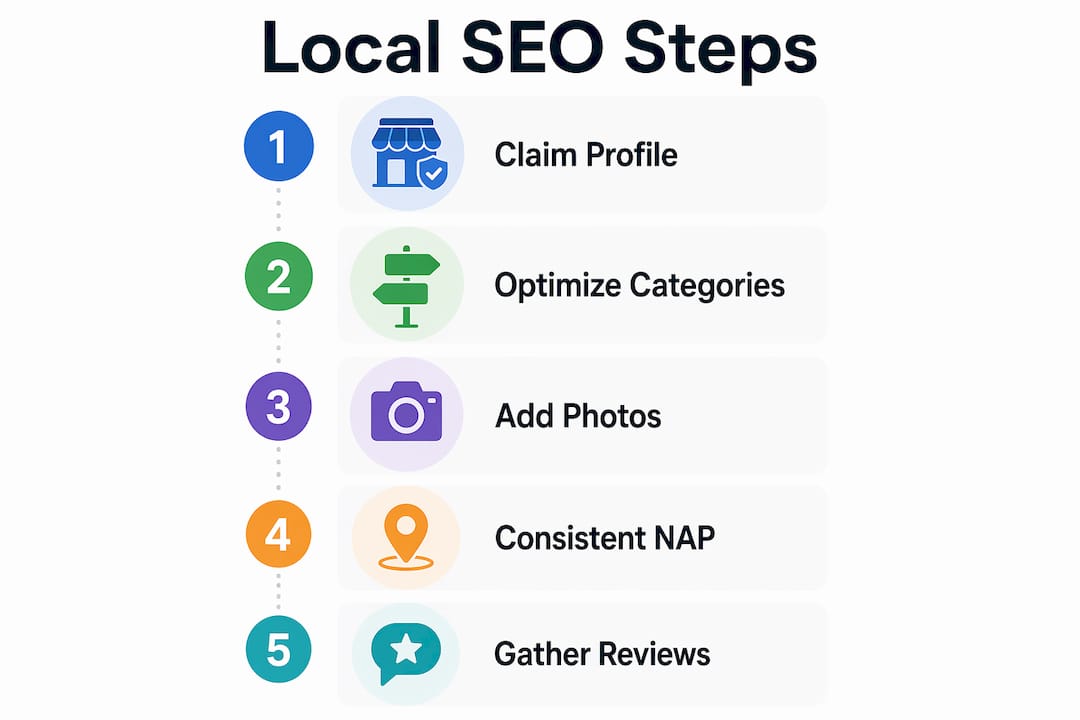
Follow these steps to build your local SEO foundation:
- Claim and complete your Google Business Profile. Fill in every field: business category, services list, hours, phone number, website URL, and at least 10 photos. Incomplete profiles rank lower, full stop.
- Keep your NAP consistent. Your Name, Address, and Phone number must appear identically on your website, Google Business Profile, Yelp, Facebook, and every other directory where your business is listed. Even small variations confuse Google’s algorithms.
- Earn and respond to reviews. Reviews are a direct local ranking signal. Ask satisfied customers to leave a Google review, and respond to every review you receive, positive or negative. Engagement signals to Google that your business is active.
- Create location-specific service pages. A plumber in Chicago should have a page titled “Plumbing Services in Chicago” rather than a generic “Services” page. Aligning your GBP categories and services with your website pages reinforces relevance for both Maps and organic results.
- Audit your listings monthly. Check that your hours are current, especially around holidays. Outdated information is one of the most common and most damaging local SEO mistakes.
Pro Tip: Top local SEO performers align GBP categories and website pages so closely that Google can verify your business details from multiple sources at once. That cross-referencing boosts your local ranking signals significantly.
What on-page and content strategies actually work for small businesses?
Content is where many small business owners either win big or waste months of effort. The mistake most owners make is targeting too many broad keywords at once. Starting with a focused set of 10–20 high-intent keywords is the recommended approach for small businesses to match customer search intent and create relevant content.
Effective on-page SEO for your business comes down to these priorities:
- Write service pages that match searcher intent. A customer searching “emergency roof repair Denver” wants a page that confirms you do emergency repairs in Denver, shows your phone number prominently, and includes real photos of your work. Generic service pages do not convert.
- Optimize title tags and meta descriptions. Your title tag is the blue link in Google search results. Keep it under 60 characters, include your primary keyword, and make it specific. Your meta description should be 150–160 characters and give searchers a reason to click.
- Use internal linking. Link from your homepage to your service pages, and from blog posts back to relevant service pages. Internal links help Google understand your site structure and keep visitors on your site longer.
- Write in your customers’ language. Use the words and phrases your customers actually type into Google, not industry jargon. If your customers say “water heater replacement” rather than “hydronic system installation,” your pages should say the same.
- Publish FAQs and blog posts regularly. Fresh content signals to Google that your site is active. A monthly blog post answering a common customer question is one of the most affordable SEO strategies available to any small business.
Pro Tip: Use Google’s “People also ask” box for your target keyword to find the exact questions your customers are searching. Answer those questions directly on your service pages or in a dedicated FAQ section.
What technical SEO basics does every small business owner need to know?
Technical SEO is the part of search optimization that most small business owners ignore until something goes wrong. Getting the basics right protects your rankings and improves the experience for every visitor who lands on your site.

Mobile-first indexing means Google primarily uses the mobile version of your site to determine rankings. If your site looks broken on a phone, your rankings suffer regardless of how good your content is. Check your site on multiple devices every time you make a significant change.
Google measures site performance through Core Web Vitals, three specific metrics with clear thresholds:
- LCP (Largest Contentful Paint): The main content of a page should load in 2.5 seconds or less.
- INP (Interaction to Next Paint): Your site should respond to user input within 200 milliseconds.
- CLS (Cumulative Layout Shift): Visual elements should not shift unexpectedly; the score should stay at 0.1 or below.
Websites with fast load times under 2 seconds are favored by search engines. Practical fixes include compressing images, converting them to WebP format, and removing scripts that block page rendering. You can find all of these issues flagged inside Google Search Console under the Core Web Vitals report.
Clear URL structures also matter. A URL like yoursite.com/services/roof-repair-chicago tells both Google and your visitors exactly what the page covers. A URL like yoursite.com/page?id=47 tells neither. Review your website crawling and indexability settings to make sure Google can reach every important page on your site.
How do you measure and improve SEO performance with Google Search Console?
Google Search Console is the primary tool for understanding how your site performs in search. CTR should be interpreted in context, not in isolation, but the Performance report gives you the four metrics that matter most: clicks, impressions, click-through rate, and average position.
A practical monthly SEO workflow looks like this:
- Open the Performance report. Filter by the last 28 days and compare it to the previous 28-day period. Look for pages where impressions stayed high but clicks dropped. That gap usually means your title tag or meta description stopped being compelling.
- Identify your best opportunities. Pages ranking in positions 8–15 are close to page one. A better title tag or a more thorough answer to the search query can push them into the top five.
- Check Core Web Vitals. The Core Web Vitals report shows which pages are failing performance thresholds. Fix the failing pages before adding new content.
- Review crawl errors. The Coverage report flags pages Google cannot access. A page Google cannot crawl is a page that cannot rank.
- Track trends over time. Google Search Console retains data for up to 16 months, which is enough to spot seasonal patterns and measure the impact of changes you made months ago.
Pro Tip: Sort your queries by impressions and look for keywords where you rank on page two but have hundreds of monthly impressions. Those are your fastest wins. Update the page’s title, add a paragraph that directly answers the query, and recheck in 30 days.
How do you balance SEO with paid marketing and keep it working long term?
SEO and paid search are not competitors. They serve different timelines. Paid ads deliver traffic today. SEO builds the foundation that keeps delivering traffic next year and the year after. The best approach for most small businesses is to run paid ads while building organic rankings, then reduce ad spend as SEO gains momentum.
Practical principles for managing SEO with limited resources:
- Focus on fundamentals first. A complete Google Business Profile, consistent NAP data, and a mobile-friendly website will outperform any advanced tactic if the basics are broken.
- Integrate SEO with your other channels. Share your blog posts on social media. Add your website URL to every business listing. Each channel reinforces the others.
- Avoid chasing algorithm updates. Google updates its algorithm hundreds of times per year. Businesses that focus on creating genuinely useful content and maintaining a technically sound site ride out updates far better than those chasing shortcuts.
- Keep content fresh. Update your service pages when your offerings change. Refresh blog posts with new information annually. Fresh content is cited more frequently by search engines and AI tools alike.
- Think in quarters, not weeks. SEO results typically take three to six months to become measurable. Set quarterly goals, track them in Search Console, and adjust your approach based on data rather than impatience.
Off-page SEO strategies like local citations, backlinks from local news sites or industry directories, and reputation management compound the on-page work you do and accelerate ranking gains over time.
Key Takeaways
SEO for small business owners works when you combine a fully optimized Google Business Profile, technically sound website, and consistent content creation focused on high-intent local keywords.
| Point | Details |
|---|---|
| Start with Google Business Profile | Complete every field and keep hours, photos, and services current to maximize local visibility. |
| Target 10–20 focused keywords | A tight keyword set prevents diluted efforts and aligns your content with actual customer searches. |
| Fix technical SEO first | Pass Core Web Vitals thresholds (LCP ≤2.5s, INP ≤200ms, CLS ≤0.1) before adding new content. |
| Use Search Console monthly | Track clicks, impressions, and CTR to find quick wins and catch performance drops early. |
| Treat SEO as a long-term asset | Organic rankings built on strong fundamentals outlast any paid campaign and reduce marketing costs over time. |
What I’ve learned after watching hundreds of small businesses approach SEO
Most small business owners I’ve worked with make the same mistake: they treat SEO as a one-time project rather than an ongoing practice. They spend a week updating their website, see no results in 30 days, and conclude that SEO doesn’t work for their type of business. That conclusion is almost always wrong.
The businesses that see real growth from SEO share one habit. They check Google Search Console once a month, make one or two targeted improvements, and repeat. No dramatic overhauls. No chasing the latest ranking trick. Just steady, informed maintenance. A restaurant owner who updates her Google Business Profile photos every month and responds to every review will outrank a competitor with a fancier website who ignores their profile entirely.
Local SEO is the single best entry point for most small businesses. The competition is lower than national SEO, the results are faster, and the customers you attract are already nearby and ready to buy. If you run a service business in a specific city or region, your Google Business Profile is worth more than almost any other SEO investment you can make.
The one thing I’d push back on from conventional SEO advice: don’t wait until your website is perfect to start. A good-enough website with a fully optimized Google Business Profile and 20 genuine reviews will outperform a beautiful website with no local presence. Start where you are, fix the biggest gaps first, and build from there.
— Maayan
How Seo-analytic helps small businesses build real SEO results
Small business owners who want to move faster than trial and error can afford to have a professional team in their corner. Seo-analytic specializes in website building, search engine optimization, and digital marketing tailored for US-based businesses at every stage of growth.
Whether you need to build an SEO-ready website from scratch or want expert guidance on your search engine optimization strategy, Seo-analytic offers practical, results-focused support. The team covers everything from Google Business Profile setup and mobile-friendly design to ongoing performance monitoring. If you’re ready to turn your website into a consistent source of qualified leads, Seo-analytic is built to help you get there.
FAQ
What is the first step in SEO for a small business?
Claim and fully complete your Google Business Profile, then set up Google Search Console. These two free tools give you the foundation for both local and organic search visibility.
How long does SEO take to show results for small businesses?
Most small businesses see measurable improvements in three to six months. Local SEO results, especially from Google Business Profile optimization, often appear faster than broader organic ranking gains.
Is local SEO different from regular SEO?
Local SEO focuses on ranking in Google Maps and location-based searches using Google Business Profile, NAP consistency, and localized website pages. Regular SEO targets broader organic rankings without a geographic focus.
How much does SEO cost for a small business?
Basic SEO using free tools like Google Search Console and Google Business Profile costs nothing except time. Hiring a professional agency or consultant typically ranges from a few hundred to several thousand dollars per month depending on scope.
What is the biggest SEO mistake small business owners make?
Neglecting mobile performance is the most damaging mistake. Google uses mobile-first indexing, so a site that performs poorly on phones will rank lower regardless of how strong the content is.