

TL;DR:
- Reputation management involves monitoring, influencing, and maintaining how your business is perceived online. It directly impacts revenue, as positive reviews increase trust and conversion rates.
Reputation management is the continuous process of monitoring, influencing, and maintaining how your business is perceived online by customers and stakeholders. It sits at the intersection of brand reputation strategy, customer experience, and digital visibility. 98% of consumers read online reviews for local businesses, and 93% made a purchase after reading them. A single star rating increase on Google or Yelp can generate 5–9% more annual revenue. For a business doing $1 million a year, that translates to $35,000–$63,000 in additional income without a single new ad.
What is reputation management and why does it drive revenue?
Reputation management is the formal discipline of shaping public perception through consistent messaging, review governance, and crisis response. The industry also refers to it as Online Reputation Management, or ORM. Both terms describe the same practice: controlling what people find and believe when they search for your business.

The revenue connection is direct and measurable. 87% of consumers use Google specifically to evaluate local businesses before making a decision. That means your Google Business Profile is often the first sales conversation you have with a prospect, and you are not in the room.
Negative reviews carry disproportionate weight. 63% of businesses report lost sales due to negative reviews in the last six months. A single unaddressed complaint can cost you more than a paid ad campaign earns. The math makes ORM a revenue function, not just a marketing task.
Consumers are also skeptical of perfection. A 5.0 star average with only 12 reviews reads as suspicious to most shoppers. Volume, recency, and response rate matter as much as the rating itself. Businesses that treat reviews as a living signal, not a vanity metric, consistently outperform those that do not.
How do online reviews shape customer trust and buying decisions?
Reviews function as social proof at the moment of highest purchase intent. A prospect searching for your service is already motivated. What they read in the next 30 seconds determines whether they call you or your competitor.
Star ratings affect more than perception. They affect cost. When your average rating rises, your conversion rate improves, which means you spend less per acquired customer. Fake and policy-violating reviews can cause a 15–20% rating drop within a week, and businesses lose up to $10,000 annually from fraudulent review activity. That is a direct hit to the bottom line, not a soft brand metric.
Review bombing, where a coordinated group floods your profile with negative ratings, is a specific threat that requires a documented response plan. Google and Yelp both have removal processes for reviews that violate their policies. Knowing those processes before an attack happens is the difference between a one-week problem and a three-month recovery.
The importance of online reviews for conversion extends beyond star ratings. Recency matters enormously. A business with 200 reviews from three years ago looks less trustworthy than one with 40 reviews from the last 90 days. Freshness signals that you are still active, still accountable, and still earning customer feedback.
Pro Tip: Ask for reviews within 24 hours of service completion. That is when the experience is freshest and the customer is most likely to respond.
What governance structures make reputation management work?
A governance-led approach treats your online reputation as a core business asset, not a task delegated to whoever manages social media that week. Without clear ownership, responses are inconsistent, escalations get missed, and your brand voice fractures across platforms.
The three pillars of reputation governance are:
- Identity guardrails. Define your brand promise, the proof points that support it, and the lines you will not cross in public communication. Every review response, press statement, and social post should reflect these.
- Role assignments. Marketing or communications owns the voice. Customer service handles the day-to-day response queue. Leadership and legal review escalations involving defamation, litigation risk, or media attention.
- Response playbooks. Write templated but personalized responses for common scenarios: a 1-star complaint, a 5-star compliment, a factually incorrect review, and a crisis-level public incident. Templates prevent panic-driven responses.
Proof content is the fourth pillar most businesses skip. Case studies, certifications, measurable outcomes, and third-party endorsements give your brand claims credibility. A promise without proof is just marketing copy. Proof content converts skeptics.
Internal training rounds out the structure. Customer-facing staff need to know what they can say publicly, what requires escalation, and how to document complaints that may become review content. Consistent branding across every channel reinforces the governance framework and prevents contradictory messaging.
How can you build, maintain, and recover your online reputation?
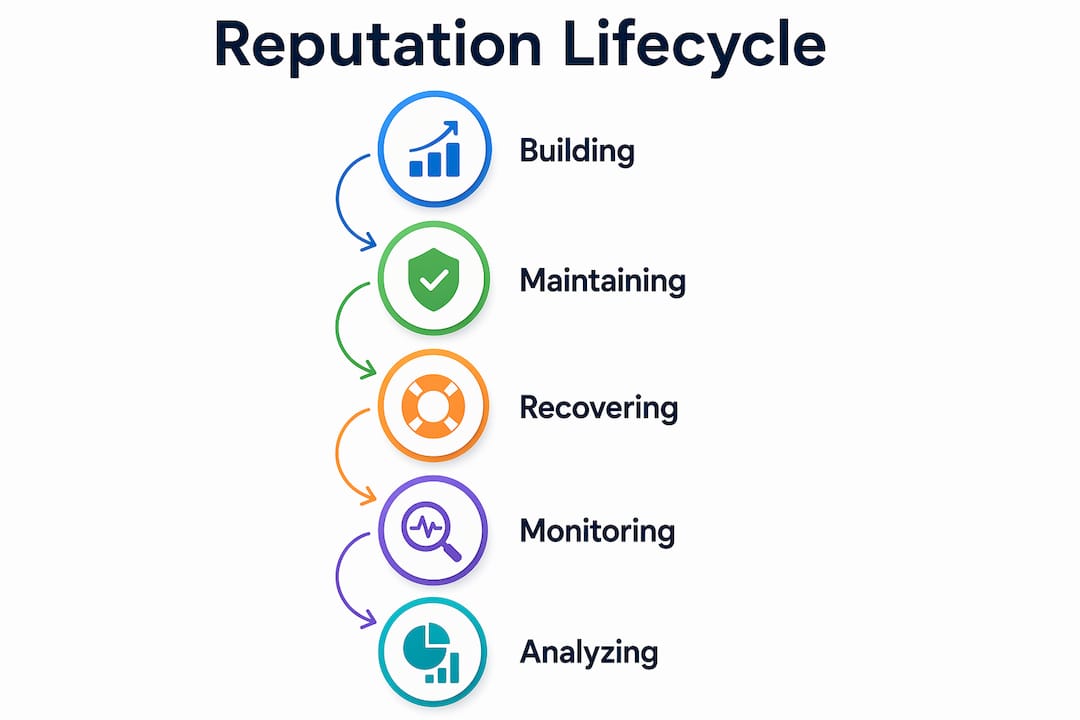
Reputation lifecycle management covers three phases: building, maintaining, and recovering. Most business owners only think about recovery after something goes wrong. The businesses with the strongest reputations invest in building and maintaining long before a crisis appears.
Building: generate authentic reviews at scale
Sending review requests shortly after service completion achieves the highest response rates. SMS outperforms email by 3:1 in many service verticals. Automate the request sequence using marketing automation tools so the timing is consistent regardless of staff workload.
Never incentivize reviews. Google and Yelp both prohibit it, and the risk of a policy violation removing your entire review history far outweighs any short-term gain. Ask genuinely, ask often, and make the process frictionless.
Maintaining: respond to every review
Businesses that respond to reviews within 24 hours report a 10–30% increase in booking requests. Speed signals accountability. A response does not need to be long. It needs to be personal, professional, and empathetic.
The goal of a review response is not to appease the original reviewer. It is to signal accountability to every future customer who reads the exchange. A calm, factual response to a hostile review often does more for your reputation than the original complaint did against it. Write for the audience, not the reviewer.
For responding to online reviews effectively, follow this sequence:
- Acknowledge the experience without admitting fault prematurely.
- Thank the reviewer for the feedback.
- Offer a specific resolution or next step.
- Keep the tone professional regardless of the reviewer’s tone.
Recovering: the 30/60/90-day crisis plan
Crisis recovery follows a phased approach. The first 30 days focus on factual correction: publish accurate reference content, flag policy-violating reviews for removal, and issue a clear public statement if the incident has media attention. Days 31–60 shift to proof generation: collect new authentic reviews, publish case studies, and document corrective actions taken. Days 61–90 establish long-term consistency through repetitive messaging and ongoing feedback loops.
Pro Tip: Document every step of your crisis response. If the situation escalates legally, your response record becomes evidence of good-faith effort.
What tools and metrics should you track for reputation success?
Reputation monitoring tools fall into two broad categories: review aggregators that pull ratings from Google, Yelp, Facebook, and industry-specific directories into one dashboard, and sentiment analysis platforms that scan mentions across the web and social media. Entry-level tools handle review tracking and alert you to new ratings. Enterprise platforms add sentiment scoring, competitor benchmarking, and automated response workflows.
The metrics that matter most are:
- Average star rating across all platforms, tracked weekly.
- Review volume and recency, because freshness affects trust.
- Response rate and response time, which signal accountability.
- Sentiment trend, showing whether perception is improving or declining.
- Lead conversion rate by channel, which connects reputation to revenue.
Reputation KPIs also include sales cycle length, customer retention rate, and brand exposure metrics. These connect perception data to business outcomes and make it possible to demonstrate ROI to stakeholders.
Setting realistic targets matters. A business moving from a 3.8 to a 4.2 rating over six months is making meaningful progress. Chasing a 5.0 is counterproductive. Consumers trust a 4.2 with 300 reviews more than a 5.0 with 15. Your brand reputation monitoring program should track trajectory, not perfection.
Differentiate popularity metrics from trust indicators. High follower counts and website traffic are popularity signals. Review volume, response rate, and sentiment trend are trust signals. Trust drives conversion. Popularity does not.
Key Takeaways
Effective reputation management requires governance, consistent review generation, fast responses, and phased crisis recovery to protect and grow business revenue.
| Point | Details |
|---|---|
| Reviews drive revenue directly | A one-star rating increase generates 5–9% more annual revenue for local businesses. |
| Governance prevents inconsistency | Assign clear roles and response playbooks before a crisis forces improvised decisions. |
| Speed of response matters | Responding within 24 hours correlates with a 10–30% increase in booking requests. |
| Crisis recovery is a three-phase process | Address facts in 30 days, generate proof in 60, and reinforce consistency by 90. |
| Track trust metrics, not just popularity | Monitor review volume, sentiment trend, and conversion rate to measure real impact. |
What most business owners get wrong about reputation strategy
The biggest mistake I see is treating reputation management as a cleanup task rather than an operating system. Business owners call for help after a crisis, fix the immediate problem, and then go quiet until the next one. That cycle is expensive and exhausting.
The businesses I have seen build genuinely strong reputations do one thing differently: they align their marketing promises with their actual operational delivery. Overpromising in ads and underdelivering in service is the root cause of most reputation damage. No amount of review generation fixes a product that consistently disappoints.
The second thing most people miss is that review responses are not customer service. They are content marketing. Every response you write is read by hundreds of future customers. A thoughtful, professional response to a 2-star review can convert more prospects than a 5-star testimonial. Write with that audience in mind.
Consistency across channels is the third undervalued factor. Your Google profile, your website, your social accounts, and your email communications should all reflect the same voice, the same promises, and the same proof points. Fragmented messaging creates doubt. Doubt kills conversions.
Treat your reputation as a core business asset with its own budget, its own KPIs, and its own governance structure. The businesses that do this grow faster, recover from setbacks more quickly, and spend less on customer acquisition over time.
— Maayan
How Seo-analytic supports your online reputation goals
Building a strong online reputation starts with a strong digital foundation. Your website, your search visibility, and your social presence all feed the perception that customers form before they ever contact you.
Seo-analytic offers brand reputation management strategies tailored for U.S. business owners, covering everything from review governance to content planning. The search engine optimization resources help your business rank for the terms that matter, so positive content surfaces before negative noise does. For business owners ready to build a credible, conversion-ready presence from the ground up, the website building guide provides a practical starting point. Seo-analytic’s team works with entrepreneurs at every stage, from first website to full digital marketing programs.
FAQ
What is reputation management in simple terms?
Reputation management is the practice of monitoring and influencing what people find when they search for your business online. It includes managing reviews, responding to feedback, and publishing content that reflects your brand accurately.
How many consumers rely on online reviews before buying?
98% of consumers read online reviews for local businesses, and 87% use Google specifically to evaluate them. Reviews are the primary trust signal for most purchase decisions.
How quickly should I respond to a negative review?
Respond within 24 hours. Businesses that maintain this response speed report 10–30% more booking requests. A fast, professional response signals accountability to future customers reading the exchange.
Can fake reviews actually hurt my revenue?
Yes. Fake reviews can cause a 15–20% rating drop within a week and cost businesses up to $10,000 annually. Flag policy-violating reviews through Google or Yelp’s removal process as soon as you identify them.
What metrics should I track to measure reputation health?
Track average star rating, review volume, response rate, sentiment trend, and lead conversion rate by channel. These five indicators connect perception data directly to business outcomes and show whether your efforts are working.