

TL;DR:
- Recovering from a Google penalty requires a thorough diagnosis, comprehensive remediation, and detailed documentation. Manual actions involve human review and persist until violations are fixed, while algorithmic penalties depend on fixing quality issues and waiting for reprocessing. Patience, complete fixes, and ethical SEO practices are crucial for rebuilding trust and restoring rankings effectively.
A sudden drop in organic traffic is alarming enough on its own. When that drop is caused by a Google penalty, the stakes are even higher. Recovering from Google penalties is not a quick fix you can patch overnight. It is a structured process that demands honest diagnosis, thorough remediation, and documented proof of every step you take. This guide walks you through exactly that process, from identifying which type of penalty hit your site to rebuilding your rankings with lasting results.
Table of Contents
- Key takeaways
- Recovering from Google penalties starts with knowing what hit you
- Audit your entire site before touching anything
- Execute fixes with documentation at every step
- Submitting a reconsideration request that actually gets approved
- Rebuilding trust and rankings after the penalty lifts
- My honest take on what actually works
- How Seo-analytic can support your recovery
- FAQ
Key takeaways
| Point | Details |
|---|---|
| Identify the penalty type first | Manual actions appear in Search Console; algorithmic drops require tool-based diagnosis. |
| Audit before you fix anything | A rushed or partial audit leads to incomplete cleanup and guaranteed rejection. |
| Document every remediation step | Google reviewers expect evidence of what you fixed, when, and how. |
| Submit only when cleanup is near-complete | Premature submissions delay recovery by weeks and reset your review timeline. |
| Recovery takes time | Most penalty recoveries run between 2 and 6 months, even when done correctly. |
Recovering from Google penalties starts with knowing what hit you
Not every ranking drop is a penalty. Confusing an algorithm update with a manual action is one of the most common and costly mistakes site owners make. Google issues two distinct types of penalties, and each requires a completely different recovery path.
Manual actions are human-applied. A member of Google’s spam team reviewed your site, found a policy violation, and manually suppressed your visibility. You will see this in Google Search Console under the Manual Actions report. Common triggers include unnatural link patterns, thin or auto-generated content, cloaking, and hacked pages. The critical point: manual actions do not expire. Your site stays penalized until you fix the violations and Google approves a reconsideration request.
Algorithmic penalties are automatic. There is no direct notification. You experience a traffic drop correlated with a known update like a core algorithm update or a spam update. Google does not notify site owners about algorithmic penalties, so recovery depends on diagnosing quality issues yourself and waiting for Google’s systems to reprocess your site after you fix them.
Here is a quick comparison to clarify the differences:
| Feature | Manual action | Algorithmic penalty |
|---|---|---|
| Notification | Yes, via Search Console | No direct notice |
| Cause | Specific policy violation | Quality or relevance issue |
| Recovery process | Fix violations, submit reconsideration | Fix issues, wait for reprocessing |
| Timeline | Weeks to months | 2 to 18 months |
| Tools to identify | Search Console Manual Actions report | Traffic data, algorithm update timelines |
Common signals by type:
- Manual action signals: Sudden indexed page drop, Search Console alert, near-zero impressions on previously ranking pages
- Algorithmic signals: Traffic drop aligned with a confirmed Google update date, broad quality issues across multiple pages
Audit your entire site before touching anything
This is where most recovery attempts fall apart. Site owners identify a handful of bad links or thin pages, delete them, and rush to submit a reconsideration request. Google rejects it because the cleanup was incomplete, and the site sits penalized for another month. Do not make that mistake.

Start with Google Search Console. Pull the manual actions report, the coverage report, and the links report. Cross-reference with a dedicated SEO audit tool to surface technical issues, crawl errors, and content quality problems that Search Console alone will miss.
Here is what your audit should cover:
- Backlink profile: Export your full link profile and flag links from link farms, irrelevant directories, foreign language spam sites, or paid link networks.
- Content quality: Identify thin pages (under 300 words with no unique value), duplicate content, auto-generated pages, and keyword-stuffed articles.
- Technical violations: Look for cloaking, sneaky redirects, hidden text, and structured data markup that misrepresents your content.
- User-generated content: Forum posts, blog comments, and review sections are frequent sources of spam content that trigger penalties.
- Structured data: Check for schema markup that misleads users or violates Google’s Rich Results guidelines.
Organize every finding into a spreadsheet. Create columns for issue type (link, content, technical, UX), severity (critical, moderate, low), status, and the date you addressed each item. This spreadsheet becomes your evidence base for the reconsideration request.
Pro Tip: Run your audit across staging and live environments separately. Violations on staging environments that are accidentally crawlable can confuse your audit results and, worse, contribute to your penalty if Google indexes them.
Execute fixes with documentation at every step
This is the most labor-intensive phase, and there is no substitute for doing it thoroughly. Comprehensive fixes are mandatory because Google reviewers examine your entire site, not just the specific examples flagged in your manual action notice.
Fixing harmful backlinks
- Export your full backlink profile from Search Console and cross-reference it with a third-party tool.
- Identify every harmful link: spam directories, link farms, irrelevant foreign sites, and any links you know were purchased.
- Contact the webmaster of each linking domain. Send a polite, professional removal request. Log the date, the email address used, and the response.
- Wait at least two weeks for responses. Document every attempt, including no-replies.
- For links you cannot get removed after documented efforts, compile a disavow file. Disavow is a last resort after manual outreach has failed, not a first step.
Pro Tip: The Disavow Tool is intended for confirmed manual link penalties or serious negative SEO attacks, not as a routine cleanup tool. Google’s algorithms already ignore many low-quality links automatically. Mass disavowing without a confirmed manual action can actively hurt your rankings.
Fixing content violations
Thin and spammy content requires a decision: improve it substantially or remove it. There is no middle ground. A page with 200 words of generic filler that serves no user need should either be rewritten with real depth or deleted and redirected to a relevant page. Consolidate near-duplicate pages with a canonical tag or a 301 redirect. After revisions, use the URL Inspection tool in Search Console to request reindexing of improved pages.
Fixing technical violations
Cloaking, hidden text, sneaky redirects, and deceptive structured data need to be removed completely. No partial corrections. Check your robots.txt file to make sure you are not accidentally blocking important pages. Review your redirect chains and eliminate any that serve no legitimate purpose.
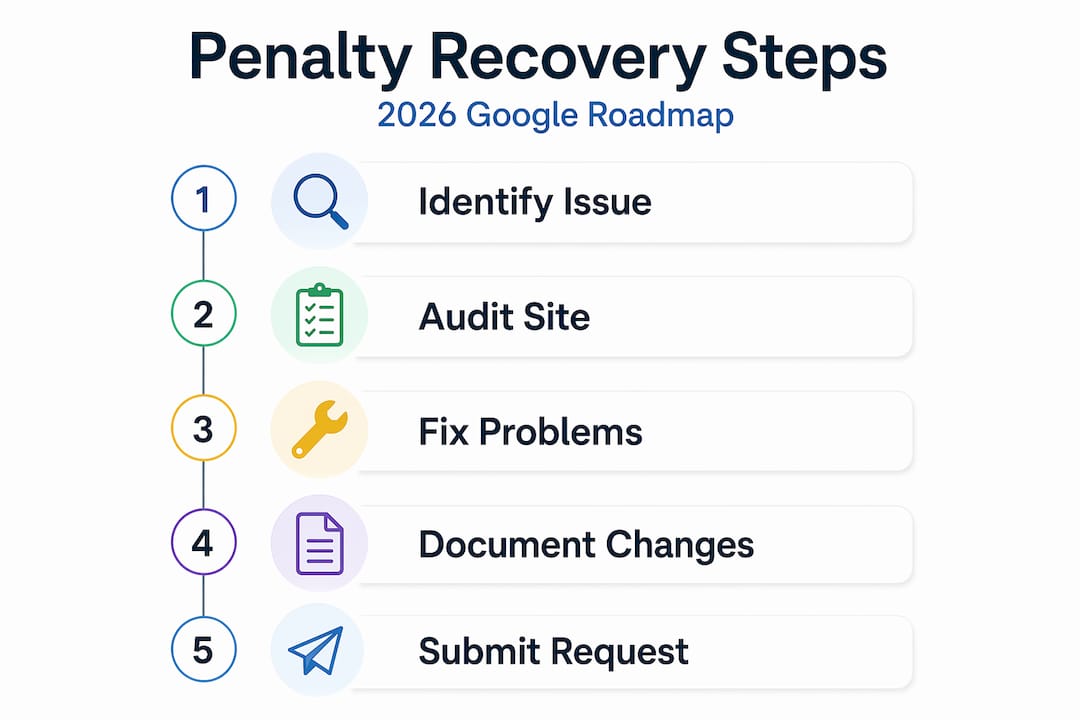
Document every fix with screenshots, URLs, and dates. A shared Google Drive folder with organized subfolders for each issue category works extremely well for this purpose.
Submitting a reconsideration request that actually gets approved
Premature reconsideration requests are responsible for more failed recoveries than any other single error. If you have only fixed 30% of your violations, Google rejects the request and you wait weeks before you can try again. Submit only when you are confident the cleanup is thorough.
A strong reconsideration request does four things:
- Acknowledges the violation clearly. Do not be defensive. State what happened and accept responsibility.
- Details what you fixed. Be specific. List the links removed, the content revised, and the technical issues resolved.
- Links to your documentation. Share your cleanup spreadsheet, screenshots of outreach, and disavow file if applicable.
- Confirms full resolution. State directly that you have addressed every instance of the violation to the best of your knowledge.
A good reconsideration request reads like a professional audit report, not an apology letter. Google reviewers are looking for evidence that you understand what went wrong and have fixed it completely. Emotional appeals and promises of future good behavior carry no weight.
After submission, typical recovery takes 2 to 6 months, though complex cases involving widespread violations can stretch to 18 months. While you wait, do not stop working on your site. Continue improving content quality, fixing technical issues, and building a cleaner link profile. If your request is rejected, Google will tell you why. Read that feedback carefully, address the remaining issues completely, and resubmit.
Rebuilding trust and rankings after the penalty lifts
Penalty removal does not mean instant ranking restoration. Think of it as clearing your record; the work of rebuilding your reputation still lies ahead. Consistent quality improvements signal to Google that your site has genuinely changed, not just corrected the minimum required to pass review.
Focus your post-recovery efforts on these areas:
- Content depth and originality: Publish content that answers real user questions with specificity and expertise. Use your on-page SEO techniques to structure each page for both users and search engines.
- Natural link building: Earn links through genuine outreach, original research, and partnerships with relevant sites. Study natural link profile strategies to rebuild authority the right way.
- User experience: Page speed, mobile usability, and clear navigation all factor into Google’s quality assessment. Fix technical UX issues before they accumulate.
- Search Console monitoring: Submit your updated sitemap after major content changes. Use the URL Inspection tool to speed up reindexing of your best pages.
Accept that ranking recovery is gradual. You may see partial improvements within weeks of penalty removal, but full reinstatement can take months. Keep your audit spreadsheet active and review site health monthly.
Pro Tip: Set up a Google Search Console performance report with a date comparison going back to before the penalty. This gives you a clear, data-driven view of recovery progress and helps you identify which pages have regained traction and which still need attention.
My honest take on what actually works
I have seen site owners do everything right technically and still delay their recovery by months, simply because they treated the reconsideration request as a formality rather than a legal brief. In my experience, the sites that recover fastest are the ones that approach this process like a forensic investigation. They document obsessively, fix comprehensively, and communicate with Google reviewers as if presenting evidence to a skeptical judge.
The other mistake I see constantly: people reach for the Disavow Tool the moment they see a bad link. Google’s algorithms have become remarkably good at discounting spam links without any input from you. Mass disavowing can harm sites if done without a confirmed manual link action. I would rather see a client do nothing with the Disavow Tool than use it incorrectly out of panic.
What actually separates fast recoveries from slow ones is not technical sophistication. It is patience combined with completeness. Rushing the process costs you time. Doing it thoroughly the first time saves months. And going forward, committing to ethical SEO practices is not just good hygiene. It is the only reliable way to avoid going through this again.
— Maayan
How Seo-analytic can support your recovery
Navigating Google penalty recovery on your own is possible, but having structured guidance makes the process faster and less prone to costly errors. Seo-analytic offers resources built specifically for website owners and digital marketers working through this process.

Whether you are dealing with a manual action or an algorithmic drop, the Seo-analytic penalty recovery services walk you through identification, cleanup, documentation, and submission with professional oversight. For those looking to rebuild their entire digital presence on solid ground, the 2025 website building guide covers site architecture and technical best practices that reduce penalty risk from day one. Explore the full suite of SEO optimization services to build the kind of site Google rewards consistently.
FAQ
What is the difference between a manual action and an algorithmic penalty?
A manual action is applied by a Google team member and appears in Search Console. An algorithmic penalty is automatic, tied to a quality update, and comes with no direct notification.
How long does it take to recover from a Google penalty?
Recovery typically takes between 2 and 6 months for straightforward cases, though complex penalties can last up to 18 months depending on the severity and quality of the cleanup.
When should I use Google’s Disavow Tool?
Use the Disavow Tool only for confirmed manual link actions or serious negative SEO attacks after you have attempted to remove harmful links manually. Careless use can hurt rankings because Google already ignores many spammy links automatically.
How do I write a successful reconsideration request?
An effective reconsideration request acknowledges the violation, details every fix with documentation, links to evidence, and confirms complete resolution. Submit only after comprehensive cleanup.
Can my rankings return to pre-penalty levels?
Yes, but it takes time. After penalty removal, consistent content improvements and natural link building gradually restore site rankings, though full reinstatement can take several months of sustained effort.