
TL;DR:
- Effective webinar promotion requires a coordinated multi-channel marketing plan starting three to four weeks before the event.
- Focusing on attendance and post-event engagement, not just registration counts, ensures better long-term results.
Promoting webinars effectively is the process of executing a multi-channel marketing plan that converts the right audience into live attendees and long-term leads. Most marketers treat webinar promotion as a single email blast. The real standard is a coordinated sequence across email, social media, paid retargeting, and reminder automation. Webinar success metrics should focus on attendance and post-event engagement, not just registration counts. Get that distinction right, and every tactic in this guide will make more sense.
What does promoting webinars effectively actually require?
Effective webinar promotion is a structured, multi-step effort that begins three to four weeks before the event. Promotions starting 14–21 days out see 69% higher attendance rates. That gap matters because it gives you time to run multiple email touches, build social momentum, and let paid ads gather enough data to retarget warm visitors.

The foundation is a segmented email list. Sending the same message to your entire database wastes budget and hurts deliverability. Segment by job title, industry, or past webinar behavior before you write a single subject line. Email marketing drives an average of 57% of total webinar sign-ups, making it the highest-performing channel by a wide margin.
A dedicated registration landing page is non-negotiable. Generic event pages buried inside your website kill conversions. The page needs a benefit-driven headline, a clear agenda, speaker credentials, and a single call to action. Top-tier registration pages with strong social proof can exceed 50% visitor-to-registrant conversion rates.
| Channel category | Primary strength | Best use case |
|---|---|---|
| Email marketing | Highest registration volume | Segmented list outreach, reminders |
| Organic social media | Authentic reach via personal profiles | Speaker posts, behind-the-scenes content |
| Paid social advertising | Precise audience targeting | B2B job title and industry targeting |
| Content marketing | Long-term discoverability | Blog posts, SEO-optimized event pages |
| SMS reminders | Last-mile attendance lift | Day-of alerts 15–30 minutes before start |
How to build a multi-channel promotion plan that fills seats
Start your promotion exactly three to four weeks out. The first week focuses on awareness. The second week builds social proof and urgency. The third week escalates with deadline messaging and last-chance reminders.
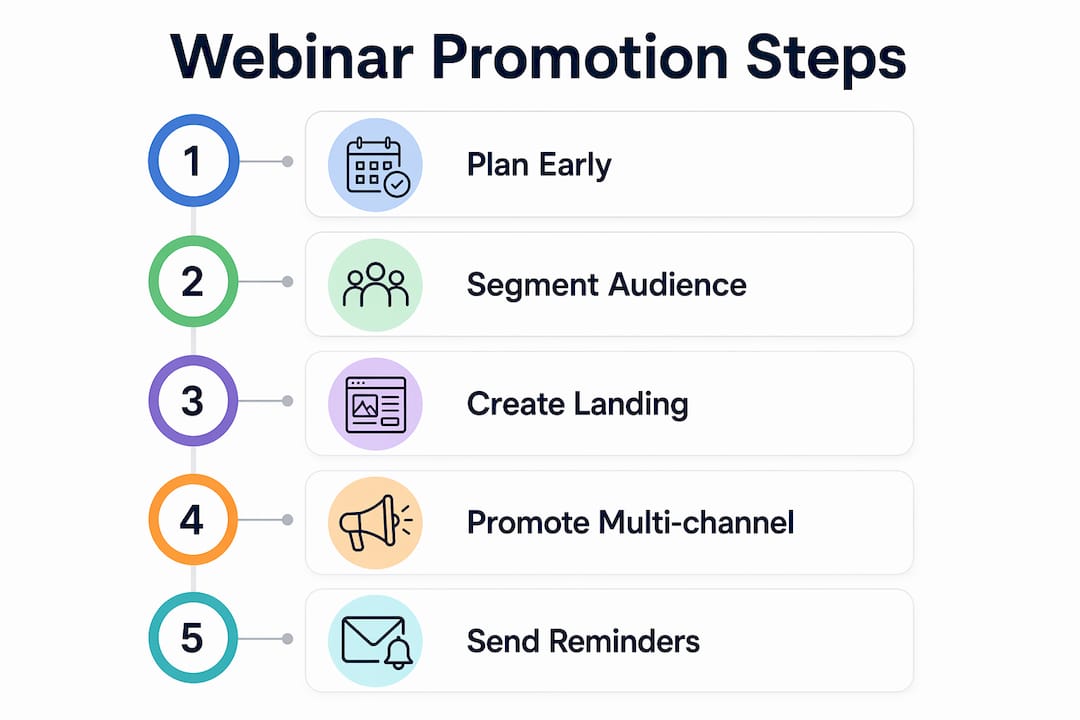
Email is your anchor channel. A 5–7 email sequence covering pre-event promotion, reminders, and post-webinar follow-up consistently outperforms shorter campaigns. Write subject lines that state the value and the date clearly. Subject lines with clear value and date beat clever wordplay in open rates every time. “Join us Tuesday: How to Cut SaaS Spend by 30%” outperforms “You won’t want to miss this.”
Here is a numbered promotion sequence that works:
- Week 3 out: Send the first announcement email to your segmented list. Post the event on your company page and ask speakers to share on their personal profiles.
- Week 2 out: Send a second email highlighting speaker credentials and a specific audience outcome. Publish a teaser clip or speaker Q&A on LinkedIn and Instagram.
- Week 1 out: Launch paid retargeting ads targeting website visitors and email non-openers. Send a third email with a “seats are limited” angle.
- Days 3–1 out: Send your urgency email. 60% of registrations happen in the final three days before the event, so this email carries serious weight.
- Day of: Send a morning reminder email and an SMS alert 15–30 minutes before start time.
Pro Tip: Ask every speaker to post a personal, conversational message on LinkedIn rather than sharing the corporate announcement. Personal posts from speakers and employees outperform corporate announcements by 5–10x in reach. A speaker saying “I’m presenting on X because I’ve seen this problem destroy margins” will always outperform a branded graphic with a logo.
For paid promotion, target by job title, company size, and industry on LinkedIn. Sponsored content targeted by job title and industry improves registration rates in B2B contexts. Set a retargeting audience from your registration page visitors and email click list. Even a modest daily budget on retargeting delivers strong returns because you are reaching people who already showed interest.
What makes a webinar registration page convert at a high rate?
A high-converting registration page answers one question immediately: “What will I be able to do after this webinar that I cannot do now?” Every element on the page should support that answer.
The must-have elements are:
- A benefit-driven headline that names a specific outcome, not a topic. “How to Reduce Customer Churn in 60 Days” beats “Webinar on Customer Retention.”
- A clear agenda with three to five bullet points showing exactly what the session covers.
- Speaker credentials that are specific. “VP of Growth at a Series B SaaS company” is more convincing than “industry expert.”
- Date, time, and time zone displayed prominently. Ambiguity kills registrations.
- Social proof in the form of testimonials from past attendees or a registrant count if it is impressive.
- A single call-to-action button with no competing links or navigation menus.
Page speed matters as much as copy. A slow-loading page loses registrants before they read a word. Keep the form short: first name, last name, email, and company name is the maximum for most B2B webinars. Every additional field reduces conversions. For deeper guidance on landing page conversion tactics, the principles apply directly to webinar registration pages.
Pro Tip: Run an A/B test on your headline before you spend a dollar on paid promotion. A headline change alone can shift conversion rates by 20% or more. Test one variable at a time and let each test run for at least 200 visitors before drawing conclusions.
Automated calendar reminders sent immediately after registration reduce no-shows. The confirmation email should include a one-click “Add to Calendar” link for Google Calendar, Outlook, and Apple Calendar. This single step keeps your event visible in the registrant’s schedule for weeks.
How do reminder sequences drive live attendance?
The gap between registrations and live attendance is where most webinar programs lose money. The average webinar attendance rate sits between 35% and 50% of registrants. A well-designed reminder sequence closes that gap.
Sending 3–4 reminder emails can boost attendance by 20%. SMS reminders sent 15–30 minutes before the webinar add another 15% lift on top of that. Those two tactics together can shift a 35% show-up rate to above 50%.
| Reminder type | Timing | Expected benefit |
|---|---|---|
| Confirmation email | Immediately after registration | Sets expectations, delivers calendar link |
| First reminder email | 1 week before | Re-engages registrants, builds anticipation |
| Second reminder email | 24 hours before | Urgency nudge, agenda recap |
| Final reminder email | 1 hour before | Last-chance alert with join link |
| SMS alert | 15–30 minutes before | Significant attendance lift over email alone |
Keep reminder content short. Each message should include the join link, the start time in the recipient’s time zone, and one sentence reminding them of the specific outcome they will gain. Do not re-sell the webinar in reminders. The registrant already said yes. Your job is to reduce friction and make showing up feel easy.
During the live session, use polls, Q&A, and chat to keep attendees engaged. Webinars that dedicate 75%+ of time to audience problems retain engagement far better than sales-heavy presentations. Attendees who stay engaged through the full session are significantly more likely to convert post-event.
How do you turn a webinar recording into a long-term marketing asset?
The live session is only the beginning. Replay viewership reaches 2.4 times the live attendance, and 58% of pipeline first touches the recording rather than the live event. That means your post-webinar promotion strategy is as important as your pre-event campaign.
A strong post-webinar plan includes:
- A replay email sent within 24 hours to all registrants, including those who attended live. Attendees rewatch key segments; non-attendees often convert on the replay.
- A nurture sequence of two to three emails over the following two weeks. Each email should reference a specific insight from the webinar and include a relevant call to action.
- AI-powered content repurposing. Use the recording transcript to generate blog posts, social media clips, quote graphics, and short-form video highlights. One 60-minute webinar can produce a month of content.
- An on-demand landing page that gates the recording behind a short form. This turns your webinar into a lead generation asset that works indefinitely.
- Integration with your marketing automation workflows. Tag attendees, non-attendees, and replay viewers differently. Each segment gets a tailored follow-up sequence based on their engagement level.
For repurposing webinar content into blog posts and social assets, a structured content calendar keeps the distribution consistent without requiring daily decisions.
Key Takeaways
Promoting webinars effectively requires a timed, multi-channel plan that prioritizes live attendance and post-event engagement over raw registration numbers.
| Point | Details |
|---|---|
| Start promotion 3–4 weeks early | Campaigns starting 14–21 days out see 69% higher attendance rates. |
| Email is the top channel | Email drives 57% of webinar sign-ups; use a 5–7 email sequence across pre and post-event phases. |
| Build a high-converting registration page | Benefit-driven headlines, speaker credentials, and social proof push conversion rates above 50%. |
| Use reminder sequences with SMS | Three to four reminder emails boost attendance by 20%; SMS alerts add another 15% lift. |
| Treat the recording as a primary asset | Replay viewership hits 2.4x live attendance and drives 58% of pipeline first touches. |
What most webinar guides get wrong about promotion
I have reviewed hundreds of webinar campaigns, and the same mistake shows up constantly: teams measure success by registration count and stop there. A webinar with 1,000 registrants and 280 live attendees is not a success. It is a missed opportunity with a good-looking vanity metric attached.
The shift that changes everything is treating attendance rate as your primary KPI from day one. That single change forces better decisions at every stage. You write more specific subject lines because you know vague ones attract curious but uncommitted registrants. You send SMS reminders because you know they move the needle on show-ups. You build a nurture sequence because you know 58% of pipeline comes from the replay.
The other thing I see underestimated is personal social promotion. Corporate posts get scrolled past. A speaker writing two honest sentences about why they care about the topic, in their own voice, generates real engagement. I have seen a single LinkedIn post from a credible speaker drive more registrations than a week of paid ads. That is not an accident. It is the difference between advertising and advocacy.
Finally, do not treat the live event as the finish line. The webinar recording is your most durable marketing asset. Repurpose it aggressively. Clip it, transcribe it, quote it, and gate it. The teams that do this consistently build a content library that generates leads for months after the event ends.
— Maayan
How Seo-analytic supports your webinar promotion efforts
Webinar promotion does not exist in isolation. It depends on a fast, well-designed website, strong landing pages, and a social media presence that builds trust before the event even starts.
Seo-analytic helps business owners build the digital infrastructure that makes webinar promotion work. From website building basics that support fast, conversion-ready pages to social media marketing strategies that amplify your speakers’ reach, the team at Seo-analytic covers the full stack. If your webinar registration page is slow, your email list is thin, or your social presence is inconsistent, the promotion tactics in this guide will underperform. Seo-analytic builds the foundation that makes every tactic above more effective.
FAQ
How far in advance should I promote a webinar?
Start promotion three to four weeks before the event. Campaigns launched 14–21 days out see 69% higher attendance rates than last-minute efforts.
What is the best channel for webinar promotion?
Email is the top-performing channel, driving 57% of total webinar sign-ups. Pair it with personal social media posts from speakers for maximum reach.
How do I increase webinar attendance after registration?
Send three to four reminder emails and add an SMS alert 15–30 minutes before the session starts. This combination can lift attendance by 35% over no reminders.
What should a webinar registration page include?
A benefit-driven headline, a clear agenda, speaker credentials, the date and time, social proof, and a single registration button with no competing links.
How do I use a webinar recording after the event?
Send a replay email within 24 hours, gate the recording on an on-demand landing page, and repurpose the transcript into blog posts, social clips, and email content. Replay viewership typically reaches 2.4 times the live audience.