
Did you know that over 90 percent of digital display ad spending is now managed through programmatic advertising? For businesses hoping to reach the right audience at the right moment, ignoring programmatic means missing out on smarter, data-driven ad campaigns. Understanding this approach can reveal new ways to cut wasted budgets and increase the impact of every marketing dollar by using automation and real-time insights.
Key Takeaways
| Point | Details |
|---|---|
| Automation Revolution | Programmatic advertising automates media buying, utilizing algorithms and real-time data for precise targeting and cost efficiency. |
| Data-Driven Personalization | Leveraging user data enhances ad relevance and personalization, leading to improved engagement with target audiences. |
| Compliance and Ethics | Companies must navigate privacy concerns and algorithmic risks, implementing robust brand safety and compliance strategies. |
| Continuous Optimization | Successful programmatic campaigns require ongoing monitoring, AI-driven adjustments, and strategic human oversight to adapt to the digital landscape. |
Table of Contents
- Programmatic Advertising: Core Concepts And Benefits
- Key Programmatic Advertising Types Explained
- How Programmatic Advertising Platforms Work
- Major Costs, Risks, And Compliance Issues
- Common Pitfalls And Best Practice Tips
Programmatic Advertising: Core Concepts and Benefits
Programmatic advertising represents a revolutionary approach to digital advertising that transforms how businesses connect with their target audiences. At its core, programmatic advertising automates the media buying process, using sophisticated algorithms and real-time data to purchase advertising space more efficiently and precisely than traditional methods.
According to research on real-time bidding, the foundational mechanism of programmatic advertising enables automated, per-impression auctions that allow advertisers to bid instantly and deliver targeted ads. This means businesses can now:
- Target specific audience segments with laser-like precision
- Reduce wasted ad spend by eliminating irrelevant impressions
- Access multiple advertising platforms simultaneously
- Optimize ad performance in real-time
The true power of programmatic advertising lies in its data-driven approach. By leveraging user behavior, demographics, browsing history, and contextual signals, advertisers can create highly personalized ad experiences. Our guide on digital advertising provides deeper insights into how these technologies are transforming marketing strategies for modern businesses.
With programmatic advertising, gone are the days of manual negotiations and broad-stroke advertising. Instead, businesses now have a sophisticated, intelligent system that ensures their message reaches the right person, at the right time, through the right channel.
Key Programmatic Advertising Types Explained
Programmatic advertising has evolved far beyond simple display ads, offering sophisticated targeting strategies that help businesses reach their ideal customers with unprecedented precision. Programmatic advertising types represent a diverse ecosystem of advanced digital marketing techniques designed to maximize advertising effectiveness and efficiency.
According to recent research from Brand Mo Tech, programmatic advertising now encompasses several cutting-edge formats:
- AI-Powered Campaign Optimization: Uses machine learning to automatically adjust ad strategies
- Cookieless Targeting: Leveraging first-party data for more privacy-conscious advertising
- Connected TV (CTV) & Over-the-Top (OTT) Placements: Targeting viewers across streaming platforms
- Programmatic Audio: Delivering ads through podcast and digital audio channels
- Contextual Targeting: Matching ads to relevant content environments
- Retail Media Networks: Advertising directly within e-commerce platforms
- Dynamic Creative Optimization (DCO): Automatically personalizing ad creative in real-time
Our comprehensive guide to digital ad types offers deeper insights into these innovative advertising approaches. Each programmatic advertising type brings unique advantages, allowing businesses to create more intelligent, responsive, and targeted marketing strategies that adapt to changing consumer behaviors and technological landscapes.
Here’s a comparison of key programmatic advertising types:
| Type | Main Channel | Key Advantage |
|---|---|---|
| AI-Powered Optimization | All digital platforms | Real-time strategy adjustment |
| Cookieless Targeting | Web & mobile ads | Privacy compliance |
| Connected TV & OTT | Streaming TV | Reach cord-cutters |
| Programmatic Audio | Podcasts Music apps |
Engages audio audiences |
| Contextual Targeting | Websites Apps |
Relevance to content |
| Retail Media Networks | E-commerce platforms | High purchase intent |
| Dynamic Creative Optimization | All digital channels | Personalization at scale |
These sophisticated programmatic advertising types represent more than just technological innovation. They signal a fundamental shift in how businesses communicate with potential customers – moving from broad, generic messaging to highly personalized, contextually relevant interactions that resonate on a deeper level.

How Programmatic Advertising Platforms Work
Programmatic advertising platforms are sophisticated technological ecosystems that transform digital advertising from a manual, time-consuming process into an automated, lightning-fast transaction. Programmatic platforms essentially act as intelligent matchmakers, connecting advertisers with the most relevant digital advertising opportunities in real-time.
The core mechanism of these platforms involves several interconnected components:
- Demand-Side Platforms (DSPs): Where advertisers set campaign parameters and budgets
- Supply-Side Platforms (SSPs): Where publishers list available ad inventory
- Ad Exchanges: The digital marketplace where real-time bidding occurs
- Data Management Platforms (DMPs): Systems that aggregate and analyze audience data
Here’s a simplified workflow of how these platforms operate:
- An advertiser defines target audience characteristics
- When a potential customer visits a website, their anonymized user data is instantly analyzed
- An automated auction occurs in milliseconds
- The winning ad is displayed to the user
Check out our Q&A section for more detailed insights into the intricacies of programmatic advertising technologies. The beauty of these platforms lies in their ability to make split-second decisions, using complex algorithms to match the right ad with the right audience at the precisely right moment.
By leveraging machine learning and vast data pools, programmatic advertising platforms have revolutionized digital marketing. They eliminate human error, reduce administrative overhead, and create unprecedented targeting precision that traditional advertising methods could never achieve.
Major Costs, Risks, and Compliance Issues
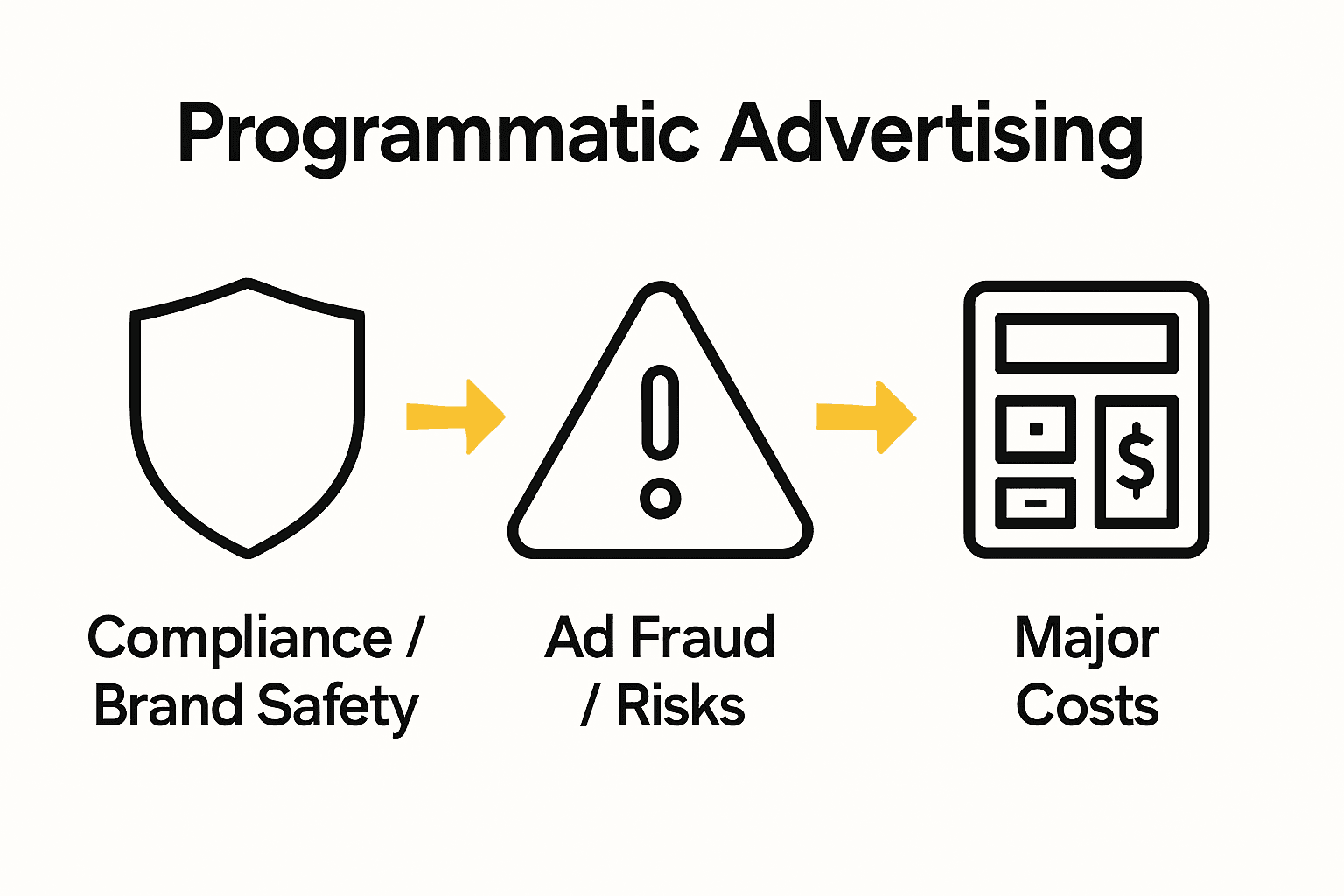
Programmatic advertising, while powerful, comes with a complex landscape of financial, ethical, and regulatory challenges that businesses must carefully navigate. Cost management and risk mitigation are critical considerations for any organization looking to leverage programmatic advertising effectively.
According to research from Brand Mo Tech, rising concerns over privacy and ad fraud have dramatically increased the importance of brand safety. Advertisers must now implement sophisticated strategies to protect their investments:
- Pre-bid filtering mechanisms
- AI-powered placement verification tools
- Comprehensive compliance monitoring systems
- Regular audit trails of ad placements
Moreover, academic research reveals deeper algorithmic risks. A study from arXiv highlights how algorithm-driven ad delivery can inadvertently produce skewed outcomes, potentially leading to demographic biases even when targeting parameters appear neutral. These unintended consequences underscore the critical need for continuous oversight and ethical algorithm design.
Our Q&A section provides additional guidance on navigating these complex challenges. The financial implications are significant: businesses must factor in not just direct advertising costs, but also potential legal risks, reputation management expenses, and the ongoing investment required to maintain compliant, ethical programmatic advertising strategies. Successful implementation demands a proactive, multi-layered approach that balances technological innovation with rigorous ethical standards.
Common Pitfalls and Best Practice Tips
Navigating the complex world of programmatic advertising requires strategic insight and careful planning. Programmatic advertising demands more than just technological implementation—it requires a nuanced approach that balances technical capabilities with strategic thinking.
According to Brand Mo Tech, advertisers should focus on several critical strategies to maximize performance and avoid common pitfalls:
- Embrace AI-Driven Optimization: Leverage machine learning to continuously refine ad strategies
- Pivot to First-Party Data: Prioritize privacy-conscious, direct audience insights
- Utilize Contextual Targeting: Match ads to relevant content environments
- Implement Dynamic Creative Optimization (DCO): Personalize ad creative in real-time
- Leverage Private Marketplaces: Gain better inventory quality and control
Key best practices for avoiding programmatic advertising mistakes include:
- Continuously monitor and audit ad placements
- Develop robust brand safety protocols
- Invest in comprehensive data management
- Regularly update targeting parameters
- Maintain transparency in advertising strategies
Our comprehensive guide to digital ad types offers deeper insights into navigating these challenges. The most successful programmatic advertising campaigns combine technological sophistication with strategic human oversight, ensuring that automated systems are continuously refined and aligned with broader marketing objectives.
Remember, programmatic advertising is not a set-it-and-forget-it solution. It requires ongoing attention, continuous learning, and a willingness to adapt to rapidly evolving digital marketing landscapes.
Ready to Unlock Advanced Programmatic Advertising Results?
Struggling to keep up with the evolving demands of precise targeting, real-time optimization, and transparent ad placements? As outlined in our guide, programmatic advertising offers unmatched efficiency and personalization, but navigating complex platforms, rising compliance pressures, and data-driven strategies can be overwhelming. Imagine accelerating your digital growth with a partner who understands these challenges and brings industry-leading solutions to your campaign. For marketers aiming to increase conversions and reduce wasted spend, our specialized search engine marketing services are designed to take your advertising to the next level.
Take charge of your programmatic strategy today. Visit seo-analytic.com to discover how our full-suite digital marketing services can help you connect with new audiences, optimize campaigns across all channels, and convert more customers. Do not let missed opportunities or ad misplacement hold your business back when you can achieve measurable results now.
Frequently Asked Questions
What is programmatic advertising?
Programmatic advertising is an automated way of buying digital ad space using sophisticated algorithms and real-time data, allowing businesses to target specific audiences more efficiently compared to traditional methods.
How does programmatic advertising work?
Programmatic advertising works through various platforms, including Demand-Side Platforms (DSPs) and Supply-Side Platforms (SSPs), which automate the buying and selling of ad inventory in real-time auctions based on user data.
What are the benefits of programmatic advertising?
Programmatic advertising offers numerous benefits, including precise audience targeting, reduced wasted ad spend, real-time performance optimization, and access to multiple advertising platforms simultaneously, leading to more effective marketing campaigns.
What are some common types of programmatic advertising?
Common types of programmatic advertising include AI-powered campaign optimization, cookieless targeting, connected TV (CTV) and over-the-top (OTT) placements, programmatic audio, contextual targeting, retail media networks, and dynamic creative optimization (DCO).