

TL;DR:
- Many business owners underestimate the importance of a privacy policy, viewing it as merely a formality.
- A privacy policy is a crucial legal document that transparently details how personal data is collected, used, and shared; it also informs user rights.
- Creating an accurate, current policy aligned with actual practices builds trust, ensures compliance, and minimizes regulatory risks.
Most business owners think a privacy policy is a formality. Something you copy from another website, paste into a footer link, and never look at again. That assumption is not just wrong, it is genuinely risky. A privacy policy is one of the most legally significant documents your website carries, and the Federal Trade Commission has real enforcement power when businesses misrepresent how they handle consumer data. This guide covers exactly what a privacy policy is, why it matters more than you think, what US laws require, and how to build one that actually protects your business and earns your customers’ trust.
Table of Contents
- What a privacy policy actually covers
- Why privacy policies matter for US businesses
- Privacy law essentials: Federal and state requirements
- How to create a privacy policy that actually works
- Most businesses get privacy policies wrong — here’s what to do instead
- Level up your website compliance and trust
- Frequently asked questions
Key Takeaways
| Point | Details |
|---|---|
| Core definition | A privacy policy describes how your business collects, uses, and shares personal information. |
| Legal requirement | Privacy policy requirements depend on your data practices and which US laws apply to your business. |
| Trust and compliance | Accurate, honest privacy statements build user trust and protect against legal risk. |
| Alignment with practice | Your privacy policy must match your actual business operations to avoid FTC penalties. |
| Practical steps | Mapping your data flow and reviewing your policy regularly keeps you compliant and competitive. |
What a privacy policy actually covers
Let’s start with the basics, because there is a lot of confusion here. A privacy policy is a legal document that tells your website visitors exactly what personal information you collect, how you use it, who you share it with, and what rights they have over their own data. That is its one job. It is not the same as your Terms of Service, which governs the rules of using your platform.
A privacy policy is not interchangeable with a Terms of Service; it specifically addresses how the business handles users’ personal data and informs users about privacy practices and rights. Think of it this way: Terms of Service is your rulebook for the relationship, while your privacy policy is your transparency report on data.
Here is what a well-written privacy policy typically includes:
- What data you collect: Names, email addresses, IP addresses, payment details, device data, browsing behavior, and any other personal information gathered through your site or app.
- Why you collect it: To process orders, send newsletters, improve your service, run analytics, or serve ads.
- How you use and share it: Whether you pass data to third-party tools like Google Analytics, email platforms, advertising networks, or payment processors.
- How long you keep it: Data retention periods matter both legally and ethically.
- User rights: Whether users can request access to, correction of, or deletion of their data.
- Contact information: Who to reach if users have questions or concerns about their data.
For US startups, clarity in these sections is especially important. Vague language like “we may share data with partners” without specifying who those partners are or what they do with the data is the kind of language that can draw regulatory attention. Practicing good digital marketing ethics means being honest about what you collect, not hiding it in legal jargon.
Pro Tip: Set a calendar reminder every six months to review your privacy policy against your actual data practices. Tools, vendors, and features change. Your policy needs to keep up.
Why privacy policies matter for US businesses
A privacy policy is not just a legal checkbox. It is one of the first signals your audience uses to decide whether they trust you with their information. When someone fills out a contact form, creates an account, or purchases from you, they are making a decision based in part on whether they believe you will handle their data responsibly.
The FTC’s role here is significant and often underestimated. FTC enforcement actions against businesses that mislead consumers about their privacy practices are real and increasingly common. In the U.S., the FTC expects businesses to honor their privacy promises and can take enforcement action when companies mislead consumers about those practices. This applies to small and medium-sized businesses too, not just tech giants.
Here is a look at how the stakes play out across different risk factors:
| Risk factor | Potential consequence | Who it affects most |
|---|---|---|
| Inaccurate or misleading policy | FTC enforcement, fines, reputation damage | All businesses collecting data |
| No privacy policy at all | State law violations, app store removal | Startups, new websites |
| Outdated policy | Non-compliance with updated state laws | Growing businesses |
| Missing user rights section | Violation of CCPA and other state laws | Businesses with CA users |
| Vague data sharing disclosures | Deceptive practices claims | Businesses using ad networks |
“Privacy is not just a legal obligation. It is a business differentiator. Companies that treat it seriously earn and keep more customer trust over the long term.” This is especially true for startups competing against established brands on credibility alone.
Building sustainable business practices from the start includes taking data privacy seriously before a regulator forces you to. And from a marketing standpoint, a clear and honest privacy policy directly supports your startup marketing strategies by building the customer trust that makes conversions possible.
Pro Tip: Your privacy policy should always reflect your actual practices, not aspirational ones. If you say you never sell data, make absolutely sure you are not using tools that technically qualify as data sales under state law definitions.
Privacy law essentials: Federal and state requirements
Understanding why privacy policies matter leads directly into the legal specifics you need to know as a US business owner. This is where things get complicated, because the United States does not have a single, unified federal privacy law the way Europe does with GDPR. Instead, you are working within a patchwork of federal sector-specific laws and a growing number of state-level frameworks.
On the federal side, COPPA is one of the most critical laws to understand. COPPA requires covered operators to provide notice of information practices to parents and obtain verifiable parental consent before collecting, using, or disclosing children’s personal information. If your website or app could attract users under 13, COPPA applies to you. Period. The FTC issued an updated COPPA policy statement in early 2026 specifically to incentivize age verification technologies, which signals how seriously regulators are treating children’s data protection right now.
At the state level, the landscape is even more fragmented. U.S. privacy regulation is fragmented across federal and state laws, meaning privacy notices and requirements often vary by jurisdiction, data types (including sensitive data), and whether you meet applicability thresholds. California’s CPRA (the updated CCPA), Virginia’s CDPA, Colorado’s CPA, Texas’s TDPSA, and a dozen other state laws all have different definitions, thresholds, and user rights obligations.
Here is a comparison of some key state-level privacy law requirements:
| State law | Applies to businesses with | Key user rights |
|---|---|---|
| California CPRA | 100K+ consumers OR 25% revenue from data sales | Access, deletion, opt-out of sale, correction |
| Virginia CDPA | 100K+ consumers or 25K+ consumers with 50% revenue from data | Access, deletion, portability, opt-out |
| Colorado CPA | 100K+ consumers or 25K+ with 50% revenue from data | Access, deletion, opt-out of profiling |
| Texas TDPSA | Does NOT apply if revenue under $10M AND fewer than 100K | Similar rights package to CDPA |
Common triggers that mean your startup likely needs a privacy policy right now:
- You collect any personal data from users, even just email addresses for a newsletter.
- Your site or app might be used by children under 13.
- You operate in or serve customers from California, Virginia, Colorado, Connecticut, or Texas.
- You use advertising pixels, cookies, or tracking tools from third parties.
- You handle health, financial, or biometric data in any form.
- You process data from international users, which may trigger GDPR considerations as well.
Building strong cybersecurity for business goes hand in hand with privacy compliance. Both are about protecting the data you are responsible for once it enters your systems.
How to create a privacy policy that actually works

With the legal landscape clear, here are the practical steps to build a privacy policy that is honest, accurate, and actually useful to your users and your business.
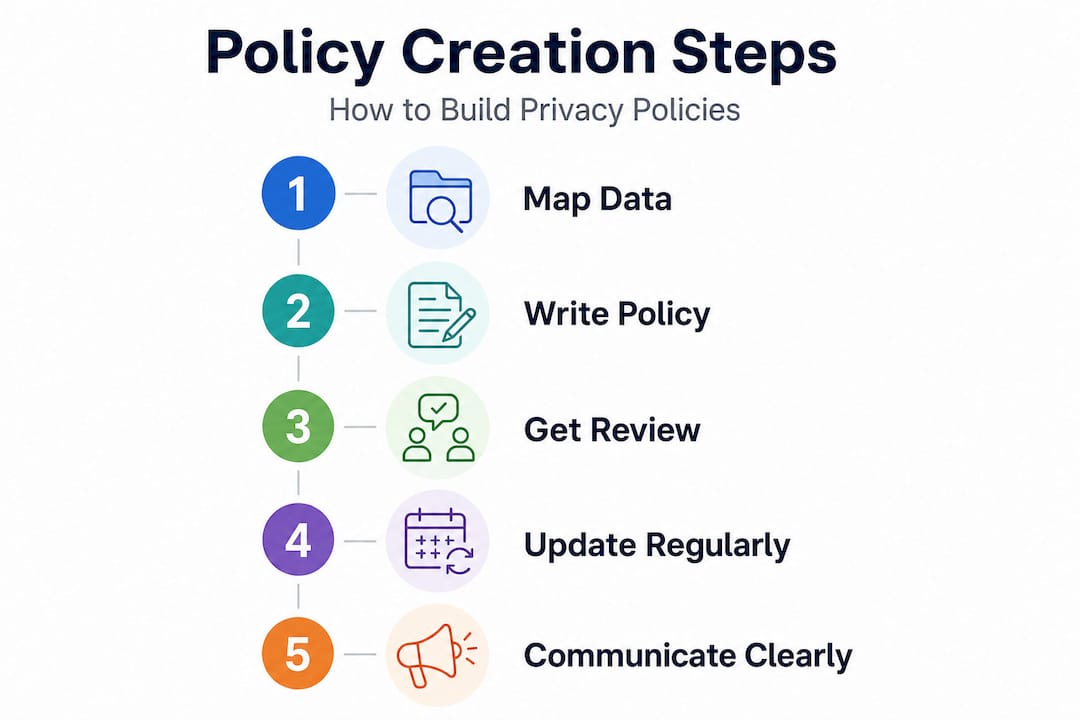
A privacy policy should be aligned with your actual data flows, including collection points, vendors and processors, sharing or sale practices, retention, and user rights mechanisms, because it is the document through which you communicate privacy promises. The FTC emphasizes honoring those promises. That alignment between document and reality is everything.
Step-by-step process to build your privacy policy:
-
Map your data flows first. Before writing a single word, document every place your site or app collects data. This includes your contact forms, checkout pages, newsletter signups, analytics tools, live chat plugins, social login buttons, and ad pixels. You cannot write an accurate policy without knowing the full picture.
-
List every third-party vendor that touches user data. Google Analytics, Facebook Pixel, Mailchimp, Stripe, HubSpot, Intercom. Every tool that receives user data needs to be accounted for, and you need to review each vendor’s own data practices.
-
Determine which laws apply to you. Based on your user base, revenue, and the types of data you handle, figure out which federal and state laws create specific obligations. This is where a legal advisor earns their fee.
-
Write in plain language. Your users are not lawyers. Write your policy the way you would explain it to a customer in conversation. Avoid dense legal jargon wherever possible. Use headers, bullet points, and short sections to make it scannable.
-
Include all required sections. Types of data collected, purposes of collection, how you share data, data retention, user rights, how you handle cookies, whether you sell data, and contact information for privacy questions.
-
Add a prominent link on your website. Your privacy policy must be easy to find. Footer links are standard. For apps, it should appear during account creation. For forms that collect data, link to it near the submit button.
-
Review and update it regularly. Whenever you add a new tool, change a vendor, launch a new feature that collects data, or when laws in your states of operation change, your policy needs a review.
Pro Tip: Involve a qualified attorney or privacy professional when you first draft your policy or when major legal changes happen. Template generators can be a starting point, but they are not a substitute for advice tailored to your actual business.
Good content marketing for startups builds authority by being transparent and trustworthy. Your privacy policy is part of that story.
Most businesses get privacy policies wrong — here’s what to do instead
Here is the uncomfortable truth we see repeatedly when working with business owners: the vast majority of small business websites have copy-pasted privacy policies that do not reflect their actual data practices. They either grabbed a template from a generic tool years ago, copied a competitor’s policy, or had someone throw one together quickly to get a website launched. None of those approaches protect you.
The real danger is not that you have no policy. It is that you have a policy that says one thing while your business does something different. That gap is exactly what the FTC looks for in enforcement actions. If your policy says you do not share personal data but you are running Facebook retargeting ads (which technically passes data to Facebook), you have a misrepresentation problem.
What we recommend instead is treating your privacy policy as a living business document, not a legal artifact. When you add a new marketing tool, update the policy. When you change email providers, update the policy. When a new state law passes that covers your users, update the policy.
More importantly, start thinking about your privacy commitments as a competitive advantage. In markets where consumers are increasingly skeptical about data practices, being genuinely transparent about what you collect and why builds a brand asset. Startups that adopt sustainable startup practices from the beginning, including honest data handling, tend to scale trust alongside revenue. That is not an accident.
The businesses that will get hurt by privacy enforcement are the ones treating compliance as a one-time task. The businesses that will win on trust are the ones that build privacy into how they operate.
Level up your website compliance and trust
Building a trustworthy, compliant website is not just about having the right documents. It is about building the right foundation from the start.

If you are a startup or small business owner trying to figure out where to begin, our resources on website building basics walk you through the essential elements every US business site needs in 2026, including compliance considerations. And if you want to understand how privacy and ethics connect to your broader online strategy, our guide on digital marketing ethics gives you a practical framework for running campaigns your customers can actually trust. Our team helps business owners build websites and digital marketing strategies that work together, so compliance and performance are not separate conversations.
Frequently asked questions
Is a privacy policy legally required for my startup website?
Most US businesses need a privacy policy if they collect user data, especially if COPPA and state privacy laws apply, which is increasingly likely for any site serving consumers across multiple states.
What happens if my privacy policy doesn’t match what my business actually does?
If your policy is misleading or inaccurate, the FTC can bring enforcement actions for deceptive practices, which can include significant fines and mandatory compliance programs.
What’s the difference between a privacy policy and Terms of Service?
A privacy policy explains user data handling, while Terms of Service set rules for using your website or app; a privacy policy is not interchangeable with Terms of Service and serves an entirely different legal purpose.
How often should I update my privacy policy?
Update it whenever your data practices change, such as when you add new tools or vendors, and whenever laws in your users’ states are amended or new ones take effect.