
TL;DR:
- On-page SEO focuses on optimizing webpage elements to improve rankings in Google and AI answer engines.
- Content relevance, proper keyword placement, and user experience are key factors that influence search performance.
On-page search engine optimization is the practice of optimizing individual webpage elements, including content, HTML tags, and page structure, to improve rankings in Google and AI-powered answer engines like ChatGPT and Perplexity. Unlike off-page tactics such as link building, on-page SEO is fully within your control and delivers measurable results as soon as Googlebot recrawls your pages. In 2026, effective on-site SEO means satisfying both traditional search crawlers and AI systems that parse your formatting to extract answers. This guide covers every core factor, from keyword placement and meta tags to Core Web Vitals and AI-optimized content structure.
What are the core on-page SEO factors that impact ranking?
Text relevance is the most influential on-page ranking signal, with a correlation coefficient of 0.47 in studies from Q2 2026. That single number tells you where to spend most of your time: writing content that directly matches what your audience is searching for.
The table below shows the primary on-page factors, their SEO impact level, and where to focus first.
| Factor | Impact level | Where to act |
|---|---|---|
| Text relevance and content quality | Very high | Match search intent; cover the topic fully |
| Title tag optimization | High | Keep to 50–60 characters, include the keyword |
| Keyword placement in first 100 words | High | Open with the target term naturally |
| Meta description | Medium | Write for clicks, not just crawlers |
| URL structure | Medium | Short, descriptive, keyword-inclusive |
| Internal linking | Medium | Distribute PageRank across key pages |
| Page speed and Core Web Vitals | High (tie-breaker) | Compress images, reduce render-blocking code |
Keyword placement and headings
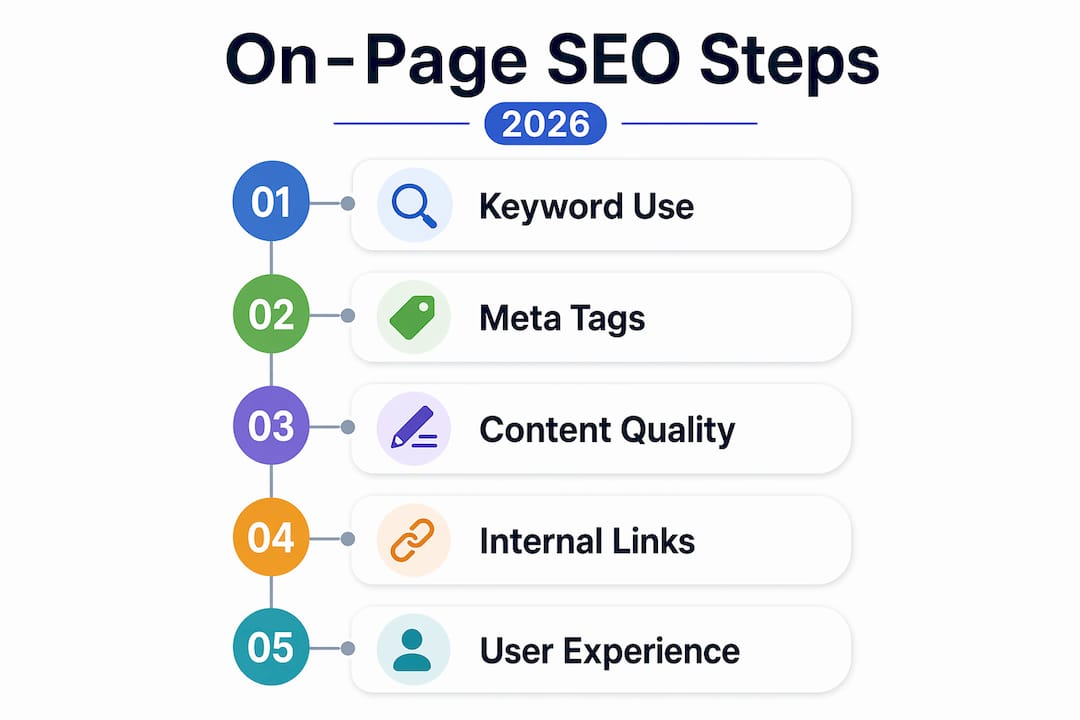
Target keywords belong in the first 100 words of your page content. Search engines read your opening paragraph as a primary relevance signal, so burying your keyword in paragraph four costs you ranking potential. Place it in your H1, in at least one H2, and naturally within the first two sentences of your introduction.

Meta tags and URL structure
Title tags should be unique, accurate, and written for humans first. A title like “On-Page SEO Guide for Marketers: 2026” outperforms “SEO Tips” because it signals specificity and intent. For meta descriptions, writing for CTR matters more than keyword density. A well-crafted description acts as ad copy in the search results, pulling clicks even when you rank third or fourth.
Internal linking strategy
Internal links distribute PageRank, improve content discovery, and keep users on your site longer. Most sites underuse this lever. Link from high-traffic pages to pages you want to rank, use descriptive anchor text that tells both users and crawlers what the destination covers, and audit your internal link structure at least quarterly.
Pro Tip: Use Google Search Console’s “Links” report to find your most internally linked pages. If those pages are not your highest-priority conversion pages, restructure your links accordingly.
How does structuring content for AI answer engines differ from traditional SEO?
AI answer engines like ChatGPT, Perplexity, and Google’s AI Overviews parse on-page signals including headings, formatting, and section length to determine which content to extract and cite. Traditional SEO rewarded long, comprehensive pages. AI-optimized content rewards clarity, structure, and directness.
The core principle is answer-first architecture. Every section should open with a direct answer to the question implied by its heading. Supporting detail follows in short paragraphs or bullet points. This structure makes your content easy for both humans to scan and AI systems to extract.
Key formatting practices that increase AI citation likelihood:
- Keep each section under 300 words. Content sections intended for AI extraction perform best when they are concise and focused on a single idea.
- Use question-based H2 headings. Questions signal intent and match how users query AI tools.
- Lead every paragraph with the key claim. Do not save your conclusion for the end of a paragraph.
- Use bullet lists and numbered lists. Structured formatting increases the probability of being referenced in AI-generated answers.
- Avoid walls of text. Paragraphs longer than five sentences are harder for AI systems to parse cleanly.
The shift is significant. SEO in 2026 requires optimizing for AI engines as much as for traditional crawlers, which changes how you plan content from the first draft. Learn more about integrating AI into your content strategy to stay ahead of this shift.
Pro Tip: Write your H2 headings as the exact questions your audience types into ChatGPT or Perplexity. Then answer those questions in the first sentence of the section. This single habit dramatically increases your chances of AI citation.
What practical steps should you take to improve on-page SEO?
On-page SEO is the foundation for all search rankings and offers the fastest leverage available to site owners. The steps below apply whether you are launching a new page or auditing an existing one.
- Run keyword research first. Use Google Search Console, Ahrefs, or Semrush to identify the primary keyword and three to five related terms. Confirm the search intent before writing a single word.
- Audit existing pages before creating new ones. Use a content audit checklist to identify thin content, duplicate titles, and missing meta descriptions. Fixing existing pages often delivers faster ranking gains than publishing new content.
- Optimize your title tag and meta description. Write the title first, keep it within 50–60 characters, and include the primary keyword near the front. Write the meta description as a 150–160 character pitch that earns the click.
- Structure your content with clear headings. Use one H1, multiple H2s for major sections, and H3s for subsections. Each heading should reflect a specific user question or subtopic.
- Place your keyword in the first 100 words. Then use related terms and synonyms throughout the body. Avoid repeating the exact phrase in every paragraph.
- Build internal links from relevant pages. Every new page should receive at least two to three internal links from existing high-authority pages on your site.
- Check technical basics. Confirm the page is crawlable, indexed, and free of broken links. Tools like Screaming Frog and Google Search Console surface these issues in minutes.
- Monitor and update regularly. Rankings shift. Set a quarterly review schedule to refresh content, update statistics, and add new internal links as your site grows.
Pro Tip: Do not treat on-page optimization as a one-time task. Pages that receive regular content updates and fresh internal links consistently outperform static pages in competitive niches. Schedule a 30-minute monthly review for your top 10 pages.
How do user experience elements affect on-page SEO rankings?
User experience is not separate from on-page SEO. Google treats Core Web Vitals as ranking signals, and in competitive niches, UX metrics act as decisive tie-breakers when content and tags are equally optimized across competing pages.
Core Web Vitals measure three specific things:
- Largest Contentful Paint (LCP): How fast the main content loads. Google’s target is under 2.5 seconds.
- Interaction to Next Paint (INP): How quickly the page responds to user input. Aim for under 200 milliseconds.
- Cumulative Layout Shift (CLS): How much the page layout shifts during loading. A score below 0.1 is the target.
Mobile responsiveness is not optional. Google indexes the mobile version of your site first. A page that looks perfect on desktop but breaks on a 375-pixel screen will underperform in rankings regardless of how well the content is written. Use Google’s PageSpeed Insights and the Mobile-Friendly Test to identify specific issues. A responsive website design is the baseline, not a bonus.
Bounce rate and dwell time signal content quality to search engines. If users land on your page and leave within 10 seconds, Google interprets that as a relevance failure. Improve dwell time by matching content to the search intent precisely, loading the page fast, and placing your most valuable information above the fold.
Optimizing images is one of the highest-impact speed improvements available. Compress images with tools like Squoosh or ShortPixel, use next-generation formats like WebP, and always include descriptive alt text. Alt text serves both accessibility and SEO, giving crawlers context about visual content that they cannot see.
Key takeaways
On-page SEO is the highest-leverage activity a site owner controls, and combining content relevance, structured formatting, and strong UX signals produces the most durable ranking gains.
| Point | Details |
|---|---|
| Text relevance drives rankings | Content that directly matches search intent carries the highest correlation with top rankings. |
| AI formatting changes content strategy | Keep sections under 300 words with answer-first headings to maximize AI engine citation. |
| Keywords belong in the first 100 words | Place your primary keyword early in the page to send a clear relevance signal to crawlers. |
| Internal links distribute ranking power | Link strategically from high-traffic pages to priority pages using descriptive anchor text. |
| UX metrics are ranking tie-breakers | Core Web Vitals determine who ranks higher when content quality is equal across competing pages. |
Where most SEO advice gets it wrong
I have reviewed hundreds of websites where the owner spent months building backlinks while their title tags were duplicated across 40 pages and their content answered the wrong question entirely. Off-page SEO gets the attention, but on-page factors are what Google actually reads first.
The second mistake I see constantly is treating on-page and technical SEO as the same thing. They are not. Technical SEO covers crawlability, site architecture, and indexing. On-page SEO covers what is on the page itself: the words, the headings, the tags, and the structure. Confusing the two, as noted by Semrush’s research, leads to misallocated resources and slow results. Fix your on-page elements first. They deliver faster, more predictable gains.
The third shift I am watching closely is the move toward AI-centric optimization. Writing for ChatGPT and Perplexity is not a gimmick. These tools now drive meaningful referral traffic, and the pages they cite share a common structure: direct answers, short sections, and clear headings. If your content reads like a 2018 blog post with long paragraphs and buried conclusions, you are invisible to AI answer engines.
My practical advice: prioritize your top 10 pages, apply every technique in this guide to those pages first, and measure the results before scaling. SEO is not a guessing game when you treat it as a system.
— Maayan
Ready to put your on-page SEO into practice?
Knowing the techniques is only half the equation. The other half is having a website built to support them from the ground up. At Seo-analytic, we help business owners and marketers build sites that are structured for search visibility from day one, with clean code, fast load times, and content frameworks that satisfy both Google and AI answer engines.
Whether you are starting from scratch or improving an existing site, our website building guide walks you through every step with SEO built into the process. You can also explore our full SEO services to see how Seo-analytic can help you turn these strategies into measurable traffic and conversions.
FAQ
What is on-page SEO in simple terms?
On-page SEO is the process of optimizing the content, HTML tags, and structure of individual web pages to rank higher in search results. It includes title tags, keyword placement, headings, internal links, and page speed.
How long does it take to see results from on-page SEO changes?
Ranking changes appear after Googlebot recrawls and processes your updated pages, which can take anywhere from a few days to several weeks depending on your crawl budget and site authority.
What is the difference between on-page SEO and technical SEO?
On-page SEO covers the content and HTML elements on a page, such as headings, keywords, and meta tags. Technical SEO covers site infrastructure, including crawlability, indexing, and site speed at the server level.
How do I optimize content for AI answer engines?
Write answer-first sections under 300 words, use question-based H2 headings, and format content with bullet lists and clear hierarchy. AI engines extract content that is structured for scanability and directness.
Which on-page SEO factor matters most?
Text relevance is the single strongest on-page ranking signal, with a correlation coefficient of 0.47 in 2026 studies. Content that fully matches the searcher’s intent outperforms pages that rely on keyword density alone.