
What is off-page SEO and why does it matter?
Off-page SEO covers every action you take outside your website to improve how search engines rank it. Think of it as your site’s reputation on the rest of the internet. While your content tells Google what you’re about, off-page signals tell Google whether to believe you.
The industry term is “off-page SEO,” sometimes called off-site SEO, and it goes well beyond just collecting backlinks. The core components include:
- Backlinks: Links from other websites pointing to yours, acting as votes of confidence and one of Google’s top ranking factors
- Brand mentions: References to your brand name online, even without a clickable link, which help Google understand your entity and reputation
- E-E-A-T signals: External validation of your Experience, Expertise, Authoritativeness, and Trustworthiness, earned through third-party coverage, author credentials, and reviews
- Social media engagement: Shares and interactions that expand content reach and create natural linking opportunities
- Local citations: Consistent listings in directories like Google Business Profile and Yelp that signal relevance for location-based searches
Together, these signals form the external proof that search engines need to trust your site. Without them, even excellent on-page content struggles to rank in competitive niches.
How does off-page SEO differ from on-page SEO?
The clearest way to separate them: on-page SEO is everything you control directly on your website, and off-page SEO is everything that happens away from it.
On-page SEO covers title tags, meta descriptions, heading structure, content quality, internal links, and page speed. You can change any of it today. Off-page SEO involves earning backlinks, getting press coverage, generating reviews, building citations, and engaging across social platforms. You can influence these, but you can’t fully control them.
Here’s how the two sides compare:
- Control: On-page is fully in your hands; off-page depends on how others respond to your brand
- Purpose: On-page helps Google understand your pages; off-page tells Google whether to trust them
- Timeline: On-page changes take effect quickly; off-page authority builds over months
- Focus: On-page targets content and technical structure; off-page targets reputation and credibility
Both are necessary. On-page SEO sets the foundation. Off-page SEO determines whether Google ranks you above a competitor with similar content. You typically need to get on-page fundamentals right first, then invest in off-page authority to gain a competitive edge.
Why off-page SEO is critical for your search rankings in 2026
Backlinks remain one of Google’s strongest ranking signals. Over 90% of pages ranking in Google’s top 10 have at least one referring domain, and pages in the number one position have an average of 3.8 times more backlinks than the pages ranking below them. That gap doesn’t close with content alone.
Stat to know: Pages ranking #1 on Google have 3.8x more backlinks than those in positions 2 through 10.
But off-page SEO in 2026 is about more than link counts. Google’s Quality Rater Guidelines emphasize off-site reputation signals when evaluating whether a site deserves to rank, which means reviews, mentions, and third-party coverage all feed into your E-E-A-T score.
Key reasons off-page SEO drives rankings:
- Domain authority: A strong backlink profile raises your site’s perceived authority, which lifts rankings across multiple pages
- Entity recognition: Consistent brand mentions help Google understand who you are and what you stand for, even when those mentions carry no link
- AI-powered search: Tools like Google’s AI Overviews and Perplexity pull from trusted, well-cited sources. Off-page authority directly influences whether your brand gets cited in AI-generated answers
- Local visibility: For businesses serving specific areas, off-page signals like reviews and citations are often the deciding factor in map pack rankings
- Trust signals: Positive reviews on Google, Yelp, and industry platforms feed into Google’s quality assessments and can influence rankings beyond local search
Key off-page SEO techniques and practical strategies
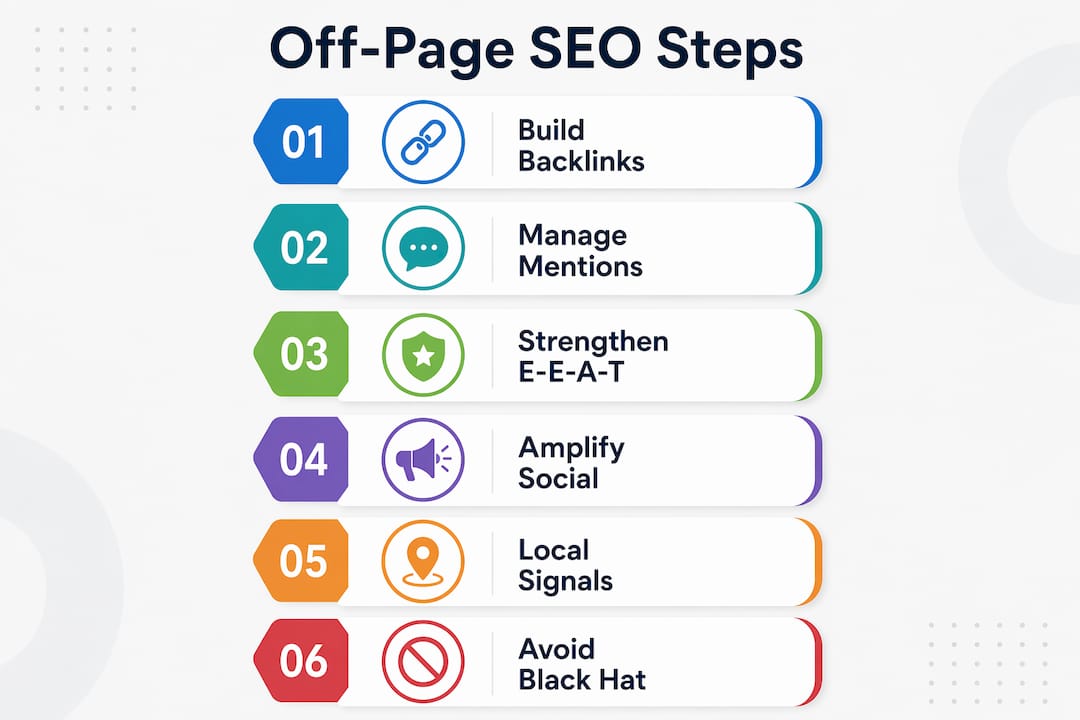
1. Build high-quality backlinks
Quality beats quantity every time. Links from high-authority, contextually relevant websites carry far more weight than dozens of links from low-relevance directories. Before pursuing any link, check three things: Is the linking site trustworthy? Is the topic relevant to yours? Will the link appear in a prominent position on the page?
Proven link building techniques that work in 2026:
- Guest posting: Write original content for reputable sites in your industry in exchange for a contextual backlink
- Broken link building: Find dead links on relevant pages, then pitch your content as a replacement
- Resource page pitching: Identify pages that curate industry resources and suggest your best guides or tools
- Original research: Publish data-driven studies or surveys. Other sites naturally cite primary sources
- Digital PR: Contribute expert opinions to news outlets or respond to journalist requests through services like HARO
Pro Tip: Unlinked mention campaigns are an underused tactic. Find sites that already mention your brand without linking, then reach out and ask them to add the link. You’re not asking for a favor; you’re completing something they started.
2. Earn and manage brand mentions

Brand mentions, even without links, contribute to entity recognition and trust signals that Google uses to rank websites. When your name appears consistently across articles, forums, reviews, and directories, algorithms pick up on it.
Ways to earn more brand mentions:
- Get interviewed on industry podcasts or featured in roundup posts
- Participate in Q&A platforms like Reddit or Quora with genuine, helpful answers
- Partner with complementary brands on co-authored content or joint webinars
- Distribute press releases for newsworthy announcements
3. Strengthen your E-E-A-T signals
E-E-A-T (Experience, Expertise, Authoritativeness, Trustworthiness) is Google’s framework for assessing content quality, and it relies heavily on off-page signals. Third-party coverage in reputable publications builds authoritativeness. Author bios with verifiable credentials and professional links strengthen expertise. Positive reviews on Google and industry platforms build trust.
Practical steps:
- Add full author bios with credentials to every article on your site
- Pursue coverage in industry publications, news sites, and niche blogs
- Actively request reviews from satisfied customers on Google and relevant platforms
4. Amplify content through social media
Social media shares and engagement are indirect off-page SEO factors. They don’t directly change your rankings, but they expand content reach, which increases the chance that journalists, bloggers, or industry voices will link to your work. LinkedIn, X, Reddit, and Instagram each reach different audiences. Collaborating with influencers in your niche multiplies that reach further. Learn more about building this side of your strategy through social media marketing.

5. Build local SEO off-page signals
Local citations and reviews are essential for businesses targeting location-based searches. Consistent NAP data (name, address, phone number) across directories helps search engines match your business to relevant local queries. An active Google Business Profile with recent reviews improves your chances of appearing in map pack results.
Local off-page tactics:
- Audit your NAP consistency across Google Business Profile, Yelp, and industry directories
- Encourage satisfied customers to leave reviews, and respond to them publicly
- Build links from local organizations, chambers of commerce, or event sponsors
- Pursue coverage in local news outlets or community blogs
For a deeper look at how citations vs. backlinks affect local SEO specifically, the distinction matters more than most guides acknowledge.
6. Avoid black hat pitfalls
Buying links, participating in private blog networks, and using automated link schemes can trigger Google penalties that are hard to recover from. The same applies to keyword-stuffed anchor text across a large number of links pointing to one page. These tactics may show short-term gains, but Google’s spam detection has grown significantly more sophisticated. Stick to earning links through genuine value.
How to track and measure the impact of off-page SEO efforts
Off-page SEO success is measurable, but you need the right metrics and a consistent monitoring habit. Tracking referring domains, backlink authority, organic rankings, and referral traffic gives you a clear picture of whether your efforts are moving the needle.
Key metrics to monitor:
- Referring domains: The count of unique domains linking to your site. A growing, diverse profile signals a healthy off-page strategy
- Backlink quality: Average domain authority of linking sites, percentage of dofollow links, and topical relevance of referring domains
- Brand mentions: Tracked via Google Alerts or dedicated monitoring tools, both linked and unlinked
- Organic rankings: Movement in target keyword positions, tracked weekly or monthly
- Referral traffic: Visitors arriving through backlinks, visible in Google Analytics under the Acquisition report
Tools that help:
Semrush and Ahrefs both provide detailed backlink profiles, domain authority scores, and keyword rank tracking. Moz offers similar functionality with its Link Explorer. Google Search Console is free and shows which external sites link to you, along with your average position for target queries.
Auditing and disavowing toxic links:
Run a link audit quarterly. Look for links from irrelevant, low-quality, or spammy domains. If you find a pattern of harmful links pointing to your site, Google’s Disavow Tool lets you tell Google to ignore them. Use it carefully; disavowing good links by mistake can hurt rankings.
Pro Tip: Set a baseline when you start any off-page campaign. Screenshot your referring domain count, your average domain authority, and your rankings for five to ten target keywords. Without a baseline, you can’t tell whether your work is actually moving anything.
The credibility layer: how off-page SEO reinforces website authority
Off-page SEO functions as the external proof that validates everything your content claims. You can write the most thorough guide on a topic, but if no one else on the internet acknowledges your expertise, search engines have no third-party reason to trust you. Without this credibility layer, high-quality content alone often fails to rank in competitive environments.
Think of it this way: your website is your argument, and off-page SEO is your evidence. Backlinks are citations from credible sources. Brand mentions are references in the broader conversation. Reviews are testimonials from real people. Together, they tell Google that your site is worth showing to searchers.
This layer also affects AI-powered search. When your brand appears consistently on high-authority, trusted sites, large language models recognize your content as a reliable source. Structured citations, strong backlinks, and consistent brand mentions all help AI tools “see” your site as worth citing in generated summaries and answers.
Key ways to build this credibility layer:
- Pursue coverage in authoritative publications relevant to your industry
- Build a consistent presence across trusted directories and review platforms
- Develop relationships with credible authors and experts who can reference your work
- Monitor your brand reputation actively and respond to reviews and mentions
The brands that rank consistently in competitive niches are almost always the ones with the strongest off-page authority. Their content may not always be the longest or the most technically polished. What sets them apart is that the rest of the internet vouches for them.
Start building your off-page authority with Seo-analytic
Off-page SEO takes time, but the compounding effect of a strong backlink profile and consistent brand presence is one of the most durable advantages in search. If you’re ready to build that foundation, Seo-analytic’s team of digital marketing specialists can help you develop a strategy that fits your market and goals.
Whether you’re starting from scratch or auditing an existing profile, the right website building foundation and a focused off-page strategy work together to grow your authority over time. Reach out to Seo-analytic to get started.
Key Takeaways
Off-page SEO is the external credibility signal that search engines require before ranking your content above well-established competitors.
| Point | Details |
|---|---|
| Backlinks drive rankings | Pages ranking #1 have 3.8x more backlinks than those in lower positions. |
| Quality over quantity | Links from high-authority, relevant sites outperform large volumes of low-quality links. |
| Brand mentions count | Unlinked brand mentions contribute to entity recognition and trust signals Google uses to rank sites. |
| Local signals matter | Consistent NAP data and active reviews are essential for businesses targeting location-based searches. |
| Measure what moves | Track referring domains, backlink quality, brand mentions, and organic rankings using tools like Semrush and Ahrefs. |
FAQ
What is off-page SEO?
Off-page SEO refers to all actions taken outside your website to improve its search engine rankings, including earning backlinks, building brand mentions, managing citations, and generating reviews. It tells search engines whether your site is trustworthy and authoritative.
What is the difference between on-page and off-page SEO?
On-page SEO covers everything you control directly on your website, such as content, title tags, and internal links. Off-page SEO involves external signals like backlinks and brand mentions that you can influence but not fully control.
Is off-page SEO still relevant in 2026?
Yes. Backlinks and off-site reputation signals remain foundational to Google’s ranking algorithm, and their importance has grown with the rise of AI-powered search tools that rely on external validation to identify trustworthy sources.
What percentage of SEO is on-page vs. off-page?
There is no fixed split, and Google has never published one. Both are necessary, and their relative weight depends on your niche and competition level. Generally, on-page SEO should be addressed first as the foundation, with off-page authority built on top of it.