

TL;DR:
- Maximizing local business listings involves claiming, optimizing, and maintaining profiles across online directories to improve search rankings and attract customers. Prioritizing high-authority platforms and data aggregators enhances citation volume and visibility, with proper workflow ensuring consistent updates and verifications. Patience and systematic effort outperform shortcuts, leading to sustained local SEO success and better customer engagement.
Maximizing local business listings is defined as the systematic process of claiming, optimizing, and maintaining your business information across online directories to improve local search rankings and drive customer engagement. Platforms like Google Business Profile, Data Axle, Neustar Localeze, and Foursquare are the core infrastructure behind this process. Done right, this approach to local SEO produces compounding returns: more citations, higher rankings, and more customers finding you before they find your competitors. This guide gives you the exact workflow to make that happen.
Which platforms must you prioritize for local listings?
The foundation of any effective local listings strategy is knowing where to focus first. Not all directories carry equal weight, and spending time on low-authority sites before locking down the major ones is a common and costly mistake.

Tier 1 directories are the platforms with the highest domain authority and the most direct influence on your local search rankings. These include Google Business Profile, Apple Maps, Bing Places, Yelp, and Facebook. Every local business in the U.S. must claim and fully complete these profiles before touching anything else.
Tier 2 directories include industry-specific and regional platforms like Angi, Houzz, Healthgrades, Avvo, and TripAdvisor. These matter more for specific verticals. A plumber benefits more from Angi than a restaurant does, so prioritize based on your industry.
The real multiplier in local listings, though, is the data aggregator layer. Submitting your standardized NAP (Name, Address, Phone) data to major aggregators like Data Axle, Neustar Localeze, and Foursquare propagates your information to hundreds of downstream directories over approximately 4–6 weeks. That single action creates citation coverage at a scale you could never achieve manually in the same timeframe.
Scale matters more than most business owners realize. Businesses with 50+ consistent listings across directories are 2.4x more likely to appear in the Google Local Pack for primary service keywords. The Local Pack is the three-business map block that appears at the top of Google search results. Showing up there is the difference between being found and being invisible.
Pro Tip: Claim your aggregator listings with Data Axle and Neustar Localeze before manually submitting to individual directories. The aggregators will push your data downstream automatically, saving you hours of repetitive data entry.
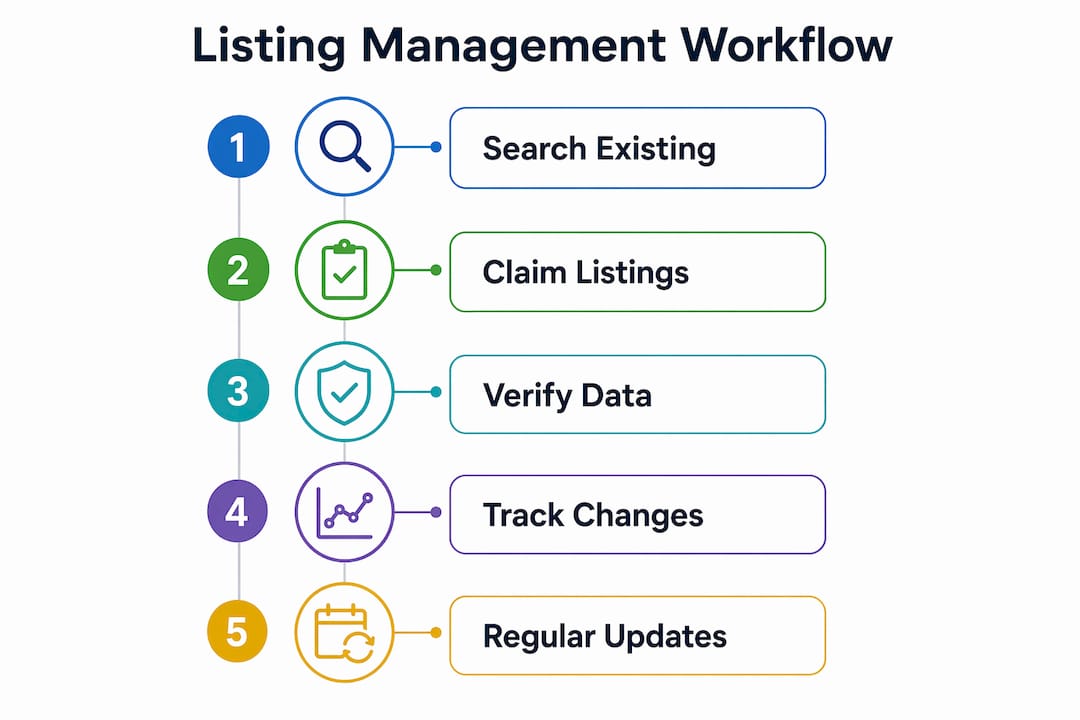
Understanding how local search ranking factors interact with citation volume helps you prioritize your effort correctly from day one.
How do you build a scalable listing management workflow?
A repeatable workflow separates businesses that maintain strong listings from those that let them decay. The process below is built for efficiency and works whether you have one location or ten.
-
Audit your existing listings. Search Google, Yelp, and Bing for your business name. Note every listing that exists, including ones you did not create. Record the URL, the current NAP data, and whether the listing is claimed or unclaimed.
-
Build a tracking spreadsheet. Maintaining a spreadsheet that tracks directory URLs, claim dates, verification status, login credentials, and last-updated dates is the operational backbone of scalable listing management. Use Google Sheets or Airtable. This document becomes your single source of truth.
-
Standardize your NAP data. Decide on one exact format for your business name, address, and phone number. Write it down. Use it everywhere without variation. “St.” versus “Street” or “Suite” versus “Ste.” are the kinds of inconsistencies that erode your credibility with search engines.
-
Claim in batches. Batch claiming directories in sets of 10 per week lets you reach 100+ listings in 8–12 weeks without burning out. Start with Tier 1, then aggregators, then Tier 2.
-
Verify each listing. Most platforms verify via phone, postcard, or email. Log the verification method and status in your spreadsheet immediately. Unverified listings can be edited by anyone, including competitors.
-
Schedule quarterly audits. Set a calendar reminder every 90 days to check your top 20 listings for accuracy. Business hours change. Phone numbers change. Listings go stale without you noticing.
Here is a simple tracking structure to use as your template:
| Column | What to Track |
|---|---|
| Directory Name | Platform name (e.g., Yelp, Data Axle) |
| Listing URL | Direct link to your business profile |
| Claim Status | Claimed, Unclaimed, or Pending |
| Verification Method | Phone, Postcard, Email, or Instant |
| Last Updated | Date you last reviewed or edited the listing |
Pro Tip: Never create a new listing on a platform without first searching for an existing one. Duplicate listings split your citation signals and confuse both customers and search engines. Merge or delete duplicates before claiming.
How do you optimize each listing to rank higher?
Claiming a listing is only half the job. An uncompleted or generic profile performs far below its potential. Optimization is where you convert a claimed listing into a genuine ranking and engagement asset.
-
NAP consistency is non-negotiable. Consistent NAP information across all listings is one of the strongest local SEO ranking signals and a direct credibility indicator for search engines. One mismatched address across 30 directories weakens all of them.
-
Write keyword-rich descriptions. Your business description on Google Business Profile, Yelp, and Bing Places should include your primary service, your city, and your neighborhood where natural. A plumber in Austin should write “licensed plumber serving Austin, TX and the surrounding Travis County area” rather than a generic tagline.
-
Select the most specific category available. Google Business Profile allows a primary category and multiple secondary categories. Choosing “Plumber” as your primary and “Water Heater Repair Service” as a secondary is more effective than stopping at the broad category alone. Backlinko’s 2026 local SEO research confirms that accurate categories and descriptions directly improve local search performance and customer engagement.
-
Upload photos consistently. Listings with photos receive significantly more direction requests and website clicks than those without. Add at least 10 photos to your Google Business Profile: exterior, interior, team, and product or service shots. Update them at least twice per year.
-
Collect and respond to reviews. Ask every satisfied customer to leave a Google review. Respond to every review, positive or negative, within 48 hours. Review volume and recency are active ranking signals. A business with 200 reviews from the past year outranks one with 200 reviews from five years ago.
AI systems and Google increasingly rely on consistent, accurate listing data aggregated from multiple sources to rank and surface local businesses. This means your listing quality now affects not just traditional search but also AI-powered tools like ChatGPT, Perplexity, and Google’s AI Overviews. Explore how AI shapes digital marketing to understand the full scope of this shift.
What are the most common local listings problems?
Even a well-planned listing strategy runs into friction. Knowing the most common problems in advance lets you fix them faster and avoid wasted effort.
-
Propagation delays catch most business owners off guard. Listing updates can take 4–12 weeks to propagate fully across the directory ecosystem. Plan weekly checks for the first 1–2 months after any major update rather than expecting instant results.
-
Conflicting data from old listings creates ranking confusion. If your business moved or changed its phone number, old listings with the previous data actively hurt you. Search them out using tools like Moz Local or BrightLocal, then correct or remove them.
-
Verification failures stall your progress. Postcard verification from Google can take up to two weeks. If a postcard does not arrive, request a new one immediately rather than waiting. Some platforms now offer video verification as a faster alternative.
-
Listing management platforms reduce manual workload at scale. Tools like Yext, Moz Local, and BrightLocal allow you to push updates to dozens of directories from a single dashboard. For multi-location businesses, this is not optional. It is the only way to maintain accuracy at scale. Review your options with a local SEO tools comparison before committing to a platform.
“Many local business owners submit their data and assume the work is done. Consistent verification over weeks and months is what separates businesses that rank from those that wonder why they don’t.”
Understanding citations for local SEO gives you the technical grounding to troubleshoot these issues with confidence rather than guesswork.
Key takeaways
Maximizing local business listings requires consistent NAP data, strategic platform prioritization, and a repeatable verification workflow to produce lasting local search visibility.
| Point | Details |
|---|---|
| Prioritize Tier 1 and aggregators | Claim Google Business Profile, Yelp, and data aggregators like Data Axle before smaller directories. |
| Use a tracking spreadsheet | Log every listing’s URL, claim status, and verification method to prevent duplicates and stale data. |
| NAP consistency drives rankings | Identical name, address, and phone across all listings is a top local SEO ranking signal. |
| Optimize beyond the basics | Add photos, keyword-rich descriptions, and correct categories to each profile for maximum impact. |
| Plan for propagation delays | Expect 4–12 weeks for updates to spread; schedule weekly checks during that window. |
Why patience and process beat shortcuts every time
I have worked with dozens of local business owners who expected their Google rankings to jump within a week of claiming their listings. That expectation sets them up for frustration and, worse, for abandoning a strategy that was actually working.
The most underrated skill in local listings management is patience combined with process. Submitting your NAP data to Data Axle on a Monday does not mean Yelp reflects it by Friday. The ecosystem moves slowly, and that is actually good news for disciplined operators. Most of your competitors give up before the results arrive.
What I have seen work consistently is the batch-and-track method. Claim 10 directories per week, log everything, verify within the platform’s required window, and move on. Do not revisit a listing obsessively. Trust the spreadsheet. After 10 weeks, you will have coverage that took your competitors years to build haphazardly.
The other thing I push back on is the idea that software tools replace the need for strategy. Yext and BrightLocal are genuinely useful, especially for multi-location businesses. But I have seen businesses pay for these tools while their Google Business Profile sits half-completed with no photos and a generic description. The tool does not fix a bad foundation. Get the fundamentals right first, then use software to maintain and scale.
For businesses with multiple locations, the complexity multiplies fast. The multi-location SEO strategies that work at one location require a more structured system at five or ten. Build the habit at one location, then systematize it.
— Maayan
How Seo-analytic helps you build visibility that lasts
Strong local listings are one piece of a larger online visibility picture. Your listings drive traffic, but your website converts it.
Seo-analytic works with U.S. local business owners to build the full digital foundation: from website building basics that support your local SEO to social media marketing strategies that keep customers engaged after they find you. Our team handles the technical and creative work so you can focus on running your business. If your listings are driving clicks but your website is not converting them, that is the next problem to solve. Seo-analytic can help you solve it.
FAQ
What does maximizing local business listings mean?
Maximizing local business listings means claiming, completing, and maintaining your business profiles across online directories to improve local search rankings and attract more customers. It includes platforms like Google Business Profile, Yelp, and data aggregators like Data Axle.
How many listings do i need to appear in the google local pack?
Businesses with 50 or more claimed and consistent listings are 2.4x more likely to appear in the Google Local Pack for their primary service keywords.
How long does it take for listing updates to go live?
Propagation can take 4–12 weeks across the full directory ecosystem. Plan weekly verification checks for the first one to two months after submitting any update.
What is NAP consistency and why does it matter?
NAP stands for Name, Address, and Phone number. Consistent NAP data across all listings is one of the strongest local SEO ranking signals and builds credibility with both search engines and customers.
Should i use a listing management tool or do it manually?
Manual claiming works well for single-location businesses using a spreadsheet. For businesses with multiple locations or more than 50 listings, tools like Yext, Moz Local, or BrightLocal reduce errors and save significant time.