

TL;DR:
- Negative SEO involves covert tactics aimed at damaging your website’s search rankings through toxic backlinks, malicious content, or fake reviews. Consistent monitoring, thorough diagnosis, and cautious response strategies help detect and mitigate these threats before they cause lasting harm. Building positive content, securing your site, and maintaining active reputation management are essential for long-term protection.
Your rankings were climbing steadily, then they fell off a cliff. You changed nothing. No algorithm update explains it. No technical issues show up in your site audit. Managing negative SEO is exactly this kind of invisible fight, and it costs businesses real money. Research shows a one-star rating drop can reduce revenue by 5 to 9 percent. Whether you are a business owner watching your traffic dry up or a digital marketer scrambling for answers, this guide walks you through identification, response, prevention, and long-term protection.
Table of Contents
- Key takeaways
- Managing negative SEO: what it is and how to spot it
- Setting up your monitoring system
- Responding when you suspect an attack
- Preventing negative SEO before it starts
- Confirming recovery and staying protected
- My honest take on where most people go wrong
- Protect your site with Seo-analytic
- FAQ
Key takeaways
| Point | Details |
|---|---|
| Diagnose before you act | Run a structured diagnostic to rule out algorithm updates and site issues before treating it as an attack. |
| Monitor consistently | Set up automated alerts for link profile changes, traffic anomalies, and manual actions to catch problems early. |
| Disavow with caution | Most link-based attacks are neutralized by Google’s SpamBrain. Overusing the disavow tool can do more harm than good. |
| Build a strong positive layer | Authoritative content, FAQs, and positive reviews help AI search engines represent your brand accurately against isolated negatives. |
| Prevent through hardening | Regular backlink audits, website security, and review management reduce your exposure to attacks significantly. |
Managing negative SEO: what it is and how to spot it
Negative SEO refers to deliberate actions taken by a competitor or bad actor to harm your website’s search engine rankings. The tactics range from flooding your backlink profile with toxic links to scraping and republishing your content, injecting malicious code into your site, or coordinating fake negative reviews across platforms.
The most common symptoms you should watch for include:
- A sudden spike in low-quality or spammy backlinks pointing to your domain
- Unexplained drops in organic rankings, especially for your strongest pages
- A manual penalty notification inside Google Search Console
- Duplicate versions of your content appearing on other domains
- Unusual traffic patterns, such as a surge of bot traffic followed by a ranking drop
- A wave of negative reviews appearing across Google, Yelp, and Trustpilot within a short period
The tricky part is that these symptoms do not always mean an attack is underway. Ranking drops frequently happen after core algorithm updates. Manual penalties coinciding with Google core updates are more likely algorithmic than the result of a deliberate attack. Before you assume the worst, you need a diagnostic approach.
Pro Tip: Export your backlink data from two or three tools at once, such as Ahrefs, Semrush, and Google Search Console. Cross-referencing them gives you a much more accurate picture of what is genuinely new and suspicious versus what one tool flags incorrectly.
Start by ruling out internal causes: site migrations, canonical tag errors, content deletions, or server issues. Then check the Google Search Console for any manual action messages. Only after clearing those should you consider an external attack as the likely cause.
Setting up your monitoring system
Early detection is the factor that separates a minor disruption from a months-long recovery. The goal is to catch suspicious signals within days, not weeks.

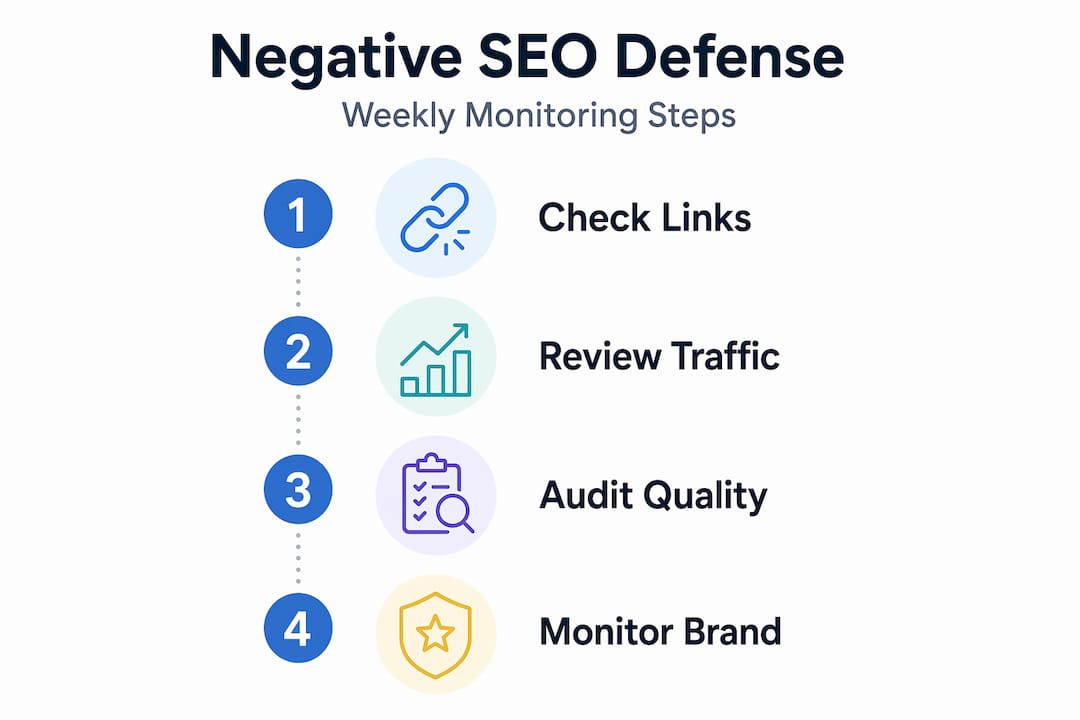
The four metrics worth tracking on a weekly basis are link profile anomalies, organic traffic fluctuations, domain quality of newly acquired links, and any manual action notifications in Google Search Console. Missing any one of these for a prolonged period can allow an attack to escalate.
Automated alerts from Ahrefs and Semrush save time and reduce the chance of human error, but they work best when a person reviews the flagged data with judgment. A spike in new referring domains can look alarming in a chart but turn out to be a normal response to a piece of content going viral. Context always matters.
Here is a quick reference for tools and what each one covers best:
| Tool | Best for | Alert type |
|---|---|---|
| Google Search Console | Manual actions, index coverage, traffic drops | Email alerts for manual penalties |
| Ahrefs Alerts | New and lost backlinks, velocity spikes | Daily or weekly email digests |
| Semrush Notifications | Backlink toxicity scores, site audits | Automated toxicity spike alerts |
| Google Alerts | Content scraping and brand mention tracking | Real-time or daily summaries |
Pro Tip: Schedule your manual link reviews within 48 hours of a confirmed Google core update. Attacks sometimes coincide with major updates because competitors know SEOs will attribute drops to the algorithm rather than investigating further.
Good brand reputation monitoring goes beyond just your backlink profile. You want to track brand mentions, review platforms, and forums where complaints can surface and influence how AI-driven search results represent your business.
Responding when you suspect an attack
Speed matters, but a rushed response can make things worse. The discipline of running a structured diagnostic before any remedial action is the most consequential improvement in negative SEO defense. Follow this sequence:
- Check for algorithm updates. Use resources like Google’s official announcements or third-party update trackers to confirm whether a core update rolled out around the time your rankings dropped.
- Review Google Search Console for manual actions. A manual penalty is documented there and requires a reconsideration request, not a disavow file.
- Audit for security breaches. Check for malicious code injections, unauthorized redirects, or hacked content pages that could cause sudden ranking losses.
- Analyze your link velocity. Pull a report on new referring domains acquired in the past 30 to 60 days. Look for patterns like bulk links from low-authority foreign domains, links with exact-match anchor text, or links from sites that link to hundreds of similar domains.
- Identify the attack signature. Distinguish between a programmatic link flood from auto-generated sites and a contextual injection where your link appears naturally on legitimate sites that were themselves compromised.
“The default recommended response for most link-based attacks is informed inaction. Google’s SpamBrain is specifically designed to neutralize spammy links at scale, and jumping to disavow before the algorithm has a chance to act often causes more harm than the attack itself.” — Negative SEO in 2026
If the attack involves contextual link injection on legitimate sites, direct outreach to those webmasters is the right move. This works best when fewer than 50 source domains are involved and you can identify the site owner’s contact information. For large-scale, clearly coordinated attacks, submitting a webspam report to Google triggers enforcement review and is often more effective than disavowal alone.
Reserve the disavow file for situations where a manual penalty is already in place and the bad links are clearly inorganic and unremovable. Used incorrectly, disavowal can strip legitimate link equity from your profile. Only 39% of SEO professionals actively use the disavow tool in 2026, largely because most prefer to diagnose thoroughly and let Google’s filters handle the rest.
Preventing negative SEO before it starts
Defending against negative SEO is far less painful than recovering from it. The good news is that most prevention strategies also improve your overall SEO performance, so this work pays off regardless of whether an attack ever comes.
Here are the core prevention practices worth building into your regular workflow:
- Run quarterly backlink audits. A clean link profile is harder to pollute. When you know your baseline, anomalies are obvious and fast to catch.
- Harden your website security. Keep your CMS, plugins, and themes updated. Use a web application firewall and enable two-factor authentication for all admin accounts. Hacked sites are a common negative SEO vector.
- Protect your content with canonical tags and sitemaps. These tell search engines which version of your content is original, making scraping attacks less effective.
- Manage your review presence actively. Addressing complaints within 24 hours improves customer sentiment by 35 percent in documented retail cases. Responding quickly to reviews also signals to platforms that you are an active, legitimate business. Seo-analytic’s guide on responding to online reviews covers this well.
- Build authoritative content consistently. Sites with deep topic authority and strong brand signals are harder to attack because the signal-to-noise ratio works in their favor.
- Use structured data and schema markup. Schema helps AI-powered search engines understand who you are and what your customers genuinely think, reducing the chance that isolated negative content gets surfaced without context.
AI-powered search engines now synthesize sentiment from Reddit, Trustpilot, complaints boards, and other sources, making traditional reputation suppression insufficient. Prevention in 2026 means building a positive content ecosystem broad enough that isolated negatives cannot dominate the picture. You can explore AI-adapted marketing strategies to understand what this looks like in practice.
Confirming recovery and staying protected
Recovery is not a single moment. It is a trend you observe over several weeks. The clearest signal is seeing your target pages return to their pre-attack ranking positions. But you should also track whether the spike in toxic links has leveled off and whether any manual actions have been resolved.
Ongoing protection requires more than a one-time cleanup:
- Check your backlink profile monthly, not just when something feels wrong. Set a recurring calendar reminder and treat it like a financial audit.
- Track branded search volume. A sustained drop in people searching for your brand name can indicate reputation damage spreading beyond rankings.
- Build your positive content footprint continuously. Structured FAQs, case studies, and authoritative mentions increase AI model trust in your content and ensure that your brand is represented accurately in AI-generated search overviews.
- Create an internal incident response plan. Document what a suspicious event looks like, who handles it, and what the escalation process is. Teams that have practiced the workflow respond in hours, not days.
- Train anyone who touches your SEO. Negative SEO risk management is not a solo job. Your content team, developers, and customer service staff all play a role in early detection and prevention.
Good off-page SEO practices compound over time and make your site a much less attractive target. Authority is the best defense.
My honest take on where most people go wrong
I have watched businesses panic and disavow half their link profile the moment they see a spike in low-quality links. It almost always causes more damage than the attack itself. In my experience, Google’s SpamBrain handles the overwhelming majority of link-based attacks without any intervention. The disavow tool is a precision instrument, and most people treat it like a fire hose.
The other mistake I see constantly is treating negative SEO as a purely technical problem. In 2026, the real threat is not a dump of forum links. It is a coordinated pattern of negative reviews, complaint posts, and fabricated controversies that AI-driven engines like Google’s AI Overviews will synthesize and serve to anyone searching your brand. That is an online reputation challenge that no disavow file can touch. The businesses that handle it best are the ones that never stopped building positive content, engaging with their customers, and maintaining a strong brand presence across platforms.
The calm, methodical approach I keep coming back to is this: monitor obsessively, diagnose rigorously, act precisely. Panic is the real enemy. The sites that recover fastest are not the ones that acted first. They are the ones that acted right.
— Maayan
Protect your site with Seo-analytic
If managing negative SEO feels like too much to handle alongside running your business, you do not have to figure it all out alone. At Seo-analytic, we work with business owners and marketing teams to build defenses that catch problems early and keep your search performance stable.
Our brand reputation management guide is a strong starting point for understanding how to protect your online presence in the current landscape. If you want to build from the ground up with security and SEO resilience baked in, the website building guide for business owners walks you through every step. And for deeper SEO support, our search engine optimization services give you expert guidance without the guesswork.
FAQ
What is negative SEO?
Negative SEO is the practice of using deliberate tactics to harm a competitor’s search rankings. Common methods include building toxic backlinks to their site, scraping their content, or coordinating fake negative reviews.
How do I know if I am under a negative SEO attack?
Look for sudden unexplained ranking drops, a spike in low-quality backlinks, manual penalty notifications in Google Search Console, or a surge of negative reviews appearing across multiple platforms in a short period.
Should I use the disavow tool right away?
No. Most SEO professionals prefer a diagnostic-first approach because Google’s SpamBrain neutralizes most spammy links automatically. Overusing the disavow tool risks removing legitimate link equity from your profile.
How does AI search change negative SEO risk management?
AI-powered search engines now surface negative sentiment from diverse platforms like Reddit and Trustpilot in AI Overviews, meaning reputation attacks extend beyond rankings into how your brand is described to users at the top of search results.
How long does negative SEO recovery take?
Recovery timelines vary based on attack severity, but most businesses that follow a structured response see ranking improvements within four to twelve weeks, assuming the root cause is properly identified and addressed.