

Bold moves often separate standout startups from those stuck on the sidelines. Growth hacking offers a creative, technical, and experimental approach for ambitious founders and marketing managers aiming for rapid user acquisition and measurable impact. Unlike traditional marketing, growth hacking thrives on cross-disciplinary collaboration and ongoing testing to uncover high-velocity strategies. This guide reveals clear definitions, common misconceptions, and proven methods that help American startups optimize online presence while scaling efficiently with limited resources.
Table of Contents
- Defining Growth Hacking And Key Misconceptions
- Types And Techniques Of Growth Hacking
- How Growth Hacking Drives User Acquisition
- Core Traits Of A Successful Growth Hacker
- Risks, Costs, And Mistakes To Avoid
- Real-World Growth Hacking Case Studies
Key Takeaways
| Point | Details |
|---|---|
| Understanding Growth Hacking | It is a strategic approach combining creativity and technical skills for rapid startup growth, requiring a shift from traditional marketing methods. |
| Cross-functional Collaboration | Successful growth hacking relies on cooperation among various teams, including marketers, developers, and product managers. |
| Emphasis on Data-Driven Decisions | Continuous experimentation and real-time data analysis are crucial for scaling user acquisition strategies effectively. |
| Avoiding Common Pitfalls | Startups must sidestep mistakes such as neglecting user experience and ignoring ethical guidelines in pursuit of rapid growth. |
Defining Growth Hacking and Key Misconceptions
Growth hacking is a strategic approach to scaling startup success that goes far beyond traditional marketing techniques. Pioneered by Silicon Valley’s tech innovators, this methodology combines creativity, technical skills, and rapid experimentation to drive exponential user growth.
At its core, growth hacking represents a cross-disciplinary approach involving multiple teams: marketers, developers, engineers, and product managers. Unlike conventional marketing strategies, growth hacking focuses intensely on:
- Rapid experimentation and testing
- Technical integration of marketing tactics
- Data-driven decision making
- Scalable and repeatable growth mechanisms
- Low-cost, high-impact user acquisition strategies
Key Misconceptions About Growth Hacking
Many entrepreneurs misunderstand growth hacking as simply another marketing buzzword. However, it’s a comprehensive methodology for rapid company expansion that requires a fundamentally different approach from traditional marketing campaigns.
Primary misconceptions include believing growth hacking is:
- Just another marketing trick
- Only applicable to tech startups
- A one-time strategy instead of an ongoing process
- Solely dependent on digital channels
Growth hacking is not about finding a single magic solution, but creating a systematic approach to continuous, scalable growth.
Successful growth hacking demands a mindset of constant iteration, technical understanding, and willingness to experiment boldly. Startups must be prepared to test multiple strategies, analyze results quickly, and pivot when necessary.

Pro tip: Develop a growth hacking mindset by creating a structured experimentation framework that allows rapid testing and learning across marketing, product, and user experience dimensions.
Here’s a summary of how growth hacking differs from traditional marketing:
| Aspect | Growth Hacking Approach | Traditional Marketing Approach |
|---|---|---|
| Primary Focus | Rapid experimentation and user growth | Brand building and awareness |
| Team Involvement | Cross-functional (tech, marketing, product) | Mostly marketing/sales departments |
| Budget Strategy | Low-cost, high-impact tactics | Larger, planned campaigns |
| Adaptability Speed | Constant iteration and rapid pivots | Slower, structured adjustments |
| Measure of Success | Scalable user acquisition metrics | Campaign ROI and market reach |
Types and Techniques of Growth Hacking
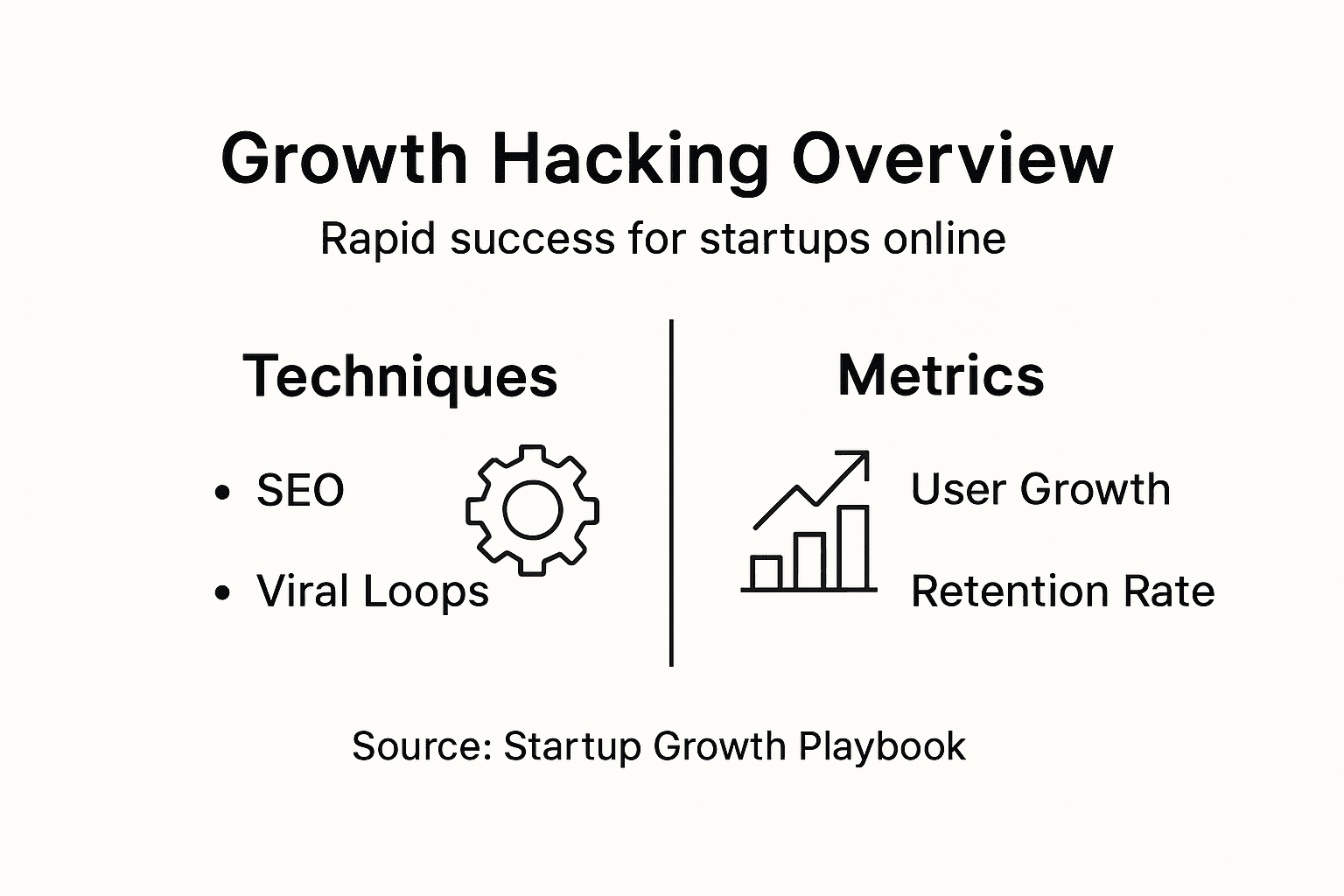
Growth hacking represents a multifaceted approach to scaling startup success through innovative, data-driven strategies. Drawing from the ASP™ framework, successful growth hackers deploy a range of sophisticated techniques designed to maximize user acquisition and retention with minimal resource expenditure.
The primary growth hacking techniques can be categorized into several key domains:
-
User Acquisition Strategies
- Search engine optimization (SEO)
- Viral marketing campaigns
- Referral program development
- Influencer collaborations
-
Product-Led Growth Techniques
- Landing page optimization
- A/B testing
- User onboarding improvements
- Feature experimentation
-
Marketing Automation
- Email marketing sequences
- Personalized user segmentation
- Behavioral trigger campaigns
- Dynamic content delivery
Startups can leverage diverse growth hacking techniques that blend technical innovation with strategic marketing. These methods go beyond traditional approaches by integrating data analytics, technical skills, and creative problem-solving to drive exponential user growth.
Growth hacking isn’t about finding a single solution, but creating a systematic, repeatable process for continuous improvement and expansion.
Successful implementation requires cross-functional collaboration between marketing, product, and engineering teams. Each technique must be rigorously tested, measured, and refined to ensure maximum impact and efficiency.
Key considerations for effective growth hacking include:
- Prioritize data-driven decision making
- Embrace continuous experimentation
- Focus on scalable, repeatable strategies
- Maintain flexibility and rapid iteration
- Integrate technical and marketing expertise
Pro tip: Create a structured growth experiments dashboard that tracks key performance indicators, allows quick hypothesis testing, and enables rapid pivoting based on real-time user data insights.
Compare these growth hacking strategies by business impact and resource needs:
| Technique | Business Impact | Resource Requirement |
|---|---|---|
| Viral Referral Programs | Exponential user growth | Medium technical setup |
| SEO Optimization | Sustainable traffic boost | High content investment |
| Landing Page A/B Testing | Higher conversion rates | Moderate design and tools |
| Influencer Collaborations | Fast credibility increase | Budget and networking |
| Behavioral Triggers | Enhanced user retention | Advanced automation tools |
How Growth Hacking Drives User Acquisition
User acquisition is the lifeblood of startup success, and growth hacking transforms traditional acquisition strategies by combining creative marketing with data-driven technical approaches. Unlike conventional methods, growth hacking focuses on building a systematic, scalable process for attracting and converting potential users.
The core mechanisms of driving user acquisition through growth hacking include:
-
Conversion Funnel Optimization
- Streamlining user registration processes
- Reducing friction in onboarding
- Creating compelling value propositions
- Implementing intuitive user interfaces
-
Viral Mechanics
- Designing shareable product features
- Implementing referral incentive programs
- Leveraging social proof
- Creating network effect opportunities
-
Targeted Acquisition Channels
- Precision social media advertising
- Content marketing strategies
- Search engine optimization
- Strategic partnerships and integrations
Rapid experimentation and continuous iteration are fundamental to growth hacking’s user acquisition approach. Successful startups continuously test multiple acquisition strategies, quickly identifying and scaling the most effective channels while rapidly abandoning underperforming tactics.
The most successful growth hackers view user acquisition not as a linear process, but as a dynamic, constantly evolving ecosystem of opportunities.
Effective user acquisition requires a holistic approach that integrates multiple disciplines:
- Deep understanding of target audience psychology
- Technical skills for implementation
- Data analytics capabilities
- Rapid experimentation mindset
- Cross-functional collaboration
Pro tip: Develop a comprehensive user acquisition dashboard that tracks key performance indicators across multiple channels, enabling real-time strategy adjustments and identifying emerging growth opportunities.
Core Traits of a Successful Growth Hacker
Growth hackers are unique professionals who blend technical prowess with marketing creativity. Combining multiple disciplinary skills, these innovative strategists approach business challenges with a distinctive mindset focused entirely on scalable, measurable growth.
The essential traits of a successful growth hacker include:
-
Analytical Mindset
- Data-driven decision making
- Comfort with complex statistical analysis
- Ability to interpret nuanced metrics
- Hypothesis testing skills
-
Technical Proficiency
- Basic coding and programming knowledge
- Understanding of web and mobile analytics
- Familiarity with marketing automation tools
- Rapid prototyping capabilities
-
Creative Problem Solving
- Unconventional thinking approaches
- Ability to identify unique growth opportunities
- Willingness to experiment boldly
- Cross-functional innovation skills
Professional growth hackers think systemically, viewing challenges as interconnected puzzles rather than isolated problems. They continuously learn, adapt, and develop strategies that transform traditional marketing constraints into innovative growth mechanisms.
The most effective growth hackers see limitations not as barriers, but as opportunities for creative solution design.
Successful growth hackers must excel across multiple competency domains:
- Technical understanding
- Marketing strategy knowledge
- Data interpretation skills
- Collaborative communication
- Persistent experimentation mindset
Pro tip: Build a personal growth hacking skill development plan that allocates dedicated time each week to learning new technical skills, experimenting with emerging marketing technologies, and analyzing innovative growth strategies.
Risks, Costs, and Mistakes to Avoid
Growth hacking requires strategic navigation to prevent potentially costly missteps. Understanding potential risks and ethical boundaries is crucial for startups seeking sustainable, responsible expansion strategies.
Common risks and potential pitfalls in growth hacking include:
-
Strategic Risks
- Over-reliance on short-term tactics
- Neglecting long-term brand reputation
- Ignoring sustainable growth principles
- Chasing vanity metrics
-
Operational Risks
- Insufficient data validation
- Poor experiment design
- Lack of robust tracking mechanisms
- Misinterpreting analytics results
-
Ethical Considerations
- Potential user privacy violations
- Aggressive marketing tactics
- Misleading growth representations
- Compromising user trust
Ethical concerns can significantly impact startup credibility, making it essential to balance aggressive growth strategies with responsible implementation. Successful growth hackers must develop a nuanced approach that prioritizes genuine user value over manipulative tactics.
Growth hacking success depends not just on tactics, but on maintaining user trust and delivering genuine value.
Most critical mistakes startups must avoid include:
- Sacrificing user experience for short-term gains
- Implementing untested growth strategies
- Neglecting comprehensive data analysis
- Failing to establish clear ethical guidelines
- Ignoring long-term brand reputation
Pro tip: Create a comprehensive risk assessment framework that evaluates potential growth hacking strategies through ethical, operational, and strategic lenses before implementation.
Real-World Growth Hacking Case Studies
Growth hacking transforms theoretical strategies into tangible success through remarkable real-world examples. Examining successful company case studies reveals powerful insights into innovative user acquisition and rapid scaling techniques.
Outstanding growth hacking case studies demonstrate diverse strategies across multiple sectors:
-
Technology Platforms
- Dropbox’s referral program
- Airbnb’s cross-platform integration
- LinkedIn’s professional network expansion
- Spotify’s viral user sharing mechanism
-
E-commerce Innovations
- Amazon’s personalized recommendation engine
- Uber’s viral referral strategies
- Warby Parker’s disruptive customer acquisition
- Zappos’ customer experience optimization
-
Social Media Growth
- Instagram’s viral onboarding
- Pinterest’s visual discovery model
- TikTok’s algorithmic content distribution
- Reddit’s community-driven growth approach
Detailed case analyses reveal consistent growth hacking patterns that transcend individual company contexts. Successful organizations leverage cross-functional teams, data-driven experimentation, and innovative product features to drive exponential user acquisition.
Growth hacking is not about a single magical technique, but a systematic approach to continuous, measurable improvement.
Key learnings from these case studies include:
- Prioritize user experience
- Design inherently shareable product features
- Leverage network effects
- Implement data-driven experimentation
- Create value beyond traditional marketing
Pro tip: Develop a case study analysis framework that deconstructs successful growth hacking strategies, identifying transferable techniques and underlying principles applicable to your specific startup context.
Accelerate Your Startup Growth with Expert Digital Marketing Solutions
Growth hacking demands rapid experimentation, seamless integration of marketing tactics, and data-driven strategies to scale startups efficiently. If you want to overcome challenges like user acquisition, retention, and scalable growth, our tailored digital marketing services are designed to support your journey. By focusing on low-cost, high-impact strategies and providing cross-functional expertise, we help you build a sustainable growth engine.
Explore how our Social Media – seo analytic solutions can amplify your viral and referral campaigns and boost engagement across platforms. Combine this with our proven Search Engine – seo analytic strategies for SEO optimization to drive targeted traffic that converts. Our comprehensive offerings empower startups to iterate quickly, optimize conversions, and maintain a steady growth trajectory.
Take the next step to unlock rapid online success for your startup by partnering with a trusted digital marketing agency. Visit https://seo-analytic.com now and let our experts craft a personalized growth hacking approach that turns visitors into loyal customers.
Frequently Asked Questions
What is growth hacking?
Growth hacking is a strategic approach that combines creativity, technical skills, and rapid experimentation to drive exponential user growth for startups, moving beyond traditional marketing techniques.
How does growth hacking differ from traditional marketing?
Growth hacking focuses on rapid experimentation and user growth, utilizing cross-functional teams and low-cost tactics, whereas traditional marketing emphasizes brand building and typically involves larger, planned campaigns.
What are some key techniques used in growth hacking?
Key growth hacking techniques include user acquisition strategies like SEO and viral marketing, product-led growth methods like A/B testing, and marketing automation through personalized campaigns and dynamic content delivery.
What are the risks associated with growth hacking?
Common risks include over-reliance on short-term tactics, neglecting long-term brand reputation, ignoring ethical considerations, and misinterpreting data analysis results.
Recommended
- Effective Startup Marketing Strategies to Boost Growth – seo analytic
- Building Online Communities for Startup Success – seo analytic
- Market Segmentation: Boosting Startup Conversions – seo analytic
- What Is a Sales Funnel and Boosting Tech Startup ROI – seo analytic
- How to Boost Website Speed in 2025: Proven Tips for SMBs & Marketers