

More than 80 percent of American consumers expect personalized engagement from online brands. For digital marketing managers at small to mid-sized e-commerce startups, mastering drip marketing can be the difference between a loyal customer and another lost lead. Understanding what sets drip campaigns apart—and why common misconceptions persist—empowers you to design smarter, more strategic messaging that drives conversion and builds real customer relationships.
Table of Contents
- Drip Marketing Defined And Common Misconceptions
- Key Types Of Drip Marketing Campaigns
- How Drip Campaigns Work For E-commerce
- Essential Features And Success Factors
- Risks, Costs, And Common Pitfalls
- Comparing Drip Marketing To Alternatives
Key Takeaways
| Point | Details |
|---|---|
| Drip Marketing Defined | Drip marketing uses automated, personalized messaging to engage customers over time, differing from one-time email blasts. |
| Segmentation is Key | Successful campaigns depend on understanding customer behavior, allowing tailored messaging that resonates with specific audience segments. |
| Campaign Types Matter | Various drip marketing campaigns serve distinct purposes, such as onboarding new users or re-engaging inactive customers, enhancing overall effectiveness. |
| Risks of Over-Automation | Businesses must balance automation with personalized communication to avoid alienating customers through irrelevant messaging. |
Drip Marketing Defined and Common Misconceptions
Drip marketing is a strategic communication approach that systematically delivers pre-written messages to potential customers through automated channels, primarily email. Unlike traditional one-time email blasts, drip marketing involves sending personalized, sequential messages that adapt to user behaviors and engagement levels. This methodology allows businesses to nurture leads more effectively by maintaining consistent, targeted communication.
The core mechanism of drip marketing revolves around automation and precision. Businesses can design message sequences that trigger based on specific customer actions or predetermined timelines. For instance, when a potential customer downloads a product guide, they might automatically receive a series of follow-up emails providing additional information, testimonials, and persuasive content designed to move them closer to making a purchase. This communication strategy is distinct because it follows a predetermined course and targets specific recipient behaviors.
Many entrepreneurs mistakenly believe drip marketing is just another term for email marketing. However, the key difference lies in personalization and strategic timing. While traditional email marketing might send generic broadcasts, drip marketing creates tailored journeys for individual customer segments. These campaigns can address different stages of the customer lifecycle, from initial awareness to post-purchase engagement, making them significantly more nuanced and effective.
Pro tip: Create customer persona segments before designing your drip marketing campaign to ensure each message resonates with its specific audience and feels personally relevant.
Key Types of Drip Marketing Campaigns
Drip marketing campaigns are strategically designed to target specific business objectives, ranging from prospect conversion to customer loyalty enhancement. These campaigns vary in duration and focus, utilizing sophisticated automation platforms to deliver systematic, targeted messaging. Understanding the primary types of drip marketing campaigns can help businesses craft more effective communication strategies.
The main types of drip marketing campaigns include onboarding sequences, re-engagement campaigns, abandoned cart recovery, post-purchase follow-ups, and lead nurturing campaigns. Onboarding sequences introduce new customers to a product or service, typically sending a series of educational emails that highlight key features and benefits. Re-engagement campaigns target dormant customers by sending compelling content designed to reignite their interest. Abandoned cart recovery campaigns automatically send reminder emails to potential customers who have left items in their online shopping cart, often including incentives like discounts to encourage completion of the purchase.

Post-purchase follow-up drip campaigns are crucial for building long-term customer relationships. These sequences might include thank-you messages, product usage tips, complementary product recommendations, and requests for customer feedback. Lead nurturing campaigns are particularly important for businesses with longer sales cycles, gradually providing valuable content that moves potential customers through the sales funnel by addressing their specific pain points and demonstrating the unique value proposition.
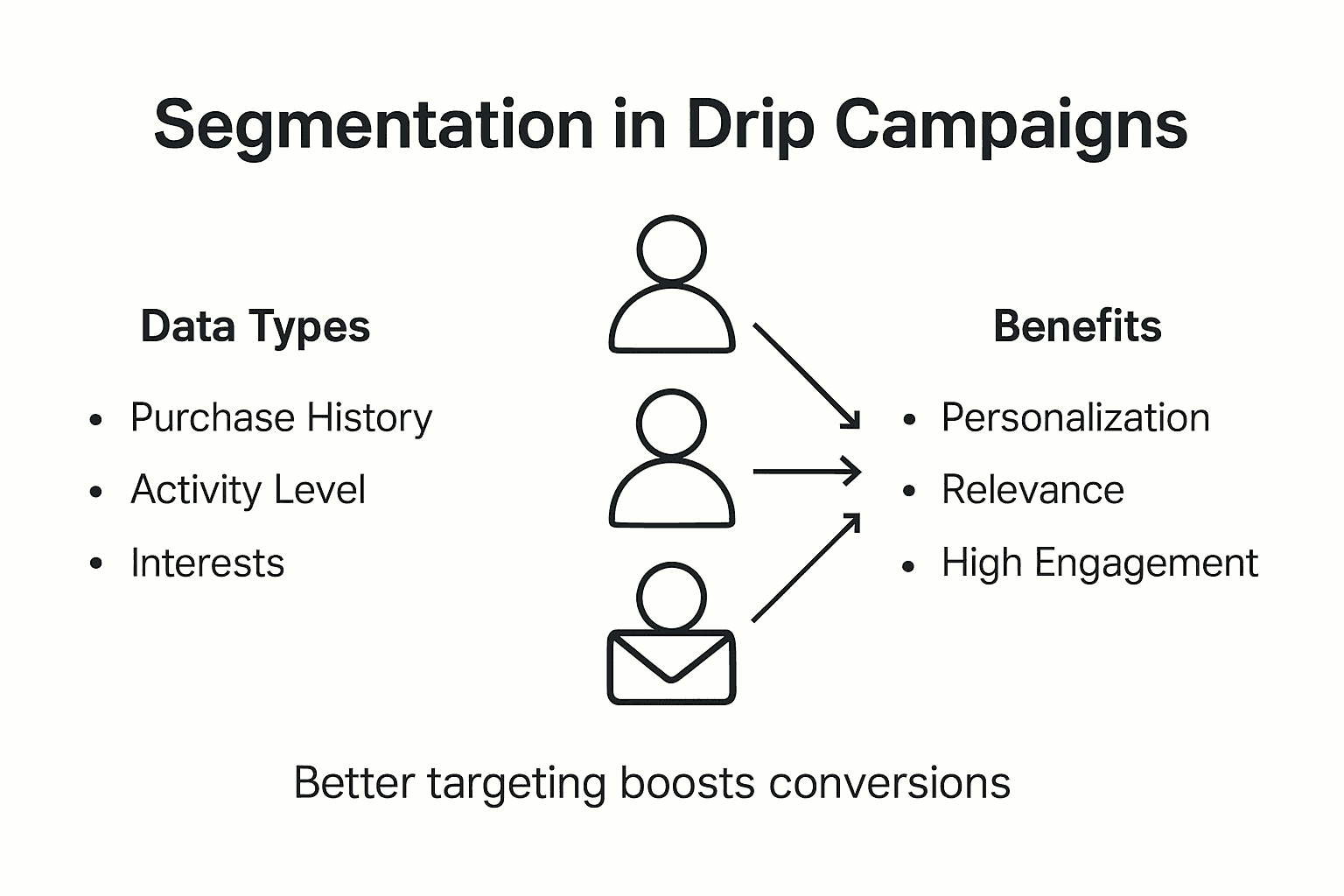
Pro tip: Segment your email lists based on customer behavior, purchase history, and engagement levels to create more personalized and targeted drip marketing campaigns that resonate with specific audience groups.
Here’s a summary of drip marketing campaign types and their primary business benefits:
| Campaign Type | Main Objective | Typical Trigger | Business Benefit |
|---|---|---|---|
| Onboarding Sequence | Educate and orient new users | Account signup | Faster product adoption |
| Re-engagement | Win back inactive customers | Extended inactivity | Recover lost revenue |
| Abandoned Cart | Encourage purchase completion | Item left in cart | Increased sales conversion |
| Post-Purchase Follow-up | Strengthen customer retention | Completed purchase | Higher repeat purchase rates |
| Lead Nurturing | Move prospects through sales funnel | Initial signup/contact | Improved qualified lead rate |
How Drip Campaigns Work for E-commerce
Automated Communication Strategies form the backbone of modern e-commerce marketing, with drip campaigns representing a sophisticated approach to customer engagement. In e-commerce, these campaigns leverage automated communication triggered by specific user actions to deliver personalized, timely messages. The process begins with identifying key customer interactions such as website sign-ups, product views, cart additions, or previous purchase history.
The mechanics of drip campaigns involve creating predefined email sequences that respond dynamically to customer behaviors. For instance, when a potential customer abandons their shopping cart, an automated sequence might trigger a series of reminder emails. The first email could gently remind them about the unpurchased items, the second might offer a small discount, and the third could provide social proof through customer testimonials. This strategic approach helps recover potentially lost sales by addressing customer hesitations and providing additional motivation to complete the purchase.
Technology plays a crucial role in executing these campaigns effectively. Marketing automation platforms track user interactions across multiple touchpoints, allowing businesses to create highly segmented and personalized communication paths. These systems can analyze customer data in real-time, determining the most appropriate message, timing, and content based on individual user profiles and previous engagement patterns. By understanding customer preferences and behaviors, e-commerce businesses can craft drip campaigns that feel less like marketing and more like personalized assistance.
Pro tip: Implement a behavioral scoring system in your drip marketing automation to dynamically adjust message frequency and content based on individual customer engagement levels and purchase likelihood.
Essential Features and Success Factors
Drip Marketing Technology represents a sophisticated approach to customer communication, with several critical components driving its effectiveness. Key features driving success include advanced automation workflows, behavior-triggered messaging, personalized content strategies, and sophisticated customer segmentation. These elements work together to create a dynamic and responsive marketing ecosystem that adapts to individual customer interactions.
The core success factors of drip marketing revolve around precise targeting and intelligent content delivery. Automation workflows enable businesses to create complex, multi-step communication sequences that respond to specific customer behaviors in real-time. For instance, a customer who downloads a product guide might automatically receive a series of educational emails that progressively introduce product features, address potential concerns, and guide them toward making a purchase. This approach transforms generic marketing communication into a personalized, adaptive journey that feels tailored to each individual’s needs and interests.
Advanced segmentation techniques play a crucial role in enhancing campaign effectiveness. By breaking down customer databases into granular groups based on demographics, purchase history, engagement levels, and behavioral patterns, businesses can craft highly targeted messaging that resonates with specific audience segments. The most successful drip marketing campaigns go beyond simple demographic categorization, utilizing predictive analytics and machine learning algorithms to anticipate customer needs and preferences, thereby creating more meaningful and compelling communication strategies.
Pro tip: Develop a comprehensive customer data integration strategy that consolidates information from multiple touchpoints to create more nuanced and accurate customer segments for your drip marketing campaigns.
Risks, Costs, and Common Pitfalls
Drip Marketing Challenges represent a significant consideration for businesses implementing automated communication strategies. The landscape of potential risks includes over-automation, message irrelevance, and poorly timed campaigns that can quickly diminish customer engagement. Understanding these potential pitfalls is crucial for developing effective and sustainable marketing approaches that maintain customer interest and trust.
The financial implications of drip marketing can be substantial, particularly for smaller businesses. Initial investments typically encompass platform setup, content creation, data management, and ongoing optimization efforts. Costly mistakes often emerge from inadequate audience segmentation, where businesses send generic messages that fail to resonate with specific customer groups. These misdirected communications can lead to increased unsubscribe rates, reduced engagement, and ultimately, wasted marketing resources. Complex automation platforms may require significant technical expertise, adding layers of potential expense through training or external consulting.
Perhaps the most critical risk lies in the delicate balance between automation and personalization. Businesses must carefully calibrate their drip marketing campaigns to avoid what experts call “automation fatigue” – a state where customers feel overwhelmed or alienated by impersonal, repetitive messaging. This requires continuous monitoring and refinement of communication sequences, tracking key performance metrics, and remaining responsive to changing customer preferences. Successful drip marketing demands a nuanced approach that feels more like a personalized conversation and less like a robotic communication stream.
Pro tip: Implement a quarterly review process that analyzes campaign performance metrics, including engagement rates, unsubscribe frequencies, and conversion data, to continuously optimize your drip marketing strategy.
Comparing Drip Marketing to Alternatives
Marketing Communication Strategies encompass various approaches, each with distinct characteristics and potential outcomes. Drip marketing distinguishes itself by emphasizing automated, scheduled message delivery tailored to recipient behavior and timing, offering a nuanced alternative to traditional marketing techniques. Unlike broadcast email campaigns or single-touchpoint strategies, drip marketing provides a more sophisticated, relationship-driven communication model.
Compared to traditional email marketing, drip campaigns offer superior personalization and targeted engagement. Broadcast emails typically send identical messages to entire lists, whereas drip marketing creates dynamic, behavior-triggered sequences that adapt to individual customer interactions. Compared to direct sales outreach, drip marketing provides a less intrusive, more scalable approach to lead nurturing. Sales calls require immediate human intervention, while drip campaigns can simultaneously engage multiple prospects through automated, personalized communication pathways.
Each marketing strategy presents unique strengths and limitations. Social media marketing excels in brand awareness but lacks the precision of drip marketing’s targeted messaging. Telemarketing offers immediate interaction but can feel invasive, whereas drip marketing creates a more subtle, consent-based communication experience. Pay-per-click advertising generates quick visibility but requires continuous financial investment, while drip marketing builds long-term customer relationships through consistent, value-driven interactions that evolve with customer behavior.
This table compares drip marketing with common alternative strategies:
| Strategy | Personalization Level | Engagement Style | Relationship Duration |
|---|---|---|---|
| Drip Marketing | Highly segmented | Automated, behavior-based | Long-term nurturing |
| Broadcast Email | Minimal | Mass, one-time delivery | Short-lived |
| Social Media Marketing | Moderate | Interactive, community | Ongoing, broad reach |
| Telemarketing | One-on-one | Direct, verbal | Immediate, temporary |
| Pay-Per-Click Advertising | Low | Ad-driven, transactional | Short-term attention |
Pro tip: Develop a hybrid marketing approach that integrates drip marketing with other communication channels to create a comprehensive, multi-touchpoint strategy that maximizes customer engagement and conversion potential.
Unlock Your E-commerce Potential with Expert Drip Marketing Support
Struggling to turn website visitors into loyal customers is a common challenge for e-commerce businesses. This article highlights how personalized, behavior-triggered drip marketing campaigns can nurture prospects, recover abandoned carts, and strengthen post-purchase loyalty. If you want to avoid pitfalls like generic messaging or automation fatigue and instead build meaningful customer journeys that boost your conversions, tailored digital marketing solutions are essential.
Discover how our Social Media strategies and comprehensive Our Services help integrate effective drip marketing within your broader digital presence. Our expert team at seo-analytic.com crafts targeted communication workflows and website optimizations that work together to increase engagement and accelerate sales growth. Take action now to turn your drip campaigns into a powerful conversion engine for your online store.
Frequently Asked Questions
What is drip marketing in e-commerce?
Drip marketing in e-commerce is a strategic communication method that delivers automated, sequential messages to potential customers based on their behavior and engagement levels. It helps nurture leads by sending personalized content tailored to each stage of the customer journey.
How can drip marketing improve conversion rates?
Drip marketing improves conversion rates by providing timely, relevant communication that addresses customer needs and concerns. By nurturing leads with targeted messages, businesses can guide potential customers through the sales funnel and encourage them to complete their purchases.
What types of campaigns are included in drip marketing?
Common types of drip marketing campaigns include onboarding sequences, re-engagement campaigns, abandoned cart recovery, post-purchase follow-ups, and lead nurturing campaigns. Each type is designed to achieve specific business objectives and engage customers at various stages of their journey.
What are the essential features of a successful drip marketing campaign?
A successful drip marketing campaign includes advanced automation workflows, behavior-triggered messaging, personalized content strategies, and sophisticated customer segmentation. These features enable businesses to deliver targeted, relevant messages that resonate with their audience.