
Choosing the right domain name can increase your brand recall by 80%, yet many small business owners treat it as an afterthought. Your domain is more than just a web address. It shapes customer perception, influences search rankings, and determines whether visitors remember your business or forget it immediately. This guide reveals how strategic domain selection boosts branding for small businesses, improves SEO performance, and builds lasting customer trust.
Table of Contents
- Why Your Domain Name Matters For Your Brand
- How Domain Names Influence Seo And Online Visibility
- Choosing The Right Domain Extension For Your Business
- Common Pitfalls And Misconceptions In Domain Name Selection
- Legal Considerations When Picking A Domain Name
- How To Apply Domain Name Best Practices For Your Startup Or Small Business
- Explore Seo Analytic’s Website Solutions For Your Business
- Frequently Asked Questions About Domain Name Importance
Key Takeaways
| Point | Details |
|---|---|
| Brand Impact | Short, simple domains boost recall by 80% and increase conversions up to 15%. |
| SEO Benefits | Keyword-relevant domains can increase organic traffic by roughly 10% when paired with quality content. |
| Extension Choice | .com domains hold 65% market share and are considered more credible by 70% of consumers. |
| Common Mistakes | Hyphens and long names reduce traffic by 30%; improper domain changes lose 40% of traffic. |
| Legal Protection | Trademark conflicts cost US small businesses around $20,000 annually in avoidable legal fees. |
Why Your Domain Name Matters for Your Brand
Your domain name is the digital storefront customers see first. Research shows that short and simple domains increase brand recall by 80%, making them essential for businesses competing in crowded markets. When potential customers can easily remember and type your domain, they return more frequently and recommend you to others.
Domain names directly influence purchasing decisions. A clear, professional domain signals legitimacy and competence, while confusing or overly complex names trigger doubt. Studies indicate that domain alignment with your brand message can increase conversions by up to 15%. This happens because consistent branding creates mental shortcuts that make customers feel confident choosing your business.
Effective brand reputation management starts with a memorable domain that reinforces your identity across every customer touchpoint. Consider these domain characteristics that strengthen brand authority:
- Easy to spell and pronounce in conversations
- Immediately communicates your business focus
- Feels natural when spoken aloud
- Avoids confusing abbreviations or numbers
Pro Tip: Test your domain choice by saying it over the phone to someone unfamiliar with your business. If they need clarification or ask you to repeat it, the domain is too complicated. Simple domains spread through word of mouth naturally, turning satisfied customers into active promoters.
How Domain Names Influence SEO and Online Visibility
Domain names play a supporting role in search engine optimization, though their impact has evolved significantly. Exact match domains once dominated search results, but Google’s algorithm updates now prioritize content quality and user experience over keyword stuffing in URLs. However, keyword-rich domains can still boost organic traffic by up to 10% when combined with authoritative content.

Search engines evaluate hundreds of ranking factors, and your domain contributes to overall relevance signals. A domain that naturally includes relevant keywords helps search engines understand your business focus, particularly for local SEO importance. For instance, a domain like “AtlantaPlumbing.com” immediately signals geographic and service relevance to both users and algorithms.
Balanced search engine optimization tips emphasize that domain selection should prioritize brand building over keyword manipulation. Consider these SEO considerations:
- Domains with clear business intent perform better than vague names
- Shorter domains typically load faster and appear cleaner in search results
- Established domains with history carry more authority than brand new registrations
- Domain age and consistent content publication build trust signals over time
Pro Tip: If your ideal .com domain is unavailable, resist the urge to stuff keywords into alternative versions. A brandable, memorable domain with strong content outperforms a keyword-heavy domain with weak content every time. Focus your energy on creating valuable resources that earn natural backlinks and social shares.
Choosing the Right Domain Extension for Your Business
Domain extensions communicate credibility and market positioning. .com domains hold 65% market share among US small businesses, making them the default expectation for American consumers. Research reveals that 70% of consumers consider .com domains more credible than alternative extensions, directly impacting conversion rates.
When customers type a remembered business name into their browser, they instinctively add “.com” to the end. Choosing a different extension means fighting against this ingrained behavior, potentially losing traffic to competitors who own the .com version of your name. This psychological preference makes .com domains worth the premium price for customer-facing businesses.
Alternative extensions serve specific purposes but require additional marketing effort to overcome trust barriers. Compare common options:
| Extension | Best Use Case | Trust Level | Market Position |
|---|---|---|---|
| .com | General businesses, e-commerce, services | Highest | Industry standard |
| .net | Technology companies, network services | Moderate | Secondary choice |
| .org | Nonprofits, community organizations | High for nonprofits | Mission-specific |
| .biz | Business services, B2B companies | Lower | Niche acceptance |
| .co | Startups, international companies | Growing | Modern alternative |
Successful branding for small businesses aligns domain choices with customer expectations. If your ideal .com is unavailable, consider creative naming variations or purchasing the .com from its current owner before settling for alternative extensions that require constant explanation.
Common Pitfalls and Misconceptions in Domain Name Selection
Many entrepreneurs make costly domain mistakes based on outdated SEO myths. The belief that exact match domains guarantee top rankings persists despite Google’s 2012 algorithm update specifically targeting low-quality exact match domains. Today’s search landscape rewards brand authority and content quality over keyword-stuffed URLs.
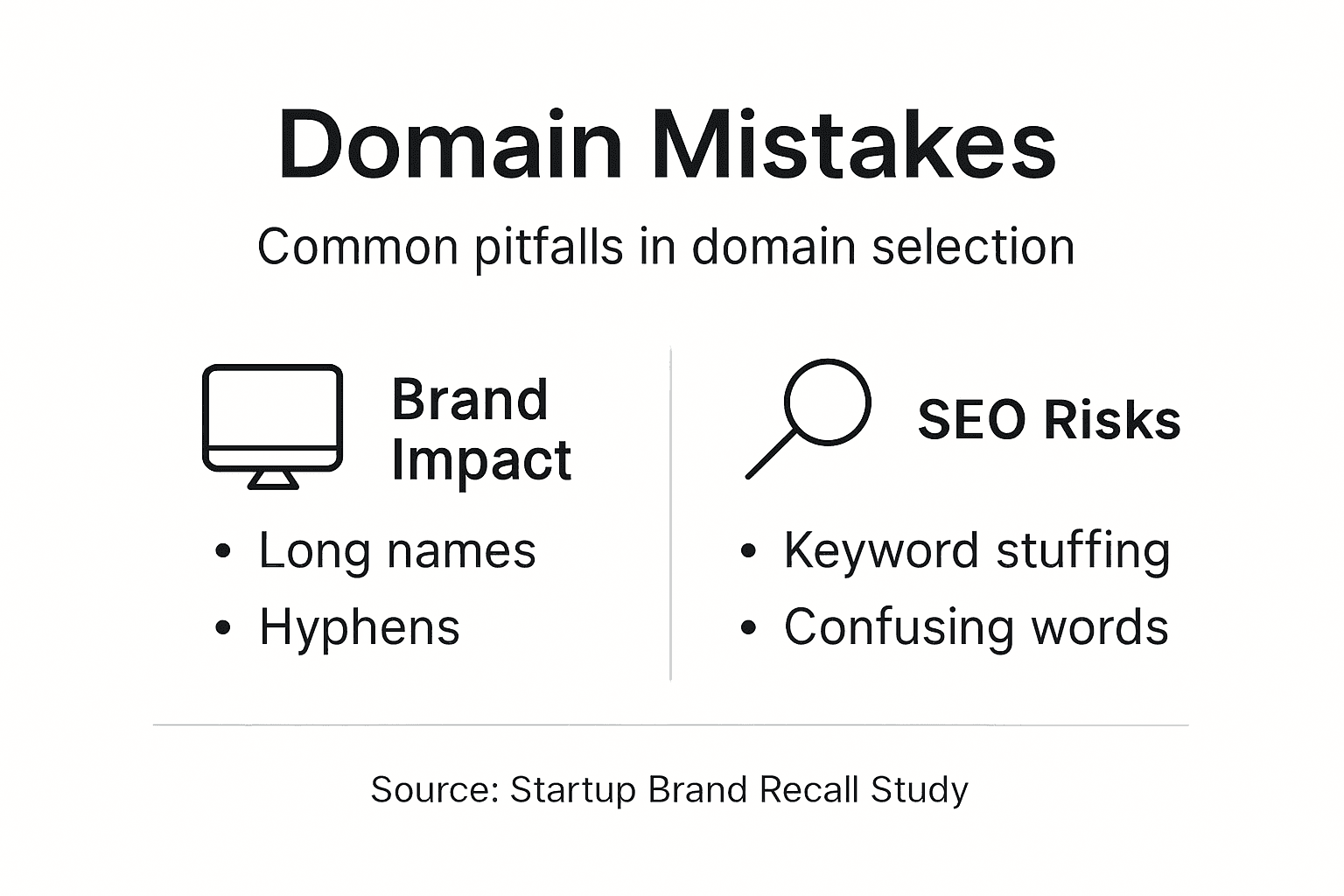
Complex domain names create friction at every customer touchpoint. Research shows that hyphens, long names, and confusing spellings can reduce traffic by about 30%. Customers mistype hyphenated domains, forget number placements, and struggle with unconventional spellings, sending valuable traffic to competitors or error pages.
Changing domains without proper planning destroys hard-earned SEO equity. Businesses that switch domains without implementing 301 redirects and updating all citations risk losing up to 40% of their organic traffic. Even with perfect technical execution, domain changes typically require six to twelve months for full traffic recovery.
Avoid these critical branding mistakes to avoid when selecting domains:
- Using hyphens or numbers that create confusion when spoken
- Choosing domains longer than 15 characters that are difficult to remember
- Selecting names too similar to established competitors
- Registering multiple domain variations without a clear consolidation strategy
- Changing domains impulsively without comprehensive redirect planning
Pro Tip: Before finalizing your domain choice, search for it on social media platforms. If the corresponding username is unavailable or held by an unrelated business, you will face constant brand confusion. Consistent naming across your website, email, and social profiles creates seamless customer experiences.
Legal Considerations When Picking a Domain Name
Trademark conflicts represent hidden financial landmines for small businesses. Trademark disputes cost US small businesses around $20,000 annually in legal fees, not counting potential damages or forced rebranding expenses. These costs devastate startups operating on tight budgets, making preventive trademark searches essential before domain registration.
The United States Patent and Trademark Office maintains a free searchable database at USPTO.gov where you can check existing trademarks. However, common law trademarks exist even without federal registration, so comprehensive searches should include state business registries and extensive web searches for businesses operating under similar names.
Proximity matters in trademark law. Choosing a domain name similar to an established brand in your industry invites cease and desist letters, even if you had no intention of confusion. Courts evaluate likelihood of confusion based on industry overlap, customer sophistication, and marketing channels.
Protect your legal brand setup tips with these preventive measures:
- Search USPTO database and state registries before domain purchase
- Conduct thorough Google searches for existing businesses with similar names
- Consult with a trademark attorney for high-stakes brand launches
- Register your own trademark after confirming availability
- Monitor trademark databases for conflicting applications after launch
Small businesses often discover trademark conflicts only after investing thousands in branding, website development, and marketing materials. This painful scenario is entirely preventable with two hours of research before domain registration.
How to Apply Domain Name Best Practices for Your Startup or Small Business
Selecting your perfect domain requires balancing multiple factors while prioritizing memorability and brand alignment. Follow this systematic approach to evaluate potential domains:
- Brainstorm 10 to 15 names that reflect your brand personality and business focus
- Eliminate options longer than 15 characters or containing hyphens and numbers
- Check domain availability using registrars like Namecheap or GoDaddy
- Search USPTO trademark database for each available option
- Verify matching social media usernames across major platforms
- Test pronunciation by saying each domain aloud to friends or family
- Register your chosen domain immediately along with common misspellings
Keyword inclusion should feel natural, never forced. A domain like “ChicagoRoofingExperts.com” clearly communicates location and service while remaining pronounceable. Compare this to “BestCheapRoofersChi.com,” which sacrifices professionalism for keyword stuffing.
Prefer .com extensions for customer-facing businesses operating in the United States. The credibility advantage and customer expectations make .com worth securing, even if it requires creative naming or purchasing from current owners. Alternative extensions work for specific niches but require additional marketing investment to overcome trust gaps.
Plan domain changes carefully if rebranding becomes necessary. Implement 301 redirects from old URLs to corresponding new pages, update all business citations and directory listings, and maintain the old domain for at least one year to capture lingering traffic. Poor redirect implementation destroys SEO equity built over years.
Reinforce consistent branding through professional business email setup using your domain. Email addresses like [email protected] signal professionalism while generic Gmail addresses suggest amateur operations. Every customer touchpoint should reflect consistent branding importance that builds recognition and trust.
Pro Tip: Register defensive domains including common misspellings and alternative extensions to prevent competitors or cybersquatters from capturing misdirected traffic. These investments cost pennies compared to lost customers and brand confusion. Redirect all variations to your primary .com domain for seamless user experiences. Local businesses should also review local branding tips to strengthen community connections.
Explore seo analytic’s Website Solutions for Your Business
Selecting the perfect domain is just the first step toward building a powerful online presence. At seo analytic, we provide comprehensive guides and expert services that help small businesses and startups establish professional websites with strong branding and optimized search visibility.
Our website building basics resources walk you through every technical decision, from hosting selection to design principles that convert visitors into customers. We combine educational content with hands-on search engine optimization services that increase your organic traffic and improve search rankings. Professional business email setup ensures your communications match your domain’s professional standards. Visit seo-analytic.com today to transform your domain choice into a thriving online business.
Frequently Asked Questions About Domain Name Importance
How long does it take for SEO traffic to recover after changing domains?
Full traffic recovery typically requires six to twelve months with proper 301 redirects and comprehensive citation updates. Google needs time to recrawl your site, transfer link equity, and rebuild trust signals associated with your new domain. Businesses that skip technical SEO best practices during domain changes often experience permanent traffic losses exceeding 40%.
What’s the best way to check if a domain name has trademark conflicts?
Start with the free USPTO trademark database at USPTO.gov to search federal registrations, then check state business registries where you plan to operate. Conduct thorough Google searches and social media username checks to identify common law trademarks that exist without federal registration. For significant brand investments, consult a trademark attorney who can perform comprehensive clearance searches including international databases.
When is it acceptable to use domain extensions other than .com?
Nonprofit organizations successfully use .org extensions because donors expect this designation for charitable entities. Technology companies sometimes leverage .io or .tech extensions to signal innovation, though they sacrifice some mainstream credibility. If your target .com is genuinely unavailable and prohibitively expensive to purchase, ensure your alternative extension aligns with industry norms and invest extra marketing resources to build brand recognition that overcomes initial trust barriers.
How can I protect my domain name legally beyond trademark registration?
Register multiple domain variations including common misspellings, hyphens, and alternative extensions to prevent cybersquatting and traffic diversion. Consider domain privacy protection services that hide your personal information from WHOIS databases, reducing spam and social engineering attacks. Monitor trademark databases regularly for conflicting applications in your industry, and set up Google Alerts for your brand name to catch unauthorized usage quickly. International businesses should register country-specific extensions (.co.uk, .ca) in markets where they operate to prevent local competitors from claiming those domains.
Recommended
- Understanding Branding for Startups: Key Concepts Explained – seo analytic
- Startup Brand Strategy: Complete Guide for Success – seo analytic
- Measuring Brand Awareness: Drive Growth for Startups – seo analytic
- 7 Brand Voice Examples Every US Startup Should Know – seo analytic
- Blog corporativo: ¿Cómo crearlo y convertirlo en un éxito?