
TL;DR:
- Digital PR SEO involves earning media coverage, authoritative backlinks, and brand mentions to boost search rankings and brand authority. It emphasizes quality editorial links, consistent brand mentions, and strategic focus on relevant publications to influence AI and search engine algorithms. Long-term success depends on diversified campaigns, spokesperson preparation, and measuring impact over several months.
Digital PR SEO is the practice of using earned media coverage, authoritative backlinks, and strategic brand mentions to improve search engine rankings and build lasting brand authority. The industry term for this discipline is “digital public relations for SEO,” and it sits at the intersection of traditional PR instincts and modern search engine optimization. AI Overviews now appear in 20% of Google searches, and over 250 million users interact with LLMs like ChatGPT every week. That shift makes brand visibility in earned media more critical than ever. If your brand is not being mentioned in authoritative publications, Google and AI models simply do not know you exist.
How does digital PR SEO impact rankings and brand authority?
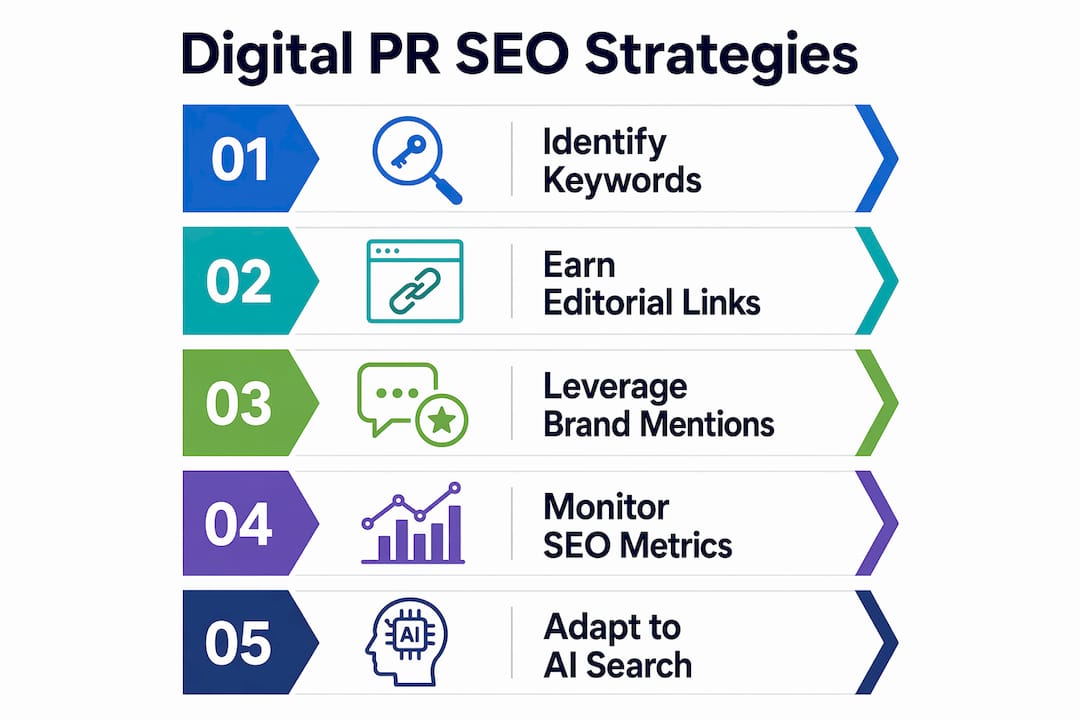
Digital PR SEO works by earning editorial coverage that signals trust and relevance to search engines. Google’s Knowledge Graph and AI-driven ranking systems do not just count links. They evaluate the quality, context, and frequency of brand mentions across the web.
One editorial link from a DA 80 publication carries more SEO value than 50 links from lower-authority sites. Google actively discounts low-trust link patterns, so volume without credibility is worthless. A single placement in Forbes, TechCrunch, or The Wall Street Journal does more for your domain authority than a hundred directory submissions.
Beyond backlinks, Google’s E-E-A-T framework (Experience, Expertise, Authoritativeness, Trustworthiness) rewards brands that appear consistently in credible editorial contexts. When your CEO is quoted in Business Insider or your research is cited by Reuters, those signals reinforce your entity profile in Google’s Knowledge Graph. AI search engines incorporate unlinked brand mentions into entity recognition, which means even coverage without a hyperlink moves the needle.
- Editorial backlinks from high-authority domains raise domain rating faster than any link-building outreach campaign.
- Brand mentions in relevant media increase entity salience, which affects how Google and AI models categorize your business.
- Expert commentary placements build E-E-A-T signals that protect rankings during algorithm updates.
- Mention frequency across trusted sources trains AI models to associate your brand with specific topics and categories.
Pro Tip: Target publications that cover your specific industry niche, not just high-DA generalist sites. A contextually relevant placement in a niche subfolder of an authoritative site can outperform a generic homepage mention on a higher-DA domain.
What are the key strategies for digital PR SEO campaigns?
Effective digital PR for SEO requires a deliberate mix of proactive storytelling and reactive speed. The brands that dominate earned media do not wait for journalists to find them.
Here are the core tactics that consistently produce results:
-
Create original research. Proprietary data gives journalists a reason to cite you. Surveys, industry reports, and data studies generate backlinks naturally because they become primary sources. BrightLocal’s annual Local Consumer Review Survey is a textbook example of research that earns hundreds of editorial links every year.
-
Use reactive PR and newsjacking. Newsjacking allows brands to provide expert commentary on breaking stories, earning high-authority coverage quickly at comparatively low cost. The Signal Windows Method involves having pre-prepared expert commentary ready to deploy during specific journalist query windows. Speed is the advantage here. Journalists filing stories on tight deadlines need credible sources fast.
-
Target product and category pages for link placement. Campaigns that link to product and category pages generate more direct SEO value than those pointing only to the homepage. Your homepage already has authority. Your “/services/seo-consulting” page needs the link equity.
-
Build genuine journalist relationships. Pitching a journalist you have never engaged with is cold outreach. Following their work, commenting on their stories, and offering exclusive data before you need coverage builds the kind of relationship that gets your pitch opened.
-
Invest in media training for spokespeople. Media training improves expert placements by ensuring spokespeople can articulate key messages clearly under pressure. A poorly delivered interview wastes the opportunity entirely. Train your executives before the opportunity arrives, not after.
-
Diversify your campaigns. Relying on one large campaign per quarter creates risk. If it underperforms, your SEO pipeline stalls. Running multiple smaller, targeted campaigns across different publications and topics keeps your link velocity consistent.
Pro Tip: Use tools like Semrush or Ahrefs to identify which competitor pages rank for your target keywords, then reverse-engineer the publications linking to those pages. That list becomes your outreach priority.
How is digital PR SEO adapting to ai-driven search in 2026?

Digital PR is no longer just an SEO support tactic. It has become a brand-first approach that builds topical authority for AI and search relevance. That shift is driven by a structural change in how people use search engines.
Informational long-tail clicks are declining. Users get answers directly from AI Overviews and LLM interfaces without clicking through to websites. That means the traditional model of “rank for informational keywords, drive traffic” is weakening. What replaces it is brand recognition and entity association.
“The brands that win in AI-driven search are the ones that appear repeatedly in authoritative, relevant contexts. AI models learn brand associations the same way humans do: through repeated, credible exposure.” — Search Engine Land
The mere exposure effect explains this precisely. Repeated brand mentions in relevant media build trust and preference, even when users do not consciously register each mention. Over time, that familiarity translates into branded search volume, direct traffic, and conversion rate improvements.
| Traditional Link Building | Digital PR SEO |
|---|---|
| Focuses on link volume and domain authority | Focuses on brand mentions, entity salience, and editorial quality |
| Targets any high-DA site regardless of relevance | Targets contextually relevant, topically aligned publications |
| Measured by number of backlinks acquired | Measured by brand mention volume, entity recognition, and ranking impact |
| Minimal impact on AI model citations | Directly influences how AI Overviews and LLMs reference your brand |
| Short-term tactic with diminishing returns | Long-term brand asset that compounds over time |
For brand reputation management, the implication is clear. Consistent, relevant coverage in authoritative media is now a prerequisite for AI visibility, not just a nice-to-have for SEO.
What metrics should you track for digital PR SEO success?
Measuring digital PR SEO requires tracking both the inputs (coverage quality) and the outputs (SEO and business impact). Vanity metrics like total press mentions tell you very little on their own.
The metrics that actually matter fall into three categories:
- Backlink quality indicators: Track domain rating growth in Ahrefs or Moz, the number of new referring domains from DA 50-plus publications, and the anchor text distribution of earned links. Focus on links pointing to your product and category pages, not just your homepage.
- Brand mention and entity metrics: Monitor unlinked brand mentions using tools like Google Alerts, Mention, or Brand24. Track how often your brand appears in Google’s Knowledge Panel and AI Overview results for your target topics.
- Ranking and traffic signals: Measure ranking improvements on the specific product and category pages your digital PR campaigns are targeting. Track branded search volume in Google Search Console. An increase in branded queries is one of the clearest signs that your entity-building efforts are working.
Digital PR campaigns typically show measurable SEO impact between 3 and 6 months after launch. That lag reflects the time Google needs to crawl, index, and process new link signals. Set realistic expectations with stakeholders before the campaign launches.
| Metric | What It Tells You |
|---|---|
| New referring domains (DA 50+) | Quality of earned backlink profile |
| Branded search volume growth | Entity recognition and audience awareness |
| Product/category page ranking changes | Direct SEO impact of link placement strategy |
| Unlinked brand mention volume | AI model exposure and entity salience |
| Earned media traffic conversion rate | Business value of PR-driven visitors |
For thought leadership and brand authority, these metrics work together. A brand that earns consistent high-quality coverage will see all five indicators move in the same direction over a 6-month window.
Key takeaways
Digital PR SEO succeeds when editorial quality, strategic link placement, and consistent brand mentions work together to build entity authority that search engines and AI models recognize and reward.
| Point | Details |
|---|---|
| Editorial links outperform volume | One DA 80 link beats 50 low-authority links for domain authority growth. |
| Target product pages, not just the homepage | Links to category and product pages drive direct SEO and revenue impact. |
| Unlinked mentions still count | AI models use brand mentions without hyperlinks to build entity profiles. |
| Expect a 3–6 month lag | SEO gains from digital PR take time to materialize; plan campaigns accordingly. |
| Brand-first beats link-first | Consistent, relevant media coverage builds AI visibility and long-term search authority. |
Why most digital PR campaigns underperform (and how to fix that)
After working across dozens of digital marketing campaigns, the pattern I see most often is this: brands invest in one big PR push, wait for results, and then declare the channel ineffective when rankings do not move in 30 days.
That is not a digital PR problem. That is a strategy problem.
The campaigns that actually compound are the ones built on consistent, diversified activity. A mix of proactive original research, reactive newsjacking, and steady expert commentary placement creates a coverage cadence that Google and AI models can learn from. One spike in coverage followed by months of silence does not build an entity profile. It creates noise.
The other mistake I see constantly is neglecting spokesperson preparation. You can land a placement in a top-tier publication and completely waste it if your executive cannot deliver a clear, quotable message. Media training for executives is not optional for brands serious about digital PR. It is the difference between a quote that gets used and one that gets cut.
The brands I have seen win long-term combine strong on-page SEO with a disciplined PR content calendar. They treat digital PR as a content channel, not a one-time campaign. They invest in data-driven stories that journalists actually want to cover. And they measure success over quarters, not weeks. That patience, combined with quality storytelling, is what separates the brands that dominate AI Overviews from the ones that never appear in them.
For teams building this capability from scratch, understanding how to build a high-impact digital marketing team is the right starting point.
— Maayan
Ready to build your digital PR and SEO foundation?
Integrating digital PR with SEO is one of the highest-leverage moves a US business can make in 2026. But it only works when your website and digital presence are built to capture and convert the traffic that earned media sends your way.
Seo-analytic helps business owners and marketing professionals build that foundation. From search engine optimization strategy to website architecture that supports earned media campaigns, the team at Seo-analytic delivers tailored solutions that turn PR coverage into measurable business growth. If you are ready to move from scattered tactics to a coordinated digital marketing strategy, explore Seo-analytic’s digital marketing fundamentals guide to see exactly where to start.
FAQ
What is digital PR SEO?
Digital PR SEO is the practice of earning editorial coverage, high-authority backlinks, and brand mentions from credible online publications to improve search engine rankings and brand authority. It combines traditional public relations strategy with SEO goals to build entity recognition and domain authority.
How does digital PR differ from traditional link building?
Traditional link building focuses on acquiring link volume from any available source, while digital PR earns contextually relevant editorial links from authoritative publications. Digital PR also builds unlinked brand mentions that influence AI model entity recognition, which traditional link building does not address.
How long does digital PR take to impact SEO rankings?
Measurable SEO impact typically appears 3 to 6 months after a digital PR campaign launches. Google needs time to crawl, index, and process new link signals before ranking changes become visible.
Do unlinked brand mentions help SEO?
Yes. AI search engines incorporate unlinked brand mentions into entity recognition, affecting how Google and AI models categorize and rank your brand even without a direct hyperlink.
Which pages should digital PR campaigns link to?
Campaigns should prioritize product and category pages over the homepage. Links to conversion-driving pages produce more direct SEO value and measurable revenue impact than generic homepage links.