
TL;DR:
- Digital advertising media encompasses all digital channels and formats used by businesses to deliver targeted promotional content online. The industry reached $1.14 trillion in global ad spend in 2025, with continued growth expected in 2026, emphasizing its importance to marketing budgets. Effective strategies depend on matching ad formats to specific funnel stages, integrating CRM data, and employing unified measurement for better results.
Digital advertising media is the collection of digital channels and formats businesses use to deliver promotional content to targeted audiences online. The industry reached $1.14 trillion in global ad spend in 2025, with 7% growth projected for 2026. That scale reflects how central paid digital channels have become to every serious marketing budget. Marketers now work with 12 recognized types of digital ads, each mapped to specific funnel stages, from awareness through conversion. Standards set by the IAB (Interactive Advertising Bureau) govern ad unit specifications, while programmatic advertising has reshaped how inventory is bought and sold at scale. Understanding which formats serve which goals is the foundation of any effective online advertising strategy.
What are the major types of digital advertising media?
The 12-type framework covers every major format in use today. Each type serves a distinct purpose and fits a different point in the customer journey. Knowing the difference between them prevents wasted budget and misaligned messaging.

| Ad Type | Primary Purpose | Funnel Stage |
|---|---|---|
| Search ads | Capture high-intent queries | Conversion |
| Display ads | Build visual brand presence | Awareness |
| Video ads | Tell brand stories, build trust | Awareness / Consideration |
| Social media ads | Drive engagement and traffic | All stages |
| Shopping ads | Show products with price and image | Conversion |
| Native ads | Blend with content for trust | Consideration |
| Retargeting ads | Re-engage past visitors | Conversion |
| Email ads | Nurture existing contacts | Retention |
| Influencer / sponsored | Build credibility via creators | Awareness |
| Audio ads | Reach listeners on streaming | Awareness |
| Interstitial / pop-up | Drive immediate action | Conversion |
| Programmatic ads | Automate cross-channel buying | All stages |
Search ads appear on Google and Microsoft Bing when users type specific queries. They capture demand that already exists, which is why they convert efficiently. Display ads use banner images across websites in the Google Display Network and similar exchanges. They build recognition before a user ever searches for your product.
Video ads run on YouTube, connected TV (CTV) platforms, and social feeds. Video ad effectiveness is determined within the first 3 seconds, so brand identity must appear immediately. Native ads match the look and feel of the surrounding content. They perform best when they deliver real value rather than a thinly veiled sales pitch.
Pro Tip: For social media ads, match your creative tone to the platform. LinkedIn audiences expect professional language and data-driven claims. Instagram and TikTok reward short, visually direct content with minimal text.
Programmatic advertising uses automated bidding to place ads across multiple networks in real time. It removes manual negotiation and gives marketers precise control over audience segments, frequency caps, and spend. For a deeper look at how these formats connect, the types of digital ads guide from Seo-analytic covers each format with campaign-level examples.
How do marketing goals determine the choice of ad format?
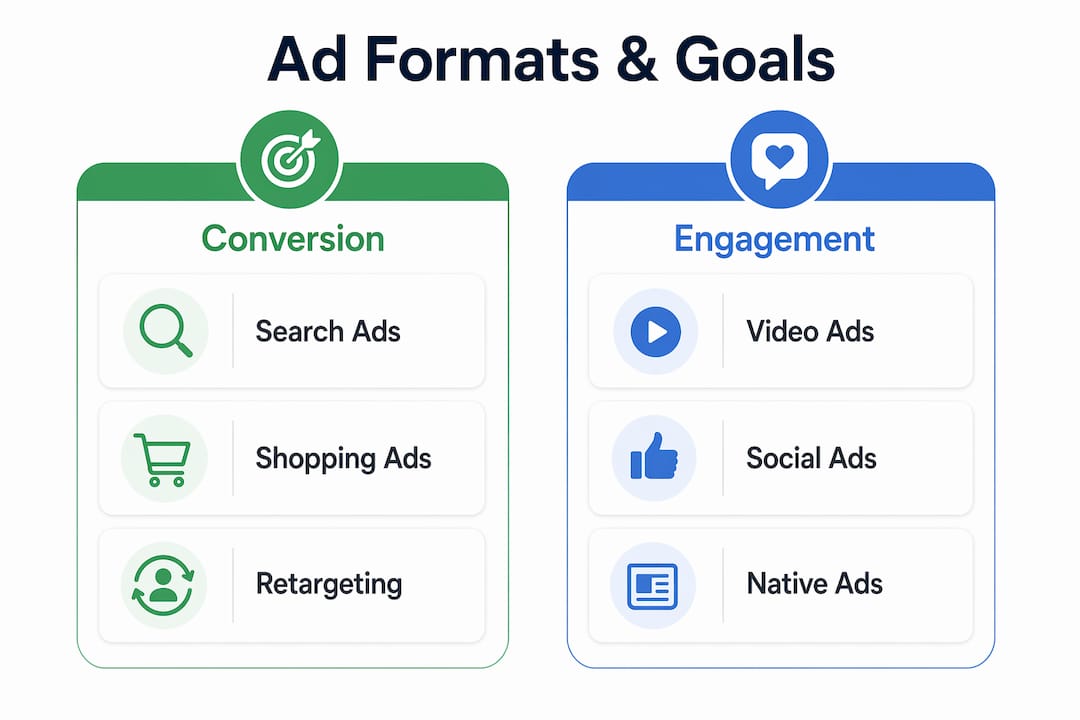
Strategic choice of ad formats depends entirely on the campaign objective: conversion, awareness, or engagement. Picking the wrong format for the goal is the most common and most expensive mistake in paid media.
For conversion goals, search and shopping ads are the strongest performers. A user searching “buy running shoes size 10” has already decided to purchase. A well-structured search ad with a clear price and call to action captures that intent directly. Shopping ads add a product image and price to the search result, which shortens the path to purchase further.
For brand awareness, video and influencer ads build the emotional connection that drives future conversions. Video and influencer formats build trust and brand recognition at the top of the funnel. A 15-second pre-roll ad on YouTube or a sponsored post from a credible creator introduces your brand to audiences who have never searched for you.
For engagement and consideration, native advertising and retargeting work together. Native ads are most effective when they provide genuine value and blend with the user’s content experience. A sponsored article that answers a real question earns more trust than a banner ad. Retargeting then follows up with users who engaged with that content but did not convert.
- Match search ads to high-intent, bottom-funnel audiences
- Use video and audio ads for awareness campaigns targeting cold audiences
- Deploy native ads during the consideration phase to build credibility
- Run retargeting ads against users who visited key product or service pages
- Reserve email ads for existing contacts in retention and upsell campaigns
Pro Tip: Before launching any campaign, write one sentence that states the single goal. If the sentence contains the word “and,” you have two goals. Split them into two separate campaigns with separate budgets and formats.
Financial marketers face a specific version of this challenge. Trust is the primary barrier in financial services, which makes native and video formats especially valuable. This 2026 digital marketing guide for financial services outlines how trust-building ad formats apply in regulated industries.
What trends are shaping digital advertising media in 2026?
The market has moved well past the era when two platforms controlled the majority of US digital ad revenue. Two platforms once held 70% of US digital ad revenue in 2016. That concentration has broken down as programmatic networks, retail media, and CTV platforms have claimed significant share.
Cross-platform measurement is now the defining operational challenge for large advertisers. Large enterprises focus on cross-platform measurement to track ad frequency across CTV and other walled garden environments. When a viewer sees your ad on a streaming service, a news app, and a social feed in the same day, frequency capping across those environments requires unified data infrastructure. Most mid-market advertisers have not solved this yet.
“The biggest gap in digital advertising today is not creative quality. It is measurement. Brands that build unified audience data across channels will outperform those that optimize each platform in isolation.”
Connected TV and digital audio are the two fastest-growing inventory categories. CTV reaches cord-cutters who are unreachable through traditional broadcast. Digital audio ads on Spotify, podcast networks, and streaming radio reach audiences during commutes and workouts, when screens are not in view.
Personalization through CRM integration is the other major shift. Integrating CRM data with ad platforms enables lookalike audience modeling for personalized campaigns across channels. A business that uploads its customer list to an ad platform can find new prospects who share the same behavioral and demographic profile. That is a fundamentally different approach than broad demographic targeting.
Out-stream video ads, which play in article bodies rather than video players, carry a real risk. Out-stream video ads can slow page load times and create user annoyance, which reduces ad performance. Brands that prioritize user experience over raw impression volume see better long-term results.
How can businesses implement effective digital advertising strategies?
Effective implementation starts with audience definition, not platform selection. Most businesses pick a platform first and then try to find their audience on it. The correct sequence runs in the opposite direction.
- Define your audience first. Identify the behavioral signals, demographics, and intent patterns of your best customers. Then find which platforms hold the highest concentration of those users.
- Select formats based on funnel stage. Map each campaign to one specific funnel stage. Use the format that matches that stage, not the format that is cheapest or most familiar.
- Set bidding models that match your goal. Cost-per-click (CPC) bidding suits conversion campaigns. Cost-per-thousand-impressions (CPM) bidding suits awareness campaigns. Mixing them within a single campaign produces unreliable data.
- Integrate your CRM from day one. Treating platforms as silos instead of connecting CRM data for lookalike modeling is the most common structural mistake in digital advertising. Upload customer lists, build lookalike segments, and sync conversion data back to the platform.
- Track the right metrics for each goal. Awareness campaigns should be measured by reach, frequency, and brand lift. Conversion campaigns should be measured by cost per acquisition (CPA) and return on ad spend (ROAS). Measuring awareness campaigns by CPA produces misleading conclusions.
Pro Tip: Run a 2-week test budget before committing to a full campaign. Allocate 10–15% of your planned spend to test two or three audience segments and two creative variations. Let the data pick the winner before scaling.
Budget allocation across formats matters as much as format selection. A common mistake is concentrating the entire budget in one channel because it performed well in the previous quarter. Platform algorithms change, audience fatigue sets in, and costs rise. Spreading budget across two or three complementary formats reduces that risk.
Tracking should never be siloed by platform. Use a unified analytics view, whether through Google Analytics 4, a customer data platform, or a marketing attribution tool, to see how channels interact. A user who sees a display ad, clicks a native article, and then converts via a search ad represents a multi-touch journey. Last-click attribution alone misses the contribution of the first two touchpoints.
For business owners building their digital presence from the ground up, the digital marketing basics guide from Seo-analytic covers how advertising fits into a broader online growth plan.
Key Takeaways
Effective digital advertising media requires matching the right format to the right funnel stage, integrating CRM data across platforms, and measuring each campaign by the metric that reflects its actual goal.
| Point | Details |
|---|---|
| Format selection drives results | Match ad type to funnel stage: search for conversion, video for awareness, native for consideration. |
| Market scale is significant | Global ad spend reached $1.14 trillion in 2025, with 7% growth projected for 2026. |
| CRM integration is non-negotiable | Connecting customer data to ad platforms enables lookalike modeling and cross-channel personalization. |
| Measurement must be unified | Siloed platform reporting misses multi-touch attribution and leads to poor budget decisions. |
| Video demands immediate impact | Brand identity must appear within the first 3 seconds of any video ad to secure viewer attention. |
Why I think most businesses are using digital ads wrong
After working across dozens of digital advertising campaigns, the pattern I see most often is not a creative problem. It is a structural one. Businesses set up separate campaigns on separate platforms, check each platform’s native dashboard, and declare a winner based on whichever channel claims the most conversions. That approach rewards the last click, not the channel that actually built the relationship.
The shift that changed everything for the campaigns I have seen perform best was treating the ad account as a single system, not a collection of individual channels. When CRM data flows into the platform, when audiences are built from real customer behavior, and when creative is tested systematically rather than swapped out on instinct, results compound. The businesses that do this well are not necessarily spending more. They are spending with better information.
Native advertising is the format I think is most underused by American business owners. The instinct is to run a banner or a search ad because those are familiar. But a well-written sponsored article that answers a genuine question builds the kind of trust that a banner ad cannot buy. The catch is that it requires real content quality. A native ad that reads like a press release defeats its own purpose.
The other thing I would push back on is the assumption that more channels equal more results. Spreading a modest budget across six platforms produces thin, unmeasurable signals on every one of them. Two channels, executed well, with proper tracking and creative testing, will outperform six channels run at minimal spend every time. Start focused. Expand when the data tells you to.
— Maayan
How Seo-analytic supports your digital advertising goals
Running paid digital campaigns without a strong web presence behind them wastes budget. Every ad click lands somewhere, and that destination determines whether the click becomes a customer.
Seo-analytic helps US business owners build the digital foundation that makes advertising work. From website building basics that turn ad traffic into conversions, to social media marketing guidance that aligns your organic and paid presence, the team at Seo-analytic covers the full picture. If you are planning a paid campaign and want the strategy and the infrastructure to match, Seo-analytic offers the expertise to connect both.
FAQ
What is digital advertising media?
Digital advertising media is the set of digital channels and formats businesses use to deliver paid promotional content to targeted audiences online. It includes search ads, display ads, video, social media ads, native content, programmatic placements, and more.
What are the main types of digital ads in 2026?
The 12 major types include search, display, video, social media, shopping, native, retargeting, email, influencer/sponsored, audio, interstitial, and programmatic ads. Each type serves a different funnel stage and marketing objective.
How does programmatic advertising work?
Programmatic advertising uses automated bidding technology to buy and place ads across multiple networks in real time. It replaces manual negotiation and allows precise audience targeting based on behavioral and demographic data.
Which ad format works best for conversions?
Search and shopping ads are the strongest formats for high-intent conversions because they reach users who are actively looking to buy. Retargeting ads are the second most effective format for closing users who have already shown interest.
How do I measure digital advertising campaign success?
Measure awareness campaigns by reach, frequency, and brand lift. Measure conversion campaigns by cost per acquisition (CPA) and return on ad spend (ROAS). Using the wrong metric for the campaign type produces misleading conclusions and poor budget decisions.