

TL;DR:
- Startups benefit from decision frameworks like OODA, RAPID, and DACI to enhance speed, clarity, and effectiveness. These tools address common issues such as role ambiguity, slow execution, and miscommunication, enabling more deliberate and adaptive decision-making. Choosing the appropriate framework depends on the decision context, team maturity, and urgency, fostering sustainable growth through disciplined habits.
Most startup founders wear speed as a badge of honor, but moving fast without a decision structure is like navigating a city without a map. You might reach your destination eventually, but you’ll waste time, money, and team trust along the way. This guide breaks down the most effective decision making frameworks for startups, including OODA, RAPID, and DACI, explains exactly when to use each one, and gives you a practical way to choose the right tool for your current business challenge. The result is faster, cleaner, and more defensible decisions at every stage of growth.
Table of Contents
- Why frameworks matter for startup decision making
- Overview of the top frameworks: OODA, RAPID, DACI, and more
- How each framework works in practice
- How to choose the right framework for your startup
- The uncomfortable truth about decision making in fast-moving startups
- Next steps: Build a stronger decision culture for sustainable growth
- Frequently asked questions
Key Takeaways
| Point | Details |
|---|---|
| Structure beats speed | Formal frameworks prevent chaos and let your team act faster with fewer mistakes. |
| Choose by use case | Match the framework—like OODA, RAPID, or DACI—to your team structure and the problem’s complexity. |
| Clarity reduces conflict | Assigning roles and decision rights helps avoid delays and miscommunication, especially as you scale. |
| Flexible application wins | Evolve your decision process as your startup grows and your team’s needs change. |
Why frameworks matter for startup decision making
A decision making framework is a structured method for evaluating choices, assigning roles, and moving from ambiguity to action. It’s the opposite of “going with your gut,” but it doesn’t mean slow or bureaucratic. Done right, it’s actually faster than chaotic debate because everyone already knows their role.
Without frameworks, startups run into predictable problems:
- Confusion over decision rights: Who actually decides? The founder? The team lead? Everyone assumes someone else is handling it.
- Slow execution: Decisions get revisited repeatedly because there’s no agreed process for closing them.
- Miscommunication: Different team members walk away from the same meeting with different interpretations of what was decided.
- Repeated mistakes: Without a structured feedback loop, the same errors surface in new forms.
These aren’t minor frustrations. They compound over time and can stall product launches, derail fundraising timelines, and burn out your best people. Good startup marketing strategies and well-managed remote team management both depend on a foundation of clear, repeatable decision processes.
“Decision effectiveness principles for leaders include mitigating cognitive biases, using probabilistic thinking under uncertainty, structuring information, and balancing speed with deliberation using evidence-backed decision rules.” — IMD Business School
The IMD finding matters because it reframes what “good decisions” actually look like. It’s not just about confidence or speed. It’s about bias awareness, how you structure the information you’re working with, and knowing when to deliberate versus when to act. Frameworks give you those guardrails automatically.
Now that you know why frameworks are essential, let’s look at the most effective types for startups.
Overview of the top frameworks: OODA, RAPID, DACI, and more
Not all frameworks fit all situations. The key is knowing what problem each one solves and when to pull it off the shelf.
OODA stands for Observe, Orient, Decide, Act. It’s an iterative decision and learning loop originally developed by U.S. Air Force Colonel John Boyd for high-tempo combat situations. In business, it works best when you’re operating in rapidly changing markets and need to outmaneuver competitors by adapting faster than they can react.
RAPID is a role-clarity framework that assigns distinct responsibilities: Recommend, Agree, Perform, Input, and Decide. It’s designed to remove ambiguity on complex decisions involving multiple stakeholders. If your team consistently debates “who has the final call,” RAPID is the fix.
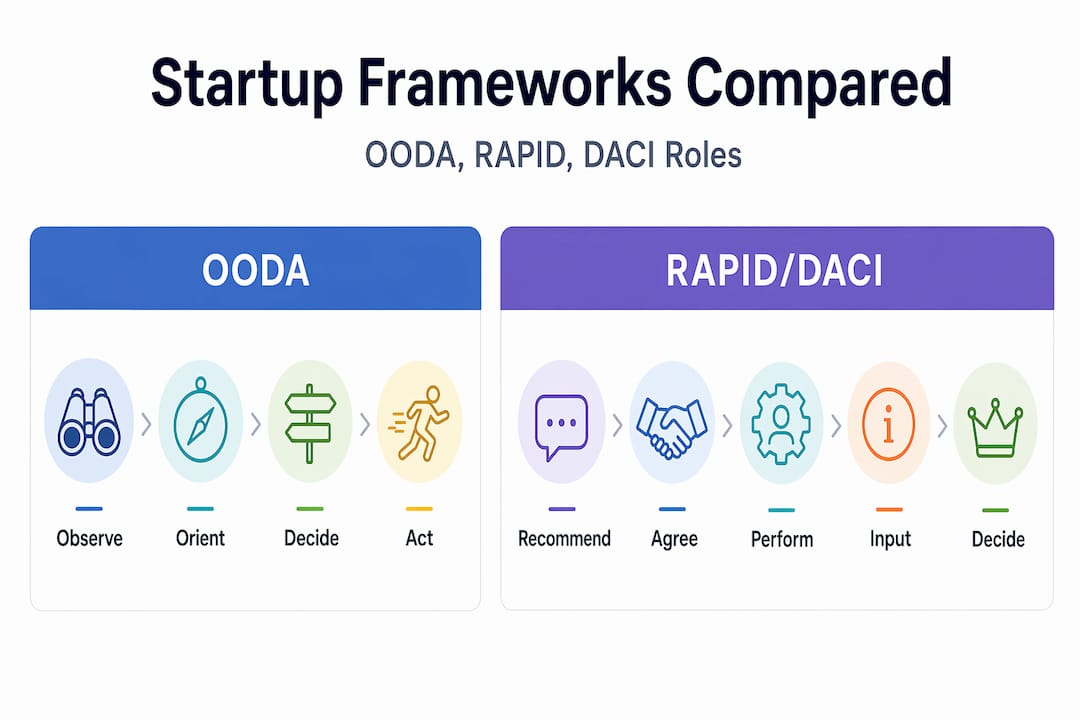
DACI separates the people who drive the decision process from those who approve or provide input. It stands for Driver, Approver, Contributor, and Informed. It works well when you need cross-functional alignment without creating endless committee debates.
| Framework | Core purpose | Key stages or roles | Best startup application |
|---|---|---|---|
| OODA | Speed and adaptation | Observe, Orient, Decide, Act | Competitive pivots, market sensing |
| RAPID | Role clarity | Recommend, Agree, Perform, Input, Decide | Product decisions, hiring, budget |
| DACI | Process clarity | Driver, Approver, Contributor, Informed | Cross-team initiatives, rebranding |
| Consensus | Buy-in and legitimacy | Group deliberation | Culture or values decisions |
| Evidence-based | Bias mitigation | Structured data evaluation | Channel decisions, resource allocation |
Here’s how these frameworks actually differ in practice:
- Speed vs. structure: OODA is loop-based and built for rapid iteration. RAPID and DACI are role-based and built for complex, multi-stakeholder decisions.
- Role clarity vs. process clarity: RAPID tells you who decides. DACI tells you how the process runs and who drives it forward.
- Consensus needs: Consensus-based approaches work when team legitimacy matters more than speed, like setting company values.
- Handling uncertainty: OODA and evidence-based frameworks thrive in uncertain environments. RAPID and DACI work better when the decision landscape is clearer but roles are fuzzy.
You’ll find detailed marketing plan templates helpful when applying these frameworks to go-to-market strategy.
Next, let’s break down each framework to see how they work in detail and where they shine.
How each framework works in practice
Knowing a framework by name is different from knowing how to run one in a real startup meeting. Here’s how each one plays out with concrete examples.
OODA in action: launching a new marketing channel
- Observe: Your team collects data on where competitors are gaining traction. You notice three rivals running aggressive LinkedIn campaigns with thought leadership content.
- Orient: You interpret that signal through your existing knowledge of your audience and prior channel experiments. You realize your audience skews to LinkedIn but you’ve under-invested there.
- Decide: Based on orientation, you choose to run a six-week LinkedIn pilot with a defined content cadence.
- Act: You launch, track engagement weekly, and immediately feed results back into the next Observe phase.
The key insight from the OODA loop is that “Orientation” is not just another step. It actively shapes what you observe in the first place and can completely reshape your interpretation before the next decide/act cycle. Most teams skip deep orientation work and jump straight to deciding, which is exactly where bias enters.
Pro Tip: When using OODA, schedule a dedicated “Orientation” review after each action phase. Ask: what mental models or assumptions influenced our read of the data? Challenging those is where real competitive advantage lives, not just moving faster through the loop.
RAPID in action: making a key hire
Imagine your startup needs to hire a VP of Marketing. Without RAPID, six people weigh in with equal authority, no one agrees, and the hire takes four months. With RAPID assigned:
- Recommend: The Head of Growth reviews candidates and proposes a finalist.
- Agree: The CFO confirms budget alignment.
- Perform: HR manages logistics and contracts.
- Input: The founding team provides perspective on culture fit.
- Decide: The CEO makes the final call.
That structure cuts weeks off the process and eliminates repeated revisiting of settled questions. Clarifying decision rights up front is one of the highest-leverage moves a growing startup can make.
DACI in action: a product pivot decision

| DACI role | Who fills it | What they do |
|---|---|---|
| Driver | Head of Product | Runs the process, schedules reviews, pushes to resolution |
| Approver | CEO | Has final veto or approval authority |
| Contributor | Engineering Lead, Sales Lead | Provides technical feasibility and market input |
| Informed | Investors, Customer Success | Notified of the decision after it’s made |
With DACI, there’s zero ambiguity about who calls the meeting, who has a voice, and who actually signs off. That structure also prevents the common startup mistake of letting contributors behave as approvers.
One critical pitfall: DACI breaks down when the Driver role is assigned to someone without enough organizational authority to push decisions through. The Driver needs to be empowered, not just tasked. Similarly, marketing funnel clarity tends to improve dramatically when teams use DACI to define who owns each stage of the funnel review process.
With the mechanics clear, the next question is how to choose the right framework for your current business challenge.
How to choose the right framework for your startup
Framework selection isn’t a one-time exercise. It depends on team size, decision complexity, urgency, and how much uncertainty you’re operating under. Here’s a practical way to read the signals.
Signals that point to RAPID or DACI:
- Recurring debates about who has the final say
- Decisions that keep getting reopened after they’re made
- Cross-functional initiatives with unclear ownership
- Fast growth leading to role overlap and confusion
Signals that point to OODA:
- Rapidly shifting market conditions or competitive threats
- High-stakes experiments where feedback loops matter most
- New channels, products, or geographies with limited prior data
- Teams that are slow to adapt because they’re waiting for certainty
Signals that point to consensus or evidence-based approaches:
- Culture or values decisions that need team buy-in to stick
- Budget or resource allocation decisions where bias toward familiar options is a risk
- Decisions where framing effects or overconfidence are visible in team discussions
A practical framework selection rule: use decision-rights tools like RAPID or DACI when cross-functional alignment and clear decision authority matter; use consensus when legitimacy and stakeholder buy-in are critical; use a loop model like OODA when uncertainty and fast learning are central; and use evidence-based decision principles when you’re seeing bias, framing problems, or poor handling of uncertainty.
Here’s how that plays out in three common startup scenarios:
- Urgent product launch: Use OODA. You need fast cycles and real-time feedback. Assign orientation reviews weekly. Don’t wait for perfect data.
- Rebrand requiring consensus: Use a consensus process first to validate the direction, then use DACI to execute. The legitimacy phase matters here.
- Data-driven channel decision: Use evidence-based principles. Structure the information, define your success metrics before you start, and build in a check for confirmation bias before finalizing.
Pro Tip: Revisit your framework choice every six months, especially after a funding round, major hire, or market shift. The right structure for a 10-person team rarely stays right for a 50-person team. A strong startup brand strategy and a well-structured digital marketing team both evolve with the business, and your decision framework should too.
Summary: aligning framework choice with growth stage and decision complexity:
- Pre-product-market fit: OODA wins. Speed and learning matter most.
- Post-PMF, scaling team: RAPID and DACI become essential for role clarity.
- Culture and values decisions: Consensus approaches build the legitimacy needed for adoption.
- Resource and budget decisions: Evidence-based frameworks cut through bias and gut-feel anchoring.
Armed with these tools, what should you watch out for and how do top founders really use frameworks over time? Here’s a candid perspective.
The uncomfortable truth about decision making in fast-moving startups
Here’s what most articles won’t tell you: the startup founders who thrive aren’t the ones who picked the “right” framework at the start. They’re the ones who built habits around reviewing and improving how they decide, not just how fast they decide.
Speed is seductive. There’s a real rush to launching, shipping, and moving. But we’ve seen startups run their OODA loops at lightning speed and still end up in the same place every quarter because nobody improved their orientation. They observed the same signals, interpreted them through the same mental models, and made the same class of errors faster. Speed without reflection is just efficient repetition of mistakes.
The real edge comes from questioning your orientation layer. Ask regularly: what assumptions is this team making that we haven’t tested? What data are we consistently ignoring? What would have to be true for the opposite decision to be correct? These questions slow you down for ten minutes and save you three months of rebuilding.
Another thing founders often miss: rotating frameworks as your team matures is not a sign of confusion. It’s a sign of organizational maturity. The OODA loop that served you during early growth becomes a liability when your team hits 30 people and decisions affect multiple departments. That’s when DACI or RAPID earns its place. Holding onto the “startup scrappiness” identity when your decisions require cross-functional coordination is how you create the chaos you’re trying to avoid.
The real startup edge isn’t a secret framework. It’s three habits: role clarity built in before decisions get complex, bias challenged openly rather than privately, and learning captured after every major call. Growth marketing strategies improve dramatically when teams stop blaming market conditions and start examining the quality of the decisions that produced those conditions.
With that straight talk, here’s how you can take the next step to embed decision discipline and scale startup results.
Next steps: Build a stronger decision culture for sustainable growth
Frameworks only create results when they’re embedded in your team’s daily practice, not just discussed in a leadership offsite and forgotten. The good news is that building decision discipline doesn’t require a massive overhaul. It starts with clarity: who decides what, how you structure the information, and how you learn from each outcome.
If you’re ready to put these frameworks into action, start by reviewing how your marketing function makes decisions. Ambiguity in marketing decisions is one of the most expensive drains on startup growth. Our resources on building a marketing team, the digital marketing basics for business owners, and our complete brand strategy guide give you the practical infrastructure to pair with the decision frameworks covered here. Better decisions, built into better systems, compound into sustainable growth.
Frequently asked questions
What is the OODA loop and why is ‘Orientation’ so important?
The OODA loop is an iterative decision model developed by Colonel John Boyd with steps: Observe, Orient, Decide, and Act. “Orientation” is the most critical step because it shapes which signals you notice and how you interpret outcomes, directly influencing every decision that follows.
How do RAPID and DACI frameworks clarify decision rights?
Both frameworks assign named roles to team members so there’s never confusion about who recommends, who approves, who contributes input, and who is simply kept informed. RAPID focuses on who decides, while DACI focuses on how the process runs from start to finish.
How can startups reduce bias and improve decision effectiveness?
Startups can structure information systematically, assign someone to argue against the leading option, and use probabilistic thinking to avoid overconfidence. Evidence-backed decision rules help balance speed with deliberation and reduce the impact of cognitive shortcuts.
When should a startup use consensus instead of a framework like RAPID or OODA?
Use consensus when the decision’s success depends on broad team buy-in and legitimacy, such as setting company values or defining cultural norms. As the RAPID growth guide notes, consensus is best when stakeholder commitment to the outcome matters as much as the outcome itself.