

TL;DR:
- Startups underestimate privacy compliance costs, risking their growth and customer trust.
- Knowing applicable laws depends on customer location, data types, and revenue thresholds.
- Building privacy into daily culture and operations can turn compliance into a competitive advantage.
Most founders assume data privacy compliance is a problem for big tech companies with legal teams and deep pockets. That assumption is expensive. Startups underestimate compliance costs by 2.4x, budgeting around $35,000 but actually spending closer to $84,000. The gap between what you expect and what you actually pay can threaten your runway, your investor relationships, and your customers’ trust. This guide breaks down exactly which privacy laws apply to your startup, what you must do to comply, how to build real data security on a lean budget, and how to turn privacy into a genuine competitive advantage.
Table of Contents
- Why startups can’t ignore data privacy
- What privacy laws apply to your startup?
- Core privacy compliance requirements for startups
- Building strong data security on a startup budget
- Scaling privacy: From policies to everyday startup culture
- Perspective: Why startups should own privacy, not just comply
- Start building a privacy-first foundation for your startup
- Frequently asked questions
Key Takeaways
| Point | Details |
|---|---|
| Know your thresholds | Data privacy laws often depend on revenue, consumer count, or sensitive data—even small startups can be affected. |
| Compliance can be costly | Startups often underestimate privacy compliance expenses and risk; plan and budget with accurate benchmarks. |
| Automate for efficiency | Use automation tools for assessments and access control to save costs and pass audits. |
| Make privacy part of culture | Train all team members, assign data responsibility, and review practices regularly for ongoing security. |
| Treat privacy as a growth lever | Strong privacy builds trust, supports marketing, and reduces long-term legal headaches. |
Why startups can’t ignore data privacy
The regulatory landscape shifted dramatically in recent years, and 2026 is the year many founders feel it directly. 20 U.S. states now have comprehensive privacy laws in effect, each with its own thresholds, requirements, and enforcement teeth. That’s not a theoretical risk. State attorneys general are actively pursuing enforcement actions, and the Federal Trade Commission continues to treat inadequate data security as an unfair business practice.
The financial exposure is real. Fines range from $7,500 per intentional violation under California law to $10,000 per violation in other states. A single data breach or consumer complaint can trigger a regulatory investigation that costs far more in legal fees than the fine itself. And unlike large corporations that absorb these costs, a startup facing a six-figure penalty mid-Series A is in genuine trouble.
Here’s what makes the situation worse for early-stage companies: compliance costs are consistently underestimated. Founders budget for a privacy policy and maybe a lawyer review. They don’t budget for data mapping, vendor audits, employee training, annual risk assessments, or the engineering time required to build consent management into their product. These costs add up fast.
Why the stakes are especially high for startups:
- You’re collecting data before you have processes to protect it
- Investors increasingly conduct privacy due diligence before funding rounds
- Enterprise customers require proof of compliance before signing contracts
- A breach early in your company’s life can permanently damage your brand
- Retrofitting privacy controls into an existing product costs 3x more than building them in from the start
Understanding these risks isn’t meant to paralyze you. It’s meant to help you prioritize. The startups that build privacy into their foundation, the same way they think about startup marketing strategies from day one, are the ones that scale without legal landmines.
“Privacy compliance isn’t a one-time checkbox. It’s an ongoing operational function that touches every part of your product, your team, and your vendor relationships.”
What privacy laws apply to your startup?
Knowing which laws apply to your specific situation is the first practical step. The answer depends on where your customers are located, what data you collect, and how much revenue you generate.
Here’s a quick reference for the major laws you need to know:
| Law | Who it applies to | Key threshold | Max penalty |
|---|---|---|---|
| CCPA/CPRA (California) | For-profit businesses | $26.6M+ revenue or 100K+ CA consumers | $7,500/violation |
| COPPA (Federal) | Sites/apps targeting children under 13 | Updated rules effective April 22, 2026 | $51,744/violation |
| State laws (20 states) | Varies by state | Typically 100K consumers or $100M revenue | $7,500 to $10,000/violation |
| HIPAA (Federal) | Health data handlers | Any size if handling PHI | Up to $1.9M/year |
Three steps to determine which rules apply to your startup:
- Map your data flows. List every type of personal data you collect, where it comes from, where it goes, and who has access. This single exercise reveals your actual exposure.
- Check state thresholds. Look at where your users are located, not just where your company is incorporated. If you have 100,000 California users, CCPA/CPRA applies regardless of your headquarters.
- Identify sensitive data categories. Sensitive data including biometrics, health information, and precise geolocation requires opt-in consent under most state laws, not just a privacy policy disclosure.
Special attention is required if your product could be used by minors. COPPA’s updated 2026 rules tighten requirements around parental consent, data retention limits, and push notifications targeting children. If your app is even tangentially appealing to users under 13, you need legal counsel before launch.
Understanding these thresholds matters for your content marketing for startups strategy too. If you’re collecting email addresses, behavioral data, or location information through marketing campaigns, those activities fall squarely under these laws. Similarly, your direct marketing rules must align with opt-in and opt-out requirements under applicable state laws.
Core privacy compliance requirements for startups
Once you know which laws apply, you need to understand what compliance actually looks like in practice. Here are the core documents and processes every startup needs:
| Requirement | What it is | How often |
|---|---|---|
| Privacy policy | Discloses data collected, purposes, rights, third-party sharing | Update with every law change |
| DPIA (Data Protection Impact Assessment) | Evaluates risk of new features or data uses | Before launching new data processing |
| RoPA (Record of Processing Activities) | Internal log of all data processing activities | Ongoing, reviewed annually |
| Vendor agreements | Data processing agreements with all third parties | Before onboarding any vendor |
| Cybersecurity audit | Technical review of security controls | Annual minimum |
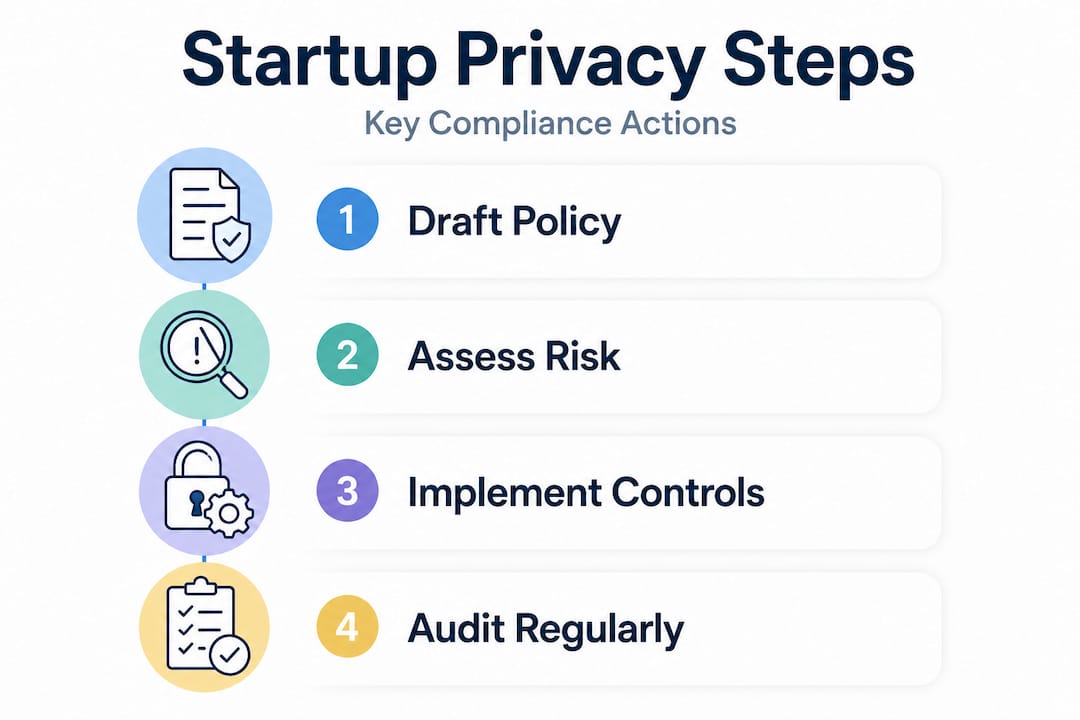
New 2026 requirements include cybersecurity audits, risk assessments, and automated decision-making disclosures for companies subject to CCPA/CPRA. This means if your product uses algorithms to make decisions that affect users, such as credit scoring, content filtering, or pricing, you must disclose that and, in many cases, give users the right to opt out.
Critical compliance actions for every startup:
- Publish a clear, complete privacy policy before collecting any user data
- Implement a consent management platform if you use tracking cookies or pixels
- Sign data processing agreements with every vendor who touches personal data
- Conduct a pre-launch privacy review for every new product feature
- Train every employee who handles personal data, including customer support staff
- Establish a process for responding to consumer rights requests within legal deadlines (typically 45 days)
Best practices including data minimization, privacy by design, DPIAs, RoPA, and annual audits are no longer optional extras. They’re the baseline expectation from regulators and enterprise buyers alike.
Pro Tip: Use automation tools like Vanta, Drata, or OneTrust to maintain your RoPA and schedule DPIAs automatically. These platforms cut manual compliance work significantly and reduce the risk of human error in your records. The upfront cost is far lower than the cost of a compliance failure.
For technical implementation, lean on resources like cybersecurity for startups to understand which controls protect you most efficiently given your stage and stack.
Building strong data security on a startup budget
Privacy compliance and data security are not the same thing, but they’re deeply connected. You can have a perfect privacy policy and still suffer a breach that exposes your customers and triggers regulatory action. Security is the operational layer that makes compliance real.

The FTC recommends encryption, access controls, and MFA as baseline security measures for small businesses, with the NIST Cybersecurity Framework as a practical guide for implementation. These aren’t aspirational goals. They’re the minimum standard regulators expect.
Security controls every startup must implement:
- Multi-factor authentication (MFA) on all accounts. MFA blocks the overwhelming majority of credential-based attacks. Enable it on email, cloud infrastructure, code repositories, and any admin panel.
- Encryption at rest and in transit. All personal data should be encrypted in your database and transmitted only over HTTPS. This is non-negotiable.
- Role-based access control. Not every engineer needs access to production customer data. Limit access to the minimum required for each role and audit it quarterly.
- Vulnerability patching. Establish a process for applying security patches within 30 days of release for critical vulnerabilities.
- Incident response plan. Document what you do when a breach happens before it happens. Most state laws require breach notification within 30 to 72 hours.
“MFA alone blocks 99.9% of automated account compromise attacks, making it the single highest-ROI security investment any startup can make.”
SOC 2 Type II is the gold standard for demonstrating security to enterprise customers and investors. It’s an independent audit of your security controls over a period of time, typically 6 to 12 months. The average SOC 2 Type II audit costs between $65,000 and $100,000, and 34% of startups fail their first audit due to access control gaps. Plan for it early, not when a customer demands it in a contract negotiation.
Automation cuts SOC 2 preparation time by 40%, and 90% of seed-stage startups lack any formal vendor risk management process. Both of these statistics point to the same lesson: manual compliance doesn’t scale, and ignoring vendor risk is one of the most common ways startups expose themselves.
Pro Tip: Budget for an annual penetration test even before you pursue SOC 2. Penetration tests, where ethical hackers attempt to breach your systems, surface vulnerabilities that automated scanners miss. A $5,000 to $15,000 pen test can prevent a breach that costs 10x that amount in notification, legal, and remediation costs.
Explore startup cybersecurity solutions to find tools and frameworks that fit your current stage and budget without over-engineering your security stack.
Scaling privacy: From policies to everyday startup culture
Writing a privacy policy and implementing MFA are table stakes. The startups that build lasting trust are the ones that make privacy part of how their team thinks and operates every day.
Privacy by design means building privacy protections into your product architecture from the beginning, rather than adding them after the fact. Practically, this means collecting only the data you actually need, defaulting to the most privacy-protective settings, and designing data deletion into your product before users ask for it.
Employee training, privacy by design, and annual audits are foundational startup best practices that separate compliant companies from companies that just have compliance documents. Training doesn’t need to be expensive. A quarterly 30-minute session covering phishing awareness, data handling rules, and incident reporting procedures is enough for most early-stage teams.
Practical privacy culture wins for small teams:
- Assign a privacy owner, even if it’s the CEO or a senior engineer, who is responsible for staying current on law changes
- Add a privacy checklist to your product development process so every new feature gets a quick privacy review before launch
- Create a vendor onboarding checklist that includes reviewing data processing agreements before signing any contract
- Document your data retention policy and actually delete data you no longer need on a scheduled basis
- Make it easy for customers to submit data rights requests and track your response times
These habits connect directly to how you build your brand. Companies that treat privacy as a core value, rather than a compliance burden, communicate that clearly in their marketing and customer relationships. This is especially relevant when you think about sustainable business practices for startups, where long-term trust is built through consistent, ethical behavior rather than short-term growth tactics.
Perspective: Why startups should own privacy, not just comply
Here’s the uncomfortable truth most compliance articles won’t tell you: treating privacy as a legal checkbox is actually more expensive than treating it as a business strategy.
The common myth is that privacy is a cost center. Something you spend money on to avoid getting fined. That framing leads founders to do the minimum required, which almost always means retrofitting controls into a product that wasn’t designed with privacy in mind. Retrofits are expensive, disruptive, and often incomplete. We’ve seen startups spend six figures fixing privacy problems that would have cost $15,000 to build correctly from the start.
The contrarian view is this: data privacy is a brand asset. Customers are increasingly aware of how their data is used. Enterprise buyers run privacy due diligence as part of procurement. Investors ask about compliance posture before writing checks. A startup that can say “we’ve been privacy-first since day one” has a genuine differentiator that its competitors who scrambled to retrofit controls cannot claim.
The FTC’s guidance on security basics makes it clear that implementing privacy by design early prevents the disruptively expensive fixes that come later. This isn’t just regulatory advice. It’s sound business architecture.
Pro Tip: Use your privacy practices as a differentiator in customer messaging. A simple “we never sell your data” statement on your pricing page or in your onboarding flow builds trust that no ad campaign can replicate. Customers who trust you stay longer and refer more. That’s a direct revenue impact from a privacy decision.
The founders who win on privacy are the ones who connect it to startup trust-building and treat it as part of their brand story, not a legal obligation they reluctantly fulfill.
Start building a privacy-first foundation for your startup
Privacy compliance doesn’t have to be overwhelming, especially when you have the right foundation in place from the beginning.
At our digital marketing agency, we help startups build that foundation across every layer of their online presence. From helping you launch a secure, well-structured website using our website building guide to implementing the technical controls covered in our business cybersecurity solutions resources, we provide the practical tools and guidance you need to grow with confidence. Getting your hosting infrastructure right from the start is also critical, and our website hosting essentials guide walks you through the decisions that affect both performance and security. Start where you are, build what you need, and protect what you’ve built.
Frequently asked questions
Do all startups need to comply with data privacy laws?
Most U.S. startups must comply if they process sensitive personal data or exceed certain thresholds, even with small teams. Most startups fall under state laws based on consumer count, data volume, or revenue, not company size.
What happens if my startup ignores privacy laws?
Startups face serious financial and reputational consequences for non-compliance. AG enforcement reaches up to $10,000 per violation, and a single complaint can trigger a costly investigation that far exceeds the fine itself.
How can startups reduce data privacy compliance costs?
Automating assessments and access controls is the most effective cost-reduction strategy available. Automation cuts SOC 2 preparation time by 40% and significantly reduces the access control failures that cause 34% of startups to fail their first audit.
Do I need to update privacy policies if laws change?
Yes, every time the laws that apply to your startup change, your privacy policy must reflect those changes. Privacy policies must disclose data categories, purposes, rights, and third-party sharing accurately and completely at all times.
What’s a quick first step for startup founders worried about privacy?
Start by mapping every type of personal data your startup collects, where it’s stored, and who can access it. Then update your privacy policy to reflect reality, and put role-based access controls in place to limit who can reach sensitive data.
Recommended
- Content Marketing for Startups: A Complete Guide for Success – seo analytic
- Business Continuity Planning: Securing Online Growth – seo analytic
- Sustainable Business Practices: Impact on Startups – seo analytic
- Startup Brand Strategy: Complete Guide for Success – seo analytic
- Digital marketing compliance explained: Essential rules for SMBs