

TL;DR:
- Customer lifetime value (CLV) is a crucial metric that predicts the total revenue or profit from a single customer throughout their relationship with a business. Small businesses often overlook CLV, risking overspending on channels that attract one-time buyers instead of loyal, high-value customers. Using accurate CLV calculations guides smarter marketing budgets, improves retention strategies, and enhances financial forecasting for sustainable growth.
Most small business owners celebrate every new sale as a win, and they should. But here’s the problem: not every customer is worth the same amount to your business over time. Some buyers purchase once and disappear. Others come back month after month, refer friends, and generate ten times their original value. Customer lifetime value (CLV, also called LTV) is the metric that tells you which is which, and it’s the single most powerful number for aligning your marketing budget, your growth plan, and your bottom line.
Table of Contents
- What is customer lifetime value (CLV)?
- Core formulas and methods to calculate CLV
- Why profit-based CLV matters for forecasting and budgeting
- Applications: how to use CLV to strengthen your marketing strategy
- Beyond CLV: CLROI and the investment mindset
- What most guides miss about using CLV in the real world
- Apply CLV insights to supercharge your digital strategy
- Frequently asked questions
Key Takeaways
| Point | Details |
|---|---|
| CLV is future-focused | Customer lifetime value measures total value over a customer’s entire journey, not just the first sale. |
| Different CLV methods | Choose the right calculation method—revenue, subscription, or cohort—based on your business and data. |
| Profit matters most | Profit-based CLV provides more accurate forecasting by including margin and cost-to-serve. |
| CLV drives strategy | Use CLV to optimize marketing, retention, and budgeting for better long-term growth. |
| Update CLV regularly | Review and revise your CLV calculations to reflect changes in customer behavior and business strategy. |
What is customer lifetime value (CLV)?
CLV is the total predicted revenue, or profit, you can expect from a single customer throughout their entire relationship with your business. It sounds simple, but most small businesses ignore it in favor of easier metrics like monthly revenue or conversion rate. That’s a mistake.
“Customer lifetime value is a forward-looking metric representing the total value you expect from a customer over the entire customer relationship.” — Salesforce
Think of it this way: a customer who spends $50 once and never returns is worth $50. A customer who spends $30 every month for three years is worth $1,080. If you’re spending the same amount to acquire both of them, your marketing budget is working against you.
Here’s why CLV matters as a north star metric for your business:
- It tells you the maximum you should spend to acquire a new customer (customer acquisition cost, or CAC)
- It reveals which customer segments generate the most long-term profit
- It guides decisions about customer loyalty programs and retention spending
- It improves financial forecasting because you’re projecting real relationship value, not just one-time transactions
- It helps you allocate ad spend across channels based on which ones attract high-value buyers
Without CLV, you’re flying blind. You might be over-investing in channels that bring in one-time buyers and under-investing in channels that bring in loyal, repeat customers.
Core formulas and methods to calculate CLV
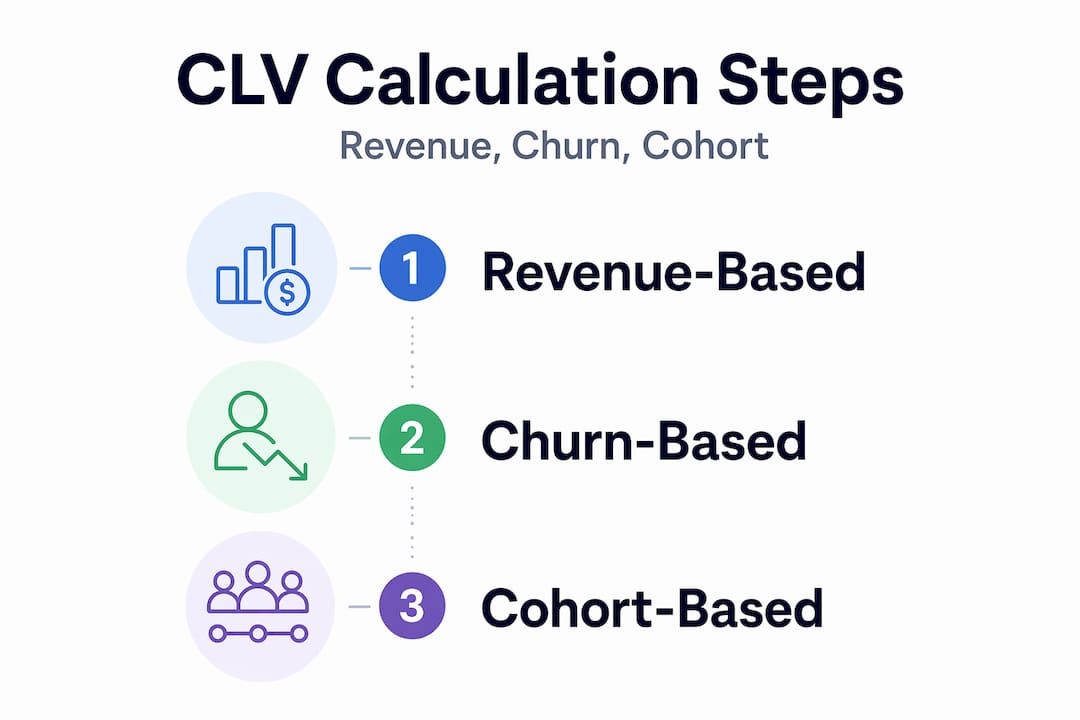
Common CLV methodologies for small businesses include revenue-based simple formulas, churn-based subscription formulas, and cohort-based tracking that measures cumulative value over time. The right method depends on your business model and the data you actually have.
Here’s a quick breakdown of when to use each:
| Method | Best for | Data needed | Complexity |
|---|---|---|---|
| Revenue-based | Retail, e-commerce | Avg. purchase value, frequency, lifespan | Low |
| Churn/subscription | SaaS, memberships | MRR, monthly churn rate | Medium |
| Cohort-based | All types with history | Transaction data by acquisition date | Medium to high |
1. Revenue-based CLV (simple formula)
Formula: CLV = Average Purchase Value x Purchase Frequency x Average Customer Lifespan
Example: A boutique coffee shop finds that customers spend $8 per visit, visit 3 times per week, and stay loyal for 2 years. CLV = $8 x 156 visits per year x 2 years = $2,496. Now you know each loyal customer is worth nearly $2,500. That changes how you think about offering a free drink to bring someone back.
2. Churn-based CLV (subscription model)
Formula: CLV = Average Revenue Per User (ARPU) divided by Churn Rate
Example: A digital newsletter charges $15 per month and loses 5% of subscribers each month. CLV = $15 / 0.05 = $300 per subscriber. This tells you that spending $60 to acquire a new subscriber is well within range if your measuring marketing ROI benchmark is 5x.
3. Cohort-based CLV (most accurate)
This method groups customers by when they were acquired (monthly or quarterly cohorts) and tracks their cumulative revenue or retention over time. It’s more work, but it shows you patterns that averages hide. For example, customers acquired during a holiday sale might churn faster than those who found you through organic search. Simple averages would never reveal this. You can learn more from a detailed customer lifetime value guide that walks through cohort analysis step by step.
Pro Tip: Start with the revenue-based formula to get your first CLV estimate. Once you have 6 to 12 months of transaction data, migrate to cohort analysis so you can spot real trends rather than relying on overall averages. Use that number to anchor your yearly marketing plan and revisit the calculation every quarter.
Why profit-based CLV matters for forecasting and budgeting
Basic CLV gives you a revenue number. But revenue is not profit. If you’re using revenue-based CLV to set your marketing budgets, you’re likely overspending, sometimes dramatically.

Profit-based CLV factors in gross margin and cost-to-serve, giving you a far more accurate picture for financial forecasting. Here’s how the two compare for a hypothetical e-commerce business:
| Metric | Revenue-based CLV | Profit-based CLV |
|---|---|---|
| Avg. annual spend per customer | $400 | $400 |
| Gross margin | Not included | 45% |
| Cost to serve (support, returns) | Not included | $35/year |
| Customer lifespan | 3 years | 3 years |
| CLV result | $1,200 | $505 |
The gap is stark. A business relying on revenue-based CLV might happily spend $300 to acquire a customer thinking they have a 4x return. In reality, their profit-based CLV of $505 makes that acquisition barely break even once ongoing costs are counted.
Costs you need to factor into profit-based CLV include:
- Cost of goods sold (COGS): The direct cost of whatever you sell
- Customer support costs: Time and tools spent resolving issues
- Returns and refunds: Especially critical in retail and e-commerce
- Shipping and fulfillment: Per-order logistics costs
- Loyalty program costs: Discounts, rewards, and administrative overhead
Once you have an accurate profit-based CLV, you can connect it directly to your marketing funnel decisions. You’ll know which funnel stages deserve more investment and which are already converting efficiently. This is the difference between budgeting based on gut feel and budgeting based on actual financial data.
Applications: how to use CLV to strengthen your marketing strategy
Knowing your CLV is one thing. Putting it to work is where most small businesses fall short. Here are the most impactful ways to use CLV as a practical decision-making tool.
The LTV to CAC ratio: your most important marketing metric
LTV/CAC is the ratio of customer lifetime value to customer acquisition cost. Harvard Business School states that a good rule of thumb is that an LTV-to-CAC ratio of 3 or higher is attractive and indicates a business is set up for scalable growth. If your ratio is below 1, you’re losing money on every customer you acquire. Between 1 and 2, you’re barely staying afloat. At 3 or above, you have room to invest in growth.
Practical steps to apply CLV in your marketing:
- Segment your customers by CLV. Divide your customer base into high, medium, and low CLV groups. You’ll likely find that the top 20% of customers generate 60 to 80% of your total revenue. This is the segment worth fighting for.
- Set acquisition budgets by segment. If your best customer segment has a profit-based CLV of $900, you can justify spending up to $300 in acquisition costs (to maintain a 3x ratio) and still build a healthy business.
- Design retention campaigns around your high-CLV profile. Study what your best customers have in common, including their acquisition channel, first product purchased, and engagement behavior, then build campaigns to attract more of them.
- Use CLV to justify retention spending. A 5% improvement in retention can increase profits by 25 to 95% according to industry research. If your CLV data shows that customers who make a third purchase become 4x more valuable, a targeted campaign to drive that third purchase becomes an obvious investment.
- Adjust channel spend based on CLV by source. Not all traffic sources produce equal customers. Track CLV by acquisition channel so you can double down on channels that attract loyal buyers.
Pro Tip: Watch for early-time bias in your CLV calculations. If you only measure customers for 90 days, you’ll underestimate their true value significantly. And if your retention rates shift (for example, after a price increase or a product change), update your CLV model immediately. Understanding customer journey stages helps you identify exactly where customers become loyal and where they drop off, making your CLV model sharper. Also consider conversion rate optimization tips that extend the journey of each customer already in your funnel.
Beyond CLV: CLROI and the investment mindset
CLV tells you how much a customer is worth. But there’s a related metric that goes further and reframes the entire acquisition decision as a financial investment.
“HBS research distinguishes CLV from Customer Lifetime Return on Investment (CLROI): CLV is well-known, while CLROI treats acquiring a customer as a financial investment with return based on future profit streams.”
CLROI asks: given everything you spend to acquire and serve a customer over their lifetime, what is the actual percentage return on that investment? It’s calculated similarly to a standard ROI formula but uses the full profit stream over the customer relationship rather than a single transaction.
Here’s a simple side-by-side comparison:
- CLV focus: Total value generated by a customer over time
- CLROI focus: The percentage return on the total investment made to acquire and retain that customer
When CLROI gives you a clearer picture than CLV alone:
- When you’re comparing two customer segments with similar CLV but very different acquisition costs
- When you’re evaluating whether a new customer type (from a new marketing channel) is worth pursuing
- When you’re making a case to investors or lenders for growth spending
- When you want to prioritize segments by true ROI in marketing, not just gross value
Together, CLV and CLROI give you a two-dimensional view of customer value. CLV tells you the size of the prize. CLROI tells you whether chasing that prize makes financial sense given what you’re spending to get there. Most small business owners stop at CLV. Adding CLROI to your toolkit sets you apart from competitors who are still guessing.
What most guides miss about using CLV in the real world
Here’s our honest take after working with hundreds of small businesses: CLV calculations are only as good as the data behind them, and most small businesses have messy data.
Customer behavior changes. Someone who bought every month for two years might suddenly stop due to a life event, a competitor’s offer, or a price change that had nothing to do with their satisfaction. When that happens, your average CLV model, built on historical patterns, becomes inaccurate almost overnight.
The biggest pitfalls we see in practice are these. First, businesses use the wrong formula for their model. A subscription business using a simple revenue-based formula will consistently overestimate CLV because it doesn’t account for churn. Second, businesses treat CLV as a fixed number. It’s not. It’s a living estimate that should be updated as your business and your customers evolve. Third, businesses average across segments that shouldn’t be averaged. If you blend your most loyal local customers with one-time buyers from a flash sale, the average tells you almost nothing useful about either group.
Our practical advice for small business owners: start simple, stay honest about data quality, and use CLV as a hypothesis-testing tool. When you’re considering a new loyalty program or a new acquisition channel, run the CLV math first. It won’t give you a perfect answer, but it will force you to articulate your assumptions, and that alone makes better decisions. Pairing CLV analysis with smart cross selling strategies is one of the fastest ways to increase customer value without increasing acquisition costs.
The businesses that win with CLV are not the ones with the most sophisticated models. They’re the ones who check their numbers regularly, update assumptions quickly, and actually use the data to change their spending decisions.
Apply CLV insights to supercharge your digital strategy
Understanding CLV is the first step. Turning that understanding into real business growth requires the right digital tools, the right strategy, and support from experts who know how to connect customer data to marketing performance.
At our agency, we help small business owners and marketers translate CLV insights into high-performing digital campaigns, smarter website experiences, and acquisition strategies that target your highest-value customer profiles from day one. Whether you’re just getting started with digital marketing basics or you’re ready to run advanced conversion optimization strategies that increase revenue per customer, our team builds solutions tailored to your business model and your audience. Stop guessing. Start growing with data.
Frequently asked questions
What’s the easiest way to estimate CLV for my small business?
Use the simple revenue-based formula: CLV equals average purchase value times purchase frequency times average customer lifespan. It takes about 15 minutes to calculate and gives you an actionable starting point right away.
How often should I update my CLV calculations?
Review and update your CLV at least once a year, or immediately when you see major shifts in retention rates, pricing, or your customer mix. Stale CLV numbers lead to stale marketing decisions.
What if my business model is changing, does CLV still work?
Yes, but switch to cohort-based tracking so you can compare how new customers behave versus older ones. Simple averages will blend the two groups and hide the real impact of your model change.
What is a good LTV to CAC ratio?
A ratio of 3 or higher is considered strong and indicates your business is positioned for scalable, sustainable growth without burning through your marketing budget.
How does CLV help with budgeting marketing spend?
By knowing your CLV, you can set a clear maximum customer acquisition cost and confidently invest more in channels that consistently attract customers with the highest long-term value to your business.