

TL;DR:
- Business reputation management actively monitors and influences customer perception across online channels. It is essential for building trust, improving search rankings, and increasing customer retention.
Business reputation management is the process of actively monitoring, influencing, and maintaining how customers perceive your company across reviews, search results, and social media. Known formally as online reputation management (ORM), it directly affects trust, purchase decisions, and long-term revenue. Consistent reputation signals are the foundation of this process, and 61% of consumers question the reliability of online information. That number means your business cannot afford to leave its public image unmanaged. Platforms like Birdeye have built entire product categories around this challenge, and reputation management services now benchmark response times in hours, not days.
What is business reputation management and why does it matter?
Reputation management is a process to monitor, influence, and maintain brand perception for trust and growth. The definition sounds simple, but the execution spans every channel where customers talk about your business: Google reviews, Yelp, Facebook, industry directories, and AI-powered search tools like Perplexity and ChatGPT.
The stakes are high because AI-driven discovery now pulls from review aggregates and social signals to answer buyer questions directly. A business with thin or negative review data gets filtered out before a potential customer ever clicks. Brand image management is no longer a PR task reserved for large corporations. It is a daily operational requirement for any business that competes online.
Managing your online reputation starts with understanding that every review, comment, and listing entry contributes to a cumulative signal. Search engines and AI platforms read that signal to decide how prominently to feature your business. Ignoring it is not a neutral choice. It is a decision to let competitors shape the narrative instead.
How does reputation management work? Core components explained
Effective ORM runs on four interconnected activities: monitoring, responding, updating, and analyzing. Businesses combine review monitoring, response protocols, listing updates, and AI-powered engagement to maintain brand consistency across channels. Each component feeds the others.

Monitoring covers every place customers leave feedback. That includes Google Business Profile, Yelp, Trustpilot, industry-specific sites like Healthgrades or Avvo, and social platforms. Missing a review on a niche site is just as damaging as ignoring a one-star Google post.
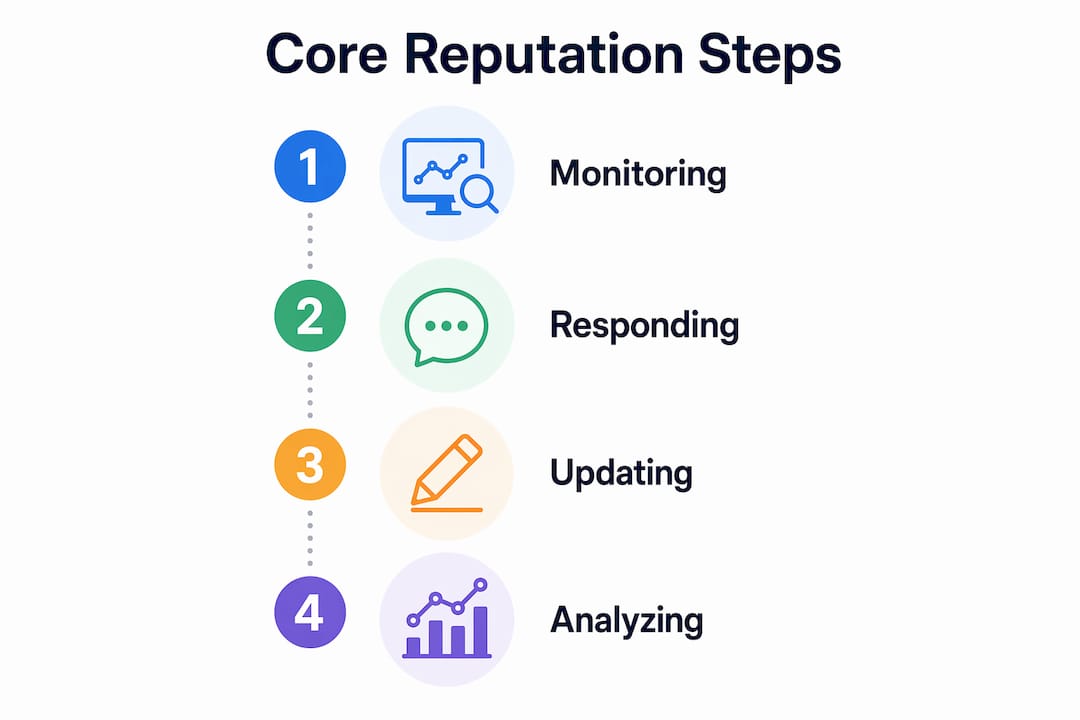
Responding requires speed and consistency. Reputation management agencies typically operate on a 2–24 hour response SLA. Slow replies signal indifference to both the original reviewer and every future customer who reads the thread.
Updating listings keeps your business information accurate across directories. Outdated phone numbers or addresses erode trust faster than a bad review because they create friction at the exact moment a customer is ready to act.
Analyzing sentiment turns raw feedback into operational insight. Centralizing reputation data prevents missed feedback and inconsistent responses. Without a single dashboard, teams work from incomplete pictures and react too slowly to sentiment shifts.
- Monitor reviews on Google, Yelp, Facebook, and industry-specific directories weekly
- Set response SLAs internally: 2 hours for negative reviews, 24 hours for positive ones
- Audit all business listings quarterly for accuracy
- Use sentiment analysis tools to track tone trends, not just star ratings
- Assign clear ownership so no feedback falls through the cracks
Pro Tip: Use a platform like Birdeye or a dedicated brand reputation monitoring tool to pull all channels into one feed. Unified data cuts response time and surfaces patterns you would never catch by checking sites one at a time.
What are the real benefits of proactive reputation management?
Proactive reputation management converts customer feedback into a revenue asset. The numbers behind this are not abstract.
Over 90% of consumers consult reviews before making a purchase decision. That statistic means your review profile is the first sales conversation most prospects have with your business, and you are not in the room. 47% of customers post reviews after an experience. That means nearly half your customer base is actively shaping your reputation whether you engage with them or not.
The benefits of active reputation protection online extend well beyond star ratings:
- Higher search visibility. Google’s local ranking algorithm weighs review quantity, recency, and response rate. Businesses that respond to reviews consistently rank higher in local pack results.
- Stronger customer trust. Buyers trust businesses that respond to criticism publicly. A well-handled negative review builds more credibility than a page of five-star ratings with no owner responses.
- Better customer retention. Customers who feel heard return. Responding to feedback, positive or negative, signals that your business values the relationship beyond the transaction.
- Competitive intelligence. Review analysis reveals what competitors do well and where they fall short. That data informs product decisions, staffing, and service design.
- AI discoverability. AI tools like Perplexity and Google’s AI Overviews pull from review aggregates. A strong, consistent review signal increases the chance your business appears in AI-generated answers.
Social proof in marketing works because buyers trust peer voices over brand claims. Your review profile is the most powerful form of social proof you can build, and it compounds over time.
In-house vs. agency reputation management services: which is right for you?
The choice between managing reputation internally and hiring a reputation management company depends on three factors: your team’s bandwidth, your budget, and how fast your review volume grows.
Reputation management agencies typically deliver initial audits within 48 hours and operate on response SLAs of 2–24 hours. That speed is difficult to match with an internal team that also handles marketing, customer service, and operations. RankRepute, for example, serves over 120 local businesses with a 2-hour SLA on responses and no long-term contracts. That model suits businesses that need professional coverage without committing to a year-long retainer.
| Attribute | In-house management | Reputation management agency |
|---|---|---|
| Cost | Lower direct cost, higher time cost | Monthly retainer, predictable spend |
| Speed | Depends on team availability | 2–24 hour SLA standard |
| Expertise | Varies by team skill level | Dedicated ORM specialists |
| Technology | Self-selected tools, fragmented | Integrated platforms included |
| Scalability | Limited by headcount | Scales with review volume |
| Audit speed | Ad hoc | Initial audit within 48 hours |
Self-management works well for businesses with fewer than 50 reviews per month and a dedicated marketing coordinator. Once review volume climbs or a reputation crisis hits, the calculus shifts. A reputation management agency brings both the tools and the institutional knowledge to respond correctly under pressure.
Pro Tip: Before hiring a reputation management agency, run a 30-day internal audit. Track how many reviews you receive, how fast you respond, and how many you miss. That baseline tells you exactly what gap an agency would fill, and it gives you a benchmark to measure their performance against.
Best practices to protect and improve your business reputation
The most effective reputation protection online strategy is not reactive. It is a system built before a crisis arrives.
- Monitor broadly, not just on Google. Industry-specific directories like Healthgrades, Houzz, or G2 carry significant weight with niche audiences. A one-star review on a vertical platform can outrank your Google profile for specific search queries.
- Respond to every review, positive and negative. Thanking a five-star reviewer takes 30 seconds and signals attentiveness to every future reader. Addressing a negative review publicly, with empathy and a resolution path, turns a liability into a trust signal.
- Generate reviews systematically. Ask customers for feedback at the peak of their satisfaction, immediately after a successful delivery, appointment, or purchase. Automated follow-up via email or SMS produces consistent review volume without manual effort.
- Use AI for sentiment analysis. AI accelerates reputation signal analysis, providing faster insights and richer context than manual review reading. Tools that categorize feedback by theme, such as “wait time” or “staff attitude,” let you fix operational problems before they become review patterns.
- Benchmark against competitors. Track competitor review scores and response rates quarterly. Gaps in their coverage are opportunities to differentiate your service.
- Embed reputation data into operations. Share review themes with your team in weekly meetings. When front-line staff understand what customers praise and criticize, behavior changes faster than any training program can achieve.
Responding to online reviews is one of the highest-return activities a small business owner can do. It costs nothing but time and pays dividends in trust, retention, and search ranking. Pair that with a consistent brand reputation strategy and you build a compounding advantage that competitors cannot easily replicate.
Key Takeaways
Effective business reputation management requires monitoring every channel, responding within hours, and feeding review insights back into daily operations to build compounding trust.
| Point | Details |
|---|---|
| Define your baseline first | Audit current reviews, response rates, and listing accuracy before changing anything. |
| Speed determines outcomes | Negative reviews addressed within 2 hours lose far less trust than those left unanswered for days. |
| Reviews drive AI visibility | AI search tools pull from review aggregates, making consistent positive signals a discoverability factor. |
| Agency vs. in-house is a volume decision | Self-management works below 50 reviews per month; agencies add value as volume and complexity grow. |
| Reputation data belongs in operations | Sharing review themes with staff weekly changes behavior faster than formal training programs. |
Why most business owners are managing reputation backwards
I have worked with business owners across retail, healthcare, legal services, and hospitality. The pattern I see most often is the same: they treat reputation management as damage control. They check reviews when something goes wrong, post a defensive reply, and move on. That approach guarantees you are always behind.
The businesses that build real trust treat reputation data the way a CFO treats financial data: as a continuous signal that informs decisions. One restaurant owner I worked with started sharing weekly review themes with her kitchen and front-of-house staff. Within 90 days, her average rating climbed from 3.8 to 4.4 stars, not because she asked for more reviews, but because the team fixed the three recurring complaints customers kept mentioning.
The other mistake I see constantly is siloed data. Marketing checks Google. Customer service checks Facebook. Nobody is looking at the full picture. AI is accelerating how fast reputation signals move, which means a sentiment shift on one platform can affect your search ranking before your team even notices it. Centralized monitoring is not optional anymore. It is the minimum viable setup.
My honest recommendation: invest in a platform that unifies all your reputation signals before you invest in generating more reviews. More reviews fed into a broken monitoring system just creates more noise. Fix the infrastructure first, then scale the volume. Working with a marketing advisor who understands ORM can accelerate that process significantly if you are starting from scratch.
— Maayan
How Seo-analytic helps you build the online presence reputation depends on
Your reputation management strategy is only as strong as the digital foundation beneath it. A slow, poorly structured website undermines every positive review you earn. Seo-analytic specializes in website building, social media marketing, and digital presence optimization for business owners who want their online assets to work as hard as their team does.
Start with the fundamentals. Seo-analytic’s website building guide for business owners walks you through creating a site that supports your reputation, ranks in search, and converts visitors into customers. Pair that with Seo-analytic’s social media marketing resources to build the consistent brand presence that reputation management requires. A strong website and active social channels give your positive reviews a credible home to point back to.
FAQ
What is business reputation management?
Business reputation management is the process of monitoring, influencing, and maintaining how your company is perceived across online channels including reviews, social media, and search results. It directly affects customer trust and purchase decisions.
How do online reviews affect my business reputation?
Over 90% of consumers read reviews before buying, making your review profile the first impression most prospects encounter. Consistent positive reviews improve both customer trust and local search ranking.
Should I hire a reputation management agency or manage it in-house?
Agencies are the better choice when your review volume exceeds what your team can monitor and respond to within 24 hours. Agencies like RankRepute offer 2-hour response SLAs and initial audits within 48 hours, which is difficult to match internally without dedicated staff.
How does AI affect online reputation management?
AI accelerates the analysis of reputation signals, providing faster insights and richer context than manual monitoring. AI-powered tools also feed review data into search and discovery platforms, making your review profile a direct factor in AI-generated search results.
How quickly should I respond to negative reviews?
The industry standard for reputation management services is a 2–24 hour response window. Responding within 2 hours to negative reviews limits reputational damage and signals to future customers that your business takes feedback seriously.