

Managing sales growth without a clear system leaves many small business owners chasing leads with no real sense of what’s working. You might have interested prospects one week and radio silence the next, making it impossible to forecast revenue or plan for growth. A structured sales pipeline changes that by organizing your sales process into clear stages, helping you track every opportunity and convert more leads into paying customers. This guide provides actionable strategies to prepare, build, and optimize a sales pipeline that drives predictable revenue growth for your business in 2026.
Table of Contents
- Understanding Sales Pipelines And Preparing To Build Yours
- Step-By-Step Guide To Building Your Sales Pipeline In 2026
- Optimizing And Managing Your Sales Pipeline For Sustained Success
- Enhance Your Sales Pipeline With Digital Marketing And Website Tools
- Frequently Asked Questions
Key takeaways
| Point | Details |
|---|---|
| Understanding pipelines | A sales pipeline organizes your sales process into stages, making it easier to track and accelerate deals. |
| Preparation is essential | Identify your ideal customer and gather quality lead sources before building your pipeline. |
| Build with clear stages | Define specific pipeline phases to move leads systematically from first contact to closed sale. |
| Optimize continuously | Track conversion metrics and automate repetitive tasks to improve efficiency and results. |
| Forecasting improves | Effective pipelines provide visibility into future revenue and help you make better business decisions. |
Understanding sales pipelines and preparing to build yours
A sales pipeline is a visual representation of your sales process broken into distinct stages, showing exactly where each prospect stands in their journey to becoming a customer. Think of it as a roadmap that guides both you and your potential buyers from initial contact through closing the deal. For small businesses, this structure transforms chaotic lead management into an organized system that drives consistent results.
The benefits extend far beyond simple organization. A clearly defined sales pipeline helps small businesses organize their sales activities and improve conversion rates, giving you the ability to forecast revenue more accurately and identify exactly where prospects get stuck. You’ll know which leads need immediate attention, which ones require nurturing, and which should be removed from your pipeline entirely. This clarity lets you allocate your time and resources where they’ll have the biggest impact on your bottom line.
Before building your pipeline, preparation sets the foundation for success. Start by identifying your target customer with precision. Who benefits most from your product or service? What problems do they face that you solve? Understanding your ideal customer profile helps you attract better quality leads and tailor your sales approach to their specific needs. Next, define clear sales goals tied to revenue targets and conversion benchmarks. Are you aiming to close 20 deals per month or increase average deal size by 30%? Specific goals keep your pipeline focused and measurable.
Gather quality lead sources by mapping where your best customers come from. Referrals, social media platforms, email campaigns, networking events, and your website all serve as potential lead channels. The key is tracking which sources produce the highest quality prospects so you can double down on what works. Learn more about effective strategies through marketing automation explained guide to streamline your lead collection process.
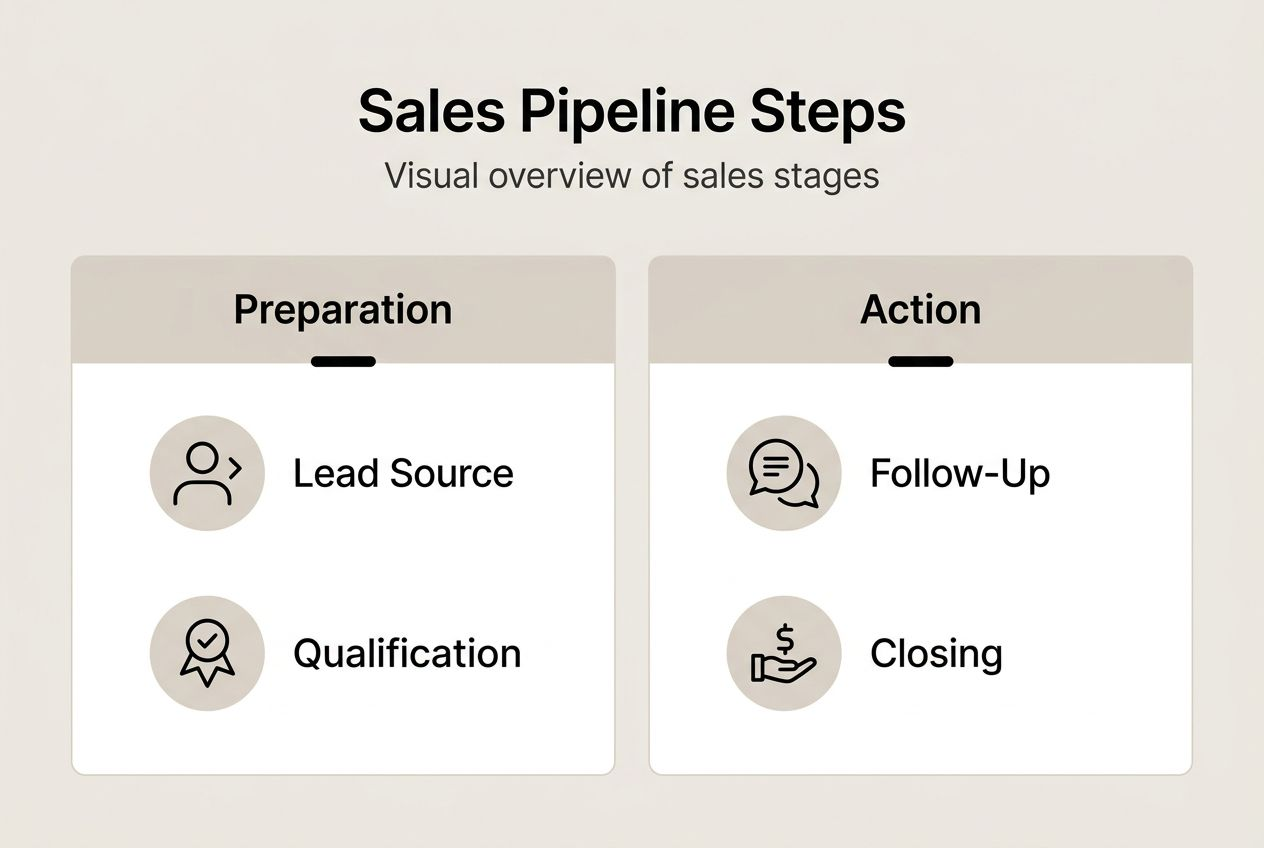
Most sales pipelines include these common stages:
- Lead generation: attracting potential customers through various marketing channels
- Qualification: determining if leads have genuine interest, budget, and authority to buy
- Proposal: presenting your solution and addressing specific prospect needs
- Negotiation: discussing terms, pricing, and addressing final objections
- Closing: finalizing the agreement and converting prospects to customers
Understanding your customer journey stages helps you tailor each pipeline phase to match how buyers actually make decisions. A software purchase might require multiple stakeholder approvals and longer consideration, while a service booking could move from interest to close in days. Align your pipeline structure with your specific sales cycle for maximum effectiveness.

Step-by-step guide to building your sales pipeline in 2026
Building an effective sales pipeline requires systematic execution across six critical steps that transform scattered leads into an organized conversion machine.
-
Gather and organize leads from multiple sources like customer referrals, LinkedIn connections, Facebook ads, email marketing campaigns, trade shows, and website inquiries. Create a centralized system where every lead gets captured immediately with key details including name, company, contact information, source, and initial interest level. Don’t let potential opportunities slip through the cracks because someone forgot to log a conversation or business card.
-
Qualify leads quickly by asking targeted questions that reveal whether prospects have real buying potential. Assess their budget, authority to make purchasing decisions, genuine need for your solution, and realistic timeline for implementation. This qualification step prevents you from wasting weeks nurturing someone who can’t actually buy. Focus your energy on prospects who match your ideal customer profile and show clear signs of purchase intent. Explore practical lead generation ideas to attract better qualified prospects from the start.
-
Define clear pipeline stages tailored to your specific business sales cycle. A consulting firm might use stages like discovery call, needs assessment, proposal presentation, contract review, and signed agreement. An e-commerce business could simplify to browse, cart addition, checkout initiation, and purchase completion. Using structured pipeline stages improves lead management and sales team focus, ensuring nothing falls through the cracks. Your stages should reflect the actual steps prospects take, not some theoretical ideal.
-
Assign leads to each stage based on their current position in the buying journey and set specific criteria for advancement. A lead moves from qualification to proposal only after confirming budget availability and decision maker involvement. From proposal to negotiation only after they’ve reviewed your offer and expressed serious interest. Clear advancement criteria prevent premature pushing and help you identify when leads stall.
-
Use Customer Relationship Management (CRM) software or simple spreadsheet tools to track progress and maintain consistent follow-up schedules. Log every interaction, set reminders for next steps, and document objections or concerns raised. Even basic tracking dramatically improves your ability to nurture relationships over time. You’ll remember exactly what you discussed three weeks ago instead of awkwardly asking the same questions twice.
-
Regularly review and clean your pipeline by removing dead leads that haven’t responded in months and re-prioritizing active opportunities based on likelihood to close. A cluttered pipeline filled with zombie prospects creates false optimism and distracts from real opportunities. Weekly or biweekly cleaning sessions keep your data accurate and your focus sharp.
Pro Tip: Automate repetitive follow-ups and reminders using email sequences or CRM automation features to save hours each week while maintaining consistent prospect communication. Automation handles the routine touchpoints so you can focus energy on high-value conversations and relationship building. Check out strategies for creating sales funnels higher conversion rates to maximize your pipeline’s effectiveness.
Optimizing and managing your sales pipeline for sustained success
Building your pipeline is just the beginning. Sustained success requires ongoing optimization through careful metric tracking, smart automation, and continuous process refinement.
Track these key metrics to measure pipeline health and identify improvement opportunities:
- Conversion rate: percentage of leads advancing from one stage to the next, revealing where prospects drop off
- Average deal size: typical revenue per closed sale, helping forecast income and prioritize high-value opportunities
- Sales velocity: average time from first contact to closed deal, showing how quickly you move prospects through stages
- Pipeline value: total potential revenue from all active opportunities, providing visibility into future income
- Win rate: percentage of qualified leads that ultimately become customers, indicating overall sales effectiveness
These numbers tell the real story of your sales performance. A low conversion rate between proposal and closing suggests your pricing might be off or your value proposition needs strengthening. Long sales velocity could mean your follow-up process has gaps or you’re targeting prospects who aren’t ready to buy.
Marketing automation tools can streamline follow-ups and improve pipeline management effectiveness by handling routine tasks that consume valuable selling time. Automated email sequences nurture leads with relevant content based on their stage and behavior. Reminder systems ensure no prospect goes too long without contact. Lead scoring algorithms flag hot opportunities requiring immediate attention. This technology doesn’t replace human relationship building but amplifies your capacity to manage more prospects simultaneously.
Compare the benefits of manual versus automated pipeline management:
| Aspect | Manual Management | Automated Management |
|---|---|---|
| Follow-up consistency | Depends on memory and discipline | Systematic and reliable |
| Time investment | High, repetitive tasks consume hours | Low, automation handles routine work |
| Lead nurturing capacity | Limited to personal bandwidth | Scales to hundreds of prospects |
| Data accuracy | Prone to human error | Consistent and trackable |
| Personalization | High touch when executed | Personalized at scale with templates |
Avoid these common pitfalls that sabotage pipeline effectiveness. Neglecting regular pipeline reviews allows stale leads to accumulate and distorts your revenue forecasts. Ignoring unresponsive leads wastes time on prospects who’ve moved on, while poor data entry creates confusion about deal status and next steps. Set clear standards for how information gets logged and enforce them consistently across your team.
Ongoing pipeline maintenance requires weekly reviews to catch bottlenecks early and adjust strategies before small problems become revenue disasters. Look for patterns like leads consistently stalling at the proposal stage or certain lead sources producing low quality prospects. These insights guide tactical improvements. Involve your sales team in feedback sessions to surface challenges and ideas from the people actually working deals daily. Their frontline perspective often reveals optimization opportunities you’d miss from a management view.
Pro Tip: Schedule a dedicated 30-minute pipeline review every Monday morning to analyze the previous week’s movement, clean out dead leads, and prioritize the week’s outreach. This consistent rhythm keeps your pipeline healthy and your focus on activities that actually close deals. Discover more strategies through conversion optimization strategies boost sales and marketing automation explained guide to continuously improve your results.
Enhance your sales pipeline with digital marketing and website tools
Your sales pipeline thrives when fed with a steady stream of qualified leads, and that’s where strategic digital marketing makes the difference. A well-designed website acts as a 24/7 lead generation machine, capturing visitor information and nurturing interest even while you sleep. Marketing automation tools then take those leads and move them systematically through your pipeline with personalized email sequences, targeted content, and timely follow-ups that feel human but scale effortlessly.
We help small businesses build powerful websites optimized for lead capture and conversion, integrate social media marketing strategies that attract your ideal customers, and implement automation systems that transform how you manage sales opportunities. Explore our resources on website building basics us business owners to create a foundation for pipeline success, leverage social media marketing to expand your reach, and discover how marketing automation explained guide can streamline your entire sales process for predictable growth.
Frequently asked questions
What is a sales pipeline and why is it important?
A sales pipeline is a visual framework outlining the specific stages a prospect travels through to become a paying customer, from initial awareness to final purchase. It helps you organize sales activities, prioritize high-value opportunities, and forecast future revenue with accuracy. Without this structure, you’re essentially guessing which leads deserve attention and when deals might close. The pipeline transforms sales from reactive scrambling into a proactive, measurable process that consistently generates results.
How do I qualify leads effectively for my pipeline?
Evaluate leads based on five key criteria: genuine interest in your solution, available budget to make a purchase, authority to make or influence buying decisions, specific need your product addresses, and realistic timeline for implementation. Ask direct questions early to assess these factors rather than spending weeks nurturing someone who can’t actually buy. Use a scoring system to rank leads objectively and focus your energy on prospects most likely to convert. Learn more strategies through practical lead generation ideas to attract better qualified prospects from the start.
What tools can help automate my sales pipeline management?
Customer Relationship Management (CRM) software like HubSpot, Salesforce, or Zoho and marketing automation platforms such as Mailchimp or ActiveCampaign are essential tools for modern pipeline management. These systems automate lead tracking, send scheduled follow-up reminders, trigger personalized email sequences based on prospect behavior, and generate reports showing exactly where deals stand. They eliminate manual data entry, reduce human error, and free up your time for actual selling instead of administrative tasks. Discover implementation strategies through marketing automation explained guide to choose and deploy the right tools for your business.
How often should I review and update my sales pipeline?
Weekly reviews are recommended to identify bottlenecks where leads consistently stall, remove outdated prospects who’ve gone cold, and adjust strategies based on what’s actually working. Consistent updates ensure your pipeline data remains accurate for forecasting and helps you catch small problems before they impact revenue. Monthly deeper analysis should examine conversion rates between stages, average deal velocity, and overall pipeline health trends. This regular maintenance discipline separates businesses with predictable sales growth from those constantly surprised by revenue shortfalls.
Recommended
- 7 Steps to Build a Yearly Marketing Plan Template for Success – seo analytic
- Sales Funnel Explained: Boosting Conversions for Startups – seo analytic
- Creating Sales Funnels for Higher Conversion Rates – seo analytic
- Customer journey stages guide for small business 2026 – seo analytic
- How to analyze ad trends for better ROI in 2026 – Palmador Blog