

Many business owners panic when they see a high bounce rate, assuming their website is broken. The truth is more nuanced. Bounce rate measures how many visitors leave after viewing just one page, but context matters more than the number itself. Understanding what bounce rate means for your specific pages helps you make smart improvements that actually increase sales and leads.
Table of Contents
- What Is Bounce Rate? Definition And Calculation
- Why Bounce Rate Matters For Your Business Website
- Common Misconceptions About Bounce Rate
- Interpreting Bounce Rate By Page Type: Blog, Landing, Product, Service Pages
- What Causes High Bounce Rate? Technical And Behavioral Factors
- Bounce Rate Benchmarks: What Numbers Should You Aim For?
- How Bounce Rate Impacts Conversions And Business Outcomes
- Conclusion: Applying Bounce Rate Insights To Improve Your Website
- Explore Our Website Building And Optimization Resources
- Frequently Asked Questions
Key Takeaways
| Point | Details |
|---|---|
| Bounce rate definition | Percentage of single-page sessions where visitors leave without further interaction |
| Context matters most | High bounce rate can be normal for blogs but problematic for sales pages |
| Industry benchmarks | Average bounce rates range from 41% to 55% depending on your sector |
| Conversion impact | Reducing bounce rate by 20% significantly increases lead generation and sales |
| Improvement focus | Target page speed, mobile usability, content relevance, and clear calls to action |
What is Bounce Rate? Definition and Calculation
Bounce rate measures the percentage of single-page sessions where visitors leave without interacting further on the site. It tracks visitor behavior at the most basic level, showing you how many people arrive at your website and then immediately exit without clicking anything else.
The calculation is straightforward. Take your single-page visits, divide by total visits, and multiply by 100. If 50 people visit your site and 20 leave after viewing just one page, your bounce rate is 40%.
Google Analytics and similar tools measure this automatically. They count a bounce when someone lands on your page and leaves without triggering another request to the analytics server. This happens when visitors close the browser, type a new URL, or click the back button.
What counts as a bounce:
- Visitor arrives on your homepage and closes the browser tab
- Someone reads a blog post then clicks back to search results
- User lands on a product page and navigates to a competitor site
- Visitor views one page and sits idle until the session times out
What does not count as a bounce:
- Visitor clicks to another page on your site
- User submits a form or completes a purchase
- Someone clicks an internal link or downloads a file
- Visitor watches a video or interacts with embedded content
Bounce rate alone does not tell you if visitors found what they needed. A high bounce rate might mean your page answered their question perfectly, or it could signal serious problems.
Why Bounce Rate Matters for Your Business Website
Bounce rate reflects how well your site engages visitors and meets their expectations. It acts as an early warning system for user experience problems that cost you money.

High bounce rate on conversion pages signals trouble. When potential customers land on your sales or contact pages and immediately leave, you are losing revenue. This pattern often points to confusing navigation, slow loading times, or messaging that does not match what brought them there.
The interpretation changes based on page purpose. A blog post answering a specific question should have a different benchmark than a product checkout page. Understanding this context prevents you from chasing the wrong metrics.
Improving website engagement through bounce rate analysis directs your optimization efforts where they matter most. Instead of guessing what to fix, you can identify which pages need attention and what changes will boost conversions.
Key business impacts:
- Lower bounce rate on landing pages increases form submissions and sign ups
- Reduced bounce rate correlates with higher pages per session and longer visits
- Better engagement metrics improve your site’s performance in search rankings
- Understanding bounce patterns helps allocate marketing budget more effectively
Focusing on bounce rate alongside conversion metrics gives you a complete picture. You see not just how many visitors arrive, but how many take meaningful actions that grow your business.
Common Misconceptions About Bounce Rate
Many business owners assume high bounce rate always means failure. This oversimplification leads to poor decisions and wasted effort on fixes that do not help.
Bounce rate must be interpreted based on visitor intent and page type. A blog reader who finds exactly what they need and leaves satisfied creates the same bounce as someone who lands on a broken page and flees in frustration. The numbers look identical, but the reality is completely different.
Lower bounce rate is not automatically better. Some tactics that reduce bounces actually harm user experience. Aggressive pop ups that trap visitors or autoplay videos that start new sessions artificially lower your bounce rate while annoying potential customers.
Bounce rate measures only initial behavior, not full engagement or success. Someone might spend ten minutes reading your article before leaving, which counts as a bounce. Another visitor might click through three pages in thirty seconds without reading anything, which looks better in bounce rate but delivers no value.
Five bounce rate myths to avoid:
- High bounce rate always means poor quality content or bad design
- You should aim for the lowest possible bounce rate on every page
- Bounce rate directly impacts your search engine rankings
- All traffic sources should have similar bounce rates
- Reducing bounce rate is the most important optimization goal
Pro Tip: Segment your bounce rate data by traffic source and device before making judgments. Mobile visitors often have higher bounce rates than desktop users, and social media traffic typically bounces more than organic search traffic. These differences are normal, not problems to fix.
Interpreting Bounce Rate by Page Type: Blog, Landing, Product, Service Pages
Bounce rate norms vary dramatically depending on what each page is designed to accomplish. Knowing these differences helps you set realistic goals and identify genuine problems.
Blog pages often see bounce rates between 70% and 90% because visitors arrive from search engines seeking specific information. They read the article, get their answer, and leave. This pattern is healthy and expected.
Landing pages and service pages should aim for bounce rates below 50%. These pages exist to move visitors toward a specific action like requesting a quote or scheduling a consultation. High bounce rates here indicate messaging problems or weak calls to action.
Product pages fall in the middle with moderate bounce rates reflecting natural shopping behavior. Visitors browse, compare, and often leave to check competitors before returning to purchase later.
| Page Type | Typical Bounce Rate | Primary Goal | High Bounce Cause |
|---|---|---|---|
| Blog posts | 70-90% | Provide information | Poor content match to search intent |
| Landing pages | 30-50% | Generate leads | Unclear value proposition or slow load |
| Product pages | 40-60% | Drive purchases | Missing details or poor images |
| Service pages | 30-50% | Book consultations | Weak calls to action or trust signals |
| Homepage | 40-55% | Guide navigation | Confusing layout or too many options |
Understanding these benchmarks helps you spot real issues. A blog with 75% bounce rate is performing normally, but a service page with the same number needs immediate attention.
Contextual factors that affect interpretation:
- Traffic source matters: paid ads typically have higher bounce rates than organic search
- Mobile vs desktop: mobile users often bounce more due to smaller screens and on the go browsing
- Page depth: deeper pages in your site architecture naturally have different patterns
- Seasonal variations: bounce rates fluctuate based on buying cycles and holidays
Boost conversions on landing pages by matching content to visitor expectations and removing friction from the next step.
What Causes High Bounce Rate? Technical and Behavioral Factors
High bounce rates stem from technical problems that frustrate visitors or behavioral mismatches between what people expect and what they find.
Slow page load times rank as the biggest technical culprit. When your page takes more than three seconds to load, bounce rates can increase by 25% or more. Mobile users are even less patient, often abandoning sites that feel sluggish.
Poor mobile usability drives bounces as more than 60% of web traffic comes from smartphones. If your site is not responsive or requires pinching and zooming, mobile visitors leave immediately.
Technical factors causing bounces:
- Pages that take over three seconds to load lose visitors before content even appears
- Broken links or 404 errors force visitors to abandon your site
- Intrusive interstitials and pop ups that block content frustrate users
- Poor contrast or tiny fonts make reading difficult and uncomfortable
- Complex navigation with too many menu options overwhelms visitors
Behavioral mismatches occur when visitor intent does not align with page content. Someone searching for pricing information who lands on a generic about page will bounce. Misleading ad copy or clickbait titles create the same disconnect.
Content quality issues that increase bounces:
- Thin content that fails to answer visitor questions thoroughly
- Outdated information that undermines trust and credibility
- No clear next step or call to action guiding visitors forward
- Dense walls of text without formatting, images, or white space
- Irrelevant content that does not match the keywords that brought visitors
Pro Tip: Use heatmaps and session recordings to see exactly where visitors get stuck or confused. These tools reveal problems that bounce rate numbers alone cannot explain, like users clicking non clickable elements or missing your call to action button entirely.
Reduce high bounce rate by prioritizing page speed optimization and ensuring your content matches visitor search intent from the first sentence.
Bounce Rate Benchmarks: What Numbers Should You Aim For?
Benchmarks for bounce rate vary widely by industry and page type, with overall average bounce rates between 41% to 55% depending on the sector. These numbers give you reference points for evaluating your own performance.
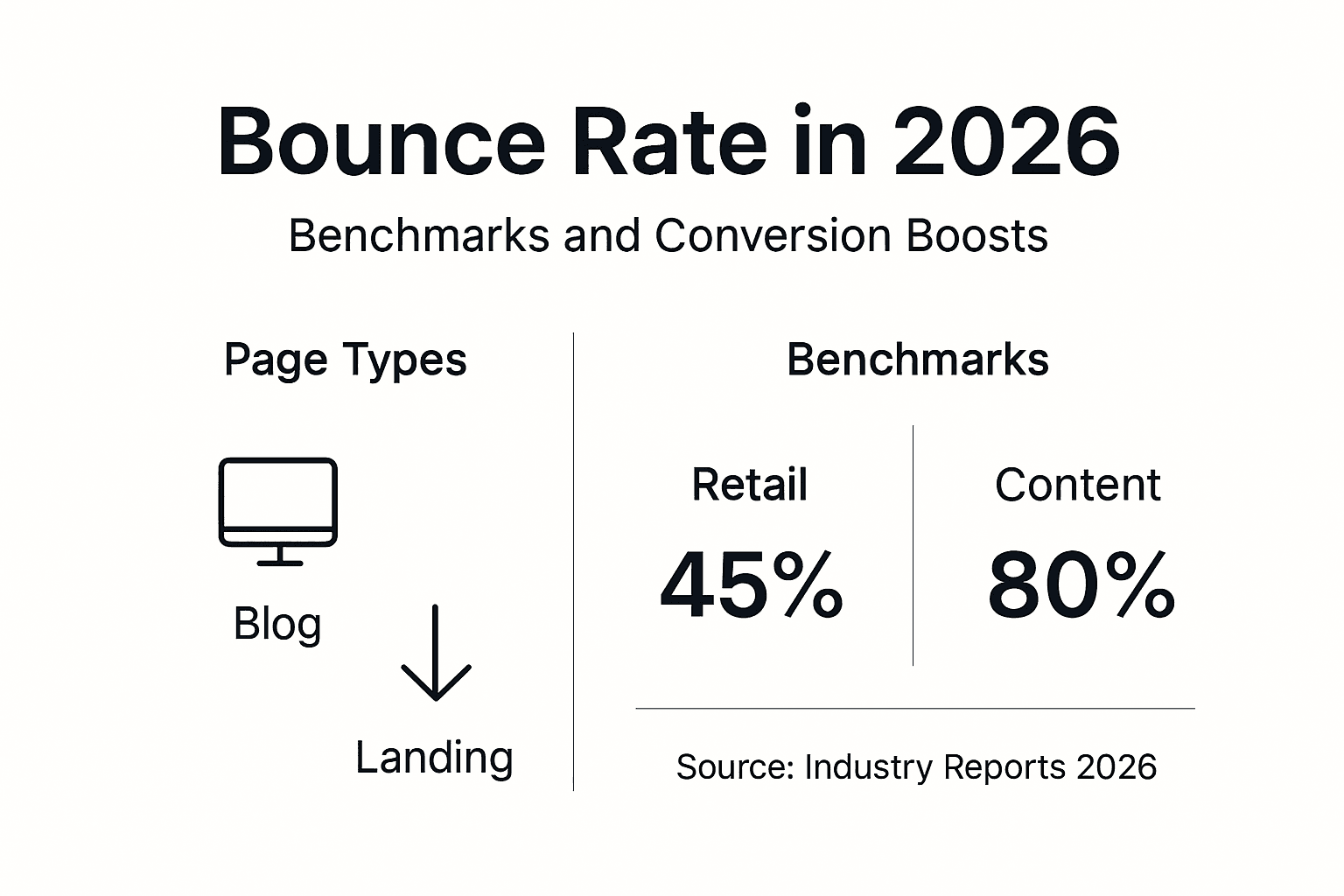
Retail and ecommerce sites typically see bounce rates around 45% as visitors browse multiple products before making decisions. Service businesses often have lower bounce rates near 40% because visitors need detailed information before committing.
Content sites and blogs naturally experience higher bounce rates between 60% and 90%. Visitors arrive seeking specific answers, consume the content, and leave satisfied. This pattern should not trigger alarm.
| Industry | Average Bounce Rate | Key Factors |
|---|---|---|
| Retail/Ecommerce | 40-50% | Product browsing, comparison shopping |
| B2B Services | 35-45% | Complex decisions, multiple touchpoints |
| Lead Generation | 30-50% | Form focused, clear conversion paths |
| Content/Publishing | 60-90% | Information seeking, single purpose visits |
| Portfolio/Creative | 50-70% | Visual browsing, subjective evaluation |
Comparing your bounce rate to these benchmarks identifies whether performance is typical or problematic. A content site with 70% bounce rate is normal, while an ecommerce site at the same level needs investigation.
Segmenting benchmarks by traffic source provides deeper insights. Organic search traffic typically has lower bounce rates than social media traffic because searchers have specific intent. Paid advertising bounce rates vary based on targeting quality and ad to page relevance.
Device specific benchmarks matter too. Mobile bounce rates run 10 to 20 percentage points higher than desktop across most industries. This difference reflects usage patterns, not necessarily problems with your mobile site.
Use benchmarks to set realistic improvement goals. If your service business has a 60% bounce rate and the industry average is 40%, you know there is room for significant optimization. Start with pages furthest from benchmark performance for maximum impact.
How Bounce Rate Impacts Conversions and Business Outcomes
Reducing bounce rate on conversion focused pages by 20% can significantly increase lead generation and sales metrics, as multiple studies show a direct correlation between engagement depth and conversion likelihood.
Lower bounce rate indicates visitors find your content relevant and engaging enough to explore further. This deeper engagement increases the probability they will complete desired actions like filling out forms or making purchases.
The relationship works through multiple mechanisms. When visitors stay on your site longer, they consume more content that builds trust and addresses objections. They have more opportunities to encounter calls to action and conversion prompts.
Business metrics improved by bounce rate and conversion optimization:
- Lead generation forms receive more submissions as visitors explore qualifying content
- Shopping cart completion rates increase when product pages engage buyers effectively
- Average order value rises as engaged visitors discover additional products
- Customer acquisition cost decreases when more traffic converts without additional spending
- Return on ad spend improves when landing pages retain paid traffic
Bounce rate reduction drives measurable revenue growth when focused on the right pages. A 15% decrease in landing page bounce rate might translate to 25% more leads, depending on your conversion funnel efficiency.
Tracking bounce rate alongside conversion optimization strategies reveals which improvements deliver real business value. Some changes that lower bounce rate also increase conversions, while others just shift metrics without helping your bottom line.
The compound effect matters over time. Small improvements in bounce rate create more opportunities for engagement, which builds toward conversion events that might happen on return visits. Visitors who bounce immediately never enter your marketing funnel at all.
Monitor these combined metrics:
- Bounce rate plus time on page shows engagement quality
- Pages per session reveals how well you guide visitors deeper
- Conversion rate relative to bounce rate identifies friction points
- Return visitor rate indicates whether initial engagement builds relationships
Conclusion: Applying Bounce Rate Insights to Improve Your Website
Interpret bounce rate within the context of page type and visitor intent rather than chasing arbitrary low numbers. A high bounce rate on informational content is normal, while the same metric on a sales page signals problems that cost you money.
Use bounce rate alongside other engagement metrics for a complete picture. Time on page, pages per session, and conversion rate together reveal whether visitors find value and take desired actions.
Focus your optimization efforts on technical improvements and content relevance in areas where bounce rate deviates from benchmarks. Page speed, mobile usability, and clear calls to action deliver the biggest impact.
Key actions to take:
- Segment bounce rate data by page type, traffic source, and device to identify real issues
- Compare your numbers to industry benchmarks to set realistic improvement targets
- Test changes systematically and measure impact on both bounce rate and conversions
- Monitor trends over time rather than reacting to daily fluctuations
- Prioritize fixes on conversion pages where bounce rate directly affects revenue
Implement improvements gradually and track results continuously. Small consistent gains in engagement metrics compound into significant business growth over months and years.
Explore Our Website Building and Optimization Resources
Understanding bounce rate is just the beginning. Our comprehensive guides walk you through building and optimizing business websites that turn visitors into customers. Learn proven techniques for creating pages that engage your target audience and guide them toward conversion actions.
Discover website building basics that establish a strong foundation for low bounce rates and high engagement. Master strategies for reducing bounce rate across all your key pages. Apply conversion optimization tactics that transform bounce rate improvements into measurable revenue growth.
Frequently Asked Questions
What is bounce rate and why does it matter?
Bounce rate measures the percentage of visitors who view only one page before leaving your website. It matters because high bounce rates on sales or conversion pages indicate you are losing potential customers and revenue opportunities.
How does bounce rate affect my website’s sales?
High bounce rate on sales pages means fewer visitors take action like making purchases or requesting quotes. Studies show that reducing bounce rate by even 20% can significantly increase conversions and lead generation.
Can a high bounce rate ever be good?
Yes, high bounce rates on blog posts or informational pages often indicate visitors found exactly what they needed. Not every high bounce rate signals poor performance if the page accomplished its purpose efficiently.
What are quick ways to reduce my website’s bounce rate?
Improve page load speed to under three seconds and ensure mobile responsiveness. Create relevant content matching visitor search intent, add clear calls to action, and simplify navigation. Learn more ways to reduce bounce rate through systematic optimization.