
TL;DR:
- Visual content boosts engagement and brand recall when used strategically with core storytelling mechanics.
- Frameworks like StoryBrand SB7 and the Three-Act Structure help craft effective, customer-centered visual stories.
- Consistent, authentic, and tested visuals outperform polished but irrelevant content across social platforms.
Visual content is everywhere, yet most small business owners post images and videos that get scrolled past in seconds. The gap between creating visuals and creating visuals that actually move people is wider than most realize. Visual content gets 94% more views and can boost engagement up to 650%, yet the majority of SMBs still treat imagery as decoration rather than a strategic tool. This article breaks down the mechanics, frameworks, and real-world tactics that separate forgettable content from the kind that builds brand trust, grows audiences, and converts browsers into buyers.
Table of Contents
- Understanding the core mechanics of visual storytelling
- Frameworks and methodologies: From storyboarding to customer-hero
- Visual storytelling in action: Data, case studies, and benchmarks
- Execution essentials: Platforms, pitfalls, and easy wins for SMBs
- Our take: What most guides miss about visual storytelling for SMBs
- Power up your digital presence with smart visual strategies
- Frequently asked questions
Key Takeaways
| Point | Details |
|---|---|
| Core visual techniques | Elements like visual hierarchy, color psychology, and rule of thirds are essential for guiding viewer focus and driving emotional connection. |
| Story frameworks matter | Using storyboarding and proven narrative models helps SMBs build stronger, customer-centered visual brand content. |
| ROI is measurable | Short videos and UGC can increase engagement and conversion rates significantly for small businesses. |
| Tailor and test | Optimizing visuals for each platform and iterating based on analytics leads to sustainable audience growth. |
| Authenticity wins | Simple, audience-first visuals often outperform overproduced content, especially for local brands. |
Understanding the core mechanics of visual storytelling
Not all visuals are created equal. A polished photo with no narrative structure will underperform a rough-around-the-edges image that guides the viewer’s eye and triggers an emotional response. The difference comes down to a handful of core mechanics that the best visual storytellers use instinctively.
Core visual storytelling mechanics include visual hierarchy, color psychology, composition, and sequencing. Each one plays a specific role in how your audience receives and remembers your message.
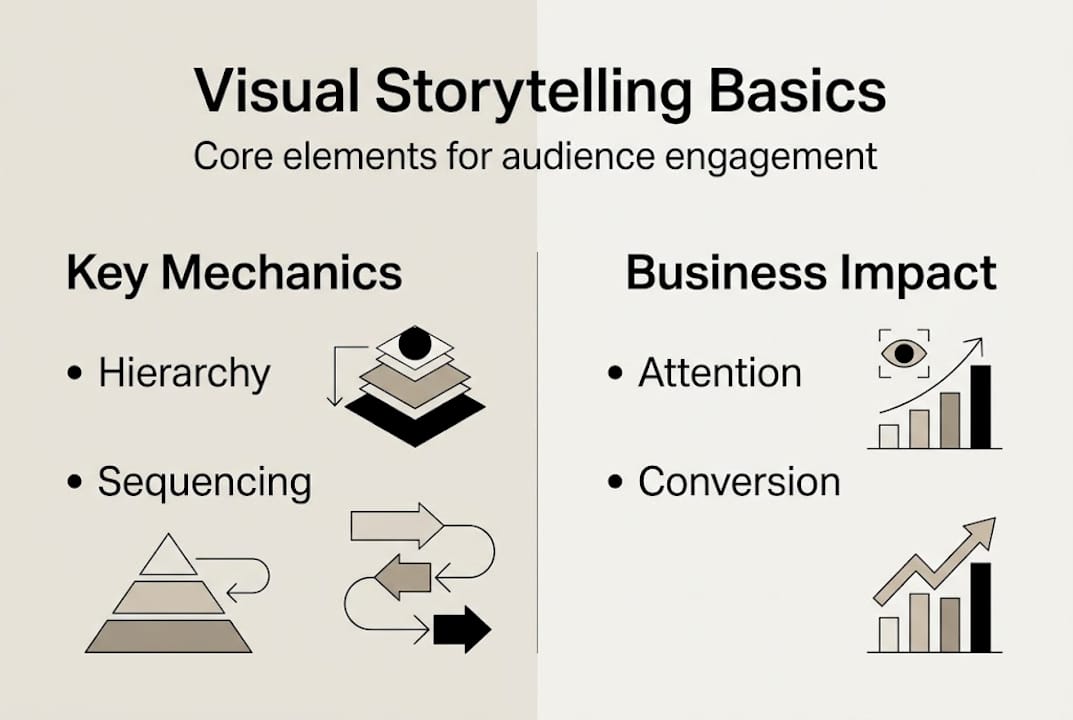
Visual hierarchy controls what viewers see first. By making your most important element the largest, brightest, or most centrally placed, you direct attention without saying a word. Color psychology works on emotion. Blues build trust, reds create urgency, and greens suggest growth or health. Understanding the psychology of color in marketing lets you choose palettes that reinforce your brand message rather than contradict it.
The rule of thirds is a composition technique where you divide your frame into a 3×3 grid and place key subjects at the intersection points. It creates natural visual tension that keeps eyes moving across the image. Sequencing is the order in which visual elements appear, whether in a carousel, video, or infographic, and it shapes how the story unfolds.
Here is a quick breakdown of each mechanic and its primary business impact:
| Mechanic | What it does | Business impact |
|---|---|---|
| Visual hierarchy | Directs viewer attention | Increases CTA click-through |
| Color psychology | Triggers emotional response | Strengthens brand recall |
| Rule of thirds | Creates balanced composition | Improves content shareability |
| Sequencing | Controls narrative flow | Boosts time-on-page and retention |
Why does this matter so much? Because brains process images 60,000x faster than text, and people retain 65% of information when it is paired with a relevant visual. That is not a minor edge. That is the difference between a message that sticks and one that evaporates.
Key elements every SMB visual should include:
- A single dominant focal point that anchors the story
- Brand-consistent color palette used across all touchpoints
- Clear sequencing that leads toward a specific action
- Typography that supports, not competes with, the image
- Intentional white space to reduce cognitive overload
Pro Tip: Pick two or three brand colors and use them consistently across every visual you publish. Audiences begin to recognize your content before they even read your name. Understanding visual hierarchy in design can help you apply this with precision.
Frameworks and methodologies: From storyboarding to customer-hero
Knowing the building blocks is one thing. Knowing how to assemble them into a narrative that connects with customers is another. Three frameworks stand out for SMBs: the Hero’s Journey, the Three-Act Structure, and the StoryBrand SB7 method.
Here is how they compare for practical business use:
| Framework | Core idea | Best for |
|---|---|---|
| Hero’s Journey | Customer overcomes challenge with your help | Brand origin stories, video campaigns |
| Three-Act Structure | Setup, conflict, resolution | Social posts, email sequences |
| StoryBrand SB7 | Customer as hero, brand as guide | Websites, landing pages, ads |
The StoryBrand SB7 framework positions your customer as the hero, your brand as the trusted guide, and structures the message around a clear problem, a simple plan, a direct call to action, the cost of inaction, and the reward of success. It is remarkably effective because it removes your brand from the center and puts your customer’s transformation there instead.
For storytelling in marketing to work visually, you need a storyboard. Here is a simple five-step process for a social media campaign:
- Define the customer problem in one sentence. What frustration, fear, or desire drives them?
- Sketch the opening frame that shows the problem visually, no text needed.
- Map the middle frames showing your product or service as the turning point.
- Design the resolution frame that shows the customer’s life improved.
- End with a clear CTA frame that tells them exactly what to do next.
This process works for a five-slide Instagram carousel, a 30-second Reel, or a homepage hero section. The medium changes. The structure stays the same.
Strong brand storytelling techniques also rely on consistency across touchpoints. Your storyboard should inform not just one post but an entire campaign. Think about storyboarding marketing content as a planning tool, not just a creative exercise.
Pro Tip: The moment you make your brand the hero of your story, you lose the audience. Nobody wakes up wanting to hear about your company. They wake up wanting solutions to their problems. Put them in the starring role and watch engagement climb.
Visual storytelling in action: Data, case studies, and benchmarks
With a framework in hand, the next question is simple: does it actually work? The numbers are hard to argue with.

Case studies show 33% CVR uplift, 150% revenue growth, and a 25% increase in Instagram followers from visual storytelling campaigns. These are not outlier results from Fortune 500 budgets. They come from focused, story-driven content strategies that any SMB can replicate.
One standout data point: UGC images drive 28% higher engagement than branded visuals. User-generated content feels real because it is real. When your customers share photos of your product in their actual lives, it carries social proof that no studio shoot can manufacture.
“Emotional content outperforms rational content by 2x in terms of engagement and sharing. People do not share information. They share feelings.”
Here is a benchmark snapshot across key visual storytelling metrics:
| Metric | Improvement with visual storytelling |
|---|---|
| Conversion rate | Up to 33% increase |
| Revenue growth | Up to 150% in documented cases |
| Instagram follower growth | Up to 25% increase |
| Engagement vs. branded visuals (UGC) | 28% higher |
| Information retention | 65% with visuals vs. 10% text-only |
Key stats every SMB should keep in mind:
- Visual content is 40x more likely to be shared on social media than text
- Pages with images get significantly more time-on-page than text-only pages
- Infographics are among the most shared content formats across LinkedIn and Pinterest
- Video thumbnails with human faces increase click-through rates noticeably
The visual content strategies that win in 2026 are not the most expensive ones. They are the most relevant ones. A candid behind-the-scenes photo of your team solving a customer problem will often outperform a polished product shot because it tells a story.
One smart tactic is repurposing blog visuals into standalone social assets. An infographic from a blog post becomes a carousel. A data chart becomes a quote graphic. You multiply your content output without multiplying your workload.
Execution essentials: Platforms, pitfalls, and easy wins for SMBs
Ready to put it to work? Here is how to make visual storytelling sustainable and effective for your team, even with a modest budget.
First, the pitfalls. These are the most common reasons SMB visual content underperforms:
- Visual overload. Too many elements, fonts, and colors competing for attention. Simplify ruthlessly.
- No clear CTA. Beautiful content with no next step is a missed opportunity every time.
- Ignoring data. Posting without reviewing what worked last month means repeating the same mistakes.
- Platform mismatch. A horizontal image designed for a website looks broken as an Instagram Story.
- Inconsistent branding. Random color choices and font switching erode trust over time.
Platform-specific visual formats like vertical videos and carousels, paired with authentic content, consistently outperform generic branded imagery. Tailor every asset to where it will live.
Now the quick wins. You do not need a design team or a big budget to start seeing results:
- Use Canva to create on-brand templates you can reuse weekly
- Encourage customers to tag you in photos and reshare their content as UGC
- Create simple infographics from your most popular blog posts
- Run A/B tests on two versions of a post, changing only the image, to learn what resonates
- Add captions and alt text to every image for accessibility and SEO
For measurement, track engagement rate, saves, shares, and conversion rate from visual-led campaigns. Compare months where you used story-driven visuals against months of generic product posts. The pattern becomes obvious fast.
Check out video storytelling ideas for platform-specific inspiration that works even for solo operators.
Pro Tip: Before you post anything, view it on your phone in portrait mode. Over 60% of social media browsing happens on mobile. If your visual does not communicate clearly on a 6-inch screen, redesign it before it goes live.
Our take: What most guides miss about visual storytelling for SMBs
Most visual storytelling guides focus on aesthetics. Better fonts, trendier color palettes, higher-resolution photos. That advice is not wrong, but it misses the point entirely for growing businesses.
What actually drives audience action is resonance, not polish. We have seen businesses with smartphone photos and hand-drawn graphics outperform competitors with full creative agencies behind them, simply because their content felt true. Customers can sense when a brand is performing versus when it is communicating.
The real edge comes from iteration. Post something, measure the response, adjust, and post again. Most SMBs treat visual content as a one-and-done effort. The brands that grow treat it as a conversation. Real storytelling examples that move the needle are almost always built through testing, not through perfection.
Lean into what is real about your business. The messy workshop, the customer thank-you note, the team celebrating a win. Those moments connect far more than any stock photo ever will.
Power up your digital presence with smart visual strategies
If you have been nodding along to these tactics but are not sure where to start, you are not alone. Knowing the principles is one thing. Executing them consistently across your website, social channels, and ad campaigns is where most SMBs hit a wall.
Our team specializes in exactly that. From social media marketing services that build story-driven campaigns to an image optimization guide that makes every visual load fast and rank well, we cover the full picture. If you are starting from scratch or rebuilding, our guide to building your business website walks you through creating a visual foundation that converts. Let us help you turn great storytelling into measurable business growth.
Frequently asked questions
Why is visual storytelling more effective than text-heavy content for businesses?
Our brains process images much faster than text, leading to up to 650% more engagement and significantly higher information retention rates compared to text-only content.
What is the single most important visual storytelling technique for SMBs?
Prioritize authentic, audience-first visuals like UGC and simple infographics. UGC outperforms branded content by 28 to 29% in engagement because it feels real and relatable to potential customers.
How can I measure the impact of visual storytelling on my business?
Track engagement metrics like shares, saves, and comments alongside your conversion rate. Visual storytelling uplifts CVR by 33% in documented campaigns, giving you a clear benchmark to aim for.
What’s a common mistake SMBs make with visual storytelling?
The most damaging mistake is making your brand the hero of the story. The StoryBrand SB7 approach teaches that your customer must be the hero, with your brand playing the role of a helpful guide who enables their success.