

TL;DR:
- Behavioral segmentation focuses on customer actions and habits rather than demographics or location.
- It enables targeted marketing messages, improved engagement, and higher conversion rates.
- Regularly updating segments ensures relevance and sustained marketing ROI.
Most digital marketing managers assume that knowing a customer’s age, income, and location is enough to craft effective campaigns. That assumption is costing you money. Demographics tell you who someone is, but they reveal almost nothing about what that person will buy, when they’ll buy it, or why they abandon a cart at checkout. Behavioral segmentation cuts through the noise by focusing on what customers actually do, not just who they are. This guide breaks down what behavioral segmentation is, which frameworks deliver results, how to implement it step by step, and the critical mistakes you must avoid to protect your ROI.
Table of Contents
- What is behavioral segmentation and why does it matter?
- Common behavioral segmentation models and frameworks
- How to implement behavioral segmentation in your marketing strategy
- Best practices and mistakes to avoid with behavioral segmentation
- Our perspective: Why mastery of behavioral segmentation is a marketing superpower
- Boost your marketing results with smart segmentation and expert tools
- Frequently asked questions
Key Takeaways
| Point | Details |
|---|---|
| Customer actions matter | Segmenting by behavior creates more relevant, high-impact campaigns than by demographics alone. |
| Start simple | You don’t need complex tools to begin; one clear behavior group can drive better targeting. |
| Update frequently | Regularly refreshing segments keeps your marketing relevant and boosts ROI. |
| Leverage data for personalization | Using behavioral data powers highly personalized experiences and drives conversions. |
What is behavioral segmentation and why does it matter?
Behavioral segmentation is the practice of dividing your audience into groups based on their actions, habits, and interactions with your brand. That includes browsing patterns, purchase frequency, content engagement, loyalty milestones, and where someone sits in the customer lifecycle. As market segmentation research confirms, behavioral segmentation lets marketers group customers by their actions, timing, and habits, not just who they are.
This is a meaningful shift from the three other major segmentation types most marketers default to. Demographic segmentation groups people by age, gender, or income. Geographic segmentation focuses on location. Psychographic segmentation examines values and lifestyle. All three have value, but none of them predict behavior with the precision that actual behavior data provides.
| Segmentation type | Based on | Strength | Limitation |
|---|---|---|---|
| Demographic | Age, income, gender | Easy to collect | Doesn’t predict actions |
| Geographic | Location, region | Relevant for local offers | Misses intent signals |
| Psychographic | Values, lifestyle | Deep emotional insight | Hard to measure at scale |
| Behavioral | Actions, habits, timing | Predicts future behavior | Requires quality data |
When you understand behavior, you can serve the right message at the right moment. A first-time visitor browsing your pricing page three times in one session is signaling purchase intent. A loyal customer who hasn’t bought in 90 days might need a win-back offer. Neither of those insights comes from knowing their zip code.
Key customer behaviors worth tracking include:
- Purchase frequency: How often someone buys and whether that pace is increasing or declining
- Browsing patterns: Which pages they visit and in what sequence
- Engagement depth: Do they read full blog posts, watch videos, or bounce after five seconds?
- Loyalty status: First-time buyer, repeat customer, or brand advocate?
- Lifecycle stage: Are they in discovery, consideration, or ready to repurchase?
“Behavioral data transforms a generic audience into a map of real human intent. Marketers who ignore it are essentially flying blind.” The result is wasted spend and campaigns that feel irrelevant to the people receiving them.
Relevance is the core commercial advantage here. When your message matches what a user is actually doing and thinking, conversion rates climb, unsubscribe rates fall, and customer lifetime value increases. Behavioral segmentation is not a nice-to-have feature for enterprise brands. It’s the foundation of efficient, profitable digital marketing for any business that wants to grow.
Common behavioral segmentation models and frameworks
With a clear concept of behavioral segmentation, it’s time to examine the frameworks that power real marketing decisions. There are several models worth knowing, and choosing the right one depends on your business model, your data maturity, and your immediate marketing goals.
The three most widely used frameworks are:
| Model | What it measures | Best use case |
|---|---|---|
| RFM (Recency, Frequency, Monetary) | How recently, how often, and how much customers buy | E-commerce, subscription services |
| Customer journey stage | Where someone is in the buying process | Content marketing, lead nurturing |
| Lifecycle stage | Relationship age with the brand | Retention, win-back campaigns |
As cross-selling strategy data shows, utilizing behavioral models such as RFM enables targeted offers that reflect individual buying patterns. An RFM model scores each customer on three dimensions. A customer who bought yesterday, buys weekly, and spends significantly gets your highest-priority treatment. A customer who bought once two years ago and spent minimally gets a completely different message, perhaps a re-engagement offer or a low-friction product to rebuild the relationship.

Journey-stage segmentation is powerful for businesses with longer sales cycles. Grouping prospects by where they are in their decision process lets you map content directly to their questions. Someone in the awareness stage needs education. Someone in the decision stage needs social proof and risk reduction.
Here’s a four-step roadmap for selecting and applying your first model:
- Audit your current data. Identify what behavioral signals you’re already capturing through analytics, your CRM, and email platforms. You need reliable data before building segments.
- Match the model to your goal. If reducing churn is your priority, lifecycle segmentation is your starting point. If increasing average order value matters most, RFM is your tool.
- Define two or three specific segments. Don’t try to create 20 segments on day one. Start with high-value buyers, at-risk customers, or cart abandoners, whatever group has the most immediate revenue impact.
- Build and test a campaign for each segment. Create distinct messaging, measure performance, and document what changes in conversion rate or engagement.
For campaign-level execution, retargeting strategies become significantly more effective when powered by behavioral data. A user who visited your pricing page three times but didn’t convert is a completely different retargeting audience than someone who read one blog post. Treating them the same wastes budget and annoys potential buyers.
Pro Tip: Don’t let the abundance of segmentation models paralyze your team. Pick one model that aligns with your biggest revenue opportunity and run with it for 60 days. You’ll learn more from a real campaign than from months of planning meetings.
Real-world marketing personalization examples consistently show that behavioral models outperform demographic targeting when it comes to click-through rates and actual conversions. The precision is simply sharper because the signal is rooted in intent, not assumption.
How to implement behavioral segmentation in your marketing strategy
Knowing which behavioral model fits your needs, let’s tackle the nuts and bolts of rolling out segmentation in your business. Implementation is where theory meets revenue, and the process is more straightforward than most marketers expect.
Start by mapping every source of behavioral data in your current stack:
- Web analytics platforms such as Google Analytics 4 capture page visits, session duration, event completions, and traffic sources. This is your primary behavior feed.
- Email marketing platforms track open rates, click patterns, and unsubscribes, all behavioral signals that reveal engagement levels for each subscriber.
- Purchase history data from your e-commerce platform or CRM shows what customers buy, how often, and at what price points.
- Social media engagement data reveals content preferences, comment sentiment, and which messages resonate with different audience groups.
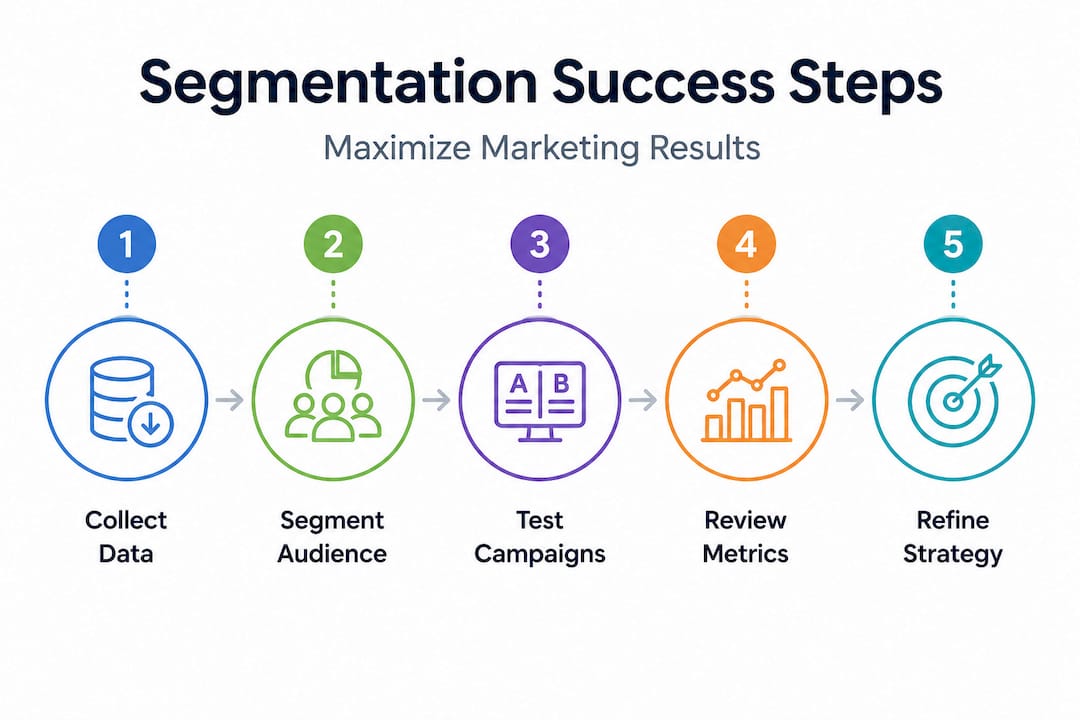
Once you’ve identified your data sources, the implementation process follows four clear phases. First, collect and clean your data, removing duplicates and filling in missing fields. Second, create your segments using your chosen model. Third, design campaign assets that speak directly to each segment’s mindset and stage. Fourth, measure results against specific KPIs and refine.
The cart abandonment use case is one of the clearest illustrations of behavioral segmentation in action. A shopper adds products to their cart and leaves without purchasing. That single behavior creates a segment. You can then trigger a personalized email sequence within two hours, referencing the specific products they left behind, possibly with a time-sensitive incentive. This is not a generic promotional email. It’s a precise, behavior-triggered response. Businesses using this approach regularly see recovery rates between 10% and 15% on abandoned carts, which adds up to significant revenue over a quarter.
Expanding into email marketing strategies that are behavior-driven rather than broadcast-based is one of the highest-leverage moves a marketing team can make. Instead of sending the same newsletter to your entire list, you send different versions based on what subscribers have clicked in the past, what stage of the lifecycle they’re in, and how recently they’ve engaged.
Personalizing marketing based on user actions can boost engagement rates by over 30%, a meaningful jump that compounds across every campaign you run.
Personalized email campaigns built on behavioral triggers consistently outperform batch-and-blast email across every measurable metric, including open rates, click-through rates, and revenue per email sent. The reason is simple: the message is relevant because it reflects what the person actually did.
Pro Tip: Start with one behavioral segment, not ten. Prove the model works on your highest-value group first. Once you have a winning playbook, scaling to additional segments becomes much faster because you’ve already solved the data and workflow problems.
Best practices and mistakes to avoid with behavioral segmentation
Implementation is only half the battle. To sustain results, you need to know what works and what causes behavioral segmentation to fail quietly over time.
The most damaging mistake is treating segmentation as a one-time project. Marketers build their segments, launch campaigns, and then leave those segments untouched for months. Customer behavior changes. A once-loyal buyer might shift to a competitor. A cold lead might suddenly re-engage. If your segments don’t reflect current behavior, your messages stop being relevant, and relevance and ROI both drop as a result.
Here are the most common behavioral segmentation mistakes and how to correct them:
- “Set it and forget it” mentality: Segments must be reviewed and refreshed at least monthly. Set calendar reminders to audit segment membership and performance data.
- Over-segmentation: Creating 30 micro-segments might feel precise, but it makes campaign management a nightmare and dilutes your resources. Three to five well-defined segments consistently outperform a fragmented approach.
- Using vague behaviors: “Visited the website” is not a useful segment. “Visited the pricing page twice in seven days without converting” is. Specificity is what makes behavioral segments powerful.
- Ignoring privacy compliance: Behavioral data collection must align with regulations including GDPR and CCPA. Always be transparent with users about what you track, and give them control over their data.
- Skipping the measurement phase: If you’re not tracking conversion rate, engagement rate, and revenue per segment, you have no way to know if your segmentation is working or costing you money.
Reviewing digital marketing basics periodically as a team keeps everyone aligned on what good data-driven practice looks like, especially when new team members join or platforms change their tracking capabilities.
Pro Tip: Balance automation with human oversight. Automated triggers and email sequences are essential for scale, but a human review of campaign performance every two weeks catches drift before it becomes expensive. No algorithm understands your brand’s voice and business context as well as your team does.
Monitoring frequency matters as much as the initial setup. Weekly checks on segment performance metrics help you catch anomalies early. If a segment’s click-through rate drops 40% in one week, that’s a signal, and you need to investigate before the next campaign goes out.
Our perspective: Why mastery of behavioral segmentation is a marketing superpower
Having covered best practices and pitfalls, let’s zoom out and share some truths that don’t make it into most articles on this topic.
Most brands that claim to use behavioral segmentation are actually only scratching the surface. They set up one or two automated triggers, call it personalization, and move on. What they’re missing is the compounding value that comes from treating segmentation as a living system rather than a feature to check off.
The uncomfortable truth we’ve observed working with digital marketing teams across industries is this: data is only as valuable as the action it inspires. We’ve seen businesses with sophisticated analytics dashboards running the same generic email sequence they’ve used for three years. The data was there. The insight was available. But no one committed to acting on it.
Frictionless, relevant experiences win customers more reliably than massive ad budgets. When a user receives a message that directly reflects what they just did on your website, the cognitive response is fundamentally different from receiving a generic promotion. It feels like the brand understands them. That perception builds trust faster than any copywriting trick.
The marketers and teams we’ve seen achieve exceptional results treat behavioral segmentation as an ongoing experiment. They form a hypothesis, run a campaign, measure the result, adjust, and repeat. They don’t need perfect data to start. They need enough data to form a reasonable hypothesis and the discipline to measure what happens next.
We’d also push back on the idea that behavioral segmentation is too complex for smaller teams. The tools available today make this accessible for marketing teams of any size. The competitive advantage goes to whoever commits to using them thoughtfully. Check the real segmentation case studies available and you’ll see that company size is not the determining factor. Commitment to iteration is.
Don’t just segment your audience. Commit to learning from every campaign you run with that data. That feedback loop is what separates teams that plateau from those that keep growing.
Boost your marketing results with smart segmentation and expert tools
Ready to upgrade your approach and see the impact of advanced behavioral segmentation?
Putting these strategies into practice requires the right knowledge and tools, and you don’t need to figure it all out alone. Our resources are designed for marketing managers and entrepreneurs who want real results without needing a data science degree.
Start by building your foundation with digital marketing fundamentals that support data-driven decision-making. Then explore our breakdown of the best digital marketing tools to find platforms that automate segmentation, trigger personalized campaigns, and track performance at every stage. Whether you’re launching your first behavioral segment or optimizing a full personalization engine, our team is here to help you convert more visitors into loyal customers.
Frequently asked questions
What types of data are best for behavioral segmentation?
Web analytics, purchase history, and email engagement data are among the best sources for behavioral segmentation, because they capture real actions rather than assumed preferences.
How does behavioral segmentation improve personalization?
It allows marketers to tailor content and offers to what users actually do, and personalizing by user actions can boost engagement rates by over 30%.
Is behavioral segmentation useful for small businesses?
Yes. Even simple behavioral campaigns drive better targeting and higher ROI for businesses of any size, because behavioral segmentation groups customers by actions and habits rather than requiring massive datasets.
What’s a common mistake in behavioral segmentation?
Not updating segments regularly is a critical error, since failing to refresh segments causes relevance and ROI to drop as customer behavior evolves.
Recommended
- Reducing Website Bounce Rate for Higher Engagement – seo analytic
- Boost E-Commerce Sales with Cross Selling Strategies – seo analytic
- Market Segmentation: Boosting Startup Conversions – seo analytic
- Master Call to Action Optimization for Higher Conversions – seo analytic
- How to craft effective video messaging for higher conversions | QuickAdVideo Blog
- SaaS conversion optimization: data-driven strategies for growth | Rule27 Design