
TL;DR:
- Small businesses often use generic marketing, resulting in low engagement and retention.
- AI enables scalable, real-time personalization using existing customer data.
- Starting with simple tools and focusing on one goal enhances effective AI implementation.
Most small and medium-sized businesses send the same email blast to every customer, show the same homepage to every visitor, and wonder why conversion rates stay flat. Generic marketing isn’t just ineffective; it actively signals to customers that you don’t know them. Most small businesses treat every customer identically and pay for it with poor retention. AI-driven personalization changes that equation entirely. It lets your business deliver the right message, to the right person, at the right moment, without a massive team or budget. This guide walks you through what that actually looks like in practice.
Table of Contents
- Why personalization matters for small businesses
- How AI transforms personalization: From data to action
- Popular AI tools and techniques for SMB personalization
- Best practices for implementing AI-powered personalization
- Our take: What most SMBs miss about AI-driven personalization
- Take your marketing to the next level with AI-powered personalization
- frequently asked questions
Key Takeaways
| Point | Details |
|---|---|
| Personalization drives results | AI-powered personalization boosts customer loyalty, engagement, and revenue for small businesses. |
| AI makes it achievable | Modern AI tools take the guesswork out and enable SMBs to deliver tailored experiences with limited resources. |
| Start simple and scale | Begin with basic personalization efforts, measure impact, and expand as your comfort and results grow. |
| Choose the right tools | The best AI solution depends on your business goals, size, and customer journey. |
Why personalization matters for small businesses
Customers in 2026 expect relevance. They’ve grown accustomed to streaming platforms that know what they want to watch, retail sites that recommend what they’re likely to buy, and apps that remember their preferences without being asked. When your business fails to meet that expectation, you’re not just losing a sale; you’re signaling that you’re not paying attention.
The business case is clear. personalization examples from real-world campaigns consistently show that tailored experiences drive higher conversion rates, deeper customer loyalty, and stronger repeat purchase behavior. When a customer receives a product recommendation that actually fits their history, or an email that addresses their specific interest, they respond. That response shows up in your revenue.
Here’s what personalization consistently delivers for small businesses:
- Higher open and click rates on email campaigns
- Lower churn because customers feel recognized and valued
- Better ROI on marketing spend since messages reach the right people
- More referrals from satisfied, engaged customers
- Greater lifetime value per customer over time
“The businesses that win long-term aren’t the ones with the biggest ad budgets. They’re the ones that make every customer feel like the only customer.”
The challenge is that manual personalization doesn’t scale. A team of three or five people cannot realistically segment thousands of customers, write customized messages for each group, and test results continuously. That’s exactly where AI steps in. It removes the labor bottleneck, turning what used to be a competitive advantage reserved for enterprise brands into something any SMB can access and act on today.
How AI transforms personalization: From data to action
AI doesn’t guess. It reads patterns in your customer data and acts on them faster than any human team could. The inputs are things you likely already have: purchase history, browsing behavior, email engagement, location, device type, and time-of-day activity.
AI in digital marketing tools can analyze customer data to personalize messages in real time, adjusting content based on what a specific user just did or searched for. That’s a level of responsiveness no manual process can match.
Here’s how the process typically works:
- Data collection: Your AI tool pulls data from your website, email platform, CRM, and purchase history.
- Pattern recognition: The AI identifies segments, such as frequent buyers, first-time visitors, and lapsed customers, based on actual behavior.
- Message creation: It generates or selects personalized content for each segment automatically.
- Real-time delivery: Messages are sent at the moment of peak relevance, not on a fixed schedule.
- Performance feedback: Results feed back into the system, improving accuracy over time.
Here’s a simple look at what the AI reads versus what it produces:
| Customer signal | AI-driven action | Expected outcome |
|---|---|---|
| Cart abandonment | Send reminder with discount | Higher recovery rate |
| First-time visitor | Show beginner-friendly content | Lower bounce rate |
| High purchase frequency | Send loyalty offer | Higher retention |
| Product page repeat visit | Display targeted ad | Higher conversion |
For website personalization strategies, the same logic applies to your homepage. A returning customer who previously browsed running shoes shouldn’t see a generic homepage. AI can surface the right category, the right offer, and even the right headline for them automatically.
Pro tip: Start by connecting just one data source, such as your email platform, to an AI tool. Even limited data produces meaningful personalization and teaches you what signals matter most for your customers.
Popular AI tools and techniques for SMB personalization
The good news is that you don’t need to build anything custom. A growing ecosystem of tools makes AI personalization accessible to businesses with modest budgets and small teams. The key is matching the right tool to your current business stage and goals.
Marketing automation platforms like HubSpot, ActiveCampaign, and klaviyo already include AI-powered segmentation and send-time optimization. Even small businesses can implement AI-powered personalization tools without a dedicated data science team.

Here’s a comparison of the main tool categories:
| Tool type | Best for | Key features | Entry cost |
|---|---|---|---|
| Email automation | List-based campaigns | AI segmentation, A/B testing, behavior triggers | Low to medium |
| chatbot tools | Website engagement | 24/7 responses, lead capture, personalized FAQs | Free to low |
| CRM with AI | Customer management | Lead scoring, pipeline automation, contact history | Medium |
| Website personalization platforms | Dynamic content | Real-time content swaps, A/B testing, visitor tracking | Medium to high |
| personalized emails platforms | Email-first businesses | Deep personalization, product recommendations, automation | Low to medium |
When choosing a tool, focus on these factors:
- Integration: Does it connect with tools you already use, like your CRM or ecommerce platform?
- Learning curve: Can your team set it up without a developer?
- Data ownership: Who controls your customer data and how is it stored?
- Support: Does the vendor offer onboarding help or just documentation?
- Trial options: Can you test it before committing to a paid plan?
Avoid the trap of buying the most feature-rich tool on the market if your team doesn’t have the bandwidth to use it. A simpler tool used well beats a complex one collecting dust.
Best practices for implementing AI-powered personalization
Getting started is easier than most SMB owners expect. The challenge isn’t the technology itself; it’s having a clear plan before you turn it on.
effective personalization requires setting clear goals and protecting user data privacy. Without those two foundations, even the best AI tool will produce underwhelming results or create compliance problems.
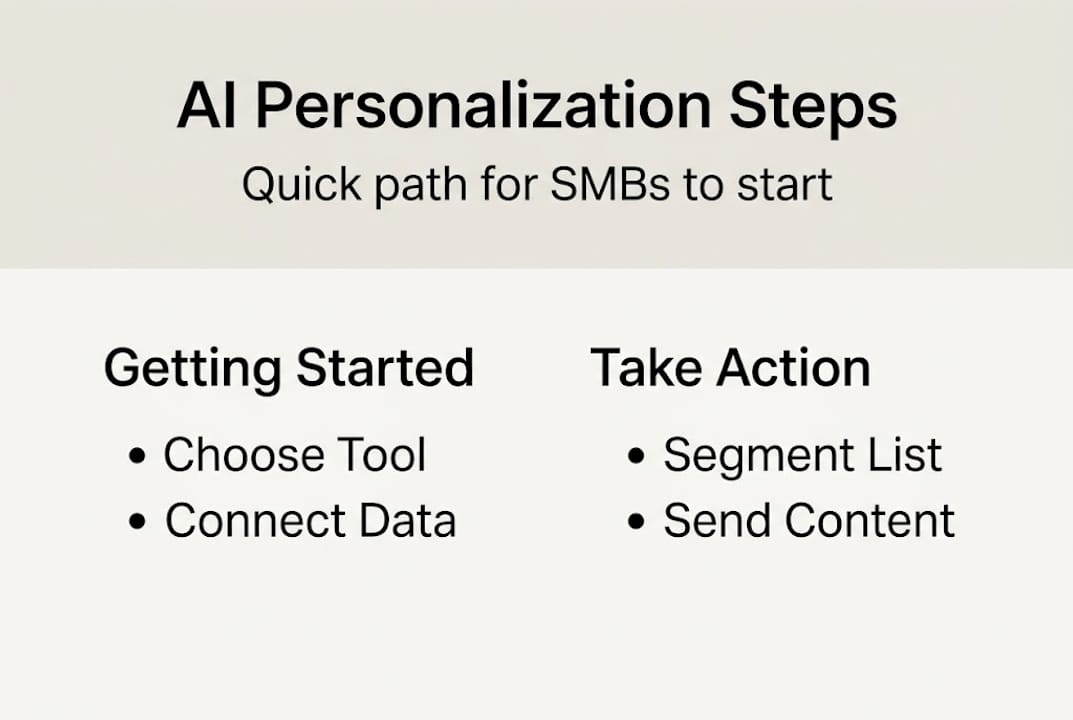
Here’s a step-by-step approach that works:
- Define your goal first. Are you trying to reduce cart abandonment, improve email open rates, or increase repeat purchases? Pick one specific objective.
- Clean your data. AI is only as good as the data you feed it. Remove duplicates, fill in missing fields, and standardize your contact records.
- Choose one channel. Start with email or your website, not both. Get traction before expanding.
- Build your segments. Create at least three: new customers, returning customers, and lapsed customers. Each needs a different message.
- Test before scaling. Run a small A/B test to confirm your personalization logic is working before sending to your full list.
- Review results weekly. AI improves with feedback. Don’t set it and forget it; check performance data regularly and adjust.
Pro tip: Add a plain-language privacy notice to any personalization touchpoint. Something as simple as “We customize this based on your browsing history” builds trust instead of eroding it.
Common mistakes to avoid:
- Over-personalizing: Using too many personal details in one message can feel intrusive. Keep it useful, not surveillance-level.
- No opt-out: Always give customers a way to reset their preferences or opt out of personalized messaging.
- Wrong metrics: Don’t measure personalization success by opens alone. Track downstream actions like purchases and retention.
- No testing cadence: Customer behavior shifts; your personalization logic needs to shift with it.
Our take: What most SMBs miss about AI-driven personalization
Here’s what most guides won’t tell you: the businesses getting the best results from AI personalization aren’t the ones with the most data or the most sophisticated tools. They’re the ones willing to act on imperfect information and improve from there.
Too many SMB owners wait until they have a “complete” customer dataset, a bigger team, or a larger budget. That moment rarely comes. Meanwhile, competitors are already using basic AI tools to send smarter emails and show more relevant website content.
We’ve seen businesses double their email click rates by doing something deceptively simple: splitting their list into buyers and non-buyers and sending slightly different messages to each group. No algorithm required. That’s the mindset shift that matters most.
Personalization isn’t a destination. It’s a practice. You don’t need to debunk advertising myths or overhaul your entire marketing stack to get started. You need one clear goal, one focused experiment, and the discipline to measure what happens. Start there. The results will tell you what to do next.
Take your marketing to the next level with AI-powered personalization
If this guide clarified how AI personalization can fit into your business, the next step is putting that knowledge to work. Our resources at seo-analytic.com are built specifically for business owners who want practical, jargon-free guidance on growing smarter online.
Explore our digital marketing basics guide to build a solid foundation, then move into our marketing automation resource to see exactly how automation fits your business. For concrete inspiration, browse real marketing personalization examples that show what results actually look like. Our expert team is ready to help you turn these strategies into measurable outcomes for your business.
frequently asked questions
What does AI personalization mean for small businesses?
AI personalization means using artificial intelligence to tailor marketing and customer experiences based on individual customer data, behaviors, and preferences, creating more relevant experiences that drive real engagement.
How hard is it to start using AI for personalization?
Most SMBs can begin with user-friendly tools and basic data. Many accessible tools help businesses start AI personalization without deep technical expertise or a large team.
Is AI-powered personalization expensive for small businesses?
It can be very affordable. Many AI personalization tools offer free tiers or low-cost plans that scale with your business as your needs and budget grow.
What is one common mistake to avoid when using AI personalization?
Don’t try to personalize every channel at once. Focus is key when implementing new marketing technology; start with one high-impact channel and build from there.
Recommended
- Master Website Personalization Strategies for Business Growth – seo analytic
- Personalized Marketing Emails: Boost Response Rates Fast – seo analytic
- Building an inclusive workplace: strategies for SMBs – seo analytic
- Chatbots for Small Business: Boosting Sales and Service – seo analytic
- Boost leads with AI: 2–4x results for small businesses
- AI in Marketing: Transforming Client Acquisition – Jarrod Harman