

TL;DR:
- SEO page analysis involves auditing a website’s technical setup, content, and AI readiness to improve search rankings. Regular audits can boost organic traffic by up to 61%, with prioritizing fix impact and structured data essential for AI-driven search features. Most audits reveal hidden issues like duplicate tags or missing schema that, when addressed systematically, significantly enhance site performance and visibility.
SEO page analysis is the process of auditing a web page’s technical setup, on-page content, and AI readiness to identify every factor suppressing its search rankings. Think of it as a full diagnostic scan for your website. Regular auditing can increase organic traffic by up to 61%, while missing meta descriptions alone reduce click-through rates by up to 30%. That gap between a page that ranks and one that doesn’t often comes down to issues you can find and fix in under 15 minutes. Tools like SEOptimer, Seobility, and SEObolt have made this process accessible to any website owner, not just agencies.
What are the key components of a thorough SEO page analysis?
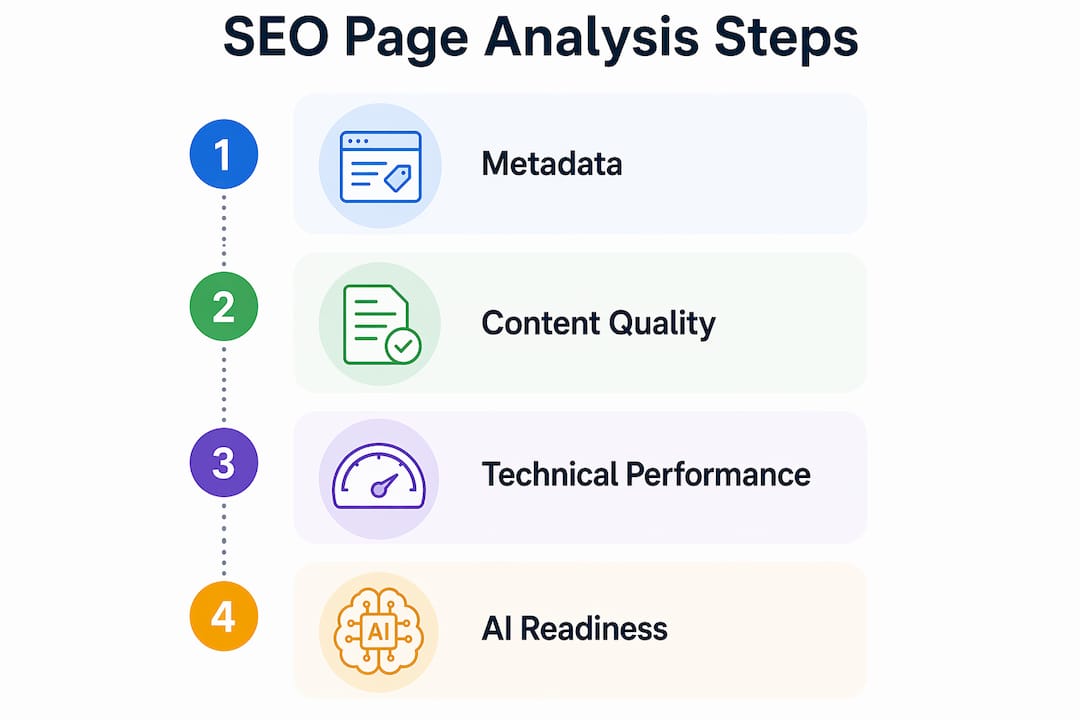
A proper on-page SEO assessment covers three distinct layers: metadata, content quality, and technical performance. Each layer feeds into how Google reads, ranks, and displays your page. Miss one, and you’re leaving ranking potential on the table.
Metadata and URL structure form the first layer. Title tags tell search engines what your page is about. Canonical URLs prevent duplicate content penalties. Meta descriptions don’t directly affect rankings, but they control whether someone clicks your result in the first place.
Content quality signals include keyword placement in headings, logical heading hierarchy (H1 through H3), word count relative to competing pages, and internal linking patterns. Google’s crawlers follow your heading structure the way a reader follows a table of contents. A broken hierarchy confuses both.
The technical layer covers:
- Core Web Vitals: Largest Contentful Paint (LCP), Cumulative Layout Shift (CLS), and Interaction to Next Paint (INP) directly affect Google’s page experience score
- Mobile responsiveness: Google indexes the mobile version of your page first
- Crawlability: Robots.txt rules, noindex tags, and sitemap accuracy determine whether your page gets indexed at all
- Structured data and schema markup: These signals help Google generate rich results like star ratings, FAQs, and product prices in search listings
The fourth layer, which most audits ignored until recently, is AI readiness. This includes E-E-A-T signals (Experience, Expertise, Authoritativeness, Trustworthiness), FAQ schema markup, and content formatted to deliver direct answers. For a full breakdown of what each layer requires, the on-page SEO checklist from Seo-analytic covers every checkpoint in sequence.
Pro Tip: Run your audit on both the desktop and mobile versions of your page. Google’s mobile-first indexing means a page that scores well on desktop but poorly on mobile is ranked by its weaker version.
How do free SEO page analysis tools work?
Free SEO analysis tools scan a URL against a predefined set of ranking signals and return a prioritized report, usually within minutes. The best ones in 2026 go well beyond basic checks. Modern free tools check between 50 and 260+ signals covering technical SEO, on-page factors, and AI readiness, delivering results in under 15 minutes with no signup required. That’s a meaningful shift from the simple meta-tag checkers that dominated the category five years ago.
Here’s how the leading free tools compare on core capabilities:
| Tool | Signals checked | AI/AEO checks | Export options |
|---|---|---|---|
| Seobility | 200+ | Limited | PDF, shareable link |
| SEObolt | 57-point audit | Yes | |
| seoscore.tools | 260+ | Yes (AEO + GEO) | |
| SEOptimer | 100+ | Limited | PDF, white-label |
The most useful feature across all four is prioritized fix lists. Rather than dumping 80 warnings on you at once, good tools rank issues by traffic impact. Free SEO auditors perform scans equivalent to agency audits valued at $200 to $500, with fix prioritization built in. That prioritization is what separates a useful report from an overwhelming one.
Free tools do have limits. They analyze a single URL at a time, miss server-side rendering issues, and can’t track ranking changes over time. When you’re managing a site with hundreds of pages or need competitive gap analysis, a paid platform or manual audit becomes necessary. For comparing which paid and free tools fit different business sizes, Seo-analytic’s SEO software comparison breaks down the options clearly.
Pro Tip: Export your audit as a PDF immediately after running it. Free tools don’t always save your results, and you’ll want a baseline to compare against after you make fixes.
What common SEO issues do page analyses uncover?
Most website owners are surprised by what a first audit reveals. Hidden problems like accidental noindex tags or robots.txt blocks that suppress rankings are among the most common findings, and they’re completely invisible without a dedicated scan.
The most frequent issues, ranked by how often they appear across sites:
- Missing or duplicate title tags: Found on about 34% of sites, these are the highest-priority fixes because title tags are the single strongest on-page ranking signal
- Missing alt text on images: Affects 61% of sites and hurts both accessibility and image search visibility
- Missing structured data: Present on 72% of sites, this gap means no rich results in Google Search
- No FAQ schema: Missing on 89% of sites, which matters more in 2026 as AI-powered search features pull from structured Q&A content
- Broken internal links: Broken links waste crawl budget and create dead ends for both users and search engine bots
- Slow-loading images: The primary cause of poor LCP scores, which directly affect Google’s page experience ranking factor
- Improper heading hierarchies: Multiple H1 tags or skipped heading levels confuse crawlers and reduce content clarity scores
Each of these issues compounds the others. A page with slow images, no schema, and broken internal links isn’t just failing on three separate checks. It’s signaling to Google that the page is poorly maintained, which affects overall domain trust.
How can website owners prioritize fixes after an SEO analysis?
The biggest mistake after running a website SEO audit is trying to fix everything at once. Prioritization by impact, not volume, is what drives actual ranking improvements.
Follow this sequence:
- Fix title tags and meta descriptions first. These are high-impact, low-effort changes. A rewritten title tag can improve click-through rates within days of Google recrawling the page.
- Resolve crawlability blockers. Check for accidental noindex tags, robots.txt blocks, and broken canonical URLs. These issues prevent Google from seeing your page at all, so no other fix matters until they’re cleared.
- Address Core Web Vitals. Fixing one Core Web Vitals issue like Largest Contentful Paint often has more traffic impact than resolving multiple minor meta-tag warnings. Compress images, defer non-critical JavaScript, and use a content delivery network.
- Add structured data and FAQ schema. Pages with structured Q&A content and FAQ schema are three times more likely to appear in AI-generated search responses from tools like ChatGPT. This is a one-time implementation with compounding returns.
- Fix broken internal links. Audit your internal link structure and redirect or replace any 404s. This restores crawl efficiency and keeps users on your site.
- Re-audit after each round of fixes. Confirm improvements before moving to the next priority tier. Changes that look correct in code don’t always render correctly in practice.
Pro Tip: Use Google Search Console alongside your audit tool. Search Console shows which pages Google has actually indexed and flags crawl errors that third-party tools sometimes miss.
What advanced SEO page analysis concepts are emerging in 2026?
The scope of what counts as a thorough SEO performance review has expanded significantly. SEO analysis now integrates AEO and GEO audits that assess AI discoverability and generative AI optimization, including structured Q&A content and expert quotations. This isn’t a future trend. It’s a current requirement for pages targeting competitive queries.
The three emerging audit dimensions are:
- AEO (Answer Engine Optimization): Auditing whether your content is structured to appear as a direct answer in voice search, featured snippets, and AI assistants like Google’s AI Overviews
- GEO (Generative Engine Optimization): Checking whether your content is citable by large language models like ChatGPT and Perplexity, which pull from pages with clear authority signals and structured formatting
- Content citability: AI search readiness requires clear, answer-focused content, E-E-A-T signals, structured data, and citation-ready formatting beyond traditional SEO factors
“Audits are evolving from error detection toward improving content citability and alignment with AI search intent.” — SEObolt, 2026
The practical implication is that a page optimized only for traditional Google ranking signals is now underperforming in a significant portion of search traffic. AI-powered search features handle a growing share of queries, and they favor pages that answer questions directly, cite sources clearly, and carry visible authority signals like author credentials and publication dates.
Tools like seoscore.tools now include dedicated AEO and GEO scoring alongside traditional SEO metrics. Running both checks in a single audit gives you a complete picture of where your page stands across the full search ecosystem, not just the blue-link results.

Key takeaways
A complete SEO page analysis covers metadata, content quality, Core Web Vitals, structured data, and AI readiness signals, with prioritized fixes delivering the fastest ranking gains.
| Point | Details |
|---|---|
| Audit regularly | Regular SEO audits can increase organic traffic by up to 61% compared to unaudited sites. |
| Fix title tags first | Missing or duplicate title tags appear on 34% of sites and are the highest-impact, lowest-effort fix. |
| Prioritize Core Web Vitals | One LCP fix often outperforms multiple minor meta-tag corrections in traffic impact. |
| Add FAQ schema | Pages with FAQ schema are 3x more likely to appear in AI-generated search responses. |
| Expand to AEO and GEO | Modern audits must assess AI discoverability alongside traditional on-page and technical factors. |
Why most SEO audits stop too short
I’ve reviewed hundreds of audit reports over the years, and the pattern is almost always the same. Site owners run a free tool, get a score, fix the red items, and consider the job done. That approach works for catching obvious errors. It doesn’t work for building pages that consistently outrank well-funded competitors.
The audits that actually move rankings treat the report as a starting point, not a finish line. The most impactful work I’ve seen comes from pairing technical fixes with a hard look at content structure. A page with perfect metadata and broken heading hierarchy will still underperform a competitor whose content is organized to answer the exact question a searcher typed.
The AI readiness dimension is where I see the biggest gap right now. Most site owners still treat FAQ schema as optional. It isn’t. With AI Overviews and tools like Perplexity pulling answers directly from structured content, a page without FAQ markup is invisible to a growing segment of search behavior. The sites investing in this now are building a compounding advantage that will be very hard to close in 12 months.
My honest advice: run a free audit today, fix the crawlability and title tag issues this week, and then spend real time on content structure and schema. The technical fixes stop the bleeding. The content and schema work is what drives growth.
— Maayan
How Seo-analytic helps you act on your audit results
Running an audit is step one. Knowing what to do with the results is where most website owners get stuck.
Seo-analytic provides guides, tool comparisons, and expert resources built specifically for website owners and marketers who want to move from audit findings to real ranking improvements. Whether you need to understand which SEO strategies apply to your site, how to implement structured data correctly, or how to build a technical SEO workflow your team can repeat, the resources at Seo-analytic cover each step in plain language. The agency team also works directly with businesses that need hands-on support translating audit recommendations into site changes that hold up over time.
FAQ
What is SEO page analysis?
SEO page analysis is the process of auditing a web page’s technical setup, on-page content, and AI readiness factors to identify issues affecting its search rankings and organic traffic.
How often should I run an SEO site audit?
Run a full audit after any major site change and at minimum once per quarter. Regular auditing is directly linked to organic traffic increases of up to 61%.
Are free SEO analysis tools accurate enough to use?
Free tools that check 50 to 260+ signals deliver reports equivalent to agency audits valued at $200 to $500, making them reliable for most single-page and small-site audits.
What is the difference between AEO and traditional SEO?
Traditional SEO optimizes pages for Google’s blue-link results. AEO (Answer Engine Optimization) optimizes content to appear as direct answers in AI assistants, voice search, and featured snippets.
Why does FAQ schema matter for rankings in 2026?
Pages with FAQ schema are three times more likely to appear in AI-generated search responses. With 89% of sites missing FAQ markup, adding it is one of the fastest ways to gain a competitive edge in AI-powered search.