

TL;DR:
- PCI compliance is a contractual requirement enforced by payment card brands and banks, not government agencies.
- All businesses storing or processing cardholder data must meet PCI DSS standards, regardless of size or industry.
If you accept credit cards at your business, pci compliance basics are not optional knowledge. They are the foundation of your legal standing with every payment processor you use. Many business owners assume PCI compliance only applies to large corporations with dedicated IT teams, but that assumption has cost real businesses thousands of dollars in monthly fines, and in some cases, their ability to accept cards at all. This guide breaks down what PCI DSS actually requires, how merchant levels affect your obligations, and the concrete steps you can take to protect your customers and your business.
Table of Contents
- Key takeaways
- What pci compliance basics actually mean for your business
- The 12 core pci compliance requirements
- Understanding merchant levels, SAQs, and compliance validation
- Practical steps to achieve and maintain compliance
- My honest take on where businesses get this wrong
- Build a secure digital foundation for your business
- FAQ
Key takeaways
| Point | Details |
|---|---|
| PCI compliance is contractual | Payment processors enforce PCI rules through your contract, not through government law. |
| All card-accepting businesses must comply | Any business that stores, processes, or transmits cardholder data falls under PCI DSS scope. |
| Merchant levels determine your workload | Your annual transaction volume sets which validation requirements apply to your business. |
| PCI DSS v4.0 changed the rules | New mandatory requirements around MFA and vulnerability scanning took effect March 31, 2025. |
| Compliance is an ongoing practice | One-time audits are not enough. Ongoing monitoring and documentation are required year-round. |
What pci compliance basics actually mean for your business
PCI DSS stands for Payment Card Industry Data Security Standard. It is a set of security requirements developed and maintained by the PCI Security Standards Council, a body founded by American Express, Discover, JCB, Mastercard, and Visa. The standard exists for one purpose: to protect cardholder data from theft and fraud.
Here is the critical distinction most business owners miss. PCI compliance is contractually mandated by payment card brands and acquiring banks, not by a government agency like the FTC or CFPB. That means enforcement happens through your merchant agreement. When you sign up with a payment processor, you agree to comply with PCI DSS. If you do not, your processor can fine you, raise your transaction fees, or terminate your account entirely.
The scope of who must comply is broad on purpose. Any business that stores, processes, or transmits cardholder data must meet PCI DSS requirements. That includes your brick-and-mortar shop using a point-of-sale terminal, your e-commerce store collecting card numbers online, and your service business invoicing clients through a payment gateway. Size does not exempt you.
Merchant levels and what they mean for you
PCI DSS classifies merchants into four levels based on annual transaction volume:
- Level 1: More than 6 million Visa or Mastercard transactions per year. Requires an annual on-site audit by a Qualified Security Assessor (QSA) and quarterly network scans.
- Level 2: Between 1 million and 6 million transactions per year. Typically requires an annual Self-Assessment Questionnaire (SAQ) and quarterly scans.
- Level 3: Between 20,000 and 1 million e-commerce transactions per year. Requires an annual SAQ and quarterly scans.
- Level 4: Fewer than 20,000 e-commerce transactions or up to 1 million total transactions per year. Most small to medium-sized businesses fall into this category, validating compliance via an appropriate SAQ.
Your acquiring bank ultimately determines which level applies to you and which validation steps are required. When in doubt, contact your processor directly and ask.
The 12 core pci compliance requirements

PCI DSS v4.0 became mandatory on March 31, 2025, replacing version 3.2.1 and introducing 64 new mandatory requirements. Understanding these 12 domains is the backbone of any pci compliance checklist.
The 12 requirements, organized into six control goals, are:
- Requirement 1: Install and maintain network security controls (firewalls).
- Requirement 2: Apply secure configurations to all system components.
- Requirement 3: Protect stored account data with encryption or hashing.
- Requirement 4: Protect cardholder data in transit with strong cryptography (TLS 1.2 or higher).
- Requirement 5: Protect all systems against malware and maintain updated anti-malware software.
- Requirement 6: Develop and maintain secure systems and software, including payment page script controls new in v4.0.
- Requirement 7: Restrict access to system components by business need to know.
- Requirement 8: Identify users and authenticate access, including expanded multi-factor authentication (MFA) requirements under v4.0.
- Requirement 9: Restrict physical access to cardholder data environments.
- Requirement 10: Log and monitor all access to network resources and cardholder data.
- Requirement 11: Test security of systems and networks regularly, including bi-annual segmentation testing required in v4.0.
- Requirement 12: Support information security with documented organizational policies and a risk management program.
What changed with v4.0
The jump from v3.2.1 to v4.0 was significant. Here is a quick comparison of the most impactful changes:
| Area | PCI DSS v3.2.1 | PCI DSS v4.0 |
|---|---|---|
| Multi-factor authentication | Required for remote access only | Required for all access to cardholder data environments |
| Payment page scripts | No specific controls | Script integrity monitoring now mandatory |
| Vulnerability scanning | Standard external scans | Authenticated internal scans required |
| Segmentation testing | Annual | Bi-annual and after any segmentation changes |
| Password policies | Minimum 7 characters | Minimum 12 characters with complexity requirements |
Pro Tip: If you use a third-party payment gateway that hosts your checkout page, Requirement 6’s new script integrity rules still apply to any JavaScript you load on that page. Check with your gateway provider to confirm they have controls in place.
Understanding merchant levels, SAQs, and compliance validation
Once you know your merchant level, the next step is understanding how to validate compliance. For most U.S. small business owners, this means completing the right Self-Assessment Questionnaire.
The SAQ is a self-reported validation tool. There are nine different SAQ types, each designed for a specific payment acceptance method. The right one for you depends entirely on how your business takes card payments:
- SAQ A: For merchants who outsource all cardholder data functions to PCI-compliant third parties. No card data touches your systems. This is the shortest SAQ and the easiest to complete.
- SAQ B: For merchants using standalone, dial-out terminals not connected to the internet.
- SAQ B-IP: For merchants using standalone IP-connected terminals.
- SAQ C-VT: For merchants using virtual terminals accessed through a web browser.
- SAQ C: For merchants whose payment applications connect to the internet but do not store cardholder data electronically.
- SAQ D: The most extensive SAQ, covering merchants who store cardholder data or do not fit the criteria of other SAQ types.
The table below summarizes the four merchant levels and their typical validation requirements:
| Merchant level | Annual transactions | Validation method | Scan required |
|---|---|---|---|
| Level 1 | More than 6 million | QSA on-site audit + Report on Compliance | Yes, quarterly |
| Level 2 | 1 million to 6 million | Annual SAQ or QSA audit | Yes, quarterly |
| Level 3 | 20,000 to 1 million e-commerce | Annual SAQ | Yes, quarterly |
| Level 4 | Fewer than 1 million | Annual SAQ | Recommended |
When a QSA-led audit is required, typically for Level 1 merchants or those who have experienced a breach, the QSA produces a Report on Compliance (ROC). For all other merchants, the SAQ accompanied by an Attestation of Compliance (AOC) is sufficient.
Practical steps to achieve and maintain compliance
Understanding pci compliance requirements on paper is one thing. Actually implementing them in your business is another. Here is a realistic, step-by-step approach for U.S. business owners.
-
Map your payment data flow. Draw out exactly where card data enters your business, where it is stored or transmitted, and which systems touch it. This is called defining your cardholder data environment (CDE). You cannot protect what you cannot see.
-
Reduce your scope with tokenization. Tokenization replaces sensitive card data with a non-sensitive placeholder, so even if your systems are breached, there is no usable card data to steal. Most modern payment gateways do this by default. Using a tokenized gateway and offloading your checkout page to your processor can qualify you for SAQ A, the simplest validation path.
-
Work through a structured pci compliance checklist. Use the 12 requirements as your framework. Start with the basics: configure your firewall, update your passwords, enable MFA on all admin accounts, and patch your systems regularly. Each requirement has sub-controls, so use the official PCI DSS documentation to work through them.
-
Document everything. PCI compliance is not just about doing the right things. It is about proving you did them. Keep records of vulnerability scans, security patches, training sessions, and policy reviews. If you face an audit or a dispute with your processor, documentation is your defense.
-
Submit your SAQ and scan results on time. Non-compliance fees range from $5,000 to $100,000 per month and can be charged even before a breach occurs. Missing your submission deadline triggers these fees automatically in many processor agreements.
-
Train your staff. Pci compliance training is a formal requirement under Requirement 12. Every employee who touches payment systems needs to understand basic security hygiene: not writing down card numbers, recognizing phishing attempts, and following your documented security policies.
-
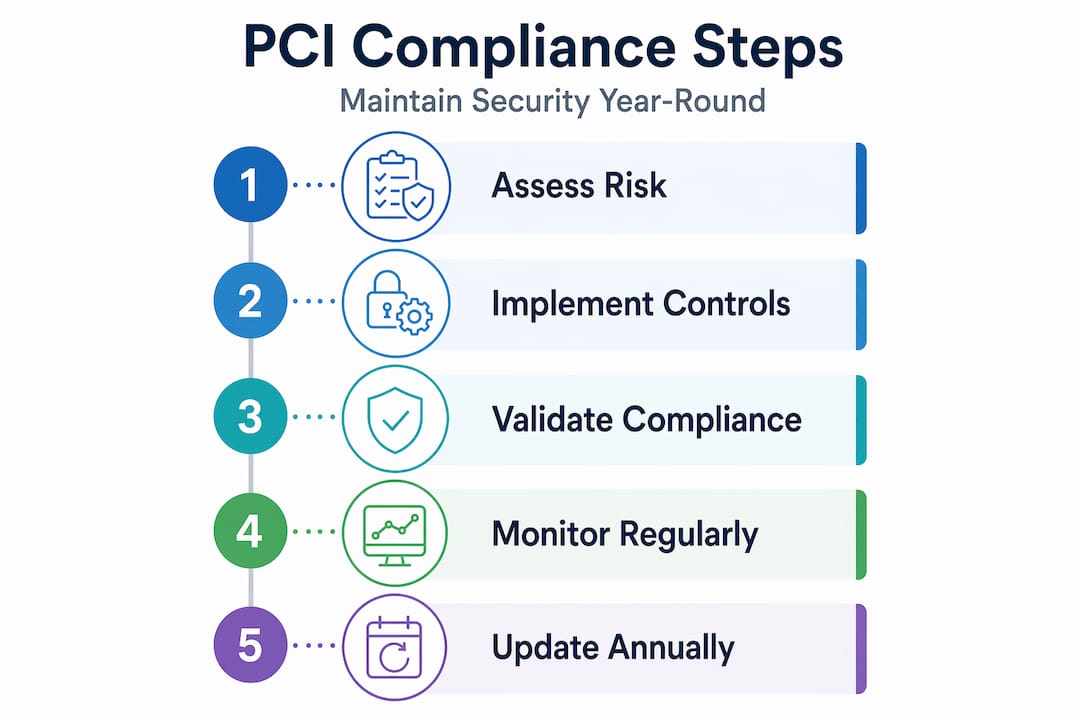
Treat compliance as a continuous cycle. Outsourcing payment data processing to compliant third parties reduces your internal scope, but you still need to verify their compliance status annually. Request their current Attestation of Compliance from your gateway or processor every year.
Pro Tip: Ask your payment processor for a compliance portal. Most major processors in the U.S. provide one at no extra cost, with SAQ templates, scan tools, and deadline reminders built in. Using it consistently is one of the most practical ways to stay on top of your website security basics alongside PCI obligations.
My honest take on where businesses get this wrong
I have seen the same pattern repeat itself. A business owner completes their SAQ in January, files it with their processor, and mentally checks compliance off the list for the year. Then they get hit with a fine in September because they missed a quarterly scan deadline. Or they change their payment gateway in March and have no idea that change affected their CDE and potentially voided their previous SAQ.
Treating PCI as a one-time project is the single most expensive mistake I see small business owners make. Compliance is not a certificate you hang on the wall. It is a set of operational habits that need to run in the background of your business year-round.
The v4.0 updates made this reality harder to ignore. The expanded MFA requirements and the new authenticated internal vulnerability scans are not tasks you can batch-process once and forget. They require scheduled attention, assigned ownership, and follow-through.
What I tell every business owner I work with: think of PCI compliance the same way you think of your business liability insurance. You do not spend every day thinking about it, but you would never let it lapse. Setting calendar reminders for quarterly scans, annual SAQ renewals, and staff training sessions takes less than 30 minutes to organize and saves you from the kind of penalties that disrupt your cash flow for months. Your customers trust you with their card data. Maintaining that trust is as much a business asset as your reputation.
— Maayan
Build a secure digital foundation for your business
Your PCI compliance obligations do not exist in isolation. They connect directly to the broader security of your website and your digital payment infrastructure. At Seo-analytic, we work with U.S. business owners to build websites that are not only high-performing but built with security and compliance considerations from the ground up.

Whether you are launching a new site or upgrading your existing one, the right hosting environment and website architecture play a real role in simplifying your compliance obligations. Our website building guide walks U.S. business owners through the setup decisions that affect everything from load times to payment security. For businesses looking at the full picture, our hosting options are designed with performance and security in mind. Reach out to the Seo-analytic team to explore how we can support your cybersecurity for business needs alongside your compliance goals.
FAQ
What is PCI DSS and who needs to comply?
PCI DSS (Payment Card Industry Data Security Standard) is a security framework required for any business that stores, processes, or transmits cardholder data. Compliance is contractually mandated by payment card brands and acquiring banks, not by a government agency.
What happens if a business fails PCI compliance?
Non-compliant businesses face monthly fines ranging from $5,000 to $100,000, higher transaction fees, and potential termination of their merchant account, all without a data breach needing to occur first.
What is the easiest way for a small business to become PCI compliant?
Using a PCI-compliant third-party payment gateway with tokenization typically qualifies a small business for SAQ A, the shortest and simplest self-assessment, significantly reducing compliance complexity.
How often does a business need to validate PCI compliance?
Most merchants must complete an annual SAQ and, depending on their level, submit quarterly vulnerability scan results. PCI DSS v4.0 also requires segmentation testing bi-annually for businesses using network segmentation.
What is PCI DSS v4.0 and why does it matter?
PCI DSS v4.0 became mandatory on March 31, 2025, and introduced 64 new requirements including expanded MFA, payment page script monitoring, and stricter vulnerability scanning rules that all in-scope businesses must now meet.