

TL;DR:
- Building a clear team structure aligned with specific marketing goals enhances campaign effectiveness.
- Hiring for the biggest skill gaps first and evaluating candidates with practical tasks improves results.
- Regular performance reviews, KPI tracking, and fostering team culture drive long-term success.
Many business owners pour money into digital marketing only to watch budgets disappear with little to show for it. The real culprit is rarely the channel or the ad spend. It’s the team structure behind the campaigns. When roles are unclear, skills are mismatched, and no one owns the results, even the best strategy falls apart. This article walks you through a step-by-step process for building a digital marketing team that actually drives online growth, from defining the right roles and recruiting top talent to equipping your team with tools and measuring what matters most.
Table of Contents
- Defining goals and roles for your digital marketing team
- Finding and recruiting top digital marketing talent
- Equipping your team with essential tools and workflows
- Optimizing team performance and measuring results
- What most guides miss about building a digital marketing team
- Grow faster with seo-analytic’s digital marketing resources
- Frequently asked questions
Key Takeaways
| Point | Details |
|---|---|
| Clarify team roles | Defining clear responsibilities is the foundation for effective marketing teams. |
| Hire for skills and fit | Source talent that matches your culture and business needs, not just resumes. |
| Use the right tools | Equipping your team with proven digital tools boosts productivity and collaboration. |
| Track performance metrics | Regularly measure outcomes with KPIs and ROI to optimize your team’s impact. |
Defining goals and roles for your digital marketing team
Before you post a single job listing, you need to know exactly what you want your marketing to accomplish. Are you trying to grow organic search traffic? Generate leads through paid ads? Build a loyal social media following? Each goal points to a different set of skills and roles. Without this clarity, you end up hiring generalists who can’t move the needle on anything specific.
Start by mapping your business objectives to digital marketing outcomes. If your goal is revenue growth, you need someone who understands conversion optimization. If brand awareness is the priority, content and social expertise matter more. A well-defined team structure aligns responsibilities with marketing goals, increasing campaign effectiveness across every channel you use.
Here are the core roles most growing businesses need on their digital marketing team:
- Digital marketing strategist: Owns the overall plan, sets priorities, and connects marketing activity to business goals
- Content creator: Produces blog posts, videos, email copy, and other assets that attract and engage your audience
- SEO and analytics specialist: Tracks performance, interprets data, and improves search visibility
- Social media manager: Manages your brand presence across platforms and engages your community
- Paid media specialist: Runs and optimizes paid ad campaigns across Google, Meta, and other networks
| Role | Key responsibilities |
|---|---|
| Strategist | Goal setting, campaign planning, budget allocation |
| Content creator | Writing, video, email, and asset production |
| SEO and analytics specialist | Keyword research, reporting, understanding KPIs |
| Social media manager | Posting, community management, content calendar planning |
| Paid media specialist | Ad creation, bidding, A/B testing |
Not every business needs all five roles from day one. Use competitive analysis to understand where your competitors are winning and where your biggest gaps are. That tells you which role to hire first.
Pro Tip: Hire for your biggest skill gap first, not the role that sounds most impressive. If your website gets no traffic, an SEO specialist delivers more value than a paid media expert right now.
Finding and recruiting top digital marketing talent
Once your ideal team structure is set, you need a plan to source and attract the right talent. The good news is that the talent pool for digital marketers is larger than ever. The challenge is filtering for people who can actually deliver results, not just talk about strategy.
Effective recruiting involves understanding industry trends and leveraging strategic hiring channels. Here’s where to look:
- LinkedIn: Best for finding experienced in-house candidates and passive job seekers
- Indeed and ZipRecruiter: High volume for active job seekers across all experience levels
- Upwork and Fiverr: Ideal for freelancers on project-based or part-time work
- Referrals: Ask your network. A trusted recommendation saves enormous screening time
- Marketing communities: Slack groups, Reddit forums, and industry events surface motivated professionals
When evaluating candidates, look beyond the resume. Ask for case studies, campaign results, and data they’ve actually moved. Anyone can claim they grew a brand’s Instagram. Fewer can show you the numbers.
| Talent type | Best for | Trade-offs |
|---|---|---|
| In-house hire | Long-term strategy, brand immersion | Higher cost, slower to hire |
| Freelancer | Flexible, project-based needs | Less availability, less team cohesion |
| Agency | Full-service, fast deployment | Less control, shared attention |
For managing remote teams, freelancers and hybrid arrangements are increasingly common and effective. The key is setting clear deliverables and communication expectations from the start.
Your hiring process should follow these steps: write a specific job description with measurable outcomes, screen resumes for relevant experience, conduct a structured interview focused on real scenarios, and assign a paid skills task before making an offer.
Pro Tip: Give every finalist candidate a small, paid practical assignment that mirrors real work. A content creator should write a sample post. An analyst should interpret a sample data set. This one step eliminates most bad hires.
Equipping your team with essential tools and workflows
Bringing talent on board is only the start. Now you need to empower your team with the right resources. The tools your team uses every day shape how fast they move, how well they collaborate, and how clearly they communicate results to you.
Choosing the right tools and standardizing workflows boosts team efficiency and communication, especially when your team includes remote members or freelancers across time zones.
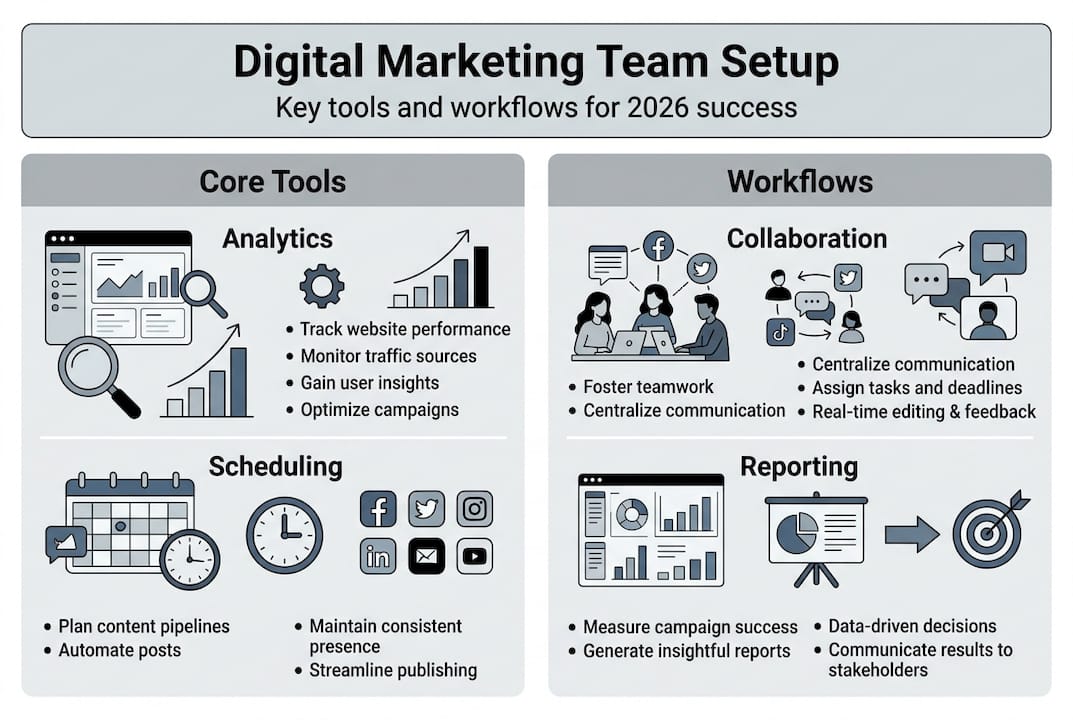
| Tool category | Recommended tools | Primary use |
|---|---|---|
| Project management | Asana, Trello, Monday.com | Task tracking, deadlines, accountability |
| Analytics | Google Analytics 4, Semrush | Traffic, conversions, SEO performance |
| Social scheduling | Buffer, Hootsuite, Later | Content planning and publishing |
| Communication | Slack, Zoom | Team updates and async collaboration |
| Content creation | Canva, Notion, Google Docs | Design, writing, documentation |
Tools are only useful when paired with consistent workflows. Here are the workflow habits that separate high-performing teams from chaotic ones:
- Hold brief weekly standups (15 minutes max) to surface blockers and align priorities
- Use a shared content calendar so everyone knows what’s publishing and when
- Document every process, even simple ones, so new team members can onboard quickly
- Set a standard reporting cadence, whether weekly or monthly, so results are always visible
- Create templates for recurring tasks like social posts, reports, and email campaigns
For remote teams especially, documentation is your best friend. When processes live only in someone’s head, you’re one resignation away from losing them entirely.
Pro Tip: Start with one core tool for each workflow category before adding more. Tool overload is a real productivity killer. Get your team proficient with one analytics platform before layering in a second.
Optimizing team performance and measuring results
Once your team is operating, keeping a pulse on results and driving improvement is key. A team without clear performance measures is like running a campaign with no conversion tracking. You’re spending energy but can’t tell what’s working.

Start by setting specific, measurable KPIs for each role. Setting marketing KPIs helps business owners quickly spot what’s working and optimize accordingly. Vague goals like “grow our social presence” don’t give your team anything to aim at. Specific targets like “increase Instagram engagement rate by 15% in 90 days” do.
Key marketing KPIs to track across your team:
- Website traffic: Total sessions, organic vs. paid breakdown, and traffic trends over time
- Lead generation: Form fills, demo requests, and email sign-ups per channel
- Conversion rate: Percentage of visitors who take a desired action on your site
- Cost per acquisition: How much you spend to win each new customer
- Marketing ROI: Revenue generated relative to total marketing spend
“Data without dialogue is just noise. The most effective marketing teams review numbers together, ask hard questions, and adjust fast. Regular, honest feedback turns metrics into momentum.”
Businesses that implement regular team performance reviews increase marketing ROI by up to 30%, making consistent review cycles one of the highest-leverage habits you can build. Schedule monthly reviews where the whole team looks at results together. Celebrate wins, address underperformance directly, and update your priorities based on what the data shows.
Calculating ROI is crucial for evaluating your marketing team’s effectiveness. If a channel consistently underperforms after genuine optimization effort, reallocate that budget to what’s working. Data-driven decisions, not gut feelings, are what separate growing businesses from stagnant ones.
What most guides miss about building a digital marketing team
Most articles about building a marketing team focus on org charts and tool stacks. Those things matter, but they’re not what actually determines whether your team succeeds long term.
In our experience, culture fit and communication style predict team performance far better than a perfect resume. We’ve seen teams with impressive credentials fall apart because no one communicated problems early. We’ve also seen scrappy, less experienced teams outperform because they trusted each other and moved fast.
The other myth worth challenging: you don’t need to hire for every skill from day one. Many successful marketing teams start with one strong generalist who can execute across channels while the business figures out where to specialize. Trying to build a full department immediately often leads to bloated payroll and misaligned priorities.
Insights from remote team management confirm that structure and trust matter more than headcount. Build the culture first. Hire for skills second. Your team will grow into the right shape as your business does.
Grow faster with seo-analytic’s digital marketing resources
If you’re ready to put your plan into action, there are resources available to help you move faster and smarter. Building a high-performing digital marketing team is a process, and having the right guides and tools makes every step more effective.
At seo-analytic, we’ve built a library of practical resources designed specifically for entrepreneurs and business owners. Start with digital marketing basics to sharpen your strategy foundation, then use our marketing tools guide to choose the right tech stack for your team. When you’re ready to scale your brand’s reach, our social media marketing resources show you exactly how to build an audience that converts. Our expert team is here to support your growth at every stage.
Frequently asked questions
What roles are essential in a digital marketing team?
Core roles include a strategist, content creator, analyst, and social media manager, but your priorities depend on your business goals. A well-defined team structure means assigning clear responsibilities so nothing falls through the cracks.
Should I hire in-house or use freelancers for my marketing team?
Freelancers provide flexibility for short-term or specialized needs, while in-house hires build deeper brand knowledge for long-term growth. The differences between in-house and freelance come down to your budget, timeline, and how much strategic continuity you need.
How do I measure if my digital marketing team is effective?
Use KPIs like website traffic, lead generation, conversion rate, and ROI to assess performance. Tracking KPIs and ROI gives you a clear picture of where your team is winning and where to adjust.
What marketing tools should my team start with?
Begin with project management, analytics, and social scheduling tools before expanding your stack. The right tools build a foundation for effective collaboration and measurable results without overwhelming your team.
How can I keep my digital marketing team motivated?
Set clear goals, give regular feedback, and recognize wins publicly. Ongoing feedback and recognition are among the most reliable drivers of sustained marketing team performance.